

How to Evaluate a Reliable Outdoor Lighting Factory in China
Finding a reliable outdoor lighting factory China buyers can trust is not simply a matter of comparing catalogue prices. Outdoor lighting may be used at campsites, roadside work zones, construction areas, vehicle recovery sites, or commercial facilities, where weak housings, inconsistent battery assemblies, poor thermal management, or unstable supply can create expensive problems. The practical decision is whether a factory can turn a defined lighting requirement into repeatable products, documented quality checks, and dependable production support.
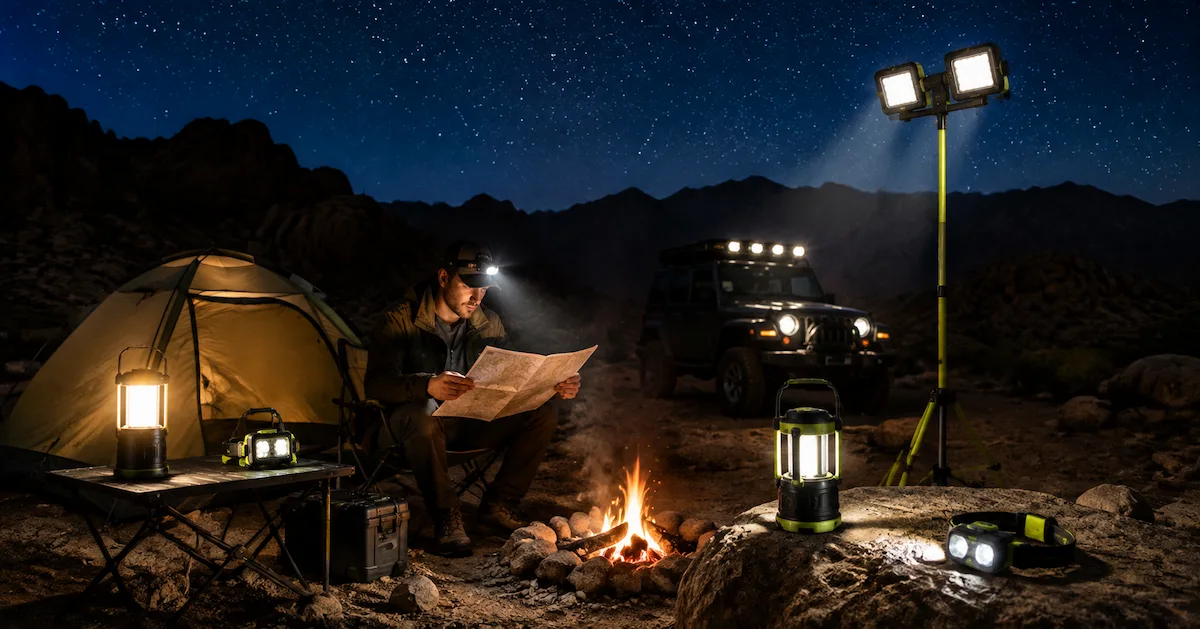
This matters especially when a buyer is considering a product range rather than one standard lamp. The visible range in this category may include portable LED lanterns, compact work lights, headlamps, tripod-mounted floodlights, and vehicle-mounted auxiliary lights. These products share some components and manufacturing disciplines, but they do not have identical performance requirements. A lantern designed for diffuse campsite illumination should not be assessed in exactly the same way as a directional floodlight for an off-road vehicle or a temporary industrial work area.
What a buyer should confirm before requesting a quotation
| Buyer concern | What to clarify with the factory |
|---|---|
| Product scope | Whether the supplier produces portable lanterns, work lights, headlamps, tripod units, vehicle lights, or only sources some of them |
| Optical function | Whether the product is intended for diffuse area illumination, task lighting, or a more directional beam |
| Construction | Housing material, diffuser design, protective frame, mounting hardware, and exposed metal components |
| Power system | Battery or mains configuration, charging interface, battery-pack assembly, controls, and protection features |
| Quality control | Incoming inspection, assembly checks, electrical testing, optical checks, aging procedures, and final inspection |
| Customization | Available changes to housing, color, logo, packaging, mounting arrangement, optics, and control layout |
A supplier that answers these questions clearly is easier to qualify than one that responds with a general catalogue and a low unit price. The latter may still be suitable, but the buyer has more work to do before treating it as a manufacturing partner.
Start with the use case, not the product photograph
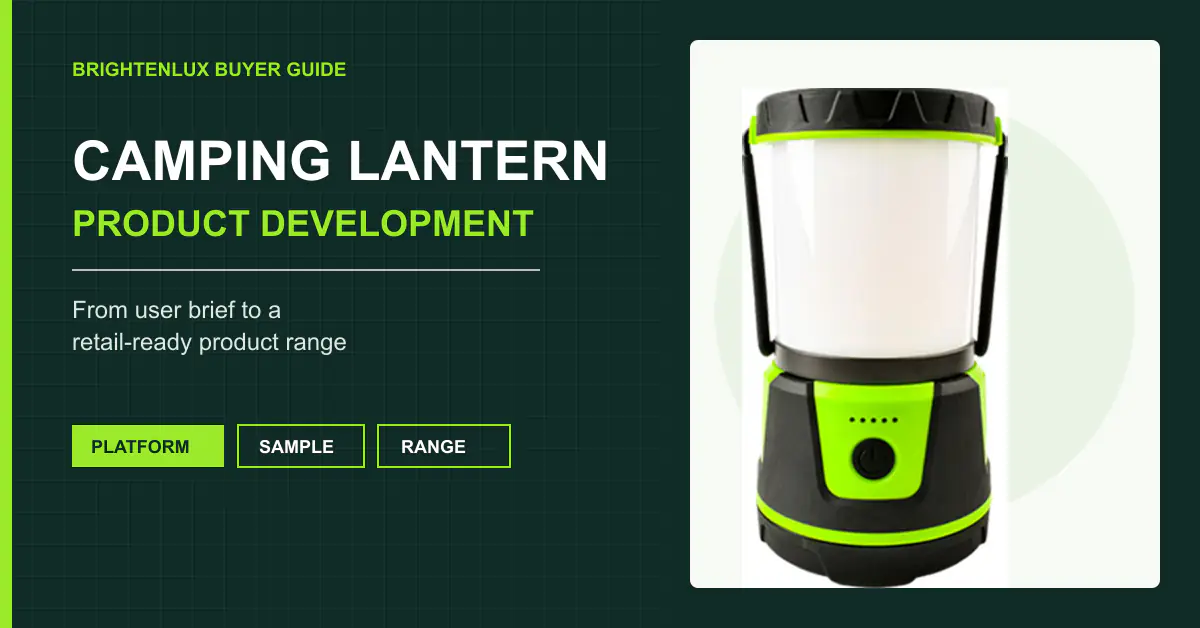
Product images are useful for identifying form factors, but they cannot establish performance. A dark housing, a translucent diffuser, or a bright LED face does not reveal lumen output, beam distance, runtime, ingress protection, impact resistance, operating temperature, or battery chemistry. Those details must be specified and verified separately.
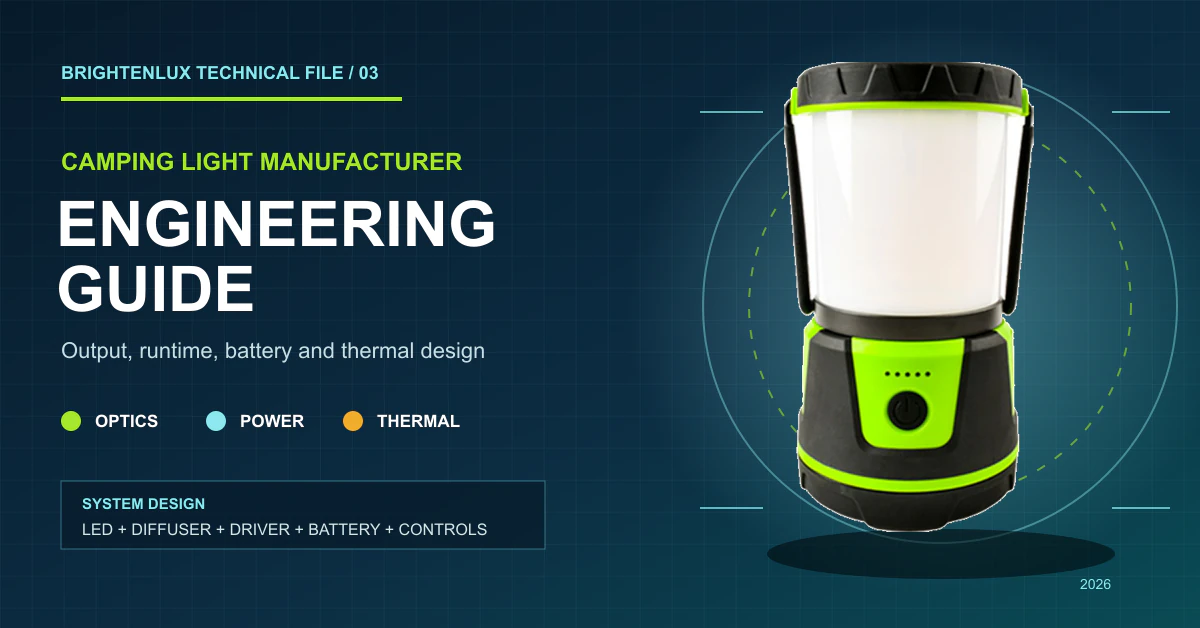
For campsite and tent illumination, the priority may be broad, comfortable light with a carry handle and a stable base. A portable lantern with a diffused panel is suited to map reading, equipment handling, and camp setup in ways that a narrow beam is not. A compact work light may instead need a more directional output, convenient positioning, and a housing that can tolerate handling during maintenance or repair.
Tripod-mounted lighting introduces another set of questions. A dual-panel floodlight can illuminate a temporary work zone from an elevated position, and independently adjustable lamp heads may help direct light where it is needed. Yet tripod height, adjustment range, leg stability, mounting interface, and transport dimensions are all important. None should be assumed from appearance alone.
Vehicle-mounted auxiliary lights also require a more disciplined specification. The buyer should define mounting conditions, vibration exposure, wiring arrangements, switching, environmental conditions, and the intended beam pattern. A lamp suitable for occasional recreational use may not be the right choice for a fleet, roadside-response, or industrial application.
Assess the factory’s manufacturing capability
Housing and mechanical assembly
Portable outdoor lighting commonly uses molded housings or composite-looking bodies, protective frames, translucent diffusers, handles, brackets, and metal support hardware. The exact materials in a particular product should be confirmed rather than inferred from a photograph. What matters during qualification is whether the factory controls fit, fastening, sealing interfaces, surface finish, and assembly consistency.
Ask to see drawings or controlled product specifications for the housing and major components. Check how the supplier handles changes to an injection-molded part, a handle, a tripod connection, or a vehicle mounting bracket. Small mechanical changes can affect balance, heat dissipation, cable routing, and the durability of the final assembly.
LED, optics, and thermal management
Outdoor lights are not defined only by the number of visible LED emitters. The optical system determines whether the light is diffuse, broad, concentrated, or directional. Lanterns typically use a diffuser to spread light, while work lights, floodlights, and vehicle lights may use a more directional front face or reflector arrangement.
A capable factory should be able to discuss LED selection, optical components, driver design, thermal paths, and the relationship between brightness and heat. Do not accept a brightness claim without asking how it is measured and under what operating conditions. If the project depends on runtime, the test method should also be defined, including operating mode, battery condition, and cutoff behavior.
Battery and electrical assembly
Many portable units in this category appear designed for mobile use, but an image cannot confirm whether they are rechargeable, mains-powered, solar-powered, or replaceable-battery products. This is a critical commercial and safety distinction. Ask the factory to identify the battery chemistry, pack configuration, charging method, protection circuit, connector, and control logic in the proposed design.
Electrical assembly should include controlled wiring, secure terminals, strain relief, and suitable protection against incorrect operation. If the factory purchases battery packs or LED boards from outside vendors, determine which parts are incoming-inspected and which supplier records are retained. A lighting assembly is only as consistent as its weakest purchased component.
How to compare different supplier types
A flood light factory China buyer contacts may be strong in high-output area lights but less experienced with compact lanterns or headlamps. Conversely, a portable-lighting producer may understand battery integration and molded housings but have limited experience with vehicle mounting or elevated tripod systems. Capability should be matched to the project rather than judged by a broad product list.
An architectural outdoor lighting supplier may focus on fixed installations, façade illumination, landscape products, or decorative applications. That can be valuable for a building or site project, but it does not automatically demonstrate competence in portable, battery-powered, or vehicle-mounted equipment.
An industrial outdoor lighting supplier may be better aligned with work zones, maintenance, emergency response, or fleet use. Even then, ask whether the supplier manufactures the products directly, uses contract assembly, or combines products from several sources. The image of a broad product range does not establish that every item comes from one production line or one organization.
Quality questions that should be answered before production
Quality control should be discussed as a process, not as a slogan. Ask how incoming LED boards, drivers, batteries, switches, cables, diffusers, and molded housings are checked. During assembly, the factory should have a method for verifying wiring, fastening, polarity, controls, charging behavior, and basic illumination.
For outdoor use, the buyer should also ask which environmental tests are available or appropriate for the design. These may include water and dust exposure, drop or impact evaluation, vibration, temperature cycling, and operating-duration checks. The exact test requirements depend on the application and target market, so it is better to agree on a written test plan than to request vague “outdoor quality.”
Request sample units from the same design and component sources proposed for production. Inspect the diffuser for uneven illumination, the handle for comfortable carrying, the switch for positive operation, the tripod for stability, and the cable exits for strain protection. Use the sample in a realistic setting. A work light that looks compact on a catalogue page may be awkward when handled with gloves or placed beside equipment.
Common buying mistakes
- Choosing the lowest quotation before defining battery, optical, mechanical, and environmental requirements.
- Assuming a product photograph proves waterproofing, impact resistance, runtime, or brightness.
- Comparing a diffuse lantern directly with a directional floodlight using only wattage or advertised brightness.
- Failing to distinguish factory-made products from items sourced through a trading company.
- Approving a logo or color change without checking whether the housing, diffuser, packaging, and spare parts remain compatible.
- Ignoring packaging and transport protection for handles, tripod legs, lamp heads, and adjustable joints.
One practical warning: customization can be deceptively simple. A lime-green accent, a new logo, or a revised bracket may appear cosmetic, but new tooling, different plastic behavior, altered balance, or a changed assembly sequence can affect cost and reliability. Ask for a sample approval process and written change control.
A practical qualification path
Begin with a product brief that identifies the application, lighting pattern, power source, control method, operating environment, mounting method, target market, packaging needs, and expected production quantity. Send the same brief to several candidates so their responses can be compared fairly.
Next, separate confirmed information from proposed information. The factory should identify what is already in production, what requires modification, and what would be a new development. Review drawings, sample units, component lists, test procedures, and inspection records where available. If a supplier cannot provide technical answers, do not fill the gap with assumptions.
Finally, agree on a production approval procedure. It should cover the approved sample, critical components, visual standards, functional checks, packaging, labeling, and handling of nonconforming goods. Exact acceptance criteria should be written into the commercial and technical documents rather than left to informal messages.
Frequently asked questions
Can one factory supply lanterns, headlamps, work lights, and tripod floodlights?
Possibly, but the product range alone does not prove that one factory manufactures every item. Confirm the production location, assembly responsibility, component sourcing, and quality-control process for each product family.
Can performance be judged from an image?
No. An image can show approximate form, visible controls, handles, lamp-head geometry, and beam-diffuser differences. It cannot verify brightness, runtime, charging, ingress protection, operating temperature, or impact performance.
What should be requested from a prospective supplier?
Request product specifications, drawings where relevant, component information, sample units, proposed test methods, packaging details, customization options, and a clear explanation of which operations are performed in-house.
Make the next step a technical comparison
The right supplier is not necessarily the one with the largest catalogue or the shortest quotation. It is the factory that can explain how the lamp is built, how its components are controlled, how the design fits the intended use, and how production consistency will be maintained. For buyers evaluating outdoor lighting from China, a structured comparison of capability, samples, documentation, and application fit is a safer starting point than a visual or price-only decision.
Prepare a concise product brief, request comparable technical responses, and ask each candidate to distinguish verified capability from proposed development. That process will quickly show whether a prospective partner is equipped for portable lighting assembly, tripod floodlight production, vehicle-light integration, or a broader outdoor lighting program.