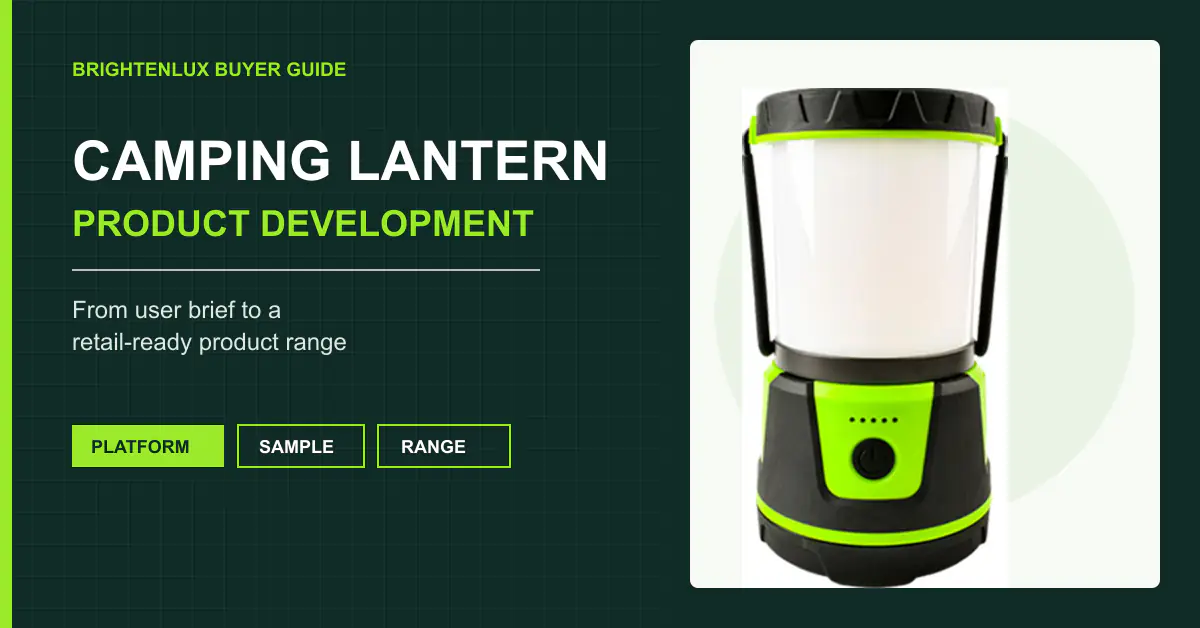


How to Evaluate a Reliable Outdoor Lighting Factory in China
Finding a reliable outdoor lighting factory China buyers can work with involves more than reviewing product photographs or selecting the lowest quoted price. The supplier must be able to produce consistent housings, integrate LED and battery components correctly, manage assembly quality, and communicate clearly about what is confirmed and what still requires testing. For importers, distributors, outdoor brands, and product teams, the decision is not simply which lamp looks attractive. It is whether the factory can support a dependable product family for camping, emergency, utility, and general outdoor use.
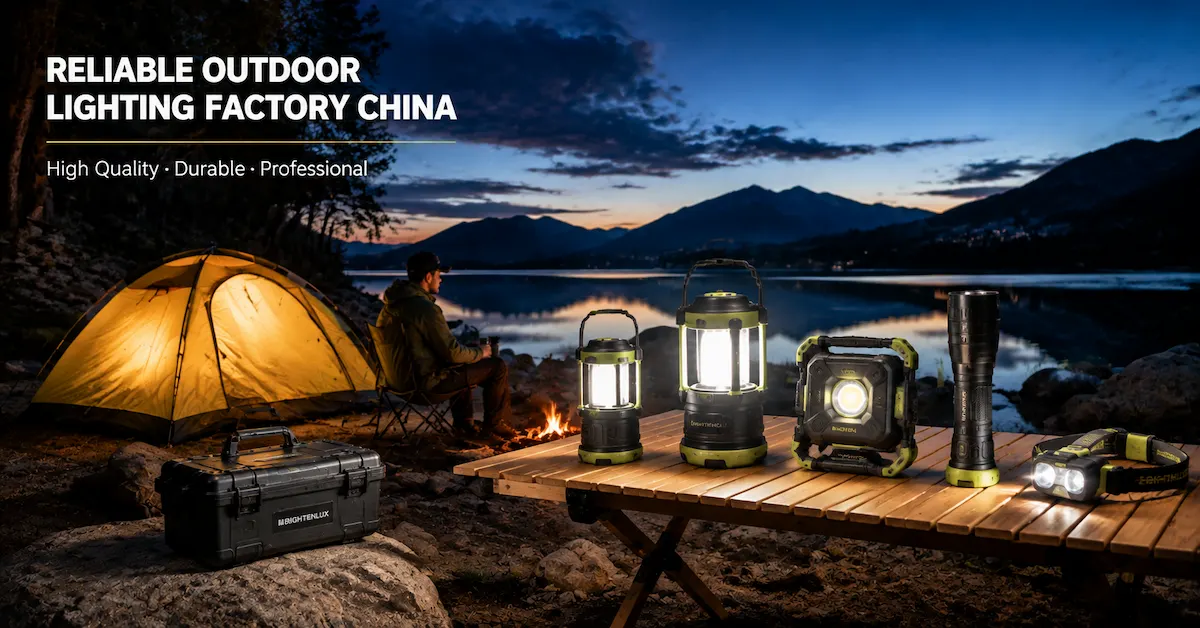
This guide explains what to examine when assessing a Chinese outdoor lighting supplier, using a product range that includes portable lanterns, a square work light or floodlight, a handheld flashlight, and a headlamp. These formats point to several practical applications, but the visible design alone does not confirm performance specifications. Buyers should use the factory evaluation process to separate appearance, stated capability, and verified product performance.
What the Product Range Suggests at a Glance
| Product format | Typical use | Points to verify before purchase |
|---|---|---|
| Portable lantern | Campsite ambient lighting, table lighting, emergency backup | Diffuser performance, battery arrangement, switch durability, carrying structure |
| Square work light or floodlight | Portable task lighting, utility work, outage lighting | Beam spread, mounting or carrying options, heat management, impact resistance |
| Handheld flashlight | Inspection, pathway lighting, general portable illumination | Grip, lens protection, controls, battery access, drop resistance |
| Headlamp | Hands-free camping, maintenance, walking, emergency tasks | Strap adjustment, beam direction, control layout, comfort, charging or battery system |
A mixed range can be useful for a brand seeking one manufacturing partner for several outdoor lighting categories. It may also indicate that the supplier understands different assembly requirements: translucent diffuser panels for lanterns, a framed central LED lens for a work light, a cylindrical housing for a flashlight, and an elastic strap system for a headlamp. However, a broad catalog is not proof of strong production control. The important question is whether the factory applies a consistent quality system across different product structures.
Inspect the Construction, Not Just the Finish
The products shown use rugged-looking plastic or polymer housings, with black and olive-green finishes. Several designs include protective cage or handle structures around the light body. Those features are relevant to portable outdoor products because lamps are often packed, carried, placed on uneven ground, or used near tools and equipment. A textured grip area can also be more practical than a smooth decorative surface when the user is wearing gloves or handling the lamp in wet conditions.
Still, visual ruggedness needs to be tested. Ask how the housing is assembled and what happens at the joints, switch openings, battery doors, lens edges, and strap attachment points. These are common weak areas in portable products. A thick-looking shell can still fail if a clip is poorly designed or if the diffuser is not securely retained.
For a buyer, the manufacturing discussion should cover the likely sequence of work: injection-molded housing production, preparation of LED modules, installation of lenses or diffuser panels, wiring or battery integration, switch assembly, final closure, and functional inspection. The supplied product information suggests this type of assembly, but it does not confirm the exact process used by a particular factory. A serious supplier should be able to explain the actual process rather than rely on broad claims such as “high quality” or “professional.”
Why Consistency Matters in Portable Lighting
Outdoor lighting is often sold as a relatively simple product. In practice, it combines optics, electronics, plastics, mechanical interfaces, and user controls in a compact package. A small variation in diffuser fit can affect light distribution. A poorly seated LED module can create heat or alignment problems. A weak battery-door seal may allow contamination into the housing. An inconsistent switch can produce returns even when the lamp still illuminates.
For this reason, factory evaluation should include process questions as well as sample review. Ask whether incoming components are checked, whether assembly instructions are documented, and whether finished units receive a basic functional inspection. The exact inspection plan will depend on the product and the buyer's requirements, but it should address illumination, switching, charging or battery operation where applicable, physical assembly, and visible defects.
Do not assume that a sample is representative of every future production run. Request samples from the intended production version and compare later samples against an agreed reference. This is particularly important if the buyer plans to change colors, logos, packaging, battery configuration, or control functions.
How to Compare a Supplier with Other Lighting Sources
A garden lighting factory China search may lead to suppliers focused on decorative landscape products, while a street lighting manufacturer China search usually identifies companies working with larger outdoor luminaires, poles, road illumination, and infrastructure-oriented projects. Those suppliers may have useful expertise, but they are not automatically the right fit for portable camping and utility lights.
The category matters. A supplier experienced in fixed outdoor fixtures may not have the same strengths in compact battery-powered assembly, portable switches, elastic headlamp straps, or impact-oriented polymer housings. Conversely, a factory specializing in portable products may not be equipped for large municipal lighting programs. Buyers should compare suppliers according to the product architecture, target market, packaging requirements, and production volume involved.
For the product family discussed here, useful supplier questions include:
- Which product formats are produced regularly rather than shown only in a catalog?
- Can the factory provide samples in the intended housing finish and configuration?
- Which components are standard, and which can be customized?
- How are LED modules, lenses, diffusers, switches, and battery compartments inspected?
- What information is available for runtime, light output, charging, ingress protection, and other performance claims?
- Can the factory provide packaging details suitable for transport and retail handling?
These questions are deliberately practical. They reveal whether the supplier understands the product as a manufactured system, not just as an image in a sales presentation.
Selection Criteria for Buyers
1. Product fit
Start with the intended use. A campsite lantern needs comfortable area illumination and convenient handling. A square work light should support task visibility and stable positioning. A flashlight needs a useful grip and protected optical end. A headlamp must balance illumination with strap comfort and control access. The same factory may offer all four, but the evaluation criteria are not identical.
2. Customization boundaries
Clarify whether the requested change involves only color and branding or requires a new mold, revised electronics, a different lens, or a new battery arrangement. The visible black and olive-green finishes and varied housing shapes suggest a product family with distinct design identities. Buyers should not assume that every element can be changed without engineering work.
3. Evidence behind performance claims
The supplied product presentation uses the claims “Reliable Outdoor Lighting Factory China” and “High Quality • Durable • Professional.” These are useful positioning statements, but they are not test data. Before approval, request the specifications and verification documents relevant to the actual model. Do not fill gaps with assumptions about lumen output, runtime, battery type, charging method, water resistance, certifications, or operating temperature.
4. Communication and documentation
A capable supplier should be able to issue clear product specifications, drawings or dimensional information where needed, component descriptions, packaging details, and a defined sample revision. Communication quality is a manufacturing indicator. If basic product information remains vague after several discussions, later changes are likely to create confusion.
Common Mistakes When Buying Outdoor Lights
The first mistake is selecting from photographs alone. Product images can show overall form, finish, and apparent construction, but they cannot establish battery life, optical performance, sealing, or durability.
The second is treating “outdoor” as a complete technical specification. Outdoor use covers very different conditions, from a dry campsite to a wet work area. Ask what level of environmental protection is required and how it will be verified.
The third is overlooking packaging. Lanterns with handles, protective cages, and protruding controls need packaging that prevents movement and surface damage during shipment. A well-made lamp can arrive with cracked diffusers or scuffed housings if the pack-out is poorly designed.
Finally, avoid approving an entire product range after reviewing only one model. A lantern, flashlight, headlamp, and square work light use different housings and user interfaces. Sample and review each important format.
A Practical Buyer Workflow
Begin by writing a short product brief for each model. Include intended use, target user, required light behavior, power arrangement, housing finish, controls, packaging, and any market-specific compliance needs. Then ask the supplier to identify which specifications are already established and which require development or confirmation.
Next, review samples in ordinary use conditions. Operate the switches repeatedly, inspect the grip and handle, open and close battery compartments, adjust the headlamp strap, and examine diffuser and lens fit. A brief hands-on review often reveals more than a polished product sheet.
After sample approval, lock the revision. Record the housing color, logo treatment, component configuration, packaging, and agreed inspection points. If the product is intended for retail sale, also confirm labeling and user instructions before production begins. Keep the process factual: a missing specification is a task to resolve, not an invitation to guess.
FAQ
Are these products suitable only for camping?
No. The formats shown can also support emergency outage lighting, handheld inspection, pathway illumination, portable work, and general utility use. The correct application depends on verified performance and the final configuration.
Can one factory supply lanterns, flashlights, work lights, and headlamps?
Possibly. A product family displaying these formats suggests broader outdoor lighting capability, but buyers should confirm which models are actually produced and whether the factory can maintain consistent quality across each assembly type.
What specifications should not be assumed?
Do not assume wattage, lumen output, runtime, battery chemistry, charging method, IP rating, certifications, or exact materials unless the supplier provides and supports those details for the specific model.
What is the next step after finding a potential supplier?
Request a technical product list, representative samples, available customization information, assembly and inspection details, and the documents needed for your target market. Compare the evidence model by model rather than relying on a general factory slogan.
Make the Factory Decision on Evidence
A reliable supplier for outdoor lighting should be judged by how clearly it connects product design to manufacturing control. Portable lanterns, square work lights, flashlights, and headlamps each have useful roles, and their rugged polymer housings, diffuser panels, protective structures, cylindrical bodies, and elastic straps provide a sensible starting point for product evaluation. They do not, by themselves, prove durability or regulatory readiness.
For sourcing teams, the next move is straightforward: define the intended application, request model-specific evidence, inspect samples physically, and document the approved configuration. That approach gives product teams a firmer basis for deciding whether a Chinese outdoor lighting factory is suitable for the market, the use case, and the quality expectations involved.