

How to Evaluate a Reliable Outdoor Lighting Factory in China
Finding a reliable outdoor lighting factory China buyers can depend on is less about choosing the lowest quotation and more about verifying whether the supplier can repeatedly deliver safe, functional, and consistent equipment. For portable work lights, the decision affects worker visibility, maintenance productivity, site safety, packaging, compliance, and after-sales risk. This guide explains what to examine when sourcing portable LED work-lighting equipment and helps buyers decide whether a potential factory is suitable for OEM, private-label, or standard-product supply.
What the Product Range Needs to Do
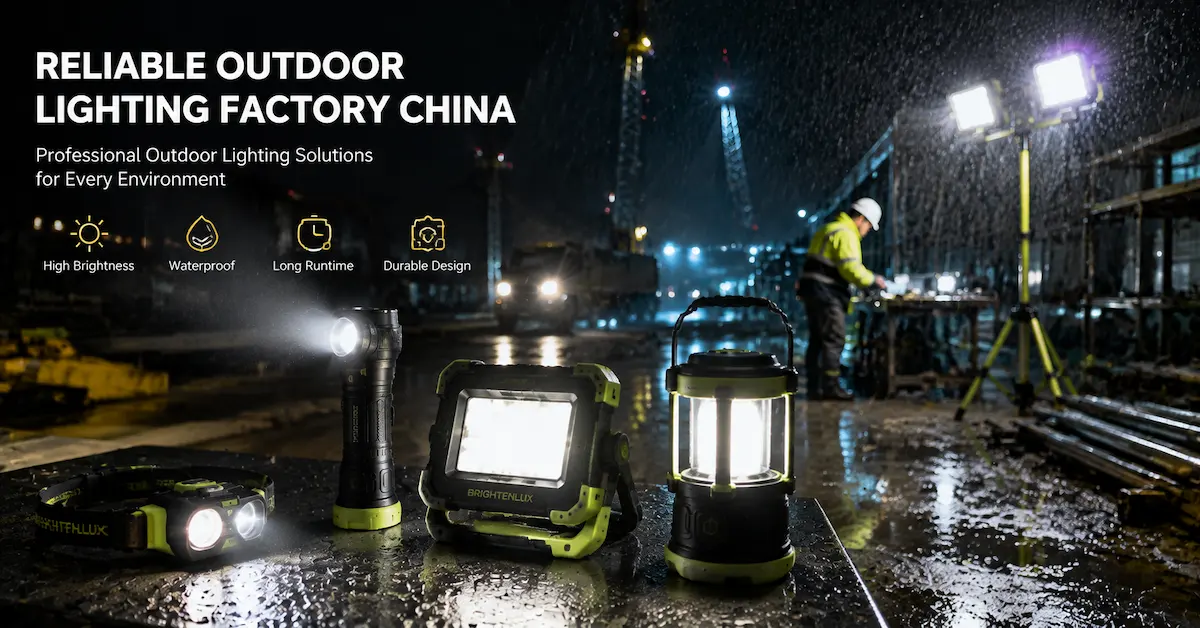
Portable industrial lighting is not one product with several colors. It is a group of tools designed for different working positions and site conditions. The visible product formats in this range include wearable headlamps, handheld flashlights, portable flood or area lights, 360-degree-style work lanterns, and tripod-mounted floodlights.
A headlamp supports hands-free work during inspection, repair, installation, and access-route movement. A handheld flashlight is more suitable for directed inspection, equipment checks, and confined areas. Area lights spread illumination across a work zone, while a lantern can provide a broader surrounding light source for temporary workstations or emergency tasks. Tripod-mounted floodlights are useful when a crew needs elevated illumination over a larger area and wants to keep the light source separate from the worker.
That variety matters during supplier evaluation. A factory may be capable of assembling a compact flashlight but have limited experience with folding supports, protective frames, adjustable mounts, battery integration, or larger light panels. Buyers should assess the manufacturing capability behind the complete product family, not just the appearance of a catalog sample.
Quick Reference: Product Format and Sourcing Focus
| Product format | Typical use | Points to verify with the factory |
|---|---|---|
| Wearable headlamp | Hands-free repair, inspection, and access work | Strap adjustment, module positioning, housing strength, controls, and battery arrangement |
| Handheld flashlight | Directed inspection and mobile task lighting | Grip, reflector or front lens assembly, switch durability, base stability, and charging or battery design |
| Portable area light | Work zones, maintenance areas, and temporary illumination | Panel protection, folding structure, adjustment hardware, heat management, and carry convenience |
| Work lantern | Broad surrounding light for job sites and service work | Cage or diffuser protection, handle strength, base stability, controls, and cleaning access |
| Tripod floodlight | Elevated area lighting for construction and industrial work | Tripod stability, adjustment range, cable or battery arrangement, panel protection, and packed dimensions |
Examine the Factory Behind the Housing
The products shown use molded black housings with bright lime-green protective or accent components. Textured grips, polymer bumpers, handles, and protective frames appear intended for field handling. Some mounting or internal support components may be metal, although the exact materials cannot be confirmed from the available product information.
For buyers, the important question is not simply whether the housing looks rugged. Ask how the factory controls molding quality, assembly fit, fastener retention, sealing interfaces, switch installation, and component variation. Injection molding may be used for housings and protective parts, while metal or polymer fabrication may support brackets, frames, handles, and mounting systems. Electronic assembly and battery integration may also form part of the production process. These are likely processes for this type of equipment, but they should be confirmed directly rather than assumed.
Request a manufacturing flow that explains incoming inspection, housing production, electronic assembly, optical installation, battery installation where applicable, final assembly, and functional testing. A credible supplier should be able to describe these stages clearly. If the answer remains at the level of “we check everything,” ask what is checked, at which stage, and how nonconforming units are separated.
LED Performance: Ask for Measurable Information
The bright white output and compact light modules are consistent with LED work lights. However, the available information does not establish the LED type, color temperature, beam angle, lumen output, beam distance, or lighting modes. The image claims “High Brightness,” “Waterproof,” “Long Runtime,” and “Durable Design,” but these are marketing statements rather than verified specifications.
This is a common sourcing trap. A high brightness claim does not tell a maintenance manager whether the light provides useful illumination at the required distance. A long runtime claim is incomplete without the operating mode, battery capacity, load conditions, and test method. Similarly, waterproof should not be treated as an ingress-protection rating unless the supplier provides a defined rating and supporting documentation.
Prepare a product specification sheet before requesting quotations. At minimum, it should identify the required light output, operating modes, beam behavior, battery or power arrangement, charging interface, expected operating duration, and intended environment. If the application includes wet locations, dust, impact, cold conditions, or high-temperature areas, state those conditions explicitly. Do not let a factory choose the test basis after the quotation has been accepted.
Evaluating an OEM Outdoor Lighting Supplier
An OEM outdoor lighting supplier should be evaluated on customization control as well as production capacity. Private-label work can involve more than printing a logo. It may include housing color, control layout, packaging, labels, manuals, mounting options, battery configuration, accessory selection, and product-specific inspection requirements.
Ask whether the supplier owns or controls the relevant tooling. Clarify who approves design changes, who pays for mold modification, and how revisions are recorded. A small change to a handle, switch opening, lens, or folding bracket can affect assembly, packaging, and field durability. Written revision control is particularly important when several product formats share a housing family or electronic platform.
Samples should be assessed as engineering references, not showroom decorations. Operate every control repeatedly. Fold and unfold supports. Check whether the lantern base remains stable, whether the headlamp strap stays adjusted, and whether the flashlight can be placed securely on a surface. Inspect seams, protective frames, lens areas, grips, and carrying handles. These practical observations often reveal more than a polished product photograph.
Testing and Documentation to Request
Testing requirements depend on the final design and market, so buyers should request evidence relevant to their application rather than collecting certificates without understanding them. Useful documentation may include a product specification, user instructions, battery information where applicable, production inspection records, and test reports for the claims being made.
For a portable LED lighting program, discuss:
- Light-output measurement and the conditions under which it is recorded.
- Runtime testing by operating mode and power setting.
- Charging, battery, and protection behavior where rechargeable products are involved.
- Switch, hinge, handle, tripod, and folding-mechanism durability.
- Water and dust resistance requirements for the intended job site.
- Drop or impact expectations if the lights will be used in construction, repair, or emergency work.
- Operating-temperature requirements for outdoor, industrial, or seasonal use.
No exact rating, certification, runtime, or test result should be accepted merely because a product image suggests rugged use. Obtain the actual specification and confirm that the tested configuration matches the product being quoted.
Common Sourcing Mistakes
Choosing by appearance alone
Black molded housings and bright accent colors can create a strong industrial impression, but visual toughness does not prove impact resistance, sealing performance, or long service life. Mechanical details deserve attention: lens protection, bracket joints, base geometry, strap anchors, and the way a support carries load.
Comparing quotations with different specifications
Two factories may quote apparently similar floodlights while using different light outputs, batteries, controls, materials, packaging, or test requirements. Compare line by line. If the specification is incomplete, the cheaper offer may simply exclude important performance or inspection requirements.
Ignoring the shipping configuration
Tripod lights, folding area lights, and lanterns can occupy very different carton volumes even when their electrical performance is similar. Ask for packed dimensions, product weight, accessory contents, and carton configuration before finalizing a purchasing decision. This is a practical point, but it can materially affect warehouse handling and transport planning.
Leaving battery details until the end
Battery chemistry, capacity, charging interface, replacement policy, and transport requirements can influence product design and market acceptance. If the product is intended for field crews, the charging method and battery service plan should be considered during product definition, not after the sample is approved.
A Practical Factory Qualification Process
Start with a written application brief. Describe whether the light is intended for construction, plant maintenance, warehouse work, road or rail repair, utility service, mining, emergency response, vehicle inspection, or another use. Identify whether the buyer needs wearable, handheld, area, lantern, or tripod-mounted formats.
Then request the factory’s product range, production description, sample process, quality-control approach, and customization options. Compare the supplier’s answers against the actual product requirements. A factory that can explain how it manages molded housings, protective components, electronic assembly, battery integration, and final functional checks is easier to qualify than one that only provides attractive images.
Use a sample review checklist and record open questions. If the first sample has an unclear runtime claim, unspecified water resistance, or an unstable support, resolve that issue before discussing volume. A second sample or pilot batch may be appropriate when the product includes custom tooling, revised controls, or a new private-label configuration.
Frequently Asked Questions
Are these products suitable for outdoor work?
The formats are visibly intended for portable industrial and outdoor work-lighting applications, including construction, infrastructure, maintenance, emergency response, and inspection. Suitability for a specific wet, dusty, cold, hot, or impact-prone environment must be confirmed through the product’s documented specifications and testing.
Can a factory provide private-label products?
The product category is compatible with OEM and private-label production, but the available information does not confirm the services of a particular company. Buyers should ask about logo application, housing colors, packaging, manuals, tooling ownership, minimum order requirements, and engineering-change control.
Does “waterproof” confirm a formal protection rating?
No. “Waterproof” is a supplied marketing claim. Request the applicable ingress-protection specification, test basis, and product configuration before relying on it for a wet job site.
Which format should a buyer choose?
Choose according to the work position. Headlamps suit hands-free tasks, flashlights suit directed inspection, area lights cover work zones, lanterns provide broad surrounding illumination, and tripod floodlights serve elevated area-lighting needs. Many industrial teams require more than one format.
Next Step for Buyers
Before selecting a factory, turn the product images and marketing claims into a controlled purchasing specification. Define the required lighting performance, operating environment, power arrangement, mechanical features, packaging, labeling, and inspection points. Then ask shortlisted suppliers to respond to the same document and provide samples or supporting evidence for each major claim.
The best sourcing decision is not necessarily the supplier with the largest catalog. It is the factory that can connect product design, component control, assembly discipline, testing, documentation, and responsive engineering communication. For portable work lights used around people, machinery, vehicles, and temporary job sites, that consistency is the real measure of reliability.