

Flashlight Supplier China Assortment Guide: SKU Architecture, Channels, and Launch Control
A buyer searching for a flashlight supplier China partner should not begin by collecting the largest possible catalogue. Begin with the users, channels, price positions, battery systems, and service obligations the range must support. Then build a small, deliberate SKU architecture in which every model has a distinct job, compatible accessories, controlled product data, and a clear launch or exit rule.
This guide is for importers, distributors, private-label brands, hardware retailers, industrial suppliers, promotional-product companies, and e-commerce teams planning a flashlight range. It does not repeat a general supplier-selection, factory-audit, quality-traceability, or export-logistics process. Its subject is assortment design: deciding what to offer, why each SKU exists, how variants should be governed, and how a supplier can help turn that plan into a manageable commercial program.
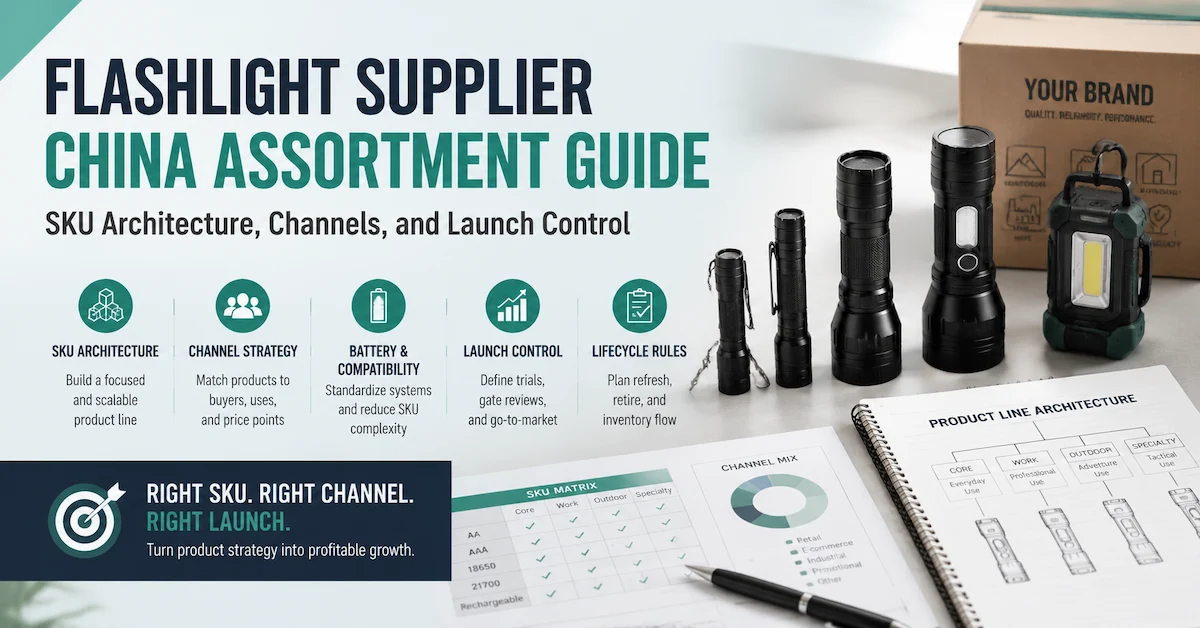
The short answer: build a range around buyer jobs
A coherent flashlight range usually covers a defined set of user jobs rather than every housing a factory can produce. A compact inspection light, a general household flashlight, a work light, a long-reach search light, and a rechargeable professional model may all deserve a place because they solve different problems. Five nearly identical zoomable flashlights with different bezels rarely create the same value.
Use a written assortment brief before asking for quotations. For each intended position, state the user, task, channel, target retail context, beam requirement, power source, charging method, size, controls, environmental expectation, included accessories, packaging format, claim restrictions, and replacement plan. The supplier can then propose configurations against defined roles instead of sending an unfiltered model list.
The result should answer four questions without explanation from a salesperson:
- Who is each product for? The user and use case are specific enough to guide product and content decisions.
- Why does each SKU exist? Its function, format, price position, or channel role differs meaningfully from adjacent products.
- What does it share? Common cells, cables, accessories, packaging structures, and data fields reduce operational complexity.
- When should it change or leave? Trial, review, replenishment, revision, and end-of-life rules are agreed before inventory accumulates.
Start with buyer segments, not flashlight categories
Factory catalogues are commonly organized by physical type: tactical flashlight, work light, headlamp, keychain light, camping lantern, or inspection light. That organization helps navigation, but it does not define a commercial assortment. Two products in the same category can serve completely different users, while a flashlight and headlamp may compete for the same task.
Describe the buyer's situation first. A facilities technician may value one-handed operation, a magnetic work position, predictable charging, and a replaceable pocket clip. A household emergency buyer may value simple controls, battery availability, long storage, and clear instructions. A trade-counter customer may compare durability and serviceability. A promotional buyer may care more about print area, presentation, order timing, and a stable specification.
Separate the person who buys from the person who uses. A procurement manager may select the range, a distributor may stock it, a retailer may explain it, and a technician may operate it. Each party needs different evidence. The assortment brief should capture channel requirements as well as end-user needs.
| Buyer or user context | Primary job | Useful range role | Evidence to request |
|---|---|---|---|
| Household and emergency | Simple light during outages, vehicle problems, or occasional tasks | Easy-entry core model with uncomplicated controls | Operating sequence, battery instructions, storage guidance, packaging clarity |
| Trade and maintenance | Frequent inspection and hands-free work around equipment | Rechargeable task light or magnetic work-light family | Runtime test conditions, attachment method, switch-cycle plan, replaceable parts |
| Outdoor and recreation | Navigation, camp tasks, and weather-exposed use | Portable model differentiated by beam and carry format | Beam description, ingress test basis, temperature limitations, charging controls |
| Security and industrial | Repeated use, fast access, identification, and shift handover | Controlled professional line with stable accessories | Lot identification, drop-test method, charger compatibility, spare-part policy |
| Promotional and corporate | Brand presentation and useful low-complexity gifting | Decoration-ready model with controlled presentation options | Print area, artwork process, color tolerance, pack-out approval, sample schedule |
These are planning examples, not fixed specifications. The product must be validated for its real use and destination. A phrase such as "industrial" or "outdoor" is not evidence of performance, and it should never replace measurable claims and documented test conditions.
Turn a flashlight supplier China catalogue into an assortment matrix
The fastest way to expose overlap is to place candidate products in a matrix. Use rows for user jobs or form factors and columns for commercial positions, channels, or power systems. Keep the first version small. Empty cells are acceptable when there is no proven demand.
A useful matrix records more than model names. Include the proposed role, one-sentence reason to buy, primary beam pattern, power source, charging interface, size class, user interface, accessory family, packaging variant, channel, launch status, and data owner. Add a "difference from nearest SKU" field. If that field cannot be completed in one precise sentence, combine the candidates or remove one.
Do not let cosmetic changes automatically become new SKUs. A color may justify a separate sellable item when the retailer, consumer, barcode, forecast, inventory, and replenishment are genuinely separate. The same color does not need to become a commercial SKU if it is simply an approved production option made to order. Distinguish sellable variants, manufacturing options, replacement parts, and packaging versions in the data model.
Use good, better, and best only when the steps are visible
A three-level product ladder can simplify a range, but only when buyers can understand why each step exists. "Good, better, best" should represent a meaningful increase in capability, suitability, service, or included value. It should not be a device for attaching three prices to nearly identical products.
| Position | Typical commercial purpose | Possible differentiators | Question that validates the step |
|---|---|---|---|
| Good | Cover the essential job with low learning and ownership complexity | Simple interface, common power source, essential accessory set | Can the intended user complete the core task without paying for unused capability? |
| Better | Serve more frequent use or add a capability with broad value | Rechargeability, improved task positioning, stronger runtime choice, better control | Is the upgrade noticeable in normal use and explainable in one sentence? |
| Best | Address demanding use, specialized control, or a premium ownership experience | Purpose-specific beam, replaceable components, richer status indication, complete kit | Does a defined segment need the added feature enough to support separate inventory? |
Brightness alone is a weak ladder. Output claims depend on measurement methods and operating conditions, and a higher maximum mode may bring more heat, shorter duration, or a different beam than the task requires. Compare the complete experience: beam distance and spread, sustained behavior, mode sequence, grip, controls, runtime choices, charging, mounting, weight, protection, packaging, and service.
Write the intended trade-off beside each tier. A compact entry model may sacrifice continuous high output to reduce size. A professional model may be larger because it supports a longer duty cycle or replaceable power source. Buyers trust a range more when limitations are stated clearly.
Create a rule for when a variation deserves a SKU
Every sellable SKU creates work. It needs a unique identity, forecast, cost, order line, artwork, barcode, product page, stock record, replenishment decision, quality reference, and end-of-life plan. Adding one variant is therefore an operational decision, not a design preference.
Approve a separate SKU when at least one durable condition applies: a different customer orders it; the product performs a different job; the power or charging system changes; destination requirements create a distinct pack; the retailer requires unique identification; the commercial price or service promise differs; or independent forecasting is necessary. Reject variants based only on internal enthusiasm or a supplier's available mold.
Use a variant request form with these fields:
- Parent product and proposed variant identity.
- User, channel, destination, and problem addressed.
- Physical, electrical, firmware, accessory, artwork, or packaging change.
- New test, compliance, instruction, translation, barcode, and document effects.
- Inventory, forecast, minimum-order, changeover, and service implications.
- Evidence that the need cannot be served by an existing SKU.
- Launch owner, review date, success criteria, and exit treatment.
The form makes hidden complexity visible. A new cable type, cell configuration, or claim may look minor in a sales meeting but affect manuals, pack-outs, transport preparation, customer support, and returns.
Design a battery and charging ecosystem
Power architecture can unify a range or fragment it. Decide deliberately which products use disposable cells, removable rechargeable cells, or built-in packs. Then document why each system fits the job. Availability, storage, user replacement, charging access, size, runtime behavior, transport, safety, and end-of-life handling all matter.
Standardizing on fewer cell and cable families can reduce purchasing, support, and accessory complexity. It also creates concentration risk. A common cell must still be suitable for every product that uses it, and a visually similar cell should not be assumed compatible. Record manufacturer, model, chemistry, dimensions, electrical ratings, protection arrangement, connector, pack construction, approved alternatives, and the exact products covered.
USB-C describes a connector family, not a complete charging promise. Ask whether the product charges from the intended source and cable combinations, how input requirements are communicated, what indicators mean, how charge termination is controlled, and whether any power-output function is present. Test the actual production configuration rather than inferring behavior from the socket shape.
For every power family, prepare a compatibility statement that customer service can use. It should list approved batteries, chargers, cables, and replacements; prohibited combinations; indicator meanings; storage instructions; and the process for an unavailable component. Do not market an open ecosystem if continued operation depends on a proprietary pack with no replacement policy.
Make accessories part of the architecture
Holsters, clips, magnets, brackets, diffusers, charging docks, cables, straps, spare seals, and replacement packs are often handled after the main product decision. That creates avoidable errors. An accessory may fit the housing but obstruct a switch, alter charging access, reduce retention, or work only with one revision.
Create an accessory compatibility table using controlled product and revision identities. Mark each relationship as included, optional, replacement, incompatible, or verification required. Add packaging quantity, attachment instructions, and the evidence used to approve the relationship. Keep "looks compatible" out of the system.
Decide which accessories are sellable and which are service items. A sellable accessory needs consumer-facing data and stock planning. A service item may need controlled distribution and installation instructions without a retail page. Included accessories belong in the BOM, inspection standard, unit-pack contents, manual, product page, and support script. Those records should agree.
Separate product, market, and channel variants
A single flashlight construction may need different language packs, warnings, barcodes, importer details, instructions, retail formats, or claims for different markets. A marketplace listing, hardware-store blister, industrial distributor carton, and corporate presentation box may share a product but should not share an uncontrolled packaging file.
Use three layers of identity:
- Product configuration. The physical and electrical item, including components, firmware where applicable, and approved performance definition.
- Market configuration. Destination-specific labels, instructions, responsible-party information, language, compliance documentation, and battery information.
- Channel pack. Barcode, pack quantity, merchandising format, promotional content, retailer data, and presentation.
This separation helps teams determine whether a change requires new testing, a new market record, a new sellable barcode, or merely an updated channel asset. The legal and regulatory conclusion must be made for the actual product and market by qualified people. A packaging matrix is a control tool, not proof of compliance.
Control claims before they become package copy
Assortment planning creates a hierarchy of claims: why one product is chosen over another and why one tier costs more. Every objective claim should have a definition, method, sample basis, operating conditions, responsible owner, supporting record, and approved wording before it enters a product page or carton.
For flashlight performance, ANSI/PLATO FL 1 provides defined concepts and test approaches for attributes commonly used in the category. Its presence does not make any particular claim true. The exact model must be tested and the wording must reflect the applicable method. Similarly, an IP code refers to a defined ingress-protection classification under IEC 60529; it should not be treated as a broad promise that a product is suitable for every wet or dusty environment.
Avoid converting internal observations into universal claims. A sample surviving an informal drop is not automatically a documented drop rating. A prototype operating for a certain period is not a complete runtime claim unless mode, battery, temperature, output endpoint, sample, and method are controlled. "Tactical," "professional," and "heavy duty" can also create expectations even when they are presented as product names.
For United States marketing, the Federal Trade Commission's business guidance emphasizes that advertising must be truthful, not misleading, and substantiated where required. Other markets have their own rules. Keep a claim register and obtain destination-specific review instead of assuming one global package can make the same statements everywhere.
Build stable SKU names and product records
A model code should identify a controlled configuration, not function as a creative description. Avoid codes that silently change meaning across customers. If one model number can contain different LEDs, cells, drivers, switches, or accessories without a documented suffix or revision, quotations and test reports become difficult to reconcile.
Create a product master with structured fields:
- Internal SKU, supplier model, revision, GTIN where used, and channel identifiers.
- Plain-language product name, range family, commercial tier, user job, and lifecycle status.
- Approved BOM reference, power system, charging interface, included contents, and accessory family.
- Dimensions and weights with measurement status and tolerances where appropriate.
- Claim text, method, evidence reference, limitations, and review date.
- Market pack, language, instructions, artwork revision, barcode, and responsible parties.
- Supplier, manufacturing site where relevant, quality plan, change-control contact, and lot-code format.
- Launch date, review date, replacement relationship, end-of-life status, and record owner.
GS1 identifiers can support unique trade-item identification across unit, case, and logistics levels. The brand owner should determine when a product change requires a new GTIN under the applicable GS1 rules. Do not let a factory reuse a buyer's barcode or create numbers outside the buyer's allocation and governance process.
Plan customization as modules, not unlimited choices
Private-label programs benefit from controlled choices. Divide customization into modules such as body color, surface finish, logo method, switch detail, battery, cable, accessory set, unit pack, manual, carton mark, and channel label. For each module, define approved options, technical dependencies, test effects, tooling status, artwork input, sample requirement, order implications, and lead-time decision point.
A modular matrix prevents an apparently simple request from producing an unreviewed combination. A body color may change material or finish behavior. A high-capacity battery may change fit, heat, charging, runtime, transport, and claim evidence. A magnetic feature may affect packaging and application suitability. A new logo position may interfere with regulatory text or grip.
Ask the supplier to quote the base configuration and each selected module separately. Do not invent a universal minimum order. Practical minimums depend on the product, component, decoration method, packaging print process, raw-material purchase, production changeover, and commercial agreement. The useful question is not "What is your MOQ?" but "Which element creates the minimum, and what alternatives reduce unused inventory without changing the approved product?"
Run a controlled trial instead of launching the full range
A trial with a flashlight supplier China partner should reduce uncertainty. It is not merely a smaller purchase order. Select a limited group of SKUs that represents the planned roles, then define what the buyer expects to learn about product fit, content clarity, channel response, replenishment, support, and returns.
Set the trial design before stock arrives:
- Which channels, regions, accounts, or user groups participate.
- Which product roles and tiers are represented.
- What product data, images, instructions, and sales training are supplied.
- How availability, sell-through, conversion, inquiries, returns, defects, and user feedback are recorded.
- Which observations trigger replenishment, correction, investigation, expansion, or exit.
- Who can authorize a specification, claim, price-position, or packaging change.
Avoid drawing conclusions from uncontrolled feedback. "Customers want brighter" may mean the comparison chart is unclear, the beam is too broad for the task, the default mode is wrong, the battery arrived at a low state of charge, or the wrong segment bought the product. Classify the observation and reproduce the problem before changing the range.
Forecast by role and source of uncertainty
New assortment forecasts should expose assumptions. Separate baseline demand, launch uplift, promotional demand, replacement demand, and pipeline opportunities. Record confidence and evidence for each component. A single optimistic number hides whether the risk comes from the market, product, channel, timing, or supply.
Allocate initial inventory according to the test objective. A core model may receive broader distribution because it represents the central demand hypothesis. A specialist model may need fewer sites but more informed users. Color or pack variants should not each inherit the full parent forecast. Estimate mix explicitly and update it as orders and stock movements become observable.
Use common components to improve flexibility only when the commercial products remain controlled. Postponing final packaging or logo application may allow later allocation across markets, but the process needs defined ownership, approved work instructions, correct labels, and traceability. Do not assume semi-finished stock can be converted freely after destination requirements are known.
Review samples as a family, not one at a time
A sample can pass on its own and still fail the assortment. Review adjacent products together. Can a user distinguish them? Do controls behave consistently? Are indicator colors and meanings aligned? Do included cables and accessories create confusion? Does the premium model feel materially different? Can staff explain the ladder without reading model codes?
Build an assortment review board with the intended line arranged by role and tier. Examine packaging fronts, product names, feature order, controls, charging, accessory fit, manuals, and storage together. Run realistic task sequences, not only visual inspection. Record gaps between the intended role and the observed experience.
Keep approval boundaries explicit. A golden sample can define appearance and assembly details, but it is not a substitute for a product specification, test plan, approved BOM, packaging files, or production inspection. Mark the sample identity, revision, date, approvers, deviations, and storage owner.
Use a commercial launch gate
A launch decision should bring product, operations, compliance, content, service, and inventory owners together. A technically acceptable flashlight is not launch-ready when the barcode is wrong, replacement battery is undefined, product page overstates performance, or customer service cannot identify the lot.
| Gate area | Release evidence | Reason to hold |
|---|---|---|
| Range role | User, channel, tier, nearest-SKU difference, and forecast owner are approved | The model duplicates an existing product or has no defined buyer job |
| Product definition | Specification, BOM, revision, sample, test plan, and change control agree | A component or claim remains provisional |
| Market and pack | Destination review, artwork, instructions, barcode, and pack-out are controlled | Language, responsible-party, warning, or identity data are unresolved |
| Content | Claims, comparison data, limitations, and support answers use approved evidence | Sales copy exceeds the tested configuration or confuses adjacent SKUs |
| Operations | Order, inspection, packaging, receiving, stock, and replenishment records align | Systems identify the same item differently or cannot separate variants |
| Service | Warranty terms, return codes, troubleshooting, accessories, and replacement path exist | Support cannot diagnose or replace the product consistently |
Record conditional releases. If a noncritical asset will follow, state the owner and deadline. Never use a conditional gate to bypass missing safety, regulatory, identity, or substantiation work.
Give sales teams a product-line content pack
A product page explains one SKU. A range content pack explains choice. Provide a one-sentence role for every item, a comparison table based on approved fields, selection questions, accessory compatibility, charging guidance, included contents, limitations, and escalation routes. Keep the same terms across catalogue, web page, marketplace listing, distributor feed, manual, and support script.
Lead with the decision a buyer is making. "Choose this model for frequent close-range inspection" is more useful than a row of unexplained output figures. Place performance values beside the relevant test basis and conditions. If models use different methods or unverified supplier data, do not present them as directly comparable.
Create structured data feeds from the product master rather than retyping facts for every channel. A controlled source reduces copy errors and makes revisions traceable. It also supports generative search systems because identities, relationships, definitions, limitations, and answers remain consistent across the site. GEO value comes from extractable, supported information, not from repeating the target phrase.
Classify returns so the range can improve
Return rate alone does not show what is wrong. Create reason codes that separate product defects, user-interface confusion, incorrect expectation, transit damage, missing accessory, charging-source mismatch, battery handling, wrong item, duplicate purchase, channel-content error, and no-fault preference. Permit a secondary code and a short evidence note.
Link the return to SKU, revision, lot, market pack, channel, order date, and disposition where lawful and practical. Review patterns by product role, not only by total volume. A model may have an acceptable overall result while failing one channel because the listing or package attracts the wrong user.
Decide which team owns each corrective path. Product defects may require supplier investigation and controlled corrective action. Expectation gaps may require content or assortment changes. Missing items may point to pack-out control. Charging questions may require clearer compatibility information. Do not ask the supplier to solve a positioning problem as if it were a factory defect.
Manage revisions and end-of-life before they are urgent
Portable-lighting components, packaging, regulations, and customer needs change. Define how revisions enter the assortment. The flashlight supplier China partner should notify the buyer before changing a component, material, process, manufacturing location, firmware, battery, charger, cable, label, or packaging element covered by the agreement. The buyer then decides what verification, sample approval, documentation, stock separation, or customer notice is required.
Do not mix revisions under one identity when the difference affects claims, compatibility, instructions, service, compliance records, or customer expectations. When a shared identity remains appropriate, preserve lot and revision traceability so support can determine what the customer has.
An end-of-life plan should state the last-order decision, remaining components, finished stock, channel inventory, warranty exposure, spare parts, replacement product, compatibility differences, content updates, and disposal or recycling obligations. A successor is not automatically a drop-in replacement. Explain changes in battery, charger, size, accessory, control, output, and pack contents.
Set a practical supplier collaboration cadence
Assortment work requires different meetings from order chasing. Use a regular range review to examine proposed additions, role overlap, component changes, forecast mix, trial results, return patterns, accessories, packaging versions, and products approaching end of life. Keep transactional shipment issues in a separate operating review so strategic decisions are not buried.
Share a controlled change queue with the supplier. Each item should identify the affected SKUs, reason, proposed solution, evidence required, sample status, artwork or document effect, inventory exposure, approver, and target decision date. Close rejected ideas as well as approved ones; otherwise they often reappear as informal assumptions.
Ask for visibility into common platforms and components, but do not assume common appearance means common construction. The value of platform information is to identify where qualification, tooling, accessories, packaging, and replacement planning might be reused. Each actual configuration still needs an appropriate definition and verification plan.
How Brightenlux can support assortment planning
Brightenlux publicly describes itself as a Zhejiang lighting manufacturer established in 2014, with more than 10,000 square metres, more than 150 employees, a broad portable-lighting range, and buyers in more than 50 countries. These company-profile statements should be confirmed with a Brightenlux representative before publication, procurement approval, or contractual use.
When contacting a flashlight supplier China team such as Brightenlux, send an assortment brief rather than a request for "best sellers." Include the intended users, channels, product roles, good/better/best logic, battery policy, accessory plan, destination packs, approved claim framework, trial design, and product-data fields. Ask the team to map candidate models to the roles, identify shared platforms and dependencies, and flag any proposed option that would create a separate configuration or verification requirement.
Explore the Brightenlux portable-lighting range, review public background on the company profile, or submit a structured assortment brief. A useful first response should explain how each proposal fits the requested job and what remains to be confirmed, not simply attach a larger catalogue.
30-point flashlight supplier China assortment checklist
- Define the end user, buyer, channel, market, and task for the range.
- Write one sentence explaining the job of every proposed SKU.
- Identify the nearest alternative and state the meaningful difference.
- Remove variants that exist only because a catalogue offers them.
- Map products by use case, form factor, tier, channel, and power system.
- Define good, better, and best steps using observable user value.
- Record the trade-off associated with every tier.
- Set a formal rule for when a variation becomes a sellable SKU.
- Separate product configuration, market pack, and channel pack identities.
- Control model, revision, GTIN, channel code, and supplier code relationships.
- Choose disposable, removable rechargeable, or built-in power deliberately.
- Document approved cells, packs, chargers, cables, and replacements.
- Verify USB-C behavior with the intended sources and cable combinations.
- Create an accessory compatibility table by product revision.
- Place included accessories in every relevant product and inspection record.
- Approve destination languages, labels, warnings, and responsible-party data.
- Create a claim register with methods, conditions, evidence, and owners.
- Keep unverified supplier data out of consumer comparisons.
- Structure customization into approved modules and dependencies.
- Identify which element creates each commercial minimum.
- Define what a controlled trial is expected to learn.
- Separate baseline, launch, promotion, replacement, and pipeline forecasts.
- Review adjacent samples together as a complete range.
- Use a launch gate covering product, market, content, operations, and service.
- Build comparison and selection content from the controlled product master.
- Classify returns by cause instead of relying on one total percentage.
- Link feedback to SKU, revision, lot, market pack, and channel.
- Require notification and approval for defined product or process changes.
- Plan replacement, support, remaining stock, and compatibility at end of life.
- Review the assortment regularly with named owners and recorded decisions.
Frequently asked questions
How many flashlight SKUs should a new private-label range launch?
There is no universal number. Launch the smallest set that covers the validated user jobs and commercial positions without forcing one product into unsuitable uses. Each additional SKU should have a distinct role, forecast, data record, inventory owner, support path, and exit rule. A controlled trial can test the architecture before the full range expands.
Should every color or packaging option have a different SKU?
Only when it is a separately sold, forecasted, stocked, replenished, or channel-controlled item. A made-to-order production option can remain an option in the configuration system. Market and channel packs may need unique identifiers even when the physical flashlight is shared, especially when barcodes, languages, warnings, or responsible-party information differ.
Is it better to use one battery type across the entire range?
A smaller battery ecosystem can simplify purchasing, compatibility, support, and replacement, but one type may not suit every size or task. Select the power system by use case, then standardize where technical suitability and verified performance permit. Control the exact approved cell or pack rather than relying on a generic size name.
What should buyers ask a flashlight supplier China company during assortment planning?
Ask the supplier to map each candidate to a defined user job, identify shared and different components, explain configuration dependencies, list compatible accessories, define product and packaging identities, and state what must be verified. Also request change-control rules, product-data fields, sample boundaries, and end-of-life support. Avoid using a best-seller list as the sole demand argument.
How should two flashlights with similar specifications be differentiated?
Compare the complete task experience. Beam shape, sustained operation, mode order, switch access, grip, mounting, power system, charging, size, weight, accessories, serviceability, pack, and channel may reveal a real difference. If the intended buyer still cannot explain the choice in one sentence, combine the products or remove one.
When does a flashlight change require a new model or barcode?
It depends on the significance of the change, customer expectations, market records, and the applicable identification rules. Changes affecting function, claims, compatibility, pack quantity, or how the item is traded may require a new identity. Review current GS1 GTIN rules and destination obligations, then preserve revision and lot traceability even when the commercial identity remains.
How can a buyer reduce risk when testing a new range?
Define a limited trial with representative products, channels, users, controlled content, and decision criteria. Record sell-through alongside inquiries, returns, defects, expectation gaps, and inventory behavior. Investigate causes before changing the specification. A trial is useful when it produces a go, correct, expand, or exit decision, not when it merely delays the same uncontrolled launch.
Final takeaway
A catalogue is a list of available products. An assortment is a managed promise to customers. It connects buyer jobs, product roles, power systems, accessories, claims, market packs, data, inventory, support, revisions, and replacement decisions.
When evaluating a flashlight supplier China proposal, reward clarity rather than quantity. Ask why every SKU exists, what it shares, what makes it different, what evidence supports its position, and how it will be maintained after launch. A smaller range with explicit roles and controlled variants is easier to explain, forecast, replenish, support, improve, and eventually replace.
References and verification resources
- PLATO: ANSI/PLATO FL 1 flashlight performance standard overview
- IEC 60529: Degrees of protection provided by enclosures
- GS1: Global Trade Item Number guidance
- United States Federal Trade Commission: advertising and marketing guidance
- Official EU General Product Safety Regulation text
- Official EU Batteries Regulation text
Standards, identification rules, advertising requirements, product regulations, battery obligations, and channel policies can change. Verify the current requirements for the exact product configuration, claim, market, channel, and contracting parties with qualified professionals before launch.