

Custom Outdoor Lighting Manufacturer China: What Buyers Should Look For
When sourcing from a custom outdoor lighting manufacturer in China, style is not the first test. The real question is whether the supplier can turn a concept into a durable product that works in weather, handling, and commercial use. That matters for architectural lighting and portable products like tent lights or camp lanterns. If you are comparing options, it helps to review the product range first, then judge whether the factory fits the use case.
Why supplier choice matters more than the brochure
Outdoor lighting covers more than one market. On one side are decorative and architectural fixtures for façades, landscapes, and public spaces. On the other are portable products such as tent lights, camp lanterns, and emergency area lights. A supplier strong in one category is not automatically right for the other, even if the brochure makes it sound that way.
That difference matters because the design priorities are different. Architectural outdoor lighting usually asks for beam control, finish quality, and visual consistency. Portable lighting asks for easy use, stable placement, and a body that can handle packing, unpacking, and repeated handling. A serious LED outdoor lighting manufacturer should be able to explain what it builds, how it builds it, and what is controlled during production. If the answers stay vague, the sample is doing more work than the supplier.
What the product details reveal about a camping lantern
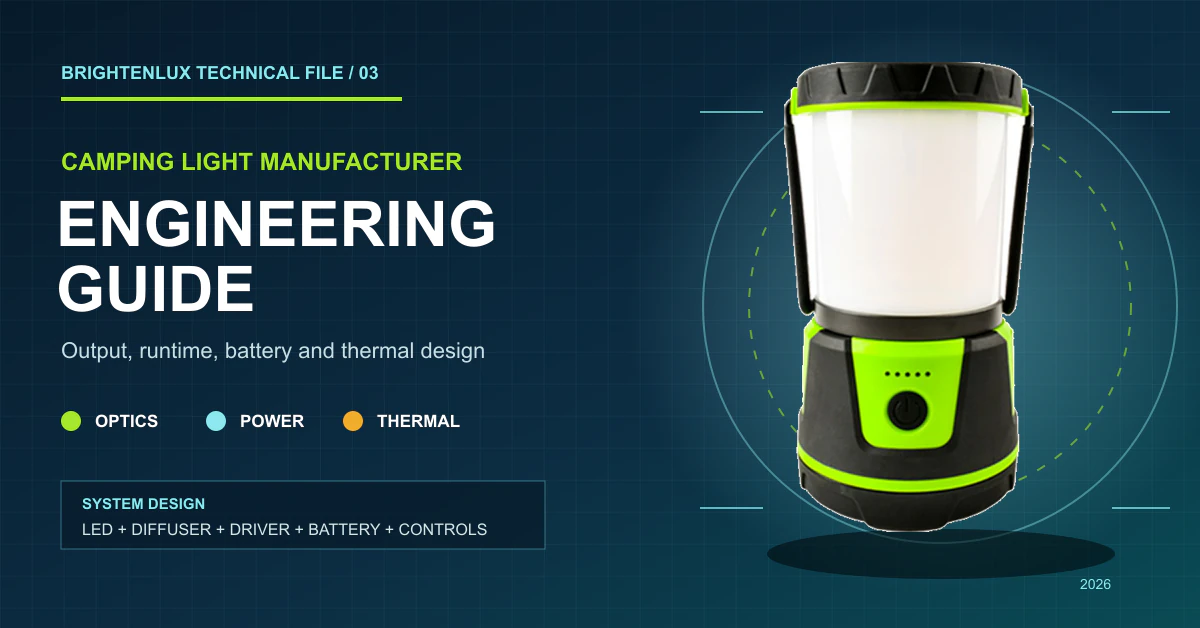
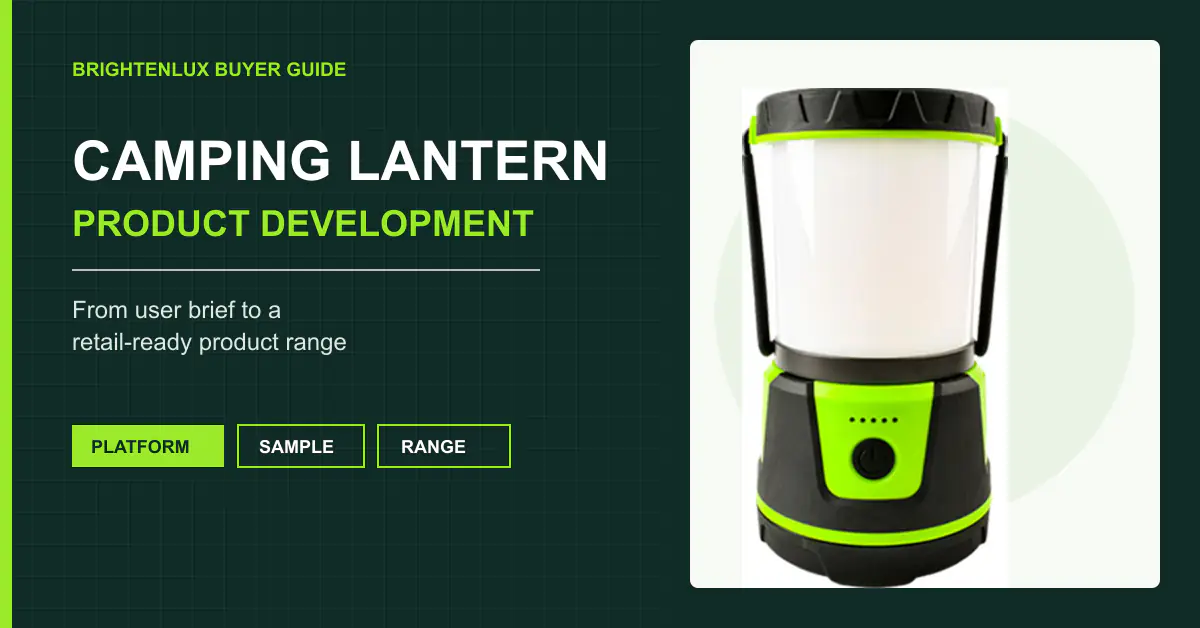
The source product information points to a compact, freestanding camping lantern or outdoor tent light. It has a cylindrical form, a transparent or frosted light chamber, and a darker section at the base or top. The light is described as warm white, which suggests area lighting rather than a narrow beam. That makes sense for a tent interior, a camp table, or a small outdoor gathering.
For buyers, the design tells you more than the look. A freestanding lantern reduces friction for the user because it can simply sit on a surface and provide light. From a manufacturing angle, that usually means attention to housing construction, diffuser performance, and base stability. The exact materials are not confirmed, so buyers should not assume metal, plastic, or a specific power source without documentation. A good sample is a starting point, not proof of every unlisted detail.
Three common sourcing paths for custom outdoor lighting
Outdoor lighting projects usually fall into one of three sourcing types. Knowing which one you are buying helps you ask better questions and avoid comparing unrelated products.
| Category | What buyers usually care about |
|---|---|
| Decorative and architectural outdoor lighting | Beam direction, finish quality, mounting, and consistency across a larger installation |
| Portable consumer outdoor lighting | Portability, ease of use, stable placement, and durability in everyday handling |
| Hybrid or branded custom lighting | Custom shell, colorway, packaging, and visual identity without full product redevelopment |
This breakdown is useful because a factory that excels in one lane may not be the best match for another. A lantern for camping tables is not built on the same logic as a façade fixture. Before you move forward, decide whether your project is primarily commercial, portable, or a mix of both.
How to judge a factory before you commit
A sourcing team often starts with the wrong question: “Can you make this?” Almost any supplier can say yes. The better question is, “How do you make it, and what do you control in-house?” That answer tells you far more about repeatability and support than a polished sales deck ever will.
For a custom outdoor lighting manufacturer in China, ask how the enclosure is formed, how the LED light source is integrated, how the diffuser is held in place, and how heat is managed inside the housing. For a portable product, ask whether the base is stable on uneven ground and whether the design is intended to stand on a table or floor. If the factory also builds architectural outdoor lighting, check whether the same engineering team and quality process apply to your category.
Selection criteria that save time later
The easiest way to reduce sourcing risk is to focus on fit for use. A campsite lantern should provide comfortable area lighting, not a harsh beam that feels awkward around faces or food. Architectural outdoor lighting, by contrast, may need stricter control over the light direction and the visual effect it creates on a building or landscape.
The second filter is enclosure realism. Outdoor products are touched with wet hands, packed into bags, set down on uneven surfaces, and stored in cars. A clean render does not prove durability. The third filter is manufacturability. A custom shape may look appealing, but if it creates assembly problems or poor diffuser fit, it can become expensive and inconsistent. The fourth is brand presentation. Many buyers need packaging and labeling to match a retail line. Service responsiveness matters too, because slow answers can delay a launch even when the product itself is sound.
Common mistakes buyers make with custom outdoor lighting
One common mistake is over-specifying appearance and under-specifying use. Teams may spend a long time on color and silhouette while leaving the real scenario unclear. Is the product for camping tables, tent interiors, roadside emergencies, or patio dining? These use cases do not lead to the same design priorities, so the factory needs a clear brief.
Another mistake is assuming all outdoor lights need the same durability features. They do not. An architectural fixture exposed to weather has different needs from a portable camp lantern that is used occasionally and stored indoors. A third mistake is forgetting how the end user behaves. For the lantern described in the source, the likely use is simple: light a tent or camp table at night for cooking, eating, or organizing gear. That means the product should be intuitive, stable, and forgiving.
Practical questions to ask before RFQ or sampling
You do not need a long questionnaire, but you do need the right one. Ask what outdoor setting the supplier is designing for. Ask how the lamp body is built and how the diffuser is retained. Ask whether the product is meant to sit, hang, mount, or do more than one of those jobs. Ask what can be customized without destabilizing the design.
It also helps to ask what remains unverified in the current sample. Buyers sometimes move too fast from a good-looking sample to production assumptions. If materials, power source, or a key performance detail have not been documented, treat them as open items. If you are refining a private-label or project brief, you can also explore the contact us page or send an inquiry once your use case is clear.
FAQ
Is China a good source for custom outdoor lighting?
Yes, as long as the factory matches the product category and the buyer can explain the use case clearly. China has manufacturing capability across both consumer outdoor lighting and architectural outdoor lighting, so the key is fit, not just location or price.
Can one supplier handle both decorative and portable outdoor lighting?
Sometimes, but not always with equal strength. A supplier may be strong in decorative housings and visual consistency yet less suited to portable ergonomics, or the reverse. Buyers should check the exact product history, engineering approach, and quality process before assuming one factory can cover both well.
What makes a campsite lantern different from other outdoor lights?
Portability, stable placement, and user comfort matter more than beam precision. A warm, area-style output is often better for a tent or camp table than a narrow beam. Simple operation and a forgiving design are important because the product is likely to be handled often in casual outdoor settings.
What should I verify before placing a custom order?
Confirm the intended outdoor setting, the housing structure, the diffuser design, the mounting or placement method, and any details that are still unverified in the sample. It is also wise to check which elements can be customized without changing the product’s basic stability or intended use.