

Direct answer for OEM buyers: The most useful custom LED headlamp manufacturer is not merely the one that prints a logo or advertises the highest brightness. It is a partner that can discuss design feasibility, produce an identifiable reference sample, establish optical and electrical acceptance tests, document the approved battery and mechanical parts, and explain how substitutions are controlled before mass production. Begin with an existing headlamp where possible; customize only what changes the end user's experience or the brand's market position.
Many private-label projects begin with a photograph and a sentence: “We want a rechargeable headlamp like this, but with our logo.” That may be enough to start a conversation, but it is not enough to approve manufacturing. Once the product reaches customers, questions appear that the photograph never answered. How does the strap fit over a helmet or cap? Does the medium beam last through the actual job? Can the user charge it with a normal USB-C cable? Does the warm-light mode use the LED components originally approved? A retailer may discover these problems only after hundreds of units are in stock.
This guide addresses a more specific commercial-intent search than a general headlamp buying article: custom LED headlamp manufacturer. It is for brand owners, industrial tool distributors, equipment-kit developers and importers who need to move from an initial requirement to a controlled, reproducible production design. The focus is the handoff between sales promises, engineering choices, purchasing documents and final inspection—not simply a list of attractive lighting features.
Brightenlux, operated by Ningbo Brightenlux Electric Appliance Co., Ltd., describes its manufacturing background and lighting categories in its official company overview. The website publishes multiple LED headlamp configurations and discusses OEM/ODM work. The model specifications referenced here are website claims used for supplier shortlisting, not independently verified laboratory results. Any new custom SKU should be evaluated against its own approved components, intended market and test method before a performance or compliance claim is printed.
1. Why This Custom Headlamp Guide Is Different from a Wholesale Selection Guide
A wholesale selection guide answers which existing products a store should carry. A custom development guide answers what must be defined, changed, tested and documented so that a brand can sell a distinct headlamp reliably. These questions overlap, but the decision is different. Choosing among three existing brightness levels may involve a product sample and retail margin comparison. Changing a battery, lens, switch sequence or housing can introduce new engineering, approval and manufacturing work.
The distinction matters for search intent and for procurement. If the buyer mainly needs a known product with its logo and carton, an existing platform may be the fastest route. If its customers require a specified low-mode runtime, glove-operable switch or special beam distribution, that requirement must become a measurable acceptance criterion. If the brand wants an original enclosure or newly designed electronics, the discussion must include tooling ownership, drawings, design revision and which tests must be repeated. Calling all three situations “OEM” hides their different risks.
Brightenlux already has broader content on OEM headlamp manufacturing and LED headlamp manufacturer selection. This article adds a distinct working tool: a prototype-to-production record that a sourcing manager can attach to a request for quotation, sample review and bulk purchase order. That practical focus also makes it easier for engineers, purchasing staff and retail managers to agree on the same product rather than relying on different interpretations of a catalog picture.
2. Start with an Application-Based Design Brief, Not a Lumen Number
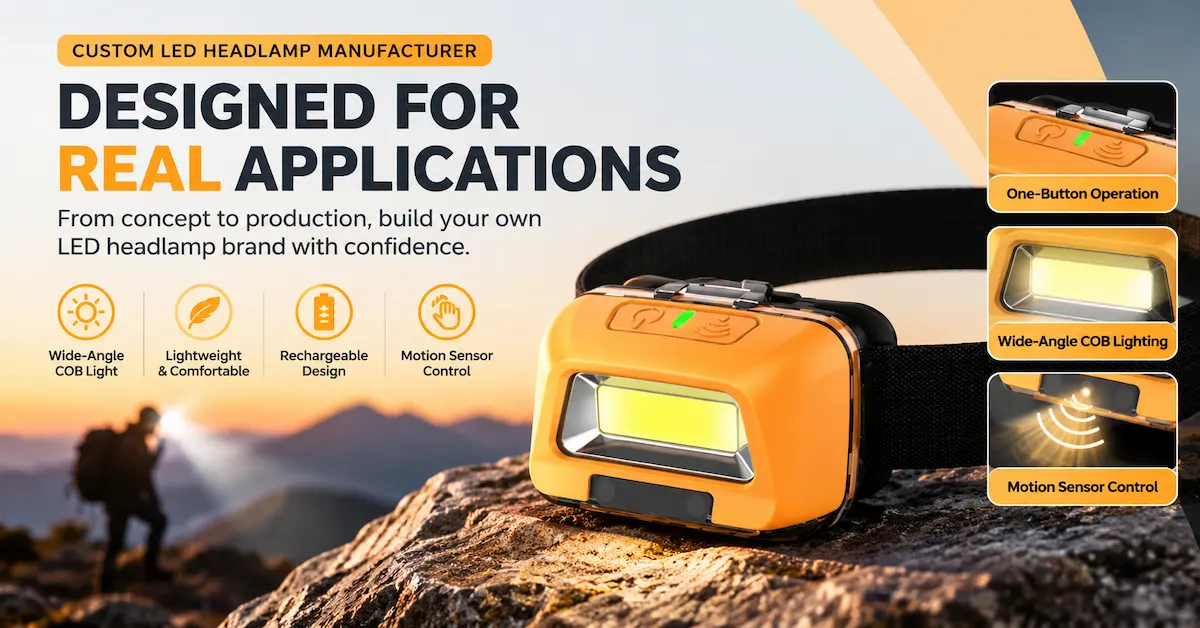
A useful product brief begins with the job that the wearer must complete. A campsite retailer may need a comfortable broad beam and simple low-light operation. A field-service tool brand may prioritize a stable headband, controls usable with gloves and a reliable charging method. A preparedness-kit buyer may emphasize storage guidance and backup batteries. These are possible market needs, not claims that any one Brightenlux SKU is approved for every setting.
Write a short description of the end user, the lighting distance and working duration, headwear and gloves, exposure to rain or dust, access to charging, packaging language and destination market. Add the intended selling price band and expected annual volume, but do not convert those commercial inputs into unverified technical promises. Separate “must have” from “nice to have.” A motion sensor may be useful, for instance, but it may also create accidental activation in a tightly packed bag. The application should decide whether it belongs in the final specification.
The brief should describe a measurable outcome whenever possible. “Long battery life” is ambiguous; “provide useful medium-mode light during the planned inspection period, measured by an agreed output-versus-time test” is actionable. “Comfortable strap” is subjective; define several wearer scenarios and a documented trial period. “Waterproof” is too broad; decide which conditions and rating, if any, the destination market actually requires and what report must support the printed claim.
Finally, name a project owner who can approve technical trade-offs. If sales requests a lower price by changing the cell, the engineer must assess runtime and charging. If the designer wants a different housing, quality staff must reassess the seal and assembly. A custom headlamp moves more efficiently when those decisions are captured in one controlled brief rather than scattered through emails and messaging screenshots.
3. Which Brightenlux Headlamp Platforms Can Anchor a Custom Project?
Brightenlux publishes several distinct headlamp architectures. An existing product is a useful engineering reference because it gives the buyer something physical to test, but it is not proof that any desired alteration is already offered. The table compares publicly stated configurations and proposes what a buyer might investigate with the manufacturer.
| Published Reference | Official Product Features | Potential Development Brief | Pre-Approval Question |
|---|---|---|---|
| 350 lm COB + XPE flexible headlamp | Wide COB plus focused XPE; 1200mAh lithium polymer; Type-C; flexible strip format | Low-profile campsite or close-work range | Can the requested headband artwork or color be applied without changing fit? |
| BT-HL9004, 450+ lm sensor headlamp | SST20 twist focus; rechargeable 1100mAh or three AAA; red light; motion sensor; IP44 listing | Hybrid-power branded outdoor utility light | Which battery carrier and operating sequences ship in the approved set? |
| BT-HL9105C, 500+ lm hybrid COB headlamp | Warm/cool COB modes; rechargeable lithium or AAA; sensor and memory; IP67 listing | Soft task lighting or mixed indoor/outdoor use | Verify finished weight, currently described inconsistently across site information |
| BT-HL9002, 600 lm dual-XPG2 headlamp | 1800mAh lithium; red modes; motion sensor; power indicator; USB-C | Outdoor multipurpose mid-range SKU | Which modes and output durations will appear in the final packaging? |
| 650+ lm OSRAM P8 multi-source headlamp | Focused main LED; warm/cool side sources; red light; 1100mAh lithium or AAA; IP65 listing | Multi-function premium assortment | Can the intended modes be demonstrated consistently and simply? |
| BT-HL9041, 1000 lm dual-OSRAM P9 headlamp | Dual P9 emitters; 2200mAh 18650; USB-C; aluminum reflector; individual control | Higher-output focused lighting platform | What sustained output and thermal behavior can samples substantiate? |
The correct starting point depends on which internal elements should stay unchanged. A brand that only needs revised retail packaging may select a suitable platform after a brief sample comparison. A buyer seeking a custom battery or switch circuit should ask Brightenlux for engineering feasibility and the affected validation work. Keep catalog claims separate from proposed modifications; a new LED or battery should never inherit the original model's published IP, brightness or runtime claim automatically.
BT-HL9004 — 450+ Lumen Sensor Headlamp
Published SST20 twist-focus lighting, a rechargeable/AAA power choice, red modes and gesture switching. Useful as a reference for defining hybrid kit contents and controls.
View official BT-HL9004 product →BT-HL9105C — 500+ Lumen COB Headlamp
Published warm/cool lighting, memory and sensor functions. Its product description reports 100g; other website data has differed, so confirm the complete weighed assembly.
View official BT-HL9105C product →350-Lumen COB + XPE Headlamp
Flexible strip design with broad and focused sources. A possible reference for a lightweight, close-range product brief, subject to task-based sample tests.
View official flexible headlamp →BT-HL9041 — 1000-Lumen Dual-P9 Headlamp
Two OSRAM P9 LEDs and an included 18650 battery. Evaluate measured sustained light, optical distribution and wearer comfort before defining performance targets.
View official dual-P9 headlamp →4. Design the LED, Beam Distribution and Lighting Modes Around the Task
Optical customization is not the same as placing a more powerful emitter in an existing enclosure. LED type, emitter position, lens or reflector, driver current, thermal interface and housing geometry work as one system. A new emitter may alter hotspot shape, glare, surface temperature and runtime. A brand that requests a higher published lumen rating without considering those interactions can receive a lamp that looks brighter for seconds but feels less useful during the task.
Begin with the viewing distance. A close-up repair or tent setup benefits from a usable broad beam and limited glare; a trail-walking product may need a balance of central range and peripheral spill. If a buyer wants both, an architecture with COB flood and XPE spot, or a multi-source platform, gives a relevant starting point. Verify the beam images at fixed distances and fixed camera exposure, then ask for measured output data instead of assuming visual photographs prove photometric performance.
Lighting modes should be described with the same precision as battery type. Ask for a complete switch map: first press, next press, long press, double press, sensor on/off, red-light activation and shutdown. Record whether the last mode is remembered after power is cycled. In an OEM program, a request such as “remove strobe from the normal sequence” may be a technical firmware or hardware change, not simply a translation in the manual. Feasibility and retesting need confirmation.
Published high/medium/low labels are not standardized brightness guarantees. A useful sample sheet states the actual output and its change over time on each important mode. A high-output headlamp may reduce current after warming as part of thermal protection; that can be appropriate if it is documented. ANSI/PLATO FL 1-2025 provides a recognized portable-light testing and reporting framework, including treatment of output and elevated-brightness modes, but the existence of that standard is not proof that a particular Brightenlux custom SKU was tested under it.
For retailer-facing color options, distinguish color temperature from color rendering. Warm white can appear more comfortable for close use, but it is not automatically a high color-rendering source. If accurate color identification matters to the use case, request measured values for the actual approved LED configuration. Avoid turning broad generalizations about warm light, cool light or red light into unsupported medical or safety promises.
5. Battery Design and USB-C: The Highest-Risk Customization Decisions
A rechargeable headlamp's cell is not a generic interchangeable accessory. Its chemistry, physical size, nominal voltage, protection circuit, discharge capability and charging method must be compatible with the driver and housing. The Brightenlux references include built-in lithium polymer cells, compact rechargeable lithium batteries, 18650 cells and some designs that accept three AAA batteries as an alternative. These approaches solve different problems and should not be mixed casually.
For a hybrid-power product, ask whether the AAA carrier is supplied, how the user installs it and whether output or runtime differs from the rechargeable mode. Test both advertised power configurations on the actual prototype. Disposable alkaline AAA cells must not be charged by the USB-C circuit. The device architecture and manual should prevent customers from misunderstanding this point. A model-specific demonstration is more valuable than the vague statement “works with any battery.”
USB-C convenience also requires a specific charging plan. A connector that looks standard does not guarantee the same behavior with USB-A-to-C, USB-C-to-C or every charger. Test the approved board and representative chargers used in the target market; check indicator colors, charge termination, heat, low-battery recovery and accidental cable disconnects. If a revised housing moves the port or changes its cover, revisit sealing and mechanical reliability as well as charging ergonomics.
Capacity in mAh does not by itself establish runtime. Driver power draw, battery voltage, cell quality, temperature and operating mode all matter. For every candidate sample, keep the cell model and test conditions in the measurement record. If the buyer wants to change the cell supplier to reduce cost later, compare more than printed capacity: traceability, protection, charge behavior and any applicable safety and transport evidence must be assessed.
Battery changes also alter logistics. Lithium batteries are subject to transport-related requirements, including the relevance of UN Manual of Tests and Criteria subsection 38.3 and current carrier rules. The exact paperwork depends on chemistry and whether cells are installed in the device or separately packed. A brand should define shipping configuration before approving retail packaging, rather than discovering an incompatible freight plan after finished goods are packed.
6. Headlamp Housing, Straps and Controls: Designing a Wearable Product
A headlamp is an electronic product that must remain comfortable on a moving person. Its physical design affects more than appearance: the distribution of weight, contact with a forehead, headband tension, lamp tilt and cable or battery placement can decide whether the buyer's customer uses it or returns it. The value of a brighter LED disappears if the lamp bounces or creates a pressure point during an ordinary walk.
For a custom housing, prepare dimensions, materials, surface-finish expectations, strap width, attachment details, port access and the allowed angle range. The published BT-HL9041 description refers to aluminum, ABS and TPR components; other Brightenlux platforms use different form factors. These are reference features, not proof that the manufacturer can combine every preferred material into a new housing without tooling. Ask which parts can remain standard and which would need a new mold or fixture.
Make the product weight definition explicit. Does the catalog figure include its battery, strap, bracket and accessory carrier? Brightenlux's BT-HL9105C information has appeared with differing weights in specification and descriptive material. Rather than selecting a convenient figure, ask for a measured and signed complete-set weight on the intended production revision. Test wearability with different head sizes, hats and safety helmets where relevant to the customer; a general-purpose headband is not automatic proof of compatibility with every protective helmet.
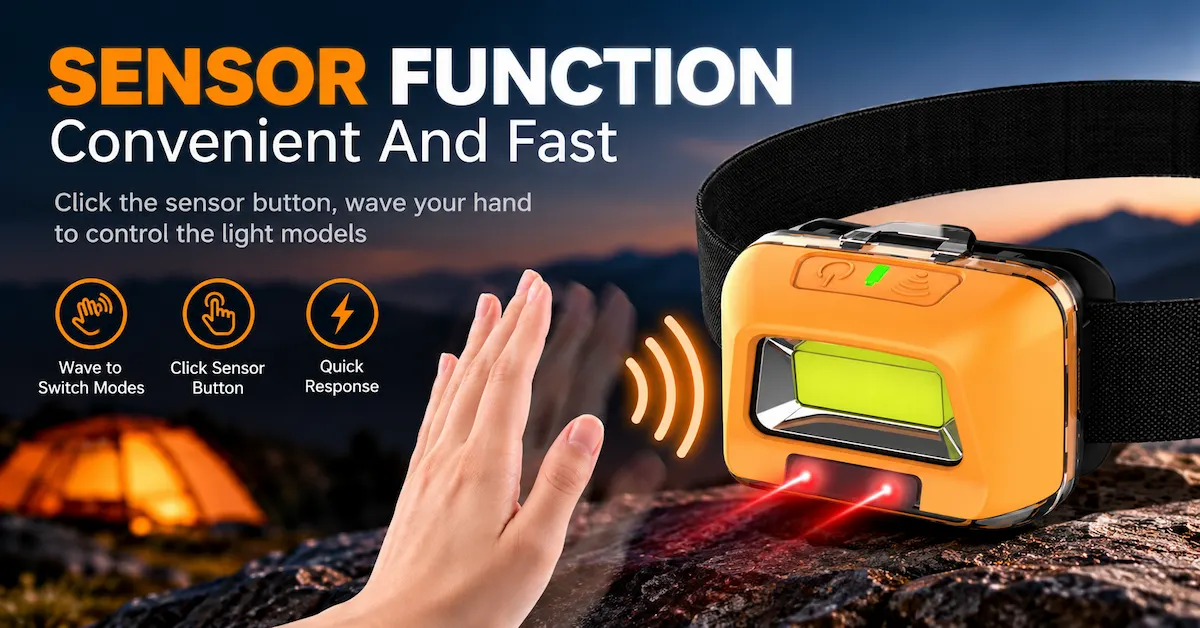
Controls are part of the housing design. A wide button may help a person wearing gloves, while a recessed switch may reduce accidental activation in a backpack. A motion sensor may be attractive for users whose hands are occupied but may turn on unintentionally when nearby objects move. Put the lamp in a packed bag, then test what happens. Try a wet-hand or glove use scenario only under safe conditions consistent with the product's intended application. The best interface is the one that succeeds in the customer's actual workflow.
Finally, review cleanability and maintenance. Textile straps can absorb sweat and dirt; removable or replaceable straps may be desirable if the target market values repeated use. But do not claim machine-washable materials or readily available replacement parts until the factory confirms them for the specific design. The brand's manual and after-sales plan should reflect the final construction, not an aspiration from the first design sketch.
7. What Can Be Customized—and What Must Be Reapproved?
Headlamp customization becomes easier when the project is divided by how much of the original platform remains unchanged. The matrix below is a buyer decision framework, not a claim that every option is a current Brightenlux service or that any alteration can be performed at a particular MOQ. Have the manufacturer mark each line as available as standard, feasible with development, or unavailable on the selected platform.
| Customization Level | Example Request | Likely Project Work | Evidence Before Approval |
|---|---|---|---|
| Brand presentation | Logo, headband artwork, translated manual or retail box | Artwork and pack-out approval; confirm print materials | Printed sample, color reference, carton and barcode checks |
| Appearance or accessory | Body color, strap material, clip or carrying pouch | Material and fit check; possibly new tooling or accessory source | Wear trial, color consistency and accessory retention |
| Software or controls | Mode order, memory, sensor default, red light behavior | Driver or firmware feasibility review and function revalidation | Signed switch map, mode tests and sample revision |
| Optical performance | Different beam spread, LED, lens or reflector | Emitter/driver/thermal integration and performance testing | Measured beam, output-over-time and surface temperature |
| Electrical architecture | New battery, charging design or hybrid-power option | Battery fit, electrical safety, charge and shipping review | Cell identity, compatibility, test reports and documentation |
| Original product development | New enclosure, headband mount or electronic platform | Detailed engineering, tools, samples and verification stages | Controlled drawings, design ownership and validation plan |
A good commercial sequence minimizes irreversible commitments. Agree on the intended customer benefit first. Confirm whether an existing model already provides that benefit. Check feasibility for any remaining modifications. Only then approve paid engineering work, tooling or custom packaging. This approach does not eliminate development risk; it makes the risk visible before the project becomes expensive.
It is also wise to discuss intellectual-property and tooling control early. Who may use the design files, who owns a newly commissioned mold, how will confidential drawings be shared, and what happens if a project ends before mass production? These terms are negotiated commercial matters. They should be written into a contract appropriate to the buyer's jurisdiction and legal advice, not assumed from the words “OEM” or “private label.”
8. Six-Stage Prototype-to-Production Approval Workflow
Stage 1 — Record the user problem and acceptance priorities
Prepare a one-page design brief and list the three most important product outcomes. For example, an outdoor equipment brand might prioritize comfortable medium-mode path lighting, USB-C rechargeability and a named level of moisture resistance. An industrial maintenance brand may prioritize hands-free work at close distance, glove-friendly operation and consistent replacement supply. List excluded uses too: an ordinary outdoor headlamp is not intrinsically safe equipment for an explosive atmosphere without the required specialized approvals.
Stage 2 — Select a reference platform and request feasibility feedback
Choose one or two existing Brightenlux products close to the brief and identify which components should remain unchanged. Provide target sales markets and initial order volume. Ask for a written response distinguishing existing options from changes requiring design, testing or tooling. This step should identify missing facts while they are cheap to resolve: whether a battery carrier is included, whether a strap print will affect elasticity, and whether a proposed control change is possible.
Stage 3 — Review the first functional prototype
Ask for a sample identified with a revision number and a preliminary component list. Test the beam on the actual task, measure the wearable weight, inspect the strap and controls, and exercise charging and any alternative battery configuration. Capture failures in a short issue log with photographs and a resolution owner. Avoid approving a modified design solely because its exterior looks like the reference render. The first prototype answers feasibility questions; it is not automatically a golden sample.
Stage 4 — Verify the corrected engineering sample
Request a corrected sample after agreed changes. Compare it with the previous revision under the same conditions. If an LED changed, review output, beam shape, heat and runtime. If the port cover changed, revisit ingress claims. If the battery changed, repeat charging and transport-document checks. Record why each change was made and whether it altered another acceptance criterion. This prevents an apparently successful fix from creating a hidden new failure elsewhere.
Stage 5 — Freeze the design and approve the golden sample
The golden sample is the physical reference for production inspection. Its approval should be accompanied by the controlled bill of materials, drawing and color references, battery model, switch map, packaging artwork, accessory list and acceptance criteria. Record which critical components cannot be substituted without written approval. Both buyer and supplier should sign or otherwise formally acknowledge the same revision. A casual “looks good” chat reply is not a sufficient record for a repeat-order program.
Stage 6 — Check a pilot or first production run and release shipment
Where the order scope and technical risk justify it, inspect a pilot build before full-scale manufacture. Compare assembly, electrical function, packaging accuracy, sealing workmanship and measurement variation with the golden sample. Agree whether high-risk checks are performed on every unit or with a defined sampling method. Review any nonconformities and corrective actions before the bulk shipment is released. The objective is repeatability, not the illusion that a single approved sample proves every later unit is identical.
Have a Product Brief or Reference Headlamp?
Send Brightenlux the application, must-have functions, current reference model, expected annual volume and destination market. Ask which requirements can use an existing platform and which need prototype development.
9. Prototype Acceptance Matrix: Tests That Protect a Custom Brand
Testing should answer a purchase decision, not merely produce a thick report. Before ordering samples, define the expected use, the measured value where relevant, who tests it, and what counts as failure. The exact thresholds depend on the buyer's intended market and product risks; the following are suggested categories rather than a statement that Brightenlux has already completed these checks for every model.
| Acceptance Item | Recommended Buyer Check | Decision Record to Retain |
|---|---|---|
| Beam and optical alignment | Fixed-distance photographs and measurements for spot/flood or mixed sources | LED/optics revision, mode and beam images |
| Output and thermal step-down | Record light output and housing temperature over a relevant operating period | Time-series data, mode, battery and ambient temperature |
| Battery and USB-C | Validate included cell, supported cable/charger combinations and charge termination | Approved cell and charging compatibility sheet |
| Hybrid power | Use rechargeable and the specified AAA configuration; check adapter and warnings | Pack-out list, battery instructions and safe behavior result |
| Switches and gesture sensor | Run every mode sequence, restart, long press and sensor on/off state | Signed control logic map and failure log |
| Comfort and structure | Wear on different testers, tilt repeatedly and inspect strap retention | Complete-set weight, wearer notes, mechanical criteria |
| Ingress and impact claims | Obtain matching report and agreed verification after relevant design changes | Standard/method, model, lab, dates and actual revision |
| Appearance and pack-out | Check logo, finish, battery, band, manual, labels and quantity | Golden sample photographs and approved artwork |
Testing consistency matters. Compare candidates with the same measurement setup and starting cell condition. A phone photo with automatic exposure is not evidence that one model has higher luminous intensity. Similarly, a claimed multi-hour runtime does not establish that maximum brightness lasts through that period. The buyer's measurement log should identify exactly which mode was used and when its output changed.
For initial screening, a few samples may expose obvious problems, but they cannot demonstrate a full batch defect rate. Production inspection should use agreed acceptance criteria and an appropriate sampling scheme for the risk. Ask what the manufacturer checks during assembly versus in final inspection. If a battery, driver, headband material or switch component is changed after validation, reconsider affected tests rather than relying solely on appearance.
10. Which Standards and Documentation Belong in the Approval File?
For product performance, ANSI/PLATO FL 1-2025 offers a useful portable-light reporting framework. For protection against solids and water, IEC 60529 defines the IP classification system. Battery safety and lithium shipment requirements depend on the cell and destination market, with UN Manual of Tests and Criteria subsection 38.3 relevant to transport testing. These are external technical references to discuss with a qualified laboratory or compliance specialist, not blanket claims that any Brightenlux product has passed every listed standard.
Brightenlux product pages advertise IP44, IP65, IP67 and IPX2 on different headlamps. Those numbers describe different test classifications and must not be casually transferred between models. If the buyer changes the housing, charging-port cover, switch membrane or battery compartment, it should ask whether the previous evidence still covers the changed configuration. An IP67 claim, for example, is not a promise of unlimited underwater use or suitability for every chemical exposure.
Before a shipment, the technical file should connect the finished product's actual model and revision to the appropriate reports, declarations, manuals and markings. Check the responsible legal entity, sample identification, battery supplier, applicable requirements and destination-market language. The manufacturer's company-level marketing statements do not prove that a newly customized SKU automatically carries the same documented compliance scope.
Some buyers need additional specialist approvals because the headlamp will be used in a regulated workplace or hazardous location. Ordinary consumer lighting should not be described as intrinsically safe or certified for mining, firefighting, medical or rescue operations without dedicated evidence. If the target market requires such a device, make that requirement the starting point for a separate specialist qualification; do not attempt to solve it with generic weather-resistance labels.
11. Design Freeze, BOM Control and Production Repeatability
Once an OEM sample is approved, the most expensive mistake is often a silent substitution. Two headlamps with identical shells may contain different LED bins, driver revisions, battery cells or port components. A later shipment can therefore change runtime, switch feel, color temperature or customer charging experience without any visible difference in the product photograph. A private-label brand should define how critical parts are identified and approved before ordering volume.
The bill of materials should identify enough detail to maintain the agreed design. This might include emitter source and allowed variants, optical parts, driver board revision, cell model and protection arrangement, USB-C board, seals, housing and strap materials, packaging and included accessories. Not every screw needs a complex approval process, but safety-related and performance-critical substitutions should be controlled. If an alternate is proposed, ask what evidence shows equivalence for the affected requirements.
Factory quality control can be structured in layers: incoming component verification, in-process assembly checks, functional testing and final pack-out inspection. The buyer should ask which activities the company actually performs for the quoted line and which are subcontracted or sample-based. Brightenlux states that it manufactures lighting products and provides OEM/ODM support, but no buyer should infer specific inspection rates, failure rates or production capacity from a generic company statement without a current written confirmation.
Reorders deserve their own controls. Keep the original golden sample accessible, document the revision on each purchase order and require advance notification of critical changes. Record an agreed corrective-action process if products fail inspection. A stable design file makes negotiation easier because both parties are comparing the same accepted product rather than arguing about what the first carton was meant to contain.
12. MOQ, Tooling, Sampling and Lead Time: Compare Real Project Costs
MOQ and price depend on the degree of customization. Printing a brand mark on an existing headband can involve different setup costs from changing a switch board or commissioning an original enclosure. A new mold may require design iterations, trial parts, tolerancing decisions and ownership terms. Ask for quotes separated by standard-platform supply, private-label presentation, modified-platform development and new product design where those alternatives are relevant.
A usable quotation should identify the finished product configuration, battery-included status, cable and adapter contents, retail packaging, tests, inspection, tooling if applicable, price tiers and Incoterms. It should also say who bears the cost of revised samples and which changes reset the quoted lead time. Do not compare a bare headlamp body with a retail-ready branded kit as if they were the same product.
Lead time is a series of dependent activities: requirements clarification, sample preparation, buyer review, design correction, critical-component procurement, packaging approval, assembly, testing and shipping coordination. Ask the supplier to provide a milestone plan rather than assuming a promise about production days includes development and freight. An unexpected change to a cell, strap material or package language can affect timing even when the lighting circuit stays the same.
The real commercial objective is landed cost per saleable unit and a repeatable retail experience. Add inspection, freight, duties, packaging, one-time development allocation and potential return or warranty costs to the comparison. A cheaper unit with unreliable charging or inconsistent straps may be more expensive after returns. Buyers should use their own sales forecast and sample evidence, not invented cost-saving percentages or unverified universal minimum quantities.
13. Copy-Ready RFQ: Ask a Custom LED Headlamp Manufacturer the Right Questions
The quickest way to receive an actionable quotation is to submit a structured brief. Buyers can copy the fields below into an email or sourcing worksheet. Ask the supplier to mark each requested feature “standard,” “possible with modification,” “requires new development” or “not supported.” This prevents catalog descriptions from being mistaken for approved custom specifications and makes proposals easier to compare across alternatives.
- Company and channel: brand, destination country, buyer type, intended use, retail or kit channel, first-order estimate and forecast volume.
- Reference platform: identify a Brightenlux model such as BT-HL9004, BT-HL9105C, BT-HL9002 or BT-HL9041 and explain which features must remain.
- Required beam: close-range flood, focused spot, warm/cool lighting, color-rendering expectation, low-mode usefulness and output test method.
- Controls: exact sequence for high/medium/low, memory, red light, strobe, sensor on/off, lockout and accidental activation.
- Wearability: complete weight including the supplied cell and strap, adjustability, headwear scenario, tilt angle and contact materials.
- Power and charge: cell part number, capacity, USB-C inputs, indicator operation, operating runtime, approved AAA alternative and accessories.
- Environment: relevant IP test condition, expected rain/dust exposure, temperature, impact or strap-use test if required.
- Branding and packaging: logo artwork, headband design, body colors, product markings, languages, packaging dimensions and carton details.
- Approval process: target sample revisions, laboratory evidence, golden sample, BOM, change control and production inspection limits.
- Commercial quotation: prototype fee, tooling ownership and cost if needed, MOQ by option, production milestones, unit price tiers, delivery terms and defect resolution.
Include the technical requirements that truly matter, but do not specify changes merely to make the design seem unique. For many brands, a functional control improvement, a comfortable strap and clear packaging are more valuable than redesigning the entire electronic platform. Ask the factory to identify which changes threaten the current validation status and which can be implemented without altering the tested core.
Send your specification through the Brightenlux contact page. To prepare for a useful response, include the intended destination market and the claims you wish to print on the final package. A supplier can then advise whether the platform is suitable or whether a different product or test plan is needed. If it cannot yet confirm MOQ, timeline or requested options, those should remain open points on the quotation rather than invented commitments.
Ready to Move from Concept to Sample?
Request a model-specific OEM proposal with customization feasibility, a preliminary sample plan, critical-component confirmation and packaging options. Clear specifications make it easier to compare prices and approve production.
14. Frequently Asked Questions About Custom Headlamp Manufacturing
1. What does a custom LED headlamp manufacturer actually customize?
Customization may involve logo and retail packaging, strap or housing appearance, accessory sets, lighting modes, optics, battery selection or even original mechanical and electrical development. The available scope depends on the selected platform and negotiated project. A responsible manufacturer should distinguish a current standard feature from an engineering change that requires samples, tests and additional cost.
2. Is private-label headlamp supply the same as new product development?
No. Private label often uses an established product with customized presentation, while new development may alter the circuit, housing, LED arrangement or other core parts. Both need artwork and inspection approval, but engineering changes can require a new BOM, tooling and renewed testing. Ask for separate proposals if you are uncertain which approach is best for your brand.
3. Should my brand begin with a catalog model or a completely new design?
Starting with a suitable existing platform may reduce unknowns in function, mechanical fit and sourcing. A new design may be justified when the customer need cannot be met with a current architecture. Compare expected benefit, development cost, verification burden and time to launch. Do not commission new tooling simply because a standard item already exists elsewhere in your market.
4. Can Brightenlux develop rechargeable and AAA hybrid-power headlamps?
Brightenlux publishes headlamp platforms offering included rechargeable lithium batteries and three-AAA alternatives, including BT-HL9004 and BT-HL9105C. This demonstrates that hybrid configurations exist in its product catalog, not that arbitrary conversions are available for every model. Confirm battery carrier, safe charge behavior, included accessories, price and validation for your specific project.
5. How can I validate the advertised lumen rating and headlamp runtime?
Request measurements linked to the approved LED, driver, battery and sample revision. A report should identify the mode, initial cell condition, ambient temperature, output-over-time trace and test method. The advertised maximum lumen value is not automatically maintained for the entire listed runtime. Independent or qualified testing should support the exact performance claim printed on the product carton.
6. Can changing the LED or battery affect an existing IP rating?
It can. A different battery may require housing or closure changes, and an LED or driver revision may alter thermal conditions. Water and dust protection apply to a specified assembled enclosure tested under defined conditions. If seals, covers or openings change, confirm whether the former test report remains applicable. Never copy an IP value from a reference SKU onto an untested custom revision.
7. What is a golden sample, and why does the buyer need one?
A golden sample is the approved physical reference representing the finished product. It should be linked to a controlled specification, critical-component list, operating sequence, appearance standard and packaging artwork. Production and later orders can then be checked against the same reference. The purpose is not ceremonial approval; it is to prevent unnoticed changes that cause customer complaints or rework.
8. What is the MOQ for a custom rechargeable LED headlamp?
There is no verified fixed MOQ covering all Brightenlux headlamp projects. Standard supply, logo printing, revised cartons, component changes and new molds have different setup economics. Ask for quantity-based quotations and separate one-time development or tooling expenses. The meaningful MOQ is the one tied to the exact product, battery, packaging and inspection scope you have approved.
9. What documents should I request before mass production?
Request the approved product specification, golden sample reference, key drawings, BOM or critical-part list, applicable test evidence, battery and charging information, market-compliance documents, retail artwork, QC acceptance criteria and change-control terms. Where a regulated or specialist application is involved, obtain the relevant additional approvals. Agree which documents will be delivered before production and shipment release.
10. How do I protect the consistency of later OEM headlamp orders?
State the exact approved revision on each purchase order and require written notice before a critical component or assembly process changes. Compare representative shipment samples with the golden sample and keep test evidence tied to each production version. Agree on defect handling and corrective actions in advance. A lower quoted price is valuable only if the product remains aligned with the approved specification and customer expectations.
Conclusion
A successful custom LED headlamp manufacturer partnership begins with a user problem and ends with a controlled, repeatable product—not merely a redesigned logo or a sample that looks good in photographs. For brand owners, the most important decisions are selecting a suitable reference platform, defining the light and power requirements that matter, validating changes in realistic tasks, and freezing the design before bulk assembly. Those disciplines help reduce disagreements, unsupported claims and preventable returns.
Brightenlux offers relevant published platforms, including flexible COB/XPE headlamps, sensor-controlled hybrid designs, warm/cool COB options and higher-output dual-LED models. Each offers different starting conditions for customization, but current website specifications are reference information rather than proof that every requested alteration is available or tested. Confirm the battery, beam, complete-set weight, controls and environmental evidence for the exact version before approving your retail presentation.
If your team is planning a custom headlamp collection or improving an existing private-label model, prepare a brief with your target wearer, required modes, battery strategy, destination market, order forecast and desired customization. Contact Brightenlux to discuss custom LED headlamp prototype approval and OEM manufacturing. Request a feasibility response, representative samples, agreed test criteria and a model-specific quotation before committing to production.