

What Is a Custom Flashlight Manufacturer?
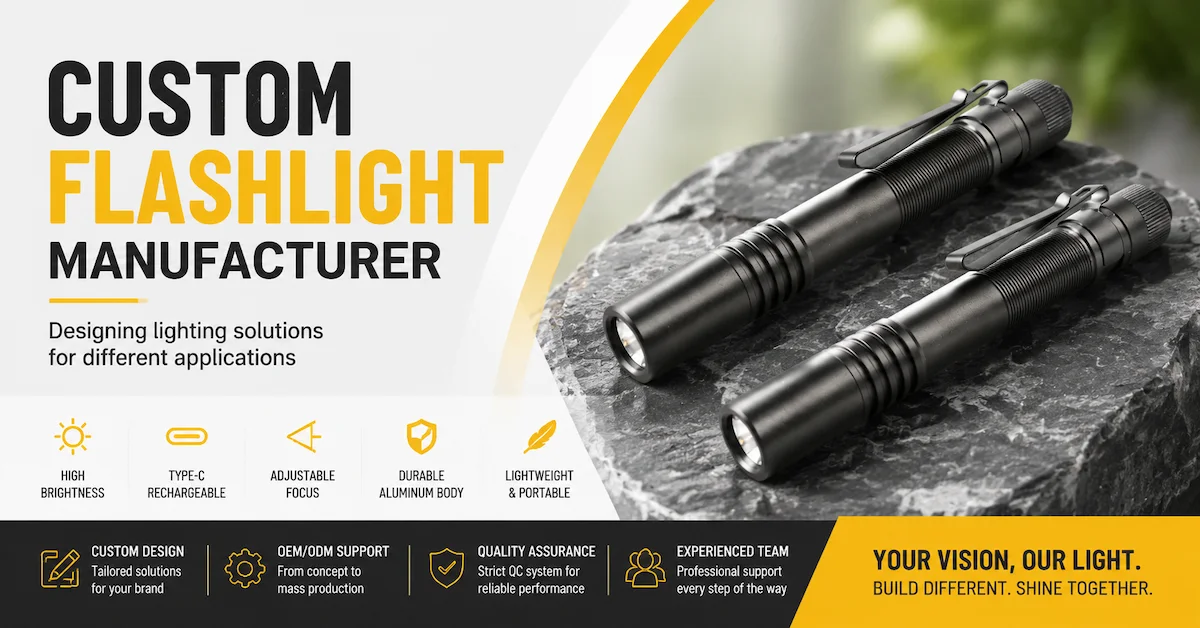
A custom flashlight manufacturer develops lighting products according to specific customer requirements instead of only producing standard catalog models.
For many businesses, a regular flashlight may not fully match their application needs. Different industries require different solutions regarding:
- Lighting performance
- Product structure
- Battery system
- Operating environment
- Mounting methods
- Durability requirements
A custom flashlight manufacturer helps companies transform application requirements into practical lighting products.
The customization process may include:
- Product concept development
- Structural modification
- LED and optical selection
- Battery configuration
- Function customization
- Material selection
- Prototype testing
- Mass production
Unlike simple wholesale purchasing, custom flashlight development focuses on creating products that solve specific user problems.
Brightenlux provides LED flashlights, rechargeable flashlights, headlamps, work lights, and customized portable lighting solutions for global customers.
Buyers can explore the Brightenlux product portfolio to understand available flashlight platforms and customization possibilities.
Custom Flashlight vs OEM vs Private Label: Understanding the Difference
These manufacturing models are related but serve different business goals.
| Model | Main Purpose | Customization Level |
|---|---|---|
| Standard Flashlight | Purchase existing products | Low |
| Private Label Flashlight | Add brand identity to existing products | Medium |
| OEM Flashlight | Modify products according to buyer requirements | High |
| Custom Flashlight | Develop application-specific solutions | Highest |
Standard Flashlights
Standard products are suitable for buyers who need:
- Fast sourcing
- Lower investment
- Existing product models
However, they provide limited differentiation.
Private Label Flashlights
Private label focuses on:
- Logo
- Packaging
- Brand presentation
It is suitable for companies entering the market quickly.
OEM Flashlights
OEM allows buyers to customize:
- Specifications
- Components
- Functions
- Product configuration
Custom Flashlights
Custom flashlight development focuses on solving unique requirements.
Examples:
- Special working environments
- Unique mounting needs
- Different battery requirements
- Industry-specific applications
Why Businesses Need Custom Flashlight Solutions
Different users experience different lighting challenges.
A flashlight designed for camping may not be suitable for industrial maintenance.
A professional inspection flashlight may be unnecessary for everyday consumers.
Custom solutions help businesses create products based on actual usage conditions.
Different Applications Require Different Designs
A custom flashlight manufacturer evaluates the application before recommending a product solution.
Important questions include:
- Where will the flashlight be used?
- How frequently will it operate?
- What environment will it face?
- What performance level is required?
- What features are essential?
Outdoor and Camping Applications
Outdoor users often require:
- Lightweight design
- Long battery life
- Weather resistance
- Portable charging
- Comfortable operation
A camping flashlight may prioritize balanced flood lighting instead of maximum brightness.
Important customization options include:
- Battery capacity
- Beam pattern
- Carrying accessories
- Waterproof structure
Industrial Maintenance Applications
Industrial users usually require higher reliability.
Common requirements include:
- Durable housing
- Stable performance
- Hands-free operation
- Magnetic mounting
- Long operating time
A maintenance flashlight may include:
- Magnetic tail caps
- Right-angle designs
- Adjustable lighting modes
- Impact-resistant structures
Automotive Repair Applications
Automotive technicians often need flexible lighting solutions.
Important features include:
- Compact design
- Strong beam performance
- Rechargeable battery
- Magnetic mounting
- Easy operation
A custom flashlight can be designed around specific repair environments.
Examples:
- Engine inspection
- Under-vehicle repair
- Workshop maintenance
Emergency and Security Applications
Emergency and security users often prioritize:
- Fast activation
- Reliable battery
- Strong visibility
- Durable construction
Custom solutions may include:
- High-output modes
- Warning functions
- Extended runtime
- Special carrying options
What Can Be Customized With a Custom Flashlight Manufacturer?
Customization can involve multiple product areas.
Product Structure Customization
Structural customization may include:
- Housing design
- Product size
- Weight adjustment
- Grip design
- Mounting solutions
A well-designed structure improves:
- User comfort
- Durability
- Product differentiation
Lighting Performance Customization
The lighting system can be adjusted according to application requirements.
Possible customization areas include:
- LED selection
- Brightness level
- Beam angle
- Throw distance
- Lighting modes
The goal is not always maximum brightness.
The correct lighting performance depends on the intended application.
Battery and Charging Customization
Power systems influence:
- Runtime
- Product size
- Weight
- Charging convenience
Customization options include:
- Rechargeable batteries
- Battery capacity
- USB-C charging
- Charging indicators
- Battery protection systems
Material and Durability Customization
Different environments require different materials.
Common options include:
Aluminum Alloy Housing
Advantages:
- Strong durability
- Better heat dissipation
- Premium appearance
ABS Housing
Advantages:
- Lightweight
- Flexible design options
- Cost efficiency
Other durability requirements may include:
- Waterproof structure
- Impact resistance
- Dust protection
Custom Flashlight Development Process
A professional custom flashlight manufacturer usually follows a structured development process.
Step 1: Requirement Analysis
The first stage defines:
- Application
- Target users
- Performance requirements
- Product size
- Battery needs
- Environmental conditions
Clear requirements reduce unnecessary development changes.
Step 2: Engineering Design
The engineering team evaluates:
- Product structure
- Electronic components
- LED selection
- Thermal management
- Manufacturing feasibility
The goal is creating a design that is both functional and manufacturable.
Step 3: Prototype Development
Before mass production, prototypes are created for evaluation.
Testing may include:
- Appearance review
- Functional testing
- User experience evaluation
- Performance verification
Step 4: Product Improvement
Based on sample feedback, improvements may be made to:
- Structure
- Components
- Functions
- Packaging
Step 5: Mass Production
After approval, production begins with:
- Material preparation
- Assembly
- Quality inspection
- Packaging
- Shipment
How to Choose a Reliable Custom Flashlight Manufacturer
Selecting the right partner is critical for successful product development.
Engineering Capability
A capable manufacturer should understand:
- Product design
- Electronics
- Optical systems
- Battery solutions
- Production limitations
Manufacturing Experience
Evaluate:
- Existing product range
- Industry experience
- Production capability
- Quality management
Testing Ability
A professional manufacturer should have clear testing processes for:
- Lighting performance
- Charging
- Runtime
- Assembly quality
- Product reliability
Communication Ability
Custom projects involve many decisions.
The supplier should communicate clearly about:
- Technical solutions
- Cost impact
- Development timeline
- Production risks
Cost Factors of Custom Flashlight Projects
Custom flashlight pricing depends on many factors.
| Cost Factor | Impact |
|---|---|
| Product design | New structures increase development cost |
| Components | Special parts affect pricing |
| Materials | Housing choices influence cost |
| Functions | Additional features increase complexity |
| Tooling | New molds may require investment |
| Testing | Special requirements add cost |
| Quantity | Higher volume improves efficiency |
The lowest price is not always the best choice.
A reliable custom flashlight manufacturer helps balance:
- Performance
- Cost
- Quality
- Market requirements
Common Mistakes in Custom Flashlight Development
Designing Without Understanding User Needs
A product should solve a real problem.
Adding unnecessary features may increase:
- Cost
- Complexity
- Failure risks
Ignoring Production Feasibility
A good design must also be practical to manufacture.
Consider:
- Material availability
- Assembly difficulty
- Quality control requirements
Changing Requirements Frequently
Frequent changes can cause:
- Longer development cycles
- Higher costs
- Delayed production
Not Defining Testing Standards
Before production, buyers should define:
- Performance expectations
- Testing methods
- Quality requirements
Frequently Asked Questions About Custom Flashlight Manufacturers
What can a custom flashlight manufacturer customize?
A custom flashlight manufacturer can customize product structure, LED configuration, battery system, functions, materials, accessories, branding, and packaging based on customer requirements.
What is the difference between OEM and custom flashlight development?
OEM usually modifies existing products according to buyer requirements, while custom flashlight development may involve deeper changes in structure, functions, and application-specific design.
How long does custom flashlight development take?
Development time depends on product complexity, design requirements, prototype changes, testing needs, and production preparation.
Can I create a completely new flashlight design?
Yes. Experienced manufacturers can support new product development including structure design, engineering evaluation, prototypes, and production preparation.
What industries use custom flashlights?
Custom flashlights are widely used in:
- Outdoor equipment
- Industrial maintenance
- Automotive repair
- Emergency services
- Security applications
- Professional tools
How much does a custom flashlight project cost?
Cost depends on customization level, materials, components, tooling, testing requirements, and production quantity.
Conclusion
A custom flashlight manufacturer helps businesses create lighting products designed around specific applications instead of relying only on standard models.
The value of customization comes from:
- Better application performance
- Stronger product differentiation
- Improved user experience
- More competitive market positioning
Successful custom flashlight projects require cooperation between the buyer and manufacturer throughout:
- Requirement analysis
- Product design
- Prototype development
- Testing
- Mass production
For brands, distributors, and industrial companies, choosing the right manufacturing partner is the foundation for creating reliable lighting products.
Brightenlux supports global customers with custom flashlight, OEM, and private-label lighting solutions.
Explore the Brightenlux products, learn more about the company's manufacturing capabilities, or contact the team through the Brightenlux contact page to discuss custom flashlight projects.