

Certified LED Lighting Manufacturer China for Portable Jobsite Lights
For contractors, sourcing managers, and product teams, portable jobsite lighting is not a decorative purchase. It must support work after daylight fades, in rough environments, and around people who move fast with tools in hand. That is why many buyers search for a certified LED lighting manufacturer China when comparing flood lights, lantern-style lights, flashlights, headlamps, and tripod-mounted work lights. The goal is simple: find a supplier that can combine useful brightness, practical housings, sealing design, repeatable production, and documentation that stands up during procurement review.
Why buyers search for certified LED jobsite lighting suppliers
When a buyer searches for a certified LED lighting manufacturer China, the phrase usually means more than location. It reflects a need for a supplier that understands LED product manufacturing, enclosure design, assembly consistency, and the realities of temporary site lighting. Construction crews, industrial maintenance teams, roadwork crews, inspectors, and emergency response teams all depend on lights that can be carried, positioned, and used in demanding spaces.
A failed work light can slow a crew, reduce visibility, or create unnecessary risk. In that context, buyers are not only comparing appearance. They are asking whether a product family can handle dust, rain, impact, frequent transport, and daily handling. Portable flood lights, lanterns, flashlights, and headlamps each solve a different jobsite problem, so a credible supplier should be able to discuss the application before pushing a model.
What visible product features tell procurement teams
The visible design language of portable jobsite lights can reveal useful information before a buyer receives a datasheet. Black housings with neon yellow or green protective accents are common in industrial lighting because high contrast helps workers find the product in cluttered or low-light environments. A square flood light with a bumper-style frame and fold-out stand suggests ground placement, adjustable angle use, and frequent movement across a site.
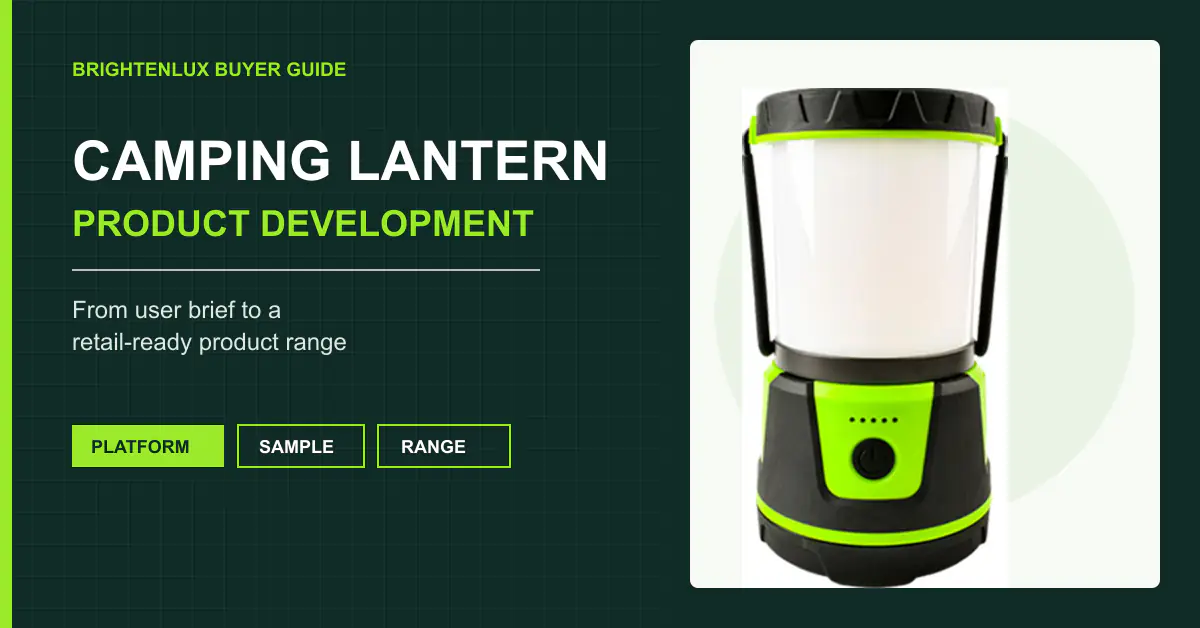
A lantern-style unit with a carry handle serves a different purpose. It is better suited for wider ambient illumination in a tented zone, temporary work area, service space, or emergency setting. A handheld flashlight supports inspections and short-distance movement, while a headlamp frees both hands for detailed tasks. Buyers can review broader portable lighting options through Brightenlux product categories when matching formats to jobsite use.
IP65, durability, and certification claims need evidence
The source image highlights claims such as “IP65 Waterproof,” “High Brightness,” “Long Battery Life,” and “Durable & Reliable.” These points are useful for initial screening, but they should not replace documentation. IP65 suggests protection against dust ingress and low-pressure water jets, yet procurement teams still need to know which model was tested, under what conditions, and whether a report is available.
The same caution applies to UL certified LED lighting or any similar compliance language. Certification value depends on exact scope, product model, standard, and intended market. A supplier may use broad wording in promotional material, but buyers should request precise documents early. For portable jobsite lights, durability also extends beyond the outer shell. Seals, handles, stands, switches, charging covers, internal connections, and battery retention can all affect reliability under real use.
Choosing the right light format for the jobsite
Portable LED work lights are not interchangeable. A flood light supports area coverage when crews need broad visibility. A tripod-mounted flood light can raise the light position for a wider working zone. A lantern-style light can provide general illumination around a temporary workspace. A flashlight is more useful for inspection, movement, and close-range tasks. A headlamp is often valued because it leaves both hands free.
Choosing only one format and expecting it to cover every use case is a common sourcing mistake. A contractor may need a mixed range, while a maintenance team may prioritize handheld and head-mounted tools. The table below shows the practical distinction without assuming unprovided specifications.
| Light type | Typical jobsite role | Buyer focus |
|---|---|---|
| Flood/work light | Area coverage | Stand, housing, angle control |
| Lantern | Ambient light | Carry handle, stable placement |
| Flashlight | Inspection and movement | Grip, switch, beam usability |
| Headlamp | Hands-free work | Comfort, fit, task visibility |
Energy efficiency, runtime, and real-world trade-offs
Energy efficient LED lights are now a natural choice for portable work lighting because LED technology can deliver useful illumination with lower power draw than older lamp types. However, efficiency alone does not decide whether a product is right for a construction or industrial application. A battery-powered light must balance brightness, runtime, weight, heat management, and user comfort.
More output is not automatically better if the unit becomes too heavy, too hot, or unsuitable for long use. A lantern may prioritize broad light and stable operation, while a compact flashlight may prioritize portability and beam control. A headlamp must remain comfortable enough to wear during work. Buyers should ask for actual values behind “high brightness” and “long battery life” during sampling or pre-production review. Without those values, teams are comparing claims rather than products.
OEM and ODM considerations for China LED lighting manufacturing
A certified LED lighting manufacturer China may be considered for OEM production, ODM development, or a combination of both. In OEM work, the buyer often has a known design and needs consistent production, packaging, housing fit, sealing, and assembly quality. In ODM work, the supplier may support product adaptation, including stand geometry, handle ergonomics, lens shape, enclosure layout, or the mix of flood light, lantern, flashlight, and headlamp formats.
The product family described in the source reflects a clear market direction: rugged portable lighting for temporary illumination. That type of range can simplify sourcing if one factory can coordinate molded parts, LED assembly, sealing control, and final inspection. Still, buyers should not assume all visible products share the same platform or internal design. Ask directly which models belong to the same family, which are rechargeable or corded, and what customization can be discussed through a formal inquiry.
Supplier questions before requesting samples
Before moving to samples, buyers should organize questions around application, documentation, and manufacturing control. Start with the environment: indoor maintenance, construction site use, roadwork, inspection, or emergency response. Then confirm whether flood lighting, lanterns, flashlights, headlamps, or a mixed range is needed. This prevents a supplier from recommending a product format that looks attractive but does not match the job.
Next, ask for the exact certification scope if regulated-market entry matters. Request the model, standard, and document status rather than relying on general claims. For IP65 waterproof positioning, ask how the housing is sealed and where weak points may exist, including ports, charging covers, lens interfaces, and handle mounts. Also ask how products are assembled and inspected. If the supplier cannot explain electrical assembly, molded part production, sealing control, and final checks in plain language, that is worth noting. Procurement teams can also contact Brightenlux to clarify product and sourcing details.
FAQ for sourcing portable LED jobsite lights
Is a certified LED lighting manufacturer China suitable for industrial portable lights?
It can be a suitable choice when the supplier understands LED assembly, enclosure design, sealing, and repeatable production for rugged portable products. Buyers should still verify the exact product scope, documentation, and manufacturing process before treating any certification-related wording as proof for a specific model.
Does IP65 waterproof mean a light is ready for all outdoor conditions?
No. IP65 is a useful indicator, but it does not mean the light is suitable for every outdoor condition or every type of exposure. Buyers should request supporting test information and review sealing details around ports, charging covers, lens edges, switches, handles, and housing joints.
Are energy efficient LED lights always the best jobsite option?
LED technology is generally well suited to portable jobsite lighting, but the best option depends on more than efficiency. Brightness, runtime, weight, heat management, comfort, durability, and the specific work pattern all matter. A headlamp, lantern, flashlight, and flood light serve different purposes.
What should buyers confirm before approving samples?
Buyers should confirm the intended application, light format, certification scope, waterproof claim support, battery or charging details if applicable, housing design, assembly process, and available documentation. They should also request actual brightness and runtime data during sampling rather than relying only on marketing phrases.
Next step for evaluating a portable lighting supplier
The best supplier discussion starts with use case rather than slogans. Decide whether your team needs flood lights, lanterns, flashlights, headlamps, tripod-mounted lighting, or a mixed range. Then ask the manufacturer to support claims about brightness, runtime, waterproof protection, durability, and certification scope with clear information.
For procurement teams, the real test is not whether a sales sheet looks polished. It is whether the supplier can explain how the lights are built, what the visible claims mean, and what documentation is available for the target market. Portable jobsite lighting must help crews keep working when daylight disappears and conditions become difficult. A credible LED lighting manufacturer should understand that practical requirement from the first conversation.