

Quick Answer: A reliable cordless LED work light supplier should provide products that deliver sufficient illumination across the intended work area, maintain useful output for the required task duration, and remain easy to position, recharge, and inspect. For B2B sourcing, buyers should evaluate work-surface lux measurements, beam uniformity, battery-supported operating time, mounting stability, and charging turnover before approving a bulk order. Maximum lumens alone cannot demonstrate workplace suitability.
A cordless LED work light is valuable because it brings illumination directly to a repair, inspection, or maintenance task without requiring a trailing power cable.
However, not all cordless lights solve the same problem.
A concentrated flashlight beam may be ideal for locating a component inside a machine. A broad COB work light may provide more useful coverage across an engine bay. A magnetic inspection lamp can free both hands, while a headlamp follows the technician's line of sight.
For overseas distributors, automotive tool brands, industrial equipment suppliers, and private-label importers, the purchasing challenge is to identify a lighting product that performs consistently in the actual working position.
A product advertised at 1,000 or 1,500 lumens does not necessarily illuminate a repair area evenly or remain at a useful brightness for the entire task.
Similarly, a rechargeable battery's capacity does not automatically establish how many lights are required to support an eight-hour maintenance shift.
This guide introduces a practical procurement method based on task-area illumination, operating-time coverage, mounting behavior, and order-specific quality verification.
It also examines documented rechargeable lighting products from Brightenlux, a China-based manufacturer offering portable LED flashlights, headlamps, and OEM/ODM lighting solutions.
1. Quick Comparison: Which Cordless Work Light Format Fits Your Application?
The first decision is not how bright the lamp should be.
It is how the light must be positioned relative to the user's task.
Different product architectures provide different benefits.
Cordless Work Light Selection Matrix
| Lighting Format | Best-Suited Task | Main Advantage | Main Limitation |
|---|---|---|---|
| Rechargeable COB inspection light | Engine bays, repair benches, general equipment maintenance | Broad close-range illumination | Requires suitable mounting or placement |
| Magnetic LED work light | Vehicle components, steel structures, machine housings | Hands-free positioning on suitable magnetic surfaces | Holding strength depends on the actual surface and orientation |
| Right-angle rechargeable flashlight | Narrow access points, cabinets, equipment inspection | Compact directional illumination | May not cover a large work area uniformly |
| Adjustable-head inspection light | Multiple work angles and restricted repair spaces | Flexible beam direction | Hinges and mounting joints require validation |
| Rechargeable LED headlamp | Mobile inspections and hands-on maintenance | Follows the user's head movement | May produce unwanted glare or shadows in certain positions |
| Portable area light | Temporary work zones and larger repair spaces | Wider illumination coverage | Typically requires more space and energy |
Recommendation: Match the lighting format to the physical task before comparing advertised brightness or factory quotations.
A distributor serving professional mechanics may need several distinct products.
A buyer serving a narrow industrial inspection application may be better served by one carefully selected model.
2. Key Takeaways for B2B Cordless Work Light Procurement
A cordless LED work light supplier should be evaluated against measurable performance and operational requirements.
The most important purchasing principles are:
-
Measure usable illumination at the task surface. Lumens describe emitted light, while lux describes illumination received by a surface.
-
Check light distribution. An intense hotspot may leave critical parts of the working area in shadow.
-
Use representative mounting positions. Magnetic mounting, hinges, hooks, and clips should be tested where technicians actually use them.
-
Validate sustained runtime. A short maximum-brightness demonstration cannot prove usable operation over several hours.
-
Plan charging around the working cycle. Battery capacity, recharge time, shift overlap, and spare-unit inventory affect operational availability.
-
Control the production configuration. Batteries, LEDs, drivers, mechanical components, and packaging must match the approved sample.
These factors influence customer satisfaction, product returns, and the long-term value of a wholesale lighting range.
3. Why Is Lux More Useful Than Maximum Lumens for Work Lights?
Lumens and lux describe different lighting characteristics.
Lumens (lm) measure the total luminous flux emitted by a light source or device under defined measurement conditions.
Lux (lx) measures the luminous flux received per unit area on a surface.
One lux equals one lumen per square meter.
For work-light buyers, this distinction is commercially important.
A flashlight may produce substantial total output but concentrate most of it into a small region.
Another product may deliver lower total output while distributing light more evenly across the area where a technician is working.
The second product can be more suitable for some close-range maintenance tasks.
Why work-surface illumination matters
Consider an automotive technician inspecting components under an open hood.
The required illumination must reach areas around hoses, connectors, fasteners, and other components.
If the work light creates a strong central hotspot and dark surrounding regions, the technician may need to reposition it repeatedly.
This reduces the practical benefit of hands-free lighting.
What should buyers measure?
A useful sample evaluation should record:
-
The lamp's operating mode.
-
The mounting or placement position.
-
The distance to the work surface.
-
The illuminated area.
-
Lux readings at defined measurement points.
-
Shadows and uncomfortable glare.
-
Whether the light remains correctly aimed during the task.
The Illuminating Engineering Society (IES) provides application-specific lighting guidance that considers horizontal and vertical illuminance, uniformity, and other visual requirements.
For portable equipment, buyers should select applicable task criteria and test the product in a representative working setup.
Do not assume that one universal lux target applies to every automotive or industrial operation.
4. Example: How to Compare Two Work Lights Using a Lux Grid
A lux-grid test is a practical way to compare how different portable lights illuminate the same work surface.
This is especially valuable when suppliers provide different lumen ratings or beam descriptions.
Step 1: Define the work area
For example, use a representative rectangular inspection area of 60 × 40 cm.
Fix the light's position, orientation, and selected operating mode.
Record the ambient lighting conditions.
Step 2: Select measurement positions
Use five or more points covering the center and surrounding task area.
The number of points should be appropriate for the intended application.
Step 3: Record the measurements
Use a suitable calibrated lux meter and follow a consistent measurement method.
If the objective is to compare the additional contribution from the portable lamp, measure ambient lighting separately and account for it appropriately.
Hypothetical Lux Distribution Comparison
| Measurement Position | Work Light A | Work Light B |
|---|---|---|
| Point 1 | 420 lx | 260 lx |
| Point 2 | 370 lx | 250 lx |
| Point 3 | 310 lx | 230 lx |
| Point 4 | 280 lx | 220 lx |
| Point 5 | 120 lx | 210 lx |
| Average illuminance | 300 lx | 234 lx |
| Minimum illuminance | 120 lx | 210 lx |
| Minimum / Average | 0.40 | 0.90 |
All figures are hypothetical examples for explaining a measurement method. They are not results for any Brightenlux model or a published pass/fail standard.
What does the example show?
Work Light A has higher average measured illuminance.
However, Work Light B provides more even illumination across the five measurement positions.
If the task requires consistent visibility across the entire inspection area, Work Light B may be more useful despite its lower average lux reading.
If the task requires high illumination at one small target, Work Light A may be preferable.
The decision depends on the job.
Important measurement limitation
A simple minimum-to-average ratio helps compare samples, but it does not establish compliance with a formal lighting standard.
The buyer should define appropriate task targets, measurement geometry, acceptance values, and test conditions.
Procurement takeaway: Ask the supplier for a repeatable task-lighting demonstration rather than relying exclusively on the maximum lumen figure.
5. What Beam Pattern Is Best for Automotive and Industrial Maintenance?
Beam distribution determines how light reaches the work surface.
A cordless LED work light supplier may offer several optical architectures.
Broad-area COB illumination
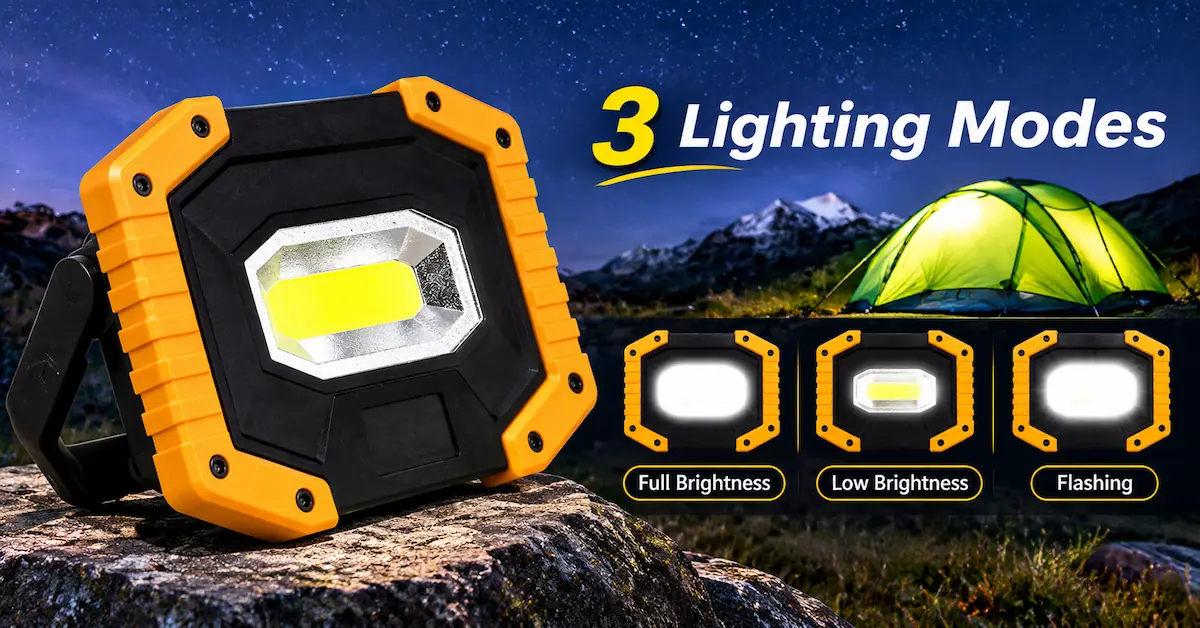
COB LED work lights can provide compact, relatively broad illumination when designed with suitable optics or diffusers.
They are often considered for engine bays, general workshop tasks, and close-range maintenance.
Buyers should still verify the actual beam distribution because COB technology alone does not guarantee uniform illumination or glare control.
Focused inspection beam
A focused beam may be useful when a technician needs to examine a small component inside a narrow housing.
A rechargeable flashlight can be appropriate for this type of work.
However, a concentrated beam may not provide adequate coverage for an entire repair area.
Adjustable-angle illumination
An adjustable-head or articulated work light can help users direct the beam into different locations.
The adjustment mechanism should remain stable after repeated positioning.
Wearable lighting
A headlamp provides illumination that follows the operator's head movement.
This can be useful for mobile inspection tasks where fixed mounting points are unavailable.
However, head-worn lighting should be tested for comfort, glare, and shadow behavior.
Matching Light Distribution to the Task
| Work Scenario | Preferred Optical Priority | Additional Requirement |
|---|---|---|
| Engine-bay inspection | Broad illumination with controlled shadows | Stable mounting |
| Fuse-box inspection | Controlled directional beam | Compact positioning |
| Workshop bench repair | Useful task-area coverage | Low glare and repeatable placement |
| Mobile service visit | Portable and adjustable illumination | Convenient recharging |
| Under-vehicle inspection | Appropriate beam positioning | Secure mounting and environmental suitability |
| Equipment cabinet inspection | Controlled local illumination | Safe access and handling |
The best product is the one that delivers the required visibility in the actual working position.
6. Which Brightenlux Products Can Be Evaluated for Cordless Work Applications?
Ningbo Brightenlux Electric Appliance Co., Ltd. publishes several rechargeable portable lighting products with magnetic tails, adjustable positioning, and hands-free applications.
Its work and repair lighting application page also describes lighting directions for workshops, repair benches, job sites, and field-service vehicles.
The company's dedicated Working Light product category does not currently display independently listed products.
Consequently, the following examples are documented portable flashlights and headlamps that may be considered for selected work-light applications.
They should not be represented as a confirmed range of dedicated COB workshop lamps.
Brightenlux Rechargeable Lighting Platform Comparison
| Product | Published Features | Potential Work Application | Priority Validation |
|---|---|---|---|
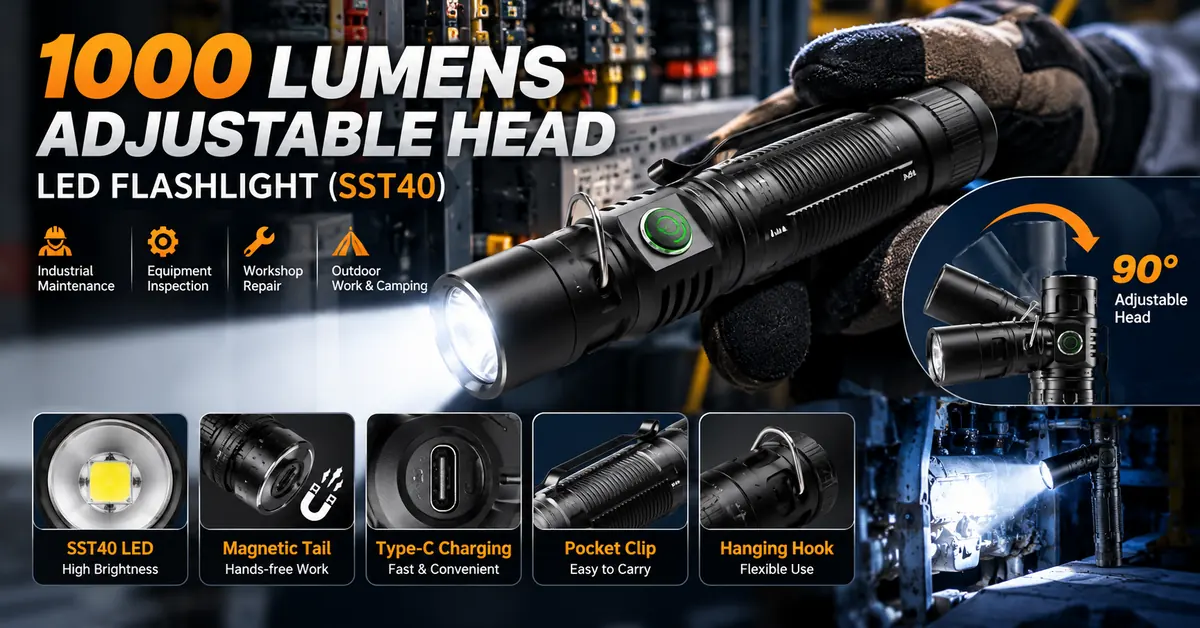
| BT-FL8078 Right-Angle Flashlight | Up to 1000 lm; SST25 LED; 16340 800mAh cell; Type-C; magnetic tail | Compact inspection and hands-free maintenance | Beam positioning, mounting, runtime |
| BT-FL8088 Magnetic Flashlight | Up to 1500 lm; SST40 LED; 21700 4000mAh cell; Type-C; magnetic tail | General repair and portable task lighting | Sustained output, charging, magnetic retention |
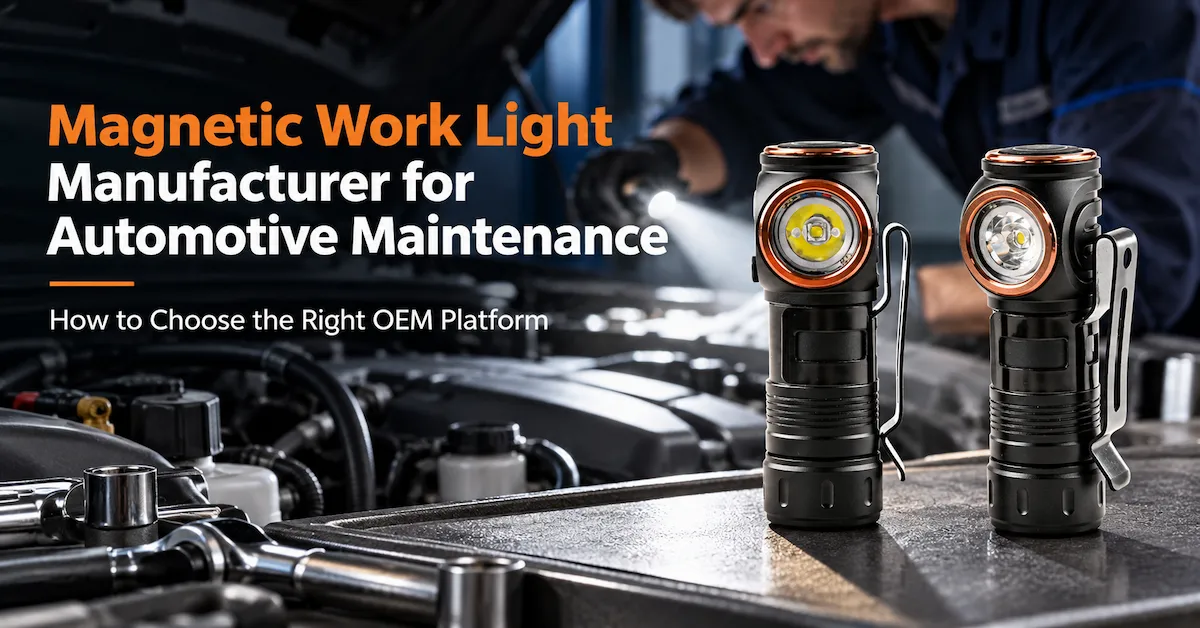
| 650-Lumen Rechargeable Headlamp | SST20 main LED; red and warm-white side lights; 1800mAh battery; Type-C | Hands-free mobile and close-up inspection | Beam comfort, strap fit, runtime |
These specifications are published by the manufacturer and have not been independently verified for this article.
BT-FL8078: Compact positioning
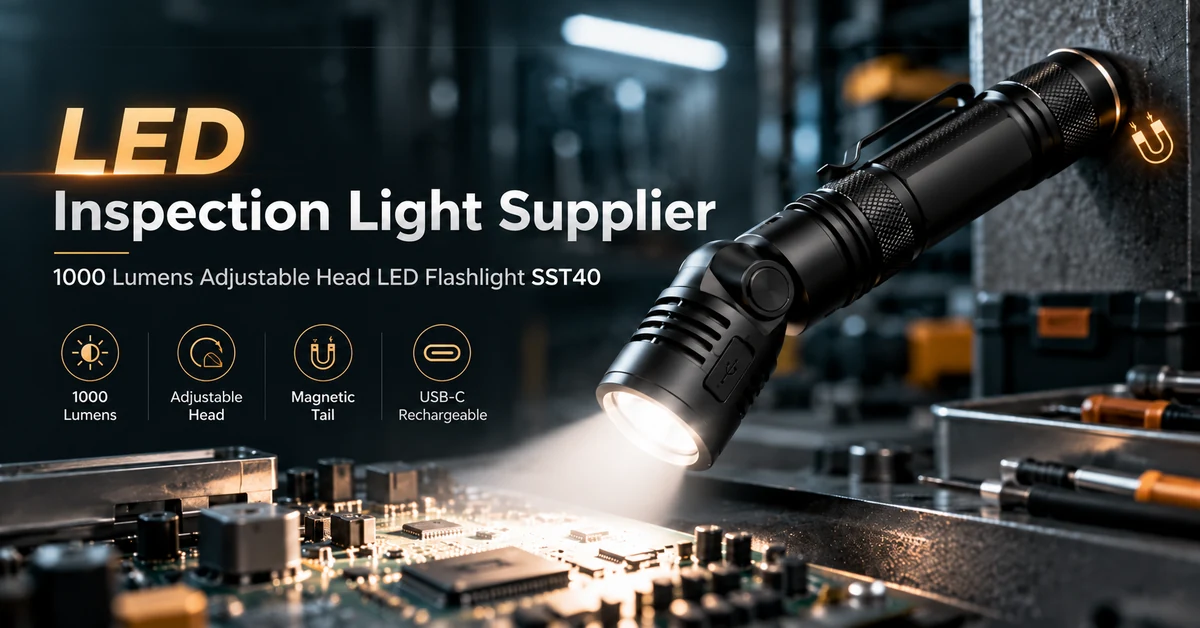
The BT-FL8078 uses a right-angle structure and magnetic tail.
The manufacturer lists a maximum output of 1,000 lumens, a rechargeable 800mAh 16340 battery, Type-C charging, and a published working-time range of two to three hours.
These characteristics provide a useful starting point for evaluating compact maintenance lighting.
However, buyers must verify the operating mode and conditions associated with the published runtime.
BT-FL8088: A larger battery configuration
The BT-FL8088 uses a 21700 lithium battery with a published capacity of 4,000mAh.
Brightenlux lists Type-C charging, a magnetic tail, several light modes, and a maximum output of 1,500 lumens.
The listed working-time range is four to eight hours, but the specific brightness level, usable-output threshold, and complete test conditions should be confirmed.
The larger battery format does not automatically make this model preferable for every task.
Weight, size, mounting and optical requirements remain relevant.
Rechargeable headlamp: An alternative hands-free solution
The published 650-lumen headlamp provides a wearable design, Type-C charging, and multiple lighting modes.
It may be considered for inspection tasks where the user cannot easily position a fixed lamp.
The buyer should evaluate the headlamp through actual maintenance work rather than comparing its headline lumens with a handheld light.
What if buyers require a dedicated COB workshop lamp?
Request Brightenlux's current work-light catalogue and technical drawings.
The factory should identify the actual available model, production configuration, mounting system, battery, sample specifications, and quotation conditions.
Explore Brightenlux Portable LED Products
Discuss Cordless Work Lighting Solutions
Request Current Work Light Models and Samples
7. How to Verify Battery Runtime Without Relying on Marketing Claims
Battery-supported working time is one of the most important requirements for cordless LED work lights.
However, runtime depends on more than battery capacity.
The battery's nominal energy, LED driver efficiency, operating mode, thermal behavior, and test endpoint all affect usable operating time.
Battery capacity versus energy
A capacity rating in milliamp-hours does not directly describe the energy available to the lighting system unless the relevant voltage and configuration are known.
A simplified nominal-energy calculation is:
Nominal battery energy (Wh) = Nominal voltage (V) × Capacity (Ah)
Suppose a hypothetical single-cell battery is rated at 3.7V and 4,000mAh.
Its nominal energy is approximately:
3.7V × 4.0Ah = 14.8Wh
This does not mean 14.8Wh can necessarily be delivered as useful lighting energy.
Losses, voltage limitations, thermal control, battery condition, and other factors affect usable energy.
Illustrative runtime calculation
Assume, solely for calculation, that:
-
Nominal battery energy is 14.8Wh.
-
The complete light draws an average of 5W.
-
An illustrative 80% of nominal energy is usable under the defined operating conditions.
The estimated runtime would be:
14.8Wh × 0.80 ÷ 5W = approximately 2.37 hours
This is an engineering illustration, not a measured runtime or specification of a Brightenlux product.
Why the calculation is not sufficient
Actual LEDs and drivers may not maintain constant power or output during discharge.
The lamp may reduce output to control temperature or extend runtime.
Therefore, buyers should request a time-based test showing how useful illumination changes during operation.
Recommended runtime test record
| Test Field | Required Information |
|---|---|
| Sample | Model, revision and battery |
| Charging | Starting battery condition and charging procedure |
| Operating mode | Exact mode used for the test |
| Environment | Relevant temperature and test conditions |
| Light performance | Output or task-plane lux recorded over time |
| Endpoint | Agreed minimum usable illumination or other defined criterion |
| Observations | Thermal step-down, indicators, control changes |
| Result | Actual usable operating duration |
The appropriate endpoint depends on the intended use.
A work light may remain switched on long after its output becomes insufficient for a particular inspection task.
For B2B purchasing, usable runtime at a specified task requirement is more informative than an unqualified maximum working-time figure.
8. How Many Cordless Work Lights Are Needed for One Maintenance Shift?
A buyer purchasing cordless lighting for multiple technicians must consider both battery endurance and the number of users who need lights simultaneously.
This is different from selecting a single lamp for an individual customer.
Hypothetical workshop scenario
Assume a maintenance facility has:
-
12 technicians.
-
One cordless light required per technician.
-
A continuous three-hour task period.
-
A hypothetical lamp that meets the task-lighting requirement for two hours per full charge.
-
No opportunity to recharge units during the task period.
-
No replaceable battery packs.
The facility needs 12 charged lamps available at the beginning.
After two hours, each technician must replace the exhausted lamp to complete the third hour.
That requires another 12 charged lamps.
Minimum physical lamp quantity = 12 initial lamps + 12 replacement lamps = 24 lamps
Adding a planning allowance
Suppose the buyer chooses a hypothetical 20% spare allowance to account for unavailable units or other operational contingencies.
The resulting planning quantity is:
24 × 1.20 = 28.8
Rounded up, the buyer would plan for 29 lamps.
This is not a universal industry requirement or an actual Brightenlux customer deployment.
It demonstrates why simultaneous use and runtime can materially affect purchasing quantity.
Can charging reduce the required inventory?
Potentially.
If charging equipment is available and work periods are staggered, some lights may return to use.
The buyer must verify:
-
Actual recharge time.
-
Power-source capacity.
-
Safe charging arrangements.
-
User schedules and break periods.
-
Whether the battery can be exchanged.
-
Whether charging and lighting can occur simultaneously, if required and supported.
Do not assume that a Type-C connector guarantees a light can be recharged and redeployed during a short break.
Procurement lesson
Work-light quantities should be based on the operating schedule and validated performance, not simply the number of technicians or the advertised battery capacity.
9. What Mounting and Mechanical Features Should Buyers Test?
Hands-free mounting can make a cordless work light useful, but only if the installation is stable in the intended environment.
Magnetic attachment
A magnetic base may attach securely to suitable ferromagnetic surfaces.
However, magnet performance depends on material, paint, thickness, geometry, contamination, orientation, and mechanical vibration.
A light that holds on a clean steel plate may behave differently on a curved, painted, or oily automotive component.
Adjustable heads and hinges
Repeated adjustments can affect retention and positioning stability.
Buyers should check whether the lamp stays aimed at the work surface after normal handling.
Hooks and clips
Hanging and clip-mounted products should be evaluated for strength, stability, and convenient access.
A clip may be suitable for carrying a small flashlight but unsuitable for supporting a heavier light during active work.
Workshop mounting test checklist
| Test | Practical Evaluation |
|---|---|
| Attachment strength | Does the mounted light remain secure in the intended position? |
| Surface compatibility | Does mounting work on representative materials and finishes? |
| Beam adjustment | Can the light be aimed without moving or loosening its support? |
| Repeated handling | Does the mechanism remain functional after repeated use? |
| Access | Can the user operate the controls while mounted? |
| Position security | Is the light protected from accidental knocks or displacement? |
| Cleaning | Can the product be maintained according to approved instructions? |
The buyer should define acceptable behavior before sample testing.
No general statement such as "strong magnetic attachment" should replace actual application validation.
10. What Materials and Construction Details Matter?
Cordless LED work lights used in repair environments may be exposed to repeated handling, dust, moisture, oils, and mechanical contact.
The appropriate construction depends on the intended task.
Housing materials
Aluminum-based structures can provide mechanical strength and a thermal path when correctly designed.
Engineering plastics may reduce weight and support complex enclosure designs.
Neither material should be considered universally superior without evaluating the complete product.
Optical protection
Lenses and diffusers should be appropriate for the intended beam distribution and mechanical environment.
Switch design
Controls should be accessible and understandable.
For some users, glove-friendly operation is important.
A product requiring several unnecessary button presses to reach the normal working mode may create inconvenience.
Charging-port protection
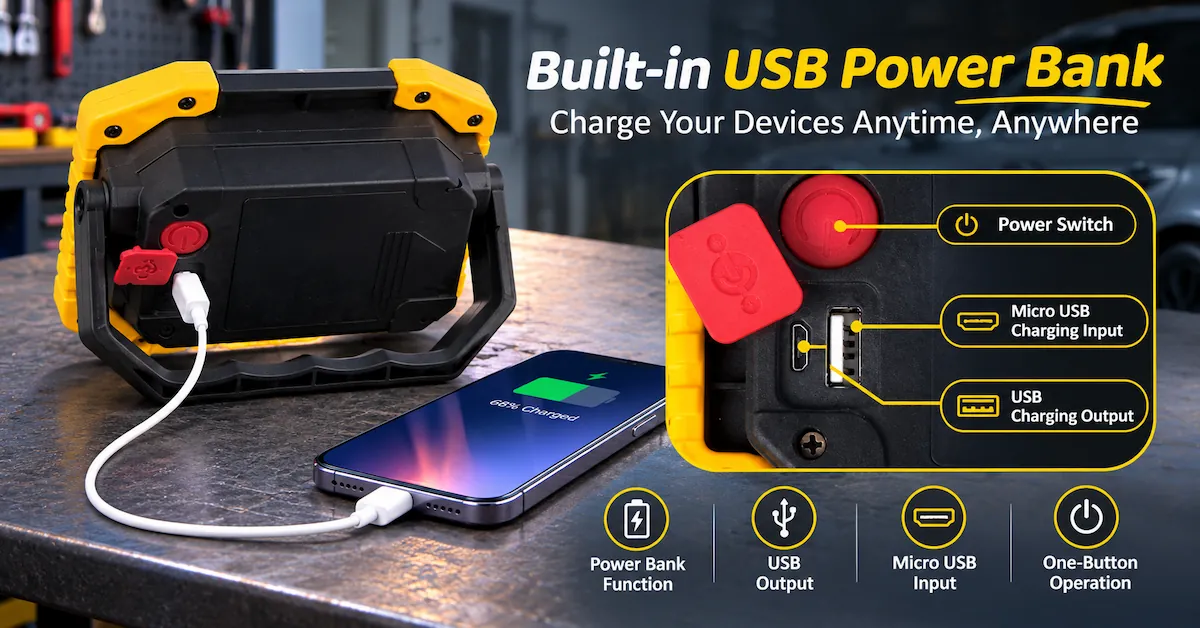
The charging connector and cover should be assessed for repeated use and the expected environment.
A cover can protect the connector only when used as designed.
Environmental protection
If the product advertises an ingress-protection rating, buyers should request supporting evidence for the exact model.
IEC 60529 provides a framework for enclosure protection classification.
An IP rating does not automatically establish resistance to oil, solvents, impact, or every cleaning method.
11. What Quality Control Should a Cordless LED Work Light Supplier Provide?
Before committing to bulk purchasing, buyers should establish a sample test plan and a controlled production specification.
Incoming components
Confirm the approved battery, LED, driver, charging components, mechanical parts, and relevant accessories.
Assembly checks
Verify electrical connection quality, mechanical fit, optical alignment, and functional controls.
Electrical and charging tests
Confirm charging input, indicators, protection behavior where applicable, and approved battery configuration.
Photometric verification
Request test data relevant to the product's actual application.
ANSI/PLATO FL 1-2025 covers performance testing and reporting for applicable portable lighting products, including flashlights, headlamps, and area lights.
The standard's inclusion of short-duration elevated-brightness testing helps buyers distinguish brief peak-output claims from normal operating performance.
Mechanical and mounting checks
Test hinges, magnetic attachments, clips, switches, and charging-port covers according to the product requirements.
Packaging inspection
Confirm that the delivered goods contain the approved battery, cable, user instructions, mounting accessories, and correct labels.
Production consistency
Retain an approved golden sample and a controlled technical specification.
The supplier should disclose relevant component or configuration changes before repeat orders.
Wholesale Acceptance Checklist
| Acceptance Area | Buyer Requirement |
|---|---|
| Product identity | Approved model and revision |
| Light distribution | Meets defined task-area performance |
| Runtime | Meets agreed usable-runtime test |
| Battery | Correct approved type and configuration |
| Charging | Compatible input and correct indicators |
| Mounting | Stable under the intended test |
| Mechanical structure | Functional controls, joints and enclosure |
| Environmental claims | Applicable supporting evidence |
| Branding | Approved logo and appearance |
| Packaging | Complete battery, cable, manual and accessories |
| Traceability | Appropriate lot or production identification |
| Repeat orders | Controlled changes and approved specification |
The inspection method and sampling plan should be agreed before production.
12. How Can OEM/ODM Customization Improve a Cordless Work Light?
For private-label tool brands and distributors, customization should address specific market requirements.
Brightenlux publicly offers OEM/ODM outdoor lighting services.
However, available options must be confirmed for the exact proposed product.
Branding customization
Potential requirements include logos, product identification, retail packaging, manuals, and other approved visual changes.
Functional customization
Changes to brightness modes, battery selection, mounting hardware, lighting geometry, or charging electronics may require additional development and testing.
Application-specific accessories
Industrial buyers may request particular clips, holders, charging cables, or protective packaging.
The supplier should confirm compatibility, cost, and whether these items are standard or custom.
Product development process
A practical project sequence is:
Application brief → Product-platform selection → Engineering assessment → Prototype approval → Task-lux testing → Runtime validation → Packaging approval → Production inspection → Shipment release
Important OEM consideration
An existing flashlight platform may be suitable for selected inspection tasks but not automatically provide the broad-area illumination of a dedicated COB work lamp.
If the buyer needs a specialist product, the RFQ should clearly identify that requirement.
Explore Brightenlux OEM/ODM Services
Discuss a Private-Label Cordless Work Light
13. How to Compare Wholesale Costs and Supplier Quotations
A competitive cordless LED work light supplier should provide a quotation that covers the complete product configuration.
The final purchasing decision should account for product cost, included battery, accessories, testing, packaging, shipping, and expected service requirements.
Normalize the product configuration
Compare products with equivalent intended applications and defined performance requirements.
A magnetic flashlight without a suitable wide-area beam should not be treated as equivalent to a dedicated COB workshop lamp solely because their advertised lumen ratings are similar.
Confirm battery inclusion
Determine whether the rechargeable battery is included and whether it matches the approved specification.
Confirm charging accessories
Check which cables and power supplies are supplied.
Do not assume the quotation includes a wall charger unless it is explicitly listed.
Confirm customization charges
Separate standard product costs from logo printing, special packaging, tooling, and new component development.
Compare complete delivered cost
A useful commercial framework is:
Total purchasing cost = Lighting units + Batteries + Accessories + Customization + Testing and inspection + Freight and handling + Applicable duties and taxes
For institutional customers, spare-unit requirements and charging arrangements should also be considered.
Confirm production terms
Ask the supplier to provide product-specific MOQ, sample timing, production lead time, shipping terms, and quotation validity.
These conditions depend on model availability, order quantity, customization, and production planning.
Why does this matter?
A lower-priced lamp may be less economical if it requires more spare units, additional charging accessories, or frequent replacement.
Conversely, a higher unit price may not be justified if the product does not improve actual task performance.
The commercial comparison should reflect the buyer's complete operating requirements.
14. What Should Be Included in a Cordless Work Light RFQ?
A detailed RFQ allows the supplier to recommend a suitable model and provide an accurate quotation.
The purchasing team should include:
-
Buyer details: Company, destination market, sales channel, and purchasing role.
-
Application: Automotive repair, industrial maintenance, equipment inspection, or another defined task.
-
Lighting format: COB work lamp, magnetic inspection light, handheld flashlight, adjustable-head lamp, or headlamp.
-
Task-area specification: Working distance, illuminated area, lux target, and relevant uniformity requirements.
-
Operating requirements: Task duration, expected simultaneous users, and shift schedule.
-
Battery system: Preferred configuration, runtime target, charging arrangement, and service requirements.
-
Mounting: Magnetic, hook, clip, stand, wearable, or other installation arrangement.
-
Environment: Expected temperature, dust, moisture, handling, vibration, or contamination.
-
OEM customization: Logo, packaging, mounting accessories, colors, or functional changes.
-
Commercial terms: Sample quantity, initial order, forecast demand, quality requirements, delivery destination, and target schedule.
Recommended Supplier Response Table
| RFQ Field | Supplier Response Required |
|---|---|
| Proposed product | Exact model and configuration |
| Lighting format | Optical and mounting architecture |
| Task-lighting evidence | Available lux or application test information |
| Runtime | Mode-specific operating duration and test method |
| Battery | Approved cell or pack and inclusion |
| Charging | Input, cable, charger inclusion, recharge time |
| Mounting | Included hardware and limitations |
| Documentation | Available test reports and supporting records |
| Customization | Standard options and development requirements |
| Commercial | MOQ, pricing, sample costs, lead time |
| Open questions | Features requiring further confirmation |
This format encourages suppliers to explain the proposed product rather than respond with an incomplete catalog description.
Request a Cordless LED Work Light Wholesale Quote
15. Frequently Asked Questions About Cordless LED Work Light Suppliers
1. What should I look for in a cordless LED work light supplier?
Look for a supplier that can provide identifiable product configurations, relevant lighting performance data, battery and charging information, mounting details, sample testing, and clear commercial terms. The supplier should distinguish confirmed specifications from features that need further validation or development.
2. What is the difference between a cordless LED work light and a rechargeable flashlight?
A cordless work light generally emphasizes practical illumination of a work area, while a flashlight often prioritizes directional portable lighting. Some rechargeable flashlights can perform selected inspection tasks, but a focused flashlight is not automatically equivalent to a broad-area work lamp.
3. Is a 1,000-lumen work light bright enough for automotive repair?
The lumen rating alone cannot answer this. Suitability depends on beam distribution, distance, mounting, work-surface lux, glare, and the particular repair task. Buyers should assess a representative sample at the actual work area.
4. How can I compare the lighting performance of two cordless work lights?
Use a consistent task setup with the same measurement positions, ambient conditions, and selected operating mode. Record lux readings across the working area, evaluate shadows and glare, and compare results with the buyer's defined requirements.
5. How long should a cordless LED work light operate?
Required runtime depends on the intended task and shift schedule. Buyers should determine the usable illumination needed and verify runtime at the specified operating mode. Published maximum working times should not be assumed to apply at maximum brightness.
6. Are magnetic cordless work lights suitable for vehicle repair?
They may be suitable when the intended surface is compatible and the mounting method remains stable. Buyers should test actual painted, curved, vertical, or contaminated surfaces rather than assuming a magnet will hold in every situation.
7. Does USB-C mean every cordless work light supports fast charging?
No. USB-C describes a connector interface, not a guaranteed charging power or protocol. The supplier should confirm supported input, compatible charging equipment, and actual recharge time.
8. Can Brightenlux provide OEM cordless work lights?
Brightenlux publicly describes OEM/ODM support for portable lighting and work-related applications. Specific cordless work-light models, modifications, MOQ, pricing, testing, and delivery schedules require direct confirmation for the proposed order.
9. What quality tests should be completed before wholesale shipment?
Relevant checks include approved model identity, illumination, runtime, battery configuration, charging, controls, mounting stability, physical condition, environmental claims where applicable, and packaging contents. Buyers should agree on acceptance criteria before production.
10. How can I request a cordless LED work light quotation from Brightenlux?
Provide the application, preferred lighting format, working distance, task-area requirements, battery and charging preferences, mounting needs, customization, target market, and purchasing quantity. Contact Brightenlux to request the current work-light range, technical data, samples, and quotation terms.
Conclusion
Choosing a cordless LED work light supplier requires more than comparing product photographs, maximum lumens, battery capacity, and factory prices.
For automotive repair, equipment inspection, industrial maintenance, and field-service applications, the decisive question is whether the light delivers the right illumination at the work surface for the duration of the task.
A reliable sourcing process should therefore evaluate task-area lux, beam distribution, mounting stability, usable runtime, recharge time, and the number of units required for simultaneous work.
These requirements should be translated into an approved product specification, sample test plan, and repeatable production configuration.
Brightenlux provides documented rechargeable lighting products, including the BT-FL8078 right-angle flashlight, BT-FL8088 magnetic rechargeable flashlight, and 650-lumen rechargeable headlamp.
These products offer starting points for selected portable inspection applications. Buyers requiring a dedicated cordless COB work light or other specialized format should request confirmation of the current model range and technical specifications.
For importers, private-label tool brands, and wholesale distributors, the next step is to define the actual work task, establish measurable lighting and battery requirements, and request a model-specific proposal.