

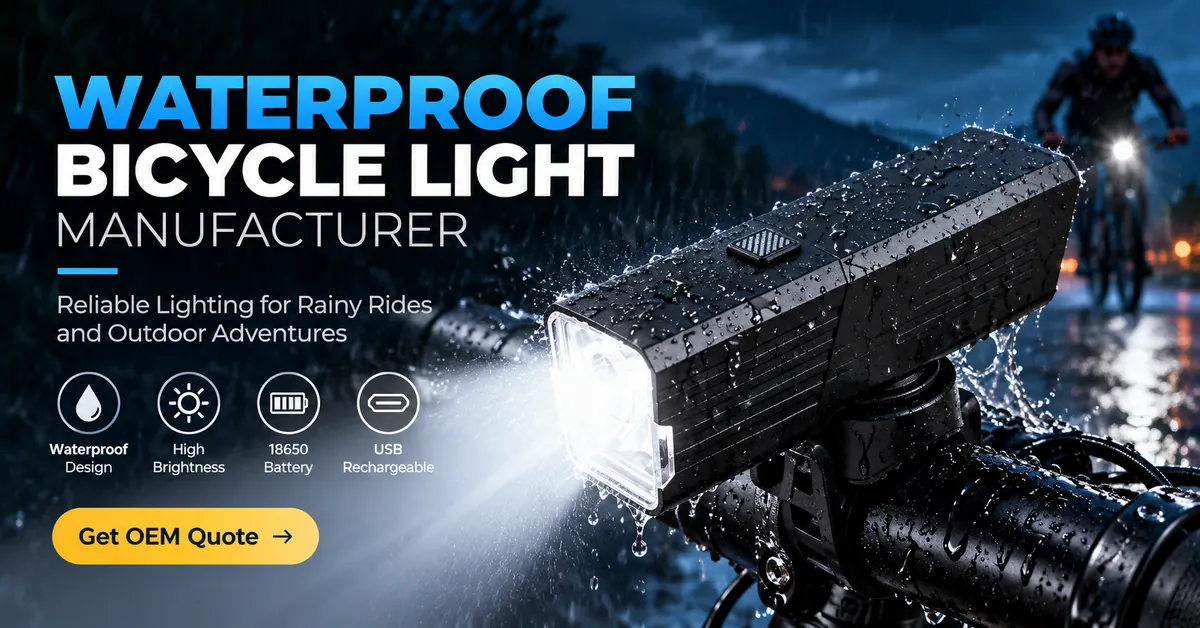
A waterproof bicycle light manufacturer should be evaluated on more than a waterproof label, a dramatic rain photograph, or a headline IP rating. A sourcing-ready bicycle light needs a documented enclosure design, a clearly stated ingress-protection target, reliable charging-port and switch sealing, appropriate front or rear illumination, and quality controls that reproduce the approved construction from sample to bulk shipment. For an importer or private-label cycling brand, the decisive question is simple: Can the supplier show exactly what was tested, which product revision passed, and how that same design will be manufactured again?
This article focuses on wet-weather bicycle lighting for urban commuting, year-round cycling accessories, and wholesale front-and-rear kits. It is written for bicycle-accessory importers, retail purchasing teams, e-commerce brands, OEM/ODM product managers, and fleet-equipment buyers who need clear specifications before they request quotations.
Brightenlux, formally Ningbo Brightenlux Electric Appliance Co., Ltd., includes bicycle lights among its published portable-lighting product directions and offers product-development and OEM/ODM discussions. Its current public Bike Light category does not list individual bicycle-light SKUs. Accordingly, the configurations and test plans in this guide are buyer specifications for evaluation, not claims that Brightenlux has a specific IPX-rated bike light in stock, has passed a particular test, or can supply a fixed MOQ or lead time without confirmation.
Discuss a Rain-Ready Bike Light Project · View Brightenlux Lighting Categories
1. Why Rain-Ready Bicycle Lighting Is a Different Purchasing Problem
Rain resistance is a system property. Water can reach the enclosure through a charging port, switch opening, lens joint, housing seam, screw interface, cable exit, or compromised gasket. Even when a lamp initially illuminates after a splash, trapped moisture can later cause corrosion, intermittent controls, optical fogging, or charging failure. These are reasons to define both initial ingress protection and post-exposure function during qualification.
A cycling product also faces conditions that a stationary laboratory sample may not fully represent. Handlebar vibration works on mounts and joints. Riders remove the light for charging. Charging-port caps are repeatedly opened and closed. A wet bicycle may be parked in a cold shed and then brought into a warmer room. Mud, road debris, and routine cleaning add other exposures. The intended operating environment determines which of these should be included in the buyer's validation plan.
For waterproof bicycle light manufacturer sourcing, the goal is not to select the highest IP code printed on an advertisement. It is to choose an evidence-backed protection level suited to how the front and rear lights will actually be used, then control the critical components and assembly steps that deliver it.
A commuter riding during occasional showers may need a different design and commercial price point from a year-round touring customer who regularly experiences rain and spray. Neither application automatically calls for immersion-capable equipment. Conversely, a premium marketing promise such as “suitable for every storm” should never be approved without a defined test scope and limitations.
Suitable and unsuitable buyer applications
Suitable applications to evaluate include daily commuter front-and-rear sets, recreational bike lights, detachable USB-rechargeable units, city-bike accessories, and branded lights for organized non-specialist fleets. Requirements that need separate engineering or regulatory assessment include lights intended for underwater use, pressure-washing exposure, certified hazardous environments, or direct connection to an e-bike's electrical system. A rechargeable accessory light should not be presented as an approved road-legal primary lamp in a specific market without the necessary supporting evidence.
2. What “Waterproof” Actually Means: Understanding IP Ratings
IEC 60529, Degrees of Protection Provided by Enclosures (IP Code), provides the technical framework for classifying protection against solids and harmful water ingress. In a two-digit code such as IP67, the first numeral describes solid-object/dust protection and the second describes water protection. An “X” in IPX4 means the solid-ingress rating is not specified by that marking; it does not mean the product has no physical protection against dust.
The word waterproof is informal and can imply more protection than the available evidence supports. In product pages, packaging, and quotations, it is better to identify the specific, verified degree of protection and the conditions under which it applies. For instance, IPX4 addresses splashing water under defined test conditions; it is not a claim that the product can be immersed, cleaned with any pressure washer, or operated with an exposed charge port.
| IP Marking | Water-Exposure Meaning | Buyer Interpretation | What It Does Not Prove |
|---|---|---|---|
| IPX4 | Protection against splashing water | Candidate target for appropriate splash-exposure briefs | No automatic immersion or water-jet claim |
| IPX5 | Protection against water jets | Candidate target where defined jet exposure is relevant | Not a blanket guarantee for high-pressure cleaning |
| IPX6 | Protection against powerful water jets | Higher specified jet exposure under standard conditions | Not proof of unlimited submersion or chemical resistance |
| IPX7 | Protection against effects of temporary immersion | Relevant only if defined accidental immersion is a real requirement | Not automatically equivalent to IPX5/IPX6 jet testing |
| IP67 | Dust-tight first numeral plus IPX7-type water protection | Defines two different protection characteristics | Does not mean every wet-weather or washing condition is covered |
This table explains standard categories, not Brightenlux product ratings. Testing, marking and permitted claims must be verified for the actual approved model and configuration.
The important nuance is that immersion and jet tests represent different exposure mechanisms. A buyer should not assume an IPX7 result automatically demonstrates an IPX5 or IPX6 result, nor infer that a unit with a high water numeral will resist any chemical, salt solution, high-temperature stream, or dynamic use condition. Where more than one exposure matters, request the applicable evidence for each.
A serious waterproof bicycle light manufacturer should be able to identify the tested model, laboratory or responsible test body, edition of the test method, sample configuration, port-cover position, pass/fail criteria, and report date. If only promotional wording is available, treat the IP claim as unverified until documents are supplied.
3. Match the Water-Exposure Requirement to the Riding Scenario
A procurement specification should define what the product is expected to survive. “Waterproof for outdoor cycling” leaves too many variables open. Ask where the bicycle is used, how the rider charges and stores the lamp, whether the light is removed daily, and which cleaning practices are likely.
City commuting in intermittent rain
For a standard commuter kit, the key questions are whether water can reach the controls and electronics during showers, whether the lens stays clear enough for usable light, and whether the mounting bracket maintains aim on wet roads. A suitable verified splash-protection target may be sufficient for a defined design brief, but the buyer must decide the required test evidence and margins rather than automatically demand the largest numeral.
Year-round commuting and touring
Longer and more frequent wet exposure raises questions about repeated soaking, wet/dry cycles, charging-cap wear, condensation, and corrosion over time. It is worthwhile to trial the complete product after realistic mounting and operation cycles. The manufacturer should also clarify how the light is dried and maintained, especially before charging.
Mountain biking and muddy routes
Mud and grit can accelerate wear around switches, detachable mounts, and exposed sealing surfaces. Bike washing may impose different exposure conditions from rainfall. A buyer should make the cleaning instructions explicit and must not advertise pressure-washer compatibility unless it is separately supported.
Fleet bicycles and unattended parking
A shared or rental bicycle may remain outdoors through multiple weather events. Its requirements can include tamper-resistant brackets, clear maintenance instructions, stable charging or replacement procedures, and traceable component lots. A general consumer light may not be optimal for this service environment even if it carries an IP label.
| Use Environment | Priority Exposure | Features to Evaluate | Documentary Request |
|---|---|---|---|
| Urban commuter | Rain and road splash | Lens joint, switch, port cover, secure mount | Defined ingress test plus function check |
| All-season touring | Repeated wet/dry use | Gaskets, condensation management, charging integrity | Repeated-cycle validation and controlled sample |
| Muddy trail riding | Wet debris and cleaning | External geometry, seals, bracket retention | Water exposure plus abrasion/cleaning review |
| Shared bicycle fleet | Outdoor storage and repeat use | Replaceability, service procedure, lot tracking | Field-maintenance and product traceability plan |
These are proposed evaluation priorities, not standardized pass grades or promises attached to an existing Brightenlux bicycle-light model.
4. Map Every Potential Water-Ingress Path Before Tooling Approval
Bicycle lights contain several interfaces that can admit moisture. A useful design review creates a water-ingress path map: an annotated drawing of every joint, opening, and control on both the front and rear light. This is especially important for OEM/ODM work because a small cosmetic change can disturb the same interfaces being tested.
Lens-to-housing joint: A lens can use a gasket, adhesive bond, weld, or other engineered attachment. Buyers should ask how compression or bond integrity is controlled, how alignment affects optics, and whether disassembly is expected. An attractive front bezel cannot substitute for an approved sealing process.
USB charging interface: A Type-C socket is not inherently waterproof once installed in a lamp. If the design relies on a port cover, its fit, hinge life, user handling, and closure instruction become critical. If a connector is specified as water-resistant, ask whether that rating applies to the port by itself, the assembled product, or a particular mated condition.
Switch and power indicator: Buttons and illuminated indicators may create mechanical openings or require transparent interfaces. Confirm the switch boot, membrane, bond, and operation after wet exposure. Repeated button presses can stress a sealing arrangement differently from a static water test.
Housing split line and fasteners: Moulded halves, covers, screws, and inserts may depend on gasket location or controlled assembly force. The design should tolerate normal manufacturing variation without losing its specified sealing performance.
Battery compartment or replaceable parts: A serviceable enclosure can be commercially attractive, but repeated opening creates additional sealing risks. Buyers should verify instructions for correct closure and whether protection is maintained after approved service operations.
Rear-light lens and mounting bracket: A small rear lamp may have limited space for seals, electronics, and optical elements. Its mounting position can also direct spray onto joints differently from the front light. Test the assembled product in a realistic orientation where needed.
A capable manufacturer should turn this map into critical-to-quality characteristics—parts, dimensions, tolerances, assembly methods, and inspection gates—not merely a statement that the lamp is sealed.
5. Choose Sealing Materials and Manufacturing Methods Carefully
There is no universal gasket, plastic, adhesive, or welding method for bicycle lights. The correct construction depends on enclosure geometry, anticipated temperature range, charging access, production volumes, serviceability, and cost. For a waterproof bicycle light manufacturer project, ask the engineering team to explain the proposed construction and why it fits the target rather than request one fashionable material.
Elastomeric gaskets may be made from different formulations, including silicone or EPDM, depending on compatibility and mechanical needs. They require appropriate groove geometry, controlled compression, and assembly inspection. Too little compression may leave a path for water; inappropriate compression or deformation can compromise the seal over time. A buyer should ask for material grade and design validation rather than assume all “silicone seals” perform the same way.
Polycarbonate, ABS and other plastics can support different housing or optical functions, but their behavior depends on the exact grade, design and processing. Lens materials must be chosen for both optical performance and durability. If a bonded or welded enclosure is proposed, ask for evidence about joint consistency, possible stress, and the implications for battery service or repairs.
Protective coatings or potting materials can offer additional protection for selected electronics, but they introduce their own trade-offs in heat dissipation, reworkability, process control, and inspection. They should not be treated as a substitute for a verified enclosure design. A coated PCB in a poorly controlled housing does not automatically make a bicycle lamp suitable for any water exposure.
For manufacturing feasibility, ask for a controlled bill of materials, assembly work instructions, seal-placement checks, supplier qualification for critical materials, and an explicit procedure when defective gaskets or housings are found. A new color variant, textured surface, branded charging cover, or revised bracket can require retesting when it changes a relevant part of the enclosure or use condition.
6. Front and Rear Bicycle Lights Need Different Wet-Weather Checks
A front lamp is intended to illuminate the route and help the rider identify hazards. A rear lamp is primarily a signal of presence to traffic behind. Both need suitable mounting and weather resistance, but their optical and mechanical risk profiles differ.
Front headlights: beam placement in rain
Wet pavement can produce glare and reflections. A bright hotspot may look impressive in a product photograph but offer poor visual comfort on an actual road. Request a defined beam pattern and test the light at an agreed mounting height and aim. If the target market requires a controlled cut-off pattern, that must be part of the optical brief and approval process.
Moisture or residue on the front lens can change usable output and scatter light. Review lens drainage, cleaning instructions, scratch sensitivity, and beam stability after the proposed water-exposure tests. Do not infer from a high lumen claim that the lamp is a safe or approved road headlight.
Rear lights: visibility and sealing at the seatpost
Rear units require appropriate red-light visibility across relevant viewing angles, consistent operation, and mount geometry compatible with the bicycle. A wet saddlebag or mudguard can obstruct a light even if the enclosure remains sealed. Test the actual mounting configuration and include installation guidance in the final retail pack.
Rear lamps may use different seals and charging arrangements because their dimensions differ from front lamps. A matched set therefore needs two product qualification records, even if one retail carton contains both units. Buyers should not assume the front and rear devices have identical ingress ratings or battery performance.
Mounting safety still matters
A lamp can be watertight yet unsuitable if its bracket slips under vibration or if the beam points into other road users' eyes. Check handlebar or seatpost compatibility, retention after repeated installation, and whether water accumulation changes the mount's grip. Weather resistance is necessary only within the context of the complete lighting function.
7. Battery, Charging Port and Condensation Risks
Rechargeable bicycle lamps connect water protection to electrical safety. The battery, charger, switch, protective electronics, and enclosure must work as a system. A sealed case cannot be judged independently of the charging arrangement, nor can USB-C compatibility be inferred from the connector alone.
Ask for the exact cell or battery-pack designation, rated capacity, charging input, protective features, and test method for runtime. A nominal milliamp-hour number does not guarantee a particular ride duration. Compare battery behavior in the mode that the buyer intends to advertise, and document what happens when the battery becomes low or the lamp warms during prolonged use.
A battery-powered light should not be charged while its charging contacts or port are visibly wet unless the supplier has documented a design and instruction that explicitly permits the condition. In ordinary product instructions, it is prudent to require users to dry and inspect the port before charging and to close the cover properly before outdoor use. The final manual must match the validated design rather than generic internet advice.
Condensation is not always identical to direct water ingress. Temperature and humidity changes may produce moisture on internal optical surfaces when humid air is trapped. A buyer observing fogging should investigate the cause, its effect on visibility, and the corrective action rather than assuming every fogged lamp passed or failed the same ingress test. If a pressure-equalizing vent is proposed, it should be treated as an engineered component with its own compatibility and validation requirements.
Battery transport requirements also remain separate from waterproof claims. Request the shipping documents, applicable cell or battery test-summary information, and instructions appropriate to the actual assembly and route. An IP rating is not a substitute for battery safety or transport compliance.
8. Technical Specification Table: What to Put in a Waterproof Bike Light RFQ
A quote-ready specification should define the required result before inviting a product recommendation. The values below are fields for the buyer and supplier to agree, not Brightenlux production data or a hidden model catalogue.
| Specification Field | Buyer Requirement to Define | Evidence to Request |
|---|---|---|
| Product role | Primary front lamp, rear lamp, auxiliary unit, or paired kit | Drawings, product images and use classification |
| Target market | Countries, road-use expectations, packaging language | Relevant market-specific compliance assessment |
| Water-protection target | IPX4, IPX5, IPX6 or other justified target | Model-specific test method and report |
| Dust-protection target | Required first-numeral protection, if any | Appropriate evidence for the proposed enclosure |
| Critical seals | Lens, switch, housing, charging port and battery access | Controlled drawings and sealing strategy |
| Optical requirement | Beam pattern, output, viewing angle and mode logic | Defined photometric report or evaluation |
| Electrical architecture | Battery, charge input, connector and operating modes | BOM, charging and runtime test information |
| Installation | Handlebar/seatpost geometry, retention and aiming | Fit samples and durability method |
| Lifecycle exposure | Wet/dry cycles, cap operation, transport and cleaning | Product-specific reliability plan |
| Private-label scope | Logo, colors, packaging, manual and accessories | Artwork proof and change-control record |
| Order plan | Samples, first order, forecast and destination | Itemized quotation and confirmed milestones |
If the buyer does not know the ideal rating, describe the actual environmental exposure and ask the supplier to propose a justified target. A technical response should explain trade-offs, not automatically sell the largest IP numeral.
9. Validate the Design: A Practical Rain-Test and Reliability Plan
A waterproof bicycle light manufacturer should support a repeatable validation plan with documented conditions and conclusions. The buyer does not need to invent its own IEC 60529 water-flow or immersion conditions; those are defined by the applicable method. What the buyer can define is the product configuration, additional use-related trials, functional inspection, and evidence needed to release the project.
Step 1 — Freeze the sample identity. Record model or project code, revision, serial or lot, battery, switch, charging cover, mounting bracket, lens and enclosure parts. Photograph both units of a front/rear set.
Step 2 — Record baseline function. Test light modes, optical appearance, charging, power indicators, button operation, and mechanical retention before exposing the sample. Keep measurements tied to the approved sample and test environment.
Step 3 — Perform the claimed ingress test. Have a competent laboratory or qualified team use the method appropriate to the proposed rating. Record the standard and edition, test arrangement, closure state, orientations, sample count, observations and pass/fail decision.
Step 4 — Evaluate immediately after exposure. Check whether harmful water ingress occurred under the applicable acceptance criteria. Recheck modes, charging interfaces as permitted by safe procedures, switch response, indicators and lens clarity.
Step 5 — Add use-cycle trials where relevant. Repeatedly open and close the charging cover, operate the switch, install and remove mounts, and expose selected samples to agreed wet/dry or temperature conditions. These are additional application-specific checks; do not label them as IEC tests unless conducted under the appropriate standard.
Step 6 — Inspect delayed effects. At agreed observation intervals, assess fogging, corrosion signs, intermittent function, seal displacement, and mechanical degradation. Document any defects, including those that do not create an immediate lamp failure.
Step 7 — Review the failures. Determine whether the root cause is component selection, design tolerance, assembly inconsistency, cap misuse, or an unrealistic claim. Request corrective actions and a revised test plan where necessary.
Step 8 — Approve the golden sample. Release the agreed BOM, critical dimensions, seal materials, work instructions, packaging claims and associated test evidence. Do not substitute a new revision without evaluating affected tests.
Step 9 — Link qualification to bulk release. Specify production inspections that reasonably monitor the design's critical characteristics, together with lot-based testing where appropriate. Not every finished unit needs destructive immersion testing; the verification approach should be agreed using product risk, method requirements and quality capability.
A report that says only “waterproof passed” is too vague for a serious OEM project. The buyer should be able to identify the scope, model and relevant test conditions without guessing.
10. Compare Four Buyer-Defined Wet-Weather Product Concepts
The comparison below helps private-label buyers discuss different purchasing roles with a supplier. Concept A, B, C and D are proposed configurations, not Brightenlux model numbers or confirmed available products. No IP rating is claimed for a Brightenlux SKU in this table.
| Proposed Concept | Intended Channel | Wet-Weather Priority | Engineering/Commercial Trade-off |
|---|---|---|---|
| A — Everyday Commuter Pair | Urban cycling retail | Verified splash protection and simple cover operation | Cost, size and basic ease of use |
| B — All-Season Front Lamp | Year-round commuters | Sealing consistency, stable beam, repeated wet/dry usability | Runtime, thermal design and target price |
| C — Compact Rear Visibility Light | Accessory retailers and fleet replenishment | Lens seal, charging access, seatpost fit and side visibility | Small enclosure space and servicing convenience |
| D — Touring Kit With Controlled Spares | Touring brands and premium distributors | Front/rear evidence, replacement parts and repeat-order consistency | Packaging complexity and supply-chain control |
Avoid positioning a design as “best for all climates” without a validated use case. Buyers can choose a market niche, commission samples and decide whether a higher protection target is commercially justified by genuine use conditions and supportable claims.
11. Factory Workmanship and Production QC: Where Waterproof Claims Become Real
A first sample is often assembled with greater attention than a high-volume production unit. The real question for a waterproof bicycle light manufacturer is whether the design can be built consistently after thousands of parts and repeated assembly operations. This requires control at incoming inspection, during assembly, at finished-goods testing, and when a supplier changes a material or subcomponent.
Incoming components: Identify critical gasket grades, housing materials, lenses, switches, connectors, charging covers, screws and adhesives. Require incoming checks relevant to dimensional fit and function. Seal geometry is especially sensitive to unexpected supplier substitutions.
Assembly workmanship: Use work instructions for gasket positioning, joint preparation, welding or bonding parameters when applicable, fastener sequence, closure inspection and correct port-cover placement. Decide which defects warrant rejection before the first production run.
In-process testing: Where feasible, use appropriate non-destructive screening methods to monitor assembly consistency, complemented by periodic product-specific validation. Do not imply that a brief factory splash check proves the complete IP classification unless the process and evidence support that claim.
Final inspection: Confirm optical performance, switch behavior, battery and charging function, labels, physical condition, bracket hardware, supplied accessories, manual and packing. Include a check that the external waterproof claim matches the approved model and report.
Traceability: Link production lots, critical material revisions and test records to shipments. An importer should be able to investigate a batch-level issue without manually identifying every anonymous lamp from a photograph.
Change control: Require approval before changes to housing tooling, gasket material, charging-port supplier, switch geometry, lens attachment, battery, driver, firmware, or other performance-critical items. Some changes may affect only packaging; others can invalidate the evidence for the advertised water rating. The buyer and manufacturer should decide which tests must be repeated.
This is the practical bridge between engineering design and reliable wholesale supply.
12. Certifications and Market Requirements Beyond Water Protection
An IP report addresses defined enclosure conditions; it does not automatically establish road-use legality, battery safety, electrical compliance, or transport compliance. Importers should request separate evidence for separate claims. This distinction is essential to responsible OEM packaging, especially when bicycle lights are sold across multiple jurisdictions.
ISO 6742-1:2023, Cycles—Lighting and retro-reflective devices—Part 1: Lighting and light signalling devices, covers relevant functions, safety requirements, photometric performance and methods for cycle lighting devices. It is a useful technical reference, not a certificate attached to every bicycle lamp.
For Great Britain, Highway Code Rule 60 addresses the white front and red rear lights required at night, together with relevant reflectors. Additional construction and performance details follow the applicable regulations and guidance. For Germany, purchasers should verify the bicycle-light requirements and product approval under the applicable StVZO rules where road use is intended. A generic “CE waterproof bike light” description does not settle either question.
The destination market, intended use, and actual product features determine which rules apply. The supplier should provide accurate model-specific documents, while the importer must check the legal responsibilities associated with putting the product on the market. Avoid adding certification logos or ratings merely because a competing product uses them.
13. Pricing, MOQ, Lead Time and Total Sourcing Risk
A low unit price can be misleading when comparing waterproof bicycle light manufacturer proposals. A quotation for a basic light without a battery, mount, retail box, testing allocation or after-sales provisions is not comparable to a complete, controlled front-and-rear kit. Normalize the offers before deciding which is cheaper.
The relevant total cost can include the lamp and battery, bracket, cable, carton, printing, tooling, inspection, testing, freight, duties, handling, warranty allowance and expected replacement work. Do not invent a margin percentage or failure rate. Use your own distribution data, supplier quotes and an explicit scenario to calculate landed cost.
MOQ may depend on whether the buyer selects a standard existing platform, changes its color or packaging, requests new tooling, or requires market-specific components. Lead time should be split into sample preparation, engineering verification, artwork approval, pilot build if required, mass production, final inspection and dispatch. A broad factory claim about fast delivery does not establish an exact promise for an undisclosed bicycle-light model.
Buyers should also consider the commercial consequences of overstating water protection. An unsupported waterproof claim can increase product returns, distributor disputes and compliance exposure. By contrast, a clear, verified claim with useful cleaning and charging instructions helps customers understand the product's limits.
For a repeat-order agreement, add a written component-change notification requirement and a way to compare new production to the approved golden sample. The true long-term value of an OEM partner lies in specification consistency, not just the first quote.
14. OEM/ODM Development: From Rain-Ready Brief to Production Release
A manufacturer can offer different levels of customization, but they should not be treated as interchangeable. Branding an approved lamp is one type of project; creating a new seal, housing, charging interface or optical system is a different engineering task.
Level 1 — Private label: Discuss logo placement, carton, language, barcode, inserts, and approved accessories. The buyer must still ensure that packaging claims match the existing tested product.
Level 2 — Configuration adaptation: Changes to light modes, battery, optic, seals, mounting parts or charging details require feasibility review and may require revised qualification. The original test report may not cover the new configuration.
Level 3 — New ODM platform: A newly designed enclosure or waterproofing approach calls for engineering drawings, prototype stages, tooling decisions, design verification, pilot production and controlled release. Ask for milestones and responsibilities before paying for development.
Brightenlux describes product-development and OEM/ODM support on its Outdoor Lighting page. Buyers can use this as a starting point to discuss a rain-ready bicycle lighting project. The specific feasibility, MOQ, qualification evidence and timing must be confirmed directly with its team.
A recommended development sequence is: market requirement → approved technical brief → design review → first sample → ingress and functional tests → corrective actions → golden sample → pilot build → production QC release → shipment. Every change that affects sealing or product claims should have a documented approval path.
15. A Buyer-Ready RFQ for Waterproof Bicycle Lighting
Before contacting an OEM team, prepare an RFQ that makes the intended use measurable. A useful enquiry needs more than “Please send your best price for an IP67 bike light.” It should describe the real riding conditions, target protection, product format, optical function and evidence requirements.
Include your company and destination market; front, rear or paired kit; user group and typical riding conditions; expected rain and cleaning exposure; requested IP classification and report; lamp size and mounting interface; intended beam and output; battery and charging arrangement; packaging and branding; expected first order and forecast; sample approval process; certification and transport requirements; and target launch schedule.
Ask the supplier to classify each requested item as available, customizable, development required, or unavailable. Ask for a current bicycle-light line sheet rather than assuming that a public general-lighting catalogue contains the exact requested item. Obtain the specification, costs, inclusions, exclusions, sample plan, evidence and revision status in writing.
Because Brightenlux's public Bike Light page currently does not display individual products, the most accurate next step is to request the current bicycle-light catalogue or an ODM feasibility assessment through Brightenlux Contact Us. That avoids promising buyers a waterproof model for which no public specifications or test report have been verified.
Request a Current Bicycle-Light Catalogue · Discuss an OEM Rain-Ready Lighting Project
16. Frequently Asked Questions About Waterproof Bicycle Light Manufacturing
1. What should I ask a waterproof bicycle light manufacturer before ordering?
Ask for the exact offered model and revision, claimed IP rating, applicable IEC 60529 test report, charging-cover design, battery configuration, optical performance, mounting method, materials, quality plan, destination-market documents, sample availability, MOQ, and lead-time milestones. Make sure the evidence refers to the configuration being quoted.
2. Is IPX4 enough for riding in rain?
IPX4 describes protection against splashing water under specified test conditions and may be a candidate target for certain rain-exposure briefs. It is not a universal guarantee for every riding duration, pressure-washing method or assembly state. Choose the target based on realistic use and verify it on the exact product.
3. Is an IP67 bicycle light automatically better than an IPX5 model?
Not for every requirement. IP67 combines a solid/dust protection classification with temporary-immersion water protection, while IPX5 addresses water jets. These are different tests, and a higher-looking code does not automatically establish every lower or different exposure capability. Compare the intended environment and supporting reports.
4. Does a USB-C bike light remain waterproof while charging?
Not necessarily. The connector, enclosure and charging-port cover must be evaluated as an assembled system. Unless a specific safe design and instruction allows otherwise, users should dry and inspect the connector before charging. Ask the manufacturer what the verified ingress claim requires regarding port closure.
5. What parts commonly require the most attention in water-resistant bike lights?
Lens joints, enclosure split lines, charging-port covers, switch boots, fasteners, battery access and cable interfaces are common review points. Their risk depends on the actual design. A water-ingress path drawing and critical-to-quality checklist are more useful than assuming one component always causes failure.
6. Can the front and rear bicycle lights in one kit have different IP ratings?
Yes. They are different assemblies with different dimensions, optical roles, charging arrangements and mounting positions. Test and document each unit separately, and describe their ratings accurately on the kit packaging.
7. How should an OEM buyer verify a supplier's waterproof claim?
Request the model-specific test report, standard and edition, specimen revision, test arrangement, test outcome and any limitations. Compare the tested build with the offered sample and bill of materials. Add application-specific wet/dry and use-cycle checks where necessary.
8. Does waterproof certification make a bicycle light road legal?
No. IP testing addresses enclosure ingress protection. Road-use suitability depends on separate optical, color, operating-mode, marking and jurisdictional requirements. Review the intended sales market and obtain the actual model-specific evidence for claims made on packaging.
9. Can Brightenlux provide custom waterproof bicycle lights?
Brightenlux publicly identifies bicycle lights among its product directions and offers general lighting OEM/ODM discussions. However, the public Bike Light category does not currently show verified waterproof bicycle-light models. Buyers should contact the factory to confirm available platforms, development feasibility, relevant testing, MOQ and timing.
10. What information helps a manufacturer quote a rain-ready bike light accurately?
Provide the destination market, buyer channel, riding exposure, intended front/rear configuration, IP target, mounting dimensions, optical and battery expectations, required documents, sample quantity, projected bulk order, artwork scope, and launch schedule. Include reference photographs and request a written list of assumptions and exclusions.
Conclusion
Selecting a waterproof bicycle light manufacturer is ultimately a test of engineering evidence, consistent workmanship and responsible purchasing communication. Buyers should define the real rain and cleaning exposure, select a justified ingress-protection target, review every critical seal and charging interface, validate the finished front and rear lights, and link successful samples to controlled mass production. A high advertised IP numeral matters less than a complete, traceable design that performs as specified.
Brightenlux is a China-based portable-lighting manufacturer that includes bicycle lights in its published product portfolio and offers OEM/ODM project discussions. Because its public bicycle-light category currently lacks model-level listings, buyers should request current configurations and supporting test documentation rather than assume a particular waterproof specification. Explore Brightenlux's business and development capabilities, review the company profile, and send your rain-ready bicycle-light RFQ to discuss a verified sourcing path.
Request Waterproof Bike Light OEM Information · Explore Brightenlux Bike Lights