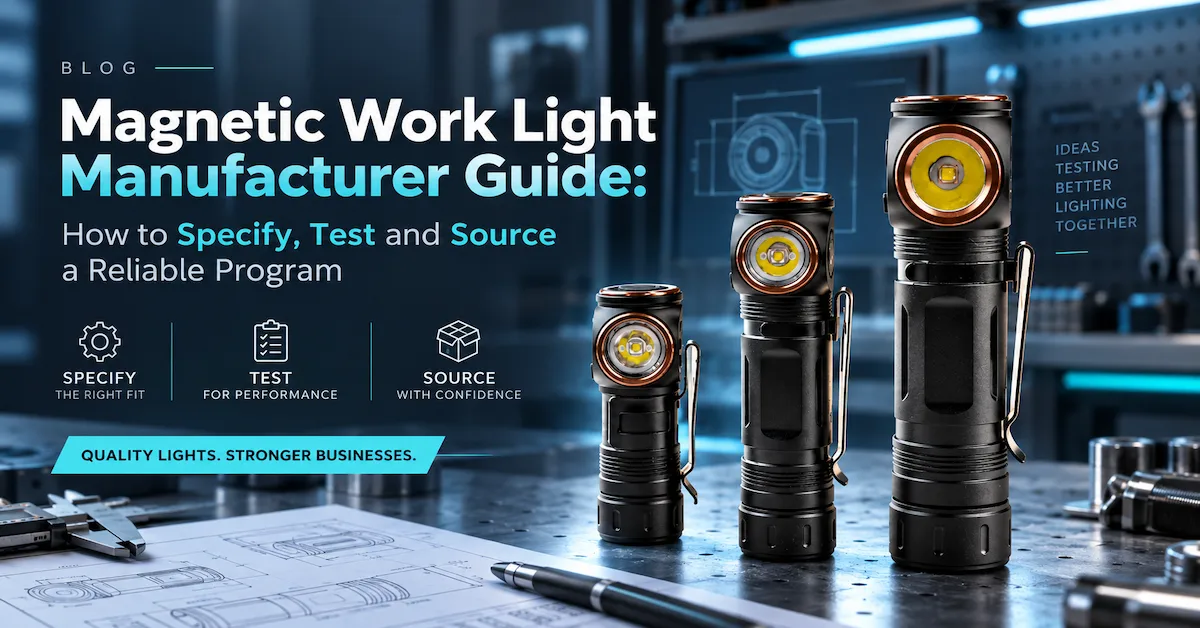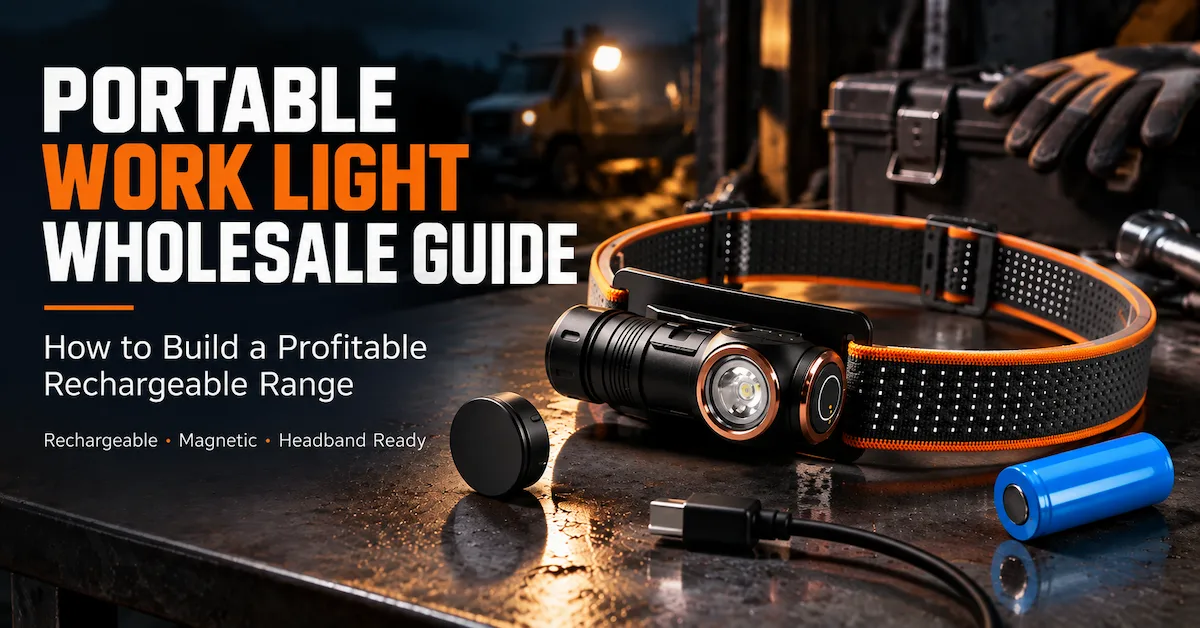


A rechargeable work light is a power system with a lamp attached. The buyer sees a beam and a charging socket. The customer lives with the less visible decisions: how brightness falls during a shift, whether the battery can be serviced, whether a cable fits in a crowded workshop, and what happens when a replacement cell enters the second production run. Those decisions determine whether a product becomes a dependable tool or a recurring returns problem.
This guide helps tool brands, automotive distributors, hardware importers and private-label buyers evaluate a rechargeable work light manufacturer. It follows the purchasing journey from task definition to sample approval and repeat orders. Brightenlux's public portable-light products illustrate possible battery and charging architectures. Its Working Light category currently lists no dedicated goods, so buyers should confirm the current work-light catalogue, actual SKU, MOQ and availability before quoting or publishing a product claim.
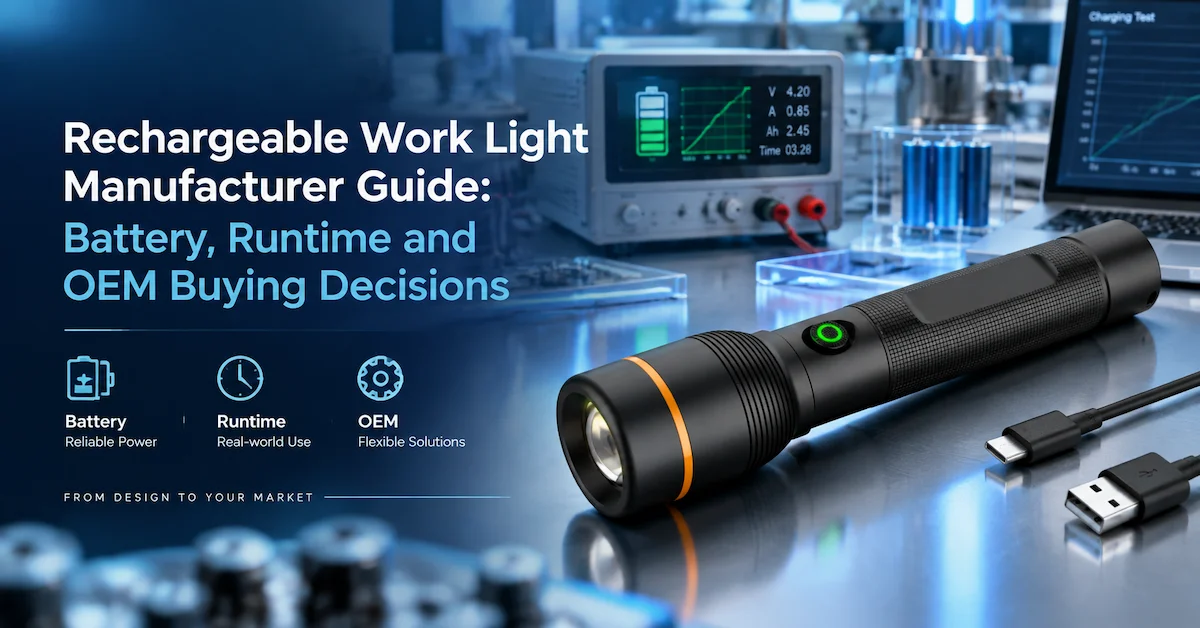
Quick answer: what separates a reliable rechargeable work light manufacturer?
A reliable supplier can describe the complete electrical and commercial build: named battery configuration, charge input, indicators, useful runtime in each relevant mode, thermal behaviour, service policy, pack contents and change control. The right rechargeable work light supplier will ask where the lamp is used and how long it must support that task before proposing capacity or maximum lumens.
For a first RFQ, send the working distance, illuminated area, shift duration, access to USB power, mounting or carrying method, target channel, price band, destination market and first-order quantity. Put a status next to each number in the response: buyer target, catalogue claim or measured sample result. A catalogue runtime should not quietly become the acceptance limit for a different battery or light mode.
The practical test is whether a technician would keep using the lamp after the first half-hour. Can it still light the work, can it be recharged where the user actually works, and will a reorder carry the same cell and accessories? Those answers matter more than a single headline output figure.
Start with the work cycle, not a capacity headline
Ask the user what happens between taking the light from storage and putting it back on charge. A mechanic may use a lamp intermittently across several repairs. A maintenance crew may need a steady medium beam for hours. A warehouse team may charge several units at one shared station. A roadside service kit may remain unused for months and then be expected to work immediately. Each pattern leads to a different battery, indicator and service decision.
Define a duty cycle in ordinary language. For example: “Forty minutes of close work, two ten-minute inspections, then a vehicle USB charge during travel.” That gives engineering more guidance than “eight-hour battery.” If the customer expects one charge to cover a full shift, specify the brightness level and acceptable end point. If intermittent use dominates, standby drain and accidental activation become important.
The beam matters too. A task requiring a broad, comfortable work area may not benefit from a narrow long-distance spotlight. An LED rechargeable work light manufacturer should discuss beam distribution, glare, colour appearance and sustained output alongside cell size. A high lumen figure measured briefly at switch-on can be less valuable than stable light after the housing warms up.
Four public Brightenlux platforms for a power-system discussion
These are portable-light references, not a claim that the same models are currently sold as dedicated work lights. They show how different battery and charging choices affect a prospective work-light brief.
| Public reference | Published power detail | Potential job | Confirm for the order |
|---|---|---|---|
| 1000 lm right-angle magnetic light | 800mAh 16340 included; Type-C; 2-3 hour working time on public page | Compact inspection and hands-free access | Runtime by mode, charge input, accessories, availability |
| 1000 lm 18650 magnetic light | 18650 battery included; Type-C and red/green charge indicator | Daily portable use with white and red modes | Cell identity, supplied pack and mode sequence |
| 1500 lm 21700 magnetic light | 4000mAh battery included; Type-C; up to 8 hours stated publicly | Higher-capacity portable step-up | Mode and end point behind the runtime claim |
| 1000 lm OSRAM P9 flashlight | 18650 rechargeable cell not included by default; twist-out Type-C port | Battery-included versus battery-excluded pack comparison | Cell inclusion, retail copy and shipping configuration |
Notice the commercial difference in the final row. A battery-excluded quote can look attractive until the distributor adds a cell, changes the carton and revises the product listing. Compare complete delivered configurations, not just body prices. Published lumen and runtime figures also require a sample-specific test before they become a claim in a new branded work-light program.
Request Rechargeable Work Light Samples
Battery architecture: built-in, removable or hybrid?
A built-in battery simplifies the customer's first use and can make a compact housing possible. It also commits the brand to a service decision when capacity fades. A removable cell can help service and long-term ownership, but requires a secure compartment, clear polarity, compatible cell dimensions and a policy for replacement cells. A hybrid design can accept a rechargeable pack and disposable cells, but adds controls and instructions that must be tested carefully.
Open a sample and find out who, if anyone, can replace its cell without damaging the housing. Some designs allow a user to swap it, some require a service bench, and others are effectively sealed. Decide how a failed cell will be handled before the first retail carton is printed. “Rechargeable” tells the customer how to add energy; it does not tell them whether the product can be repaired.
The chemistry, nominal voltage, rated capacity, protection circuit and approved source belong in the controlled specification. “18650” or “21700” describes a form factor, not a complete production battery. Cells with the same size can vary in capacity, protection, terminal style and performance. If the factory proposes an alternative, compare charge behaviour, useful runtime, mass, documentation and customer claims before approving the substitution.
Runtime: test a useful mode and disclose the end point
Battery capacity alone cannot prove useful runtime. The LED, driver, mode, heat sink, ambient temperature and battery condition affect the result. A light may start bright and step down as it warms. Another may gradually dim. Both can be legitimate designs, but a customer should know which behaviour the package promises.
For each mode that matters to the user, ask for a timed output record rather than a single “working hours” figure. Identify the initial reading, stabilization period, test temperature, fully charged battery, any programmed step-down and the end point. Is runtime counted until the lamp switches off, until it reaches a percentage of initial output, or until illumination is no longer useful for the task? The answer can change the published number substantially.
The Portable Lights American Trade Organization describes the revised ANSI/PLATO FL 1 performance standard as a framework for more consistent portable-light claims. It is a useful reference when discussing output and runtime methods, not proof that any specific Brightenlux model has been certified. Ask which test method and edition a supplier used, and request evidence for the exact production-intent configuration.
Demonstrate the mode the customer will actually leave on. A modest, comfortable medium beam maintained through the task can be more useful than a short bright burst. At arm's length, test whether low mode reduces glare on reflective parts; keep it only when users can identify a real job for it.
Charging interface and real-world compatibility
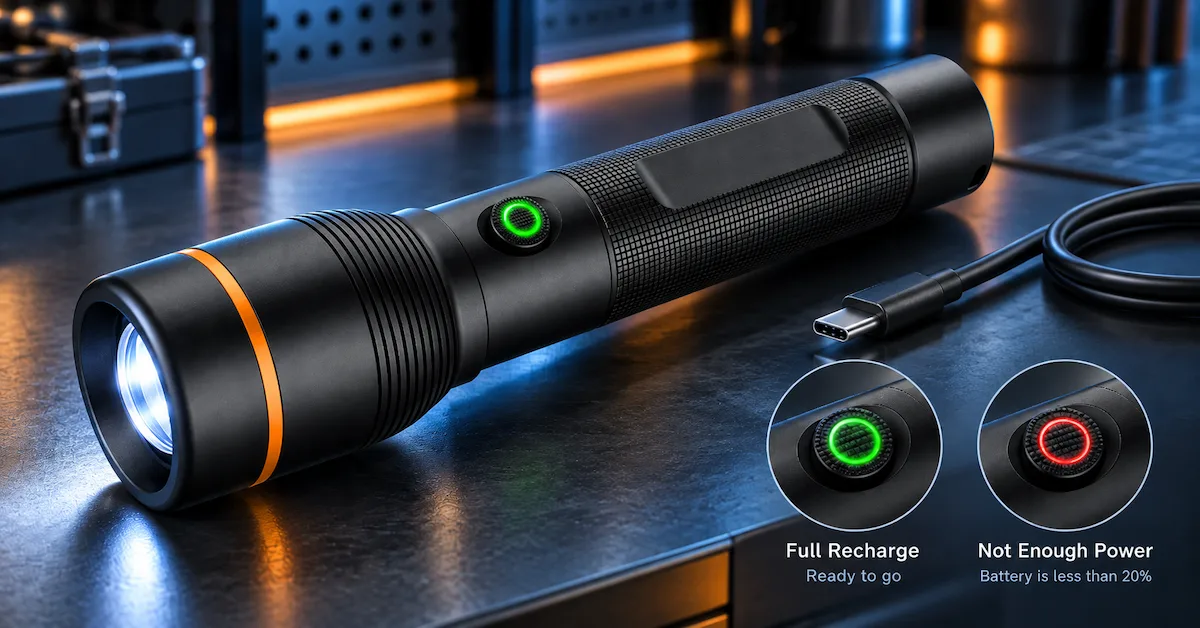
The familiar USB-C opening can conceal quite different charging circuits. In the sample room, try a vehicle outlet, a shared charging cabinet and a common phone adapter with the proposed cable. Record input voltage and current, the included cable or charger, the indicator sequence, low-battery warning, full-charge response and whether the lamp can run while plugged in. A fleet buyer's charging station and a consumer's kitchen outlet present different daily habits.
Inspect the port location in every working position. A socket hidden against a magnetic surface may be awkward. A flap that cannot remain closed after repeated use weakens the environmental story. A twist-out port may protect the connector during storage but requires clear instructions and a handling test. Ask how the unit responds to interrupted charging and whether the indicator can be understood without reading a manual.
Do not promise fast charging solely because a Type-C port is present. Record a charge-time method: starting battery state, power source, cable, ambient condition and end point. The factory should state whether the charge time is a target, a public-page value or a measured sample result.
Thermal management and sustained light
Run the light for the duration of the job before judging the housing. Aluminium can carry heat away from the LED, yet the same surface may become uncomfortable in a hand. Plastic around the grip changes the feel and the thermal path. A ten-minute handheld inspection and a lamp fixed to a cabinet for hours therefore deserve different touch-point checks.
During sample review, run the modes for the intended duration and record surface temperatures at likely touch points, output changes and any thermal step-down. Check whether the light recovers after cooling and whether charging and operation at the same time are permitted. Do not invent an IP or temperature rating by borrowing the number from a similar housing.
A portable rechargeable work light also has to survive charging-port handling, drops into a toolbox and repeated switching. Examine the cable cover, switch, clip, magnet or stand as part of the same system. During the trial, ask a technician to set the lamp down, aim it and adjust it with work gloves; this quickly exposes a weak base or awkward switch.
Shipping configuration and documents
Before printing a shipping mark, identify the production cell and its watt-hour rating. Is it installed in the lamp, packed beside it, or omitted? The answer, together with route and transport mode, changes the shipment review. The IATA 2026 battery guidance distinguishes batteries packed with equipment from those contained in it. An old label from a similar-looking model is not evidence for this pack-out.
Give the freight specialist the cell identity, test summary, watt-hour marking, number of cells, carton construction and switch-protection method. Have the factory confirm that these describe the same build approved for production. Carrier acceptance and applicable rules can change, so the shipping team must make the route-specific decision from current requirements.
Shipping decisions also affect the quotation. A light with the cell installed, a loose replacement cell in the box and a body sold without batteries are three different pack-outs. Each needs its own product listing, barcode or variant record and logistics review. The lowest unit quote can become expensive if a battery decision is left until the cartons are printed.
Plan warranty and battery service before the launch
Ask how a customer distinguishes a discharged battery from a failed cable, port, driver or cell. A clear indicator and a concise troubleshooting sequence can prevent unnecessary returns. For professional channels, consider whether a spare battery, replacement cable or service process is available. For compact sealed units, decide whether a failed product is repaired, exchanged or credited.
Warranty terms should describe the actual product and market, not a generic promise. Establish the evidence a distributor will collect: model and batch code, symptom, charging source, photos and basic functional checks. Feed patterns back to the supplier. Repeated “does not charge” reports may point to a confusing indicator, a cable mismatch, an assembly issue or poor storage practices. Each requires a different correction.
Store production batteries under a documented plan and confirm how the supplier manages aged inventory. A first shipment may perform well while a later batch uses cells from a different source or storage history. This is why battery identity and change notice belong in the repeat-order file.
Wholesale range design and landed cost
For wholesale rechargeable work lights, define each SKU by customer job and charging promise. An entry model might solve short inspection tasks. A core model can support regular USB-C charging. A longer-use model can add capacity. A specialist format may emphasize hands-free positioning. A larger battery is not automatically a higher-value SKU if it is too bulky for the channel.
Normalize quotes with the following worksheet. Every line should refer to the same approved configuration:
| Cost or risk line | Question for the supplier | Commercial consequence |
|---|---|---|
| Cell and protection | Which approved cell is included, and can it change? | Affects cost, runtime, documents and warranty |
| Charging kit | Are cable and charger included? | Affects retail value and customer support |
| Brand and package | Are logo, manual, carton and barcode setup included? | Low-MOQ setup can change unit economics |
| Testing and inspection | Which runtime, charge and function checks are included? | Reduces claims and returns risk |
| Freight and warranty | What is the battery pack-out, carton data and service policy? | Changes landed cost and post-sale reserve |
Calculate gross margin using the landed product, not the lamp body alone. Include freight, duty, inspection, compliance review where needed, sample and artwork costs, damaged stock and a realistic warranty reserve. Then test whether the range price ladder still makes sense to a retailer and end user.
A cordless rechargeable work light supplier should also explain how a sales team demonstrates the charging benefit without hiding the service trade-off. Put the included battery and cable on the shelf label, show the charging indicator in the listing, and identify the useful mode behind the runtime statement. This helps buyers compare like with like and reduces preventable returns.
OEM customization without losing electrical control
An OEM rechargeable work light manufacturer can support a logo or packaging update on an existing platform, but a new battery, charge board, output mode or housing is a different level of development. Mark each request as standard, configurable or engineered. Ask what new sample, test, tooling, MOQ and schedule each change requires.
A custom rechargeable work light supplier should identify critical electrical components and the process for approving substitutions. If the battery source changes, a previous runtime curve may no longer describe production. If the driver changes, heat and mode behaviour may change. If the charge board changes, indicators and cable compatibility may change. Keep an approved component list or performance boundary, and require written notice before a critical replacement.
Private-label artwork must agree with the physical build. Battery included or excluded, charge input, cable, runtime mode, warnings and accessories should match the carton, manual, product page and invoice. Do not print a performance mark or compliance symbol before confirming it applies to the exact configuration and destination market.
How to qualify a rechargeable work light manufacturer in China
For a rechargeable work light manufacturer China search, location is only the first filter. Confirm who designs the electrical system, sources cells, assembles the product, tests charge functions and approves substitutions. Ask how incoming batteries are identified and how a failed charging unit is isolated before packing. A factory may use specialist component partners; what matters is controlled specifications and accountability.
Request a process map for the proposed model: incoming inspection, cell identification, assembly, charging check, mode check, optical or thermal sampling, pack-out and final release. Ask which records can be traced by batch code. A production-line photograph may show capacity, but it cannot demonstrate that an unapproved battery will be caught.
Evaluate the supplier's response to conflict. If the buyer asks for a smaller housing, brighter sustained output, longer runtime and lower cost at the same time, a credible team will discuss trade-offs. An instant “yes” without a proposed battery and heat path is not a technical answer.
Nine-step buying method for a rechargeable work-light program
- Map the job and duty cycle. Identify user, distance, illuminated area, active minutes, storage time and charging opportunities.
- Choose the physical format. Decide how the light is carried, stood, clipped or mounted and how the charging port is reached.
- Set useful optical targets. Specify beam, glare, colour appearance and sustained medium-mode performance, not only peak output.
- Choose battery and service architecture. Confirm chemistry, cell, inclusion, protection, replacement method and warranty response.
- Define charging behaviour. Record input, cable, indicators, operation while charging, charge-time method and low-battery response.
- Test production-intent samples. Measure runtime, charging, heat, controls and handling with the actual cell and accessories.
- Normalize the quotation. Compare identical battery, cable, packaging, branding, inspection, freight and trade-term scope.
- Review logistics and claims. Confirm current battery documents, transport pack-out, destination requirements and evidence behind public statements.
- Lock the repeat order. Retain the approved sample, component list, test record, artwork, pack count, batch code and change-notice rule.
This nine-step method produces a decision package, not merely a catalogue shortlist. The buyer should be able to hand the same records to purchasing, quality, sales and a future reorder team without each person reconstructing what was agreed.
Send Your Rechargeable Work Light RFQ
Questions buyers ask before ordering
Is a higher-capacity battery always the better choice?
No. Capacity may add runtime, but also changes size, weight, charge time and freight economics. A compact model can be better for short inspections and confined areas. Compare useful illumination for the real task, not only milliamp-hours printed on a cell.
What should a runtime claim include?
Name the mode, battery, charge state, ambient condition, test method and end point. If output steps down, show that behaviour. A single “up to eight hours” statement without context is difficult for a professional buyer to compare.
Does USB-C mean every charger will deliver the same charging speed?
No. The connector does not by itself specify the supported input profile or charge current. Test representative power sources and cables, and state the charging conditions used for any published time.
Can a brand order the lamp without a battery?
That may be possible for some platforms, but it must be confirmed with the supplier. The Brightenlux 1000-lumen OSRAM P9 page, for example, states that its 18650 cell is not included by default. An excluded-cell variant needs its own retail wording, compatibility guidance and shipping review.
Which changes require a new sample?
A changed battery, driver, charge board, LED, thermal path, mode sequence, housing or cable can affect performance or customer experience. Assess the impact and approve a production-intent sample and relevant retests before release. A logo colour change may need a different, narrower review.
How should a distributor handle battery complaints?
Collect the batch code, symptom, charging source, cable and indicator behaviour before deciding whether the fault is the cell, port, board or instructions. Agree on replacement, credit or repair with the supplier in advance and use return trends to improve the next batch.
Ask for a build that can be charged, sold and reordered confidently
The strongest rechargeable work-light program is not the one with the largest capacity figure. It is the one that answers a specific job, gives the customer clear charging behaviour, makes truthful runtime claims, and preserves the approved electrical build across orders. That takes a useful brief, representative testing and a supplier willing to make trade-offs explicit.
Send Brightenlux your destination market, channel, target quantity, work cycle, beam and runtime needs, battery preference, charging source, mounting format, packaging, logo and launch date. Link to a reference platform and ask which current model can support the brief. An order-specific rechargeable work light manufacturer discussion can then move from generic price comparison to sample, evidence, MOQ and production planning.