

Portable work light wholesale for industrial maintenance, repair, and operations (MRO) should begin with the technician's job and the complete issued service kit—not with a list of maximum lumen figures. Buyers need lights that can be positioned at the point of repair, charged between shifts, identified in inventory, checked for damage, and reordered without unexpected specification changes. A well-designed procurement program matches illumination, mounting, battery, accessories, and acceptance tests to the work cycle.
This guide is written for industrial-supply importers, regional MRO distributors, facility-management contractors, field-service companies, and private-label procurement teams. It focuses on handheld, magnetic, right-angle, and head-worn portable lighting used for manual maintenance and inspection. Brightenlux's public product pages provide examples of real portable-light platforms; each proposed production configuration, MOQ, delivery date, and regulatory document must still be confirmed for the order.
Explore Brightenlux Portable Lighting · Request an MRO Kit Quotation
1. What Makes an MRO Service-Kit Purchase Different From Retail Work-Light Wholesale?
A retail buyer may judge a light by shelf appeal, individual selling price, and a short demonstration. An MRO buyer has a longer operating cycle. The light may be issued to a technician in the morning, carried in a service bag, attached near machinery, recharged at a depot, inspected at shift end, and issued again. The cost of a missing cable or failed switch can appear later as a delayed service call rather than a straightforward retail return. That is why portable work light wholesale for MRO teams must be evaluated at kit level rather than retail-carton level.
For that reason, the purchase unit is often the service kit rather than a bare flashlight. The kit can include the light, its battery, a suitable charging cable, mounting accessories, instructions, identification labels, a storage position, and replacement rules. These are proposed kit elements for the buyer to specify; they are not a claim that every Brightenlux model is supplied with every accessory.
This distinction creates three purchasing questions. First, what will the technician actually do with the light? Second, what must a depot or distributor do to keep it usable? Third, how will the next shipment match the approved first shipment? A unit-price comparison answers none of these questions completely.
Best-fit buyers include MRO wholesalers, mechanical-maintenance service providers, industrial consumables distributors, OEM tool-kit brands, and facilities contractors. Less suitable uses include hazardous-area lighting requiring special approvals, certified explosion-protected equipment, precision machine-vision illumination, or intrinsically safe electrical applications. General portable flashlights should never be assumed to meet those special requirements.
2. Map the Real Service Jobs Before You Select a Portable Work Light
Industrial work rarely involves one viewing position. A technician may need a focused beam inside a pump housing, a broad view across a cabinet, a head-worn light while using two tools, or a magnetic light that remains in place for several minutes. Matching light architecture to the task reduces unnecessary accessories and prevents a poor fit that only becomes obvious after distribution.
Machine maintenance and mechanical repairs
Typical tasks include examining fasteners, belts, guards, inaccessible corners, mechanical seals, and machine housings after safe shutdown. A directional handheld or adjustable-head light gives the technician control over where reflections fall. A magnetic tail can free a hand when a clean ferrous mounting surface is available. Verify that the light cannot slide or fall into moving equipment, and always follow the site's lockout and isolation procedures.
Facilities inspection and HVAC service
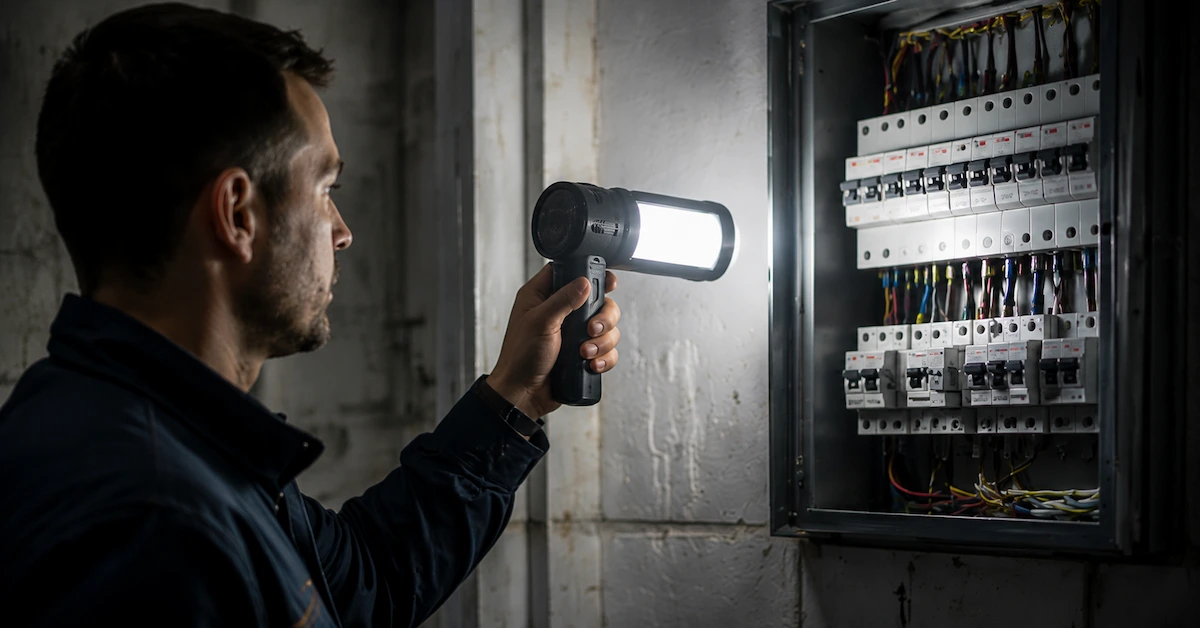
A facilities team may work inside ceiling voids, plant rooms, air-handling units, and mechanical equipment cabinets. Portability, low-mode usability, charging convenience, and grip become important. A headlamp may be more convenient when the technician is climbing a compliant access system or managing equipment with both hands. A light does not replace safety lighting, confined-space controls, or approved electrical equipment.
Field-service vehicles and remote sites
In a mobile service van, the light shares space with tools, cables, meters, and batteries. The correct questions concern accidental switch activation, protection of the charging port, visible battery state, cable consistency, and whether the unit has a designated holder. Choosing an unusually bright model is less useful if the unit cannot be secured in the service case.
Equipment inspection and quality checks
Portable lighting helps with visible leaks, corrosion, surface marks, identification plates, wiring routes, and general assembly checks. However, a flashlight is not a substitute for calibrated inspection illumination, a thermal instrument, or electrical test equipment. If defects must be graded under controlled lighting, define a separate validated inspection method.
| MRO task | Useful portable-light format | Key acceptance question | Typical kit consideration |
|---|---|---|---|
| Mechanical housing and fastener inspection | Adjustable-head or compact directional flashlight | Can the beam reach the feature without excessive glare? | Secure pocket position and cable |
| Hands-free work near a steel machine frame | Magnetic-tail or right-angle flashlight | Does the mounting hold at the intended angle and surface condition? | Clip, strap, protective placement |
| Plant room and service corridor checks | Rechargeable headlamp or portable flashlight | Is medium-mode output adequate through the task? | Headstrap condition, charging routine |
| Mobile field-service visits | Compact rechargeable light with clear controls | Can the light be located, switched and stored with gloves? | Asset marking and service-case slot |
| Precision microscope or automated inspection | Dedicated inspection illuminator | Is specialized optical control required? | Separate specialist equipment |
3. Translate Light Output Into Useful Illumination at the Job
Lumens are a starting point, not a purchase decision. Lumens describe total visible light output, while the light reaching the actual working surface depends on beam distribution, position, and distance. A high-output narrow beam can create a hotspot on stainless steel or polished fittings. A lower mode or changed angle may provide a clearer inspection view. In a portable work light wholesale comparison, the useful beam is the one that illuminates the actual task at the specified distance.
Procurement teams should specify at least three operating conditions: the approximate working distance, the intended viewing area, and the duration for which useful light is needed. For example, a technician examining a narrow connector recess has a different need from someone inspecting a large mechanical enclosure. These examples are use-case categories, not unverified claims that a particular model will meet a measured lux target.
Ask the supplier for mode-specific output and runtime evidence , not just one peak-lumen figure. A light can lower its output as the battery discharges or the housing warms; a package that quotes the first few seconds may not describe performance ten minutes later. Where meaningful comparisons are required, request test information using a consistent method.
The ANSI/PLATO FL 1-2025 Flashlight Basic Performance Standard , published by the Portable Lights American Trade Organization and ANSI, provides a framework for comparing reported portable-light performance. Its scope includes output, beam distance, runtime, impact resistance, and ingress protection. This is a useful independent reference for RFQ terminology, not evidence that any specific Brightenlux SKU has been tested or certified under that standard.
When reviewing samples, record visual glare, apparent beam width, switching sequence, thermal feel, and operator comfort. A two-person review can be practical: one technician performs the task while another documents whether the beam can be positioned without occupying a hand or interfering with tools.
4. Compare Battery Architectures Without Guessing Runtime
The battery is part of the service system. An 18650, 21700, or 16340 label identifies a cell format, but it does not independently guarantee a particular working duration. Driver efficiency, selected output mode, cell quality, temperature, and automatic step-down behavior all affect the result.
Consider what happens after the light leaves the factory. Will a depot recharge it after every shift? Will technicians carry spare charged units? Is the battery intended to be user replaceable? Will the cable be supplied with every kit? Are battery and light serial or lot references traceable for complaint handling? These matters determine long-term service cost.
USB Type-C is convenient when it is supported by the actual electrical design. Do not assume that a Type-C socket automatically establishes USB Power Delivery support, universal C-to-C compatibility, or a particular charging time. Test the intended power adapter, cable, environmental conditions, and charging behavior on production-intent samples.
A field-service charging plan should identify who owns the charger , when the unit returns to the rack, how a low battery is flagged, and what happens if a unit fails its charging check. For large team deployments, standardize the kit's connector and instructions where feasible; otherwise the procurement team may save on hardware but pay for cable confusion.
Battery and charging questions to put in the RFQ
- What exact cell type, nominal capacity, and configuration are included?
- Are the cell and charging cable included in the production pack?
- How is runtime measured for each usable mode, and what is the endpoint?
- What is the quoted charge time with the specified power source?
- What are the charge, full-charge, and low-battery indicators?
- What protection and documentation correspond to this exact battery assembly?
- How will replacement parts, returns, or end-of-life units be handled?
- Which battery, driver, and cable substitutions require written buyer approval?
These questions make a rechargeable work light wholesale quotation comparable across configurations. They also keep a public listing from being mistaken for a final controlled purchase specification.
5. Mechanical Design: The Small Components That Determine Field Usability
A portable light may spend more time attached to clothing, stored in a van, or repositioned than held in an ideal studio pose. Evaluate the whole mechanical system: housing geometry, head pivot, magnet, clip, hook, battery compartment, switch, charging cover, and supplied mount. Small mechanical failures can become major operational problems when hundreds of technicians use the same configuration.
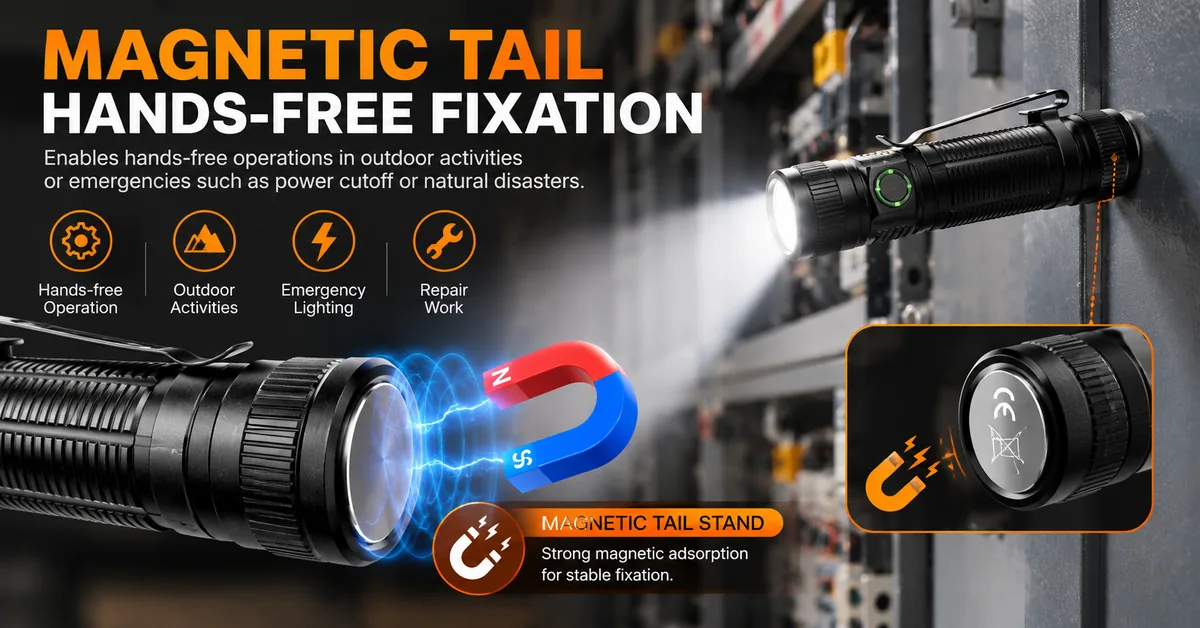
Magnetic mounting: Test the proposed magnet on the actual metal surface, including paint or coating where relevant. Measure how securely the light stays in the intended orientation. A magnet that holds a stationary light on a clean vertical plate may behave differently on a curved, oily, vibrating, or painted surface. Never treat a generic magnetic feature as permission to attach the light to energized or safety-critical equipment.
Adjustable heads and hinges: Confirm that the selected angle remains stable after repeated adjustments. Look for excessive play, wear, loose components, and interference with gloves. Document the angle range on the approved sample rather than assuming all adjustable designs rotate identically.
Pocket clips and straps: Check retention force, edge finish, ease of removal, stitching, mounting hardware, and the chance of snagging. The right accessory often improves task completion more than a small increase in peak lumens.
Materials and cleaning: Brightenlux publishes models using aluminum, ABS, and optical materials such as PMMA. These material terms help identify a starting construction, but they do not establish resistance to oils, solvents, disinfectants, or industrial chemicals. Ask for application-specific compatibility evidence where routine wiping or contact with contaminants is expected.
Water and dust exposure: Read the complete IP marking on the exact model. The international IEC 60529, Degrees of Protection Provided by Enclosures (IP Code) , describes the framework for enclosure ingress ratings; it does not automatically prove resistance to every fluid, impact, high-pressure cleaning method, or chemical exposure. Verify that the report covers the product configuration and that charging covers are used as specified.
6. Real Brightenlux Platforms for an MRO Lighting Brief
Brightenlux , operated by Ningbo Brightenlux Electric Appliance Co., Ltd., supplies portable LED lighting and discusses OEM/ODM programs for international buyers. Its outdoor work and repair lighting page describes applications in workshops, job-site inspection, and field-service vehicles.
At the time of this review, the dedicated Working Light category does not provide a reliable list of stocked specialist work-light SKUs. The comparison below therefore uses documented flashlight and headlamp platforms as possible starting points for manual MRO lighting kits. It does not mean these products are certified industrial inspection tools, that every listed accessory is included in each pack, or that the supplier has committed to a particular bulk-order specification.
| Brightenlux reference | Published configuration | Potential MRO role | Verify before bulk approval |
|---|---|---|---|
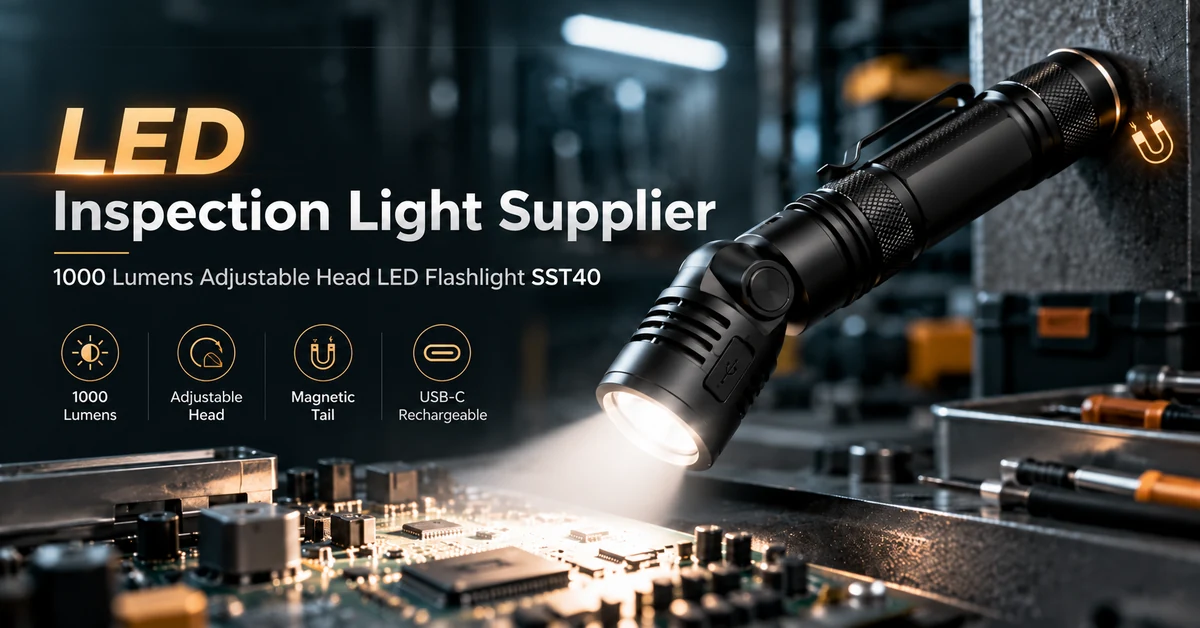
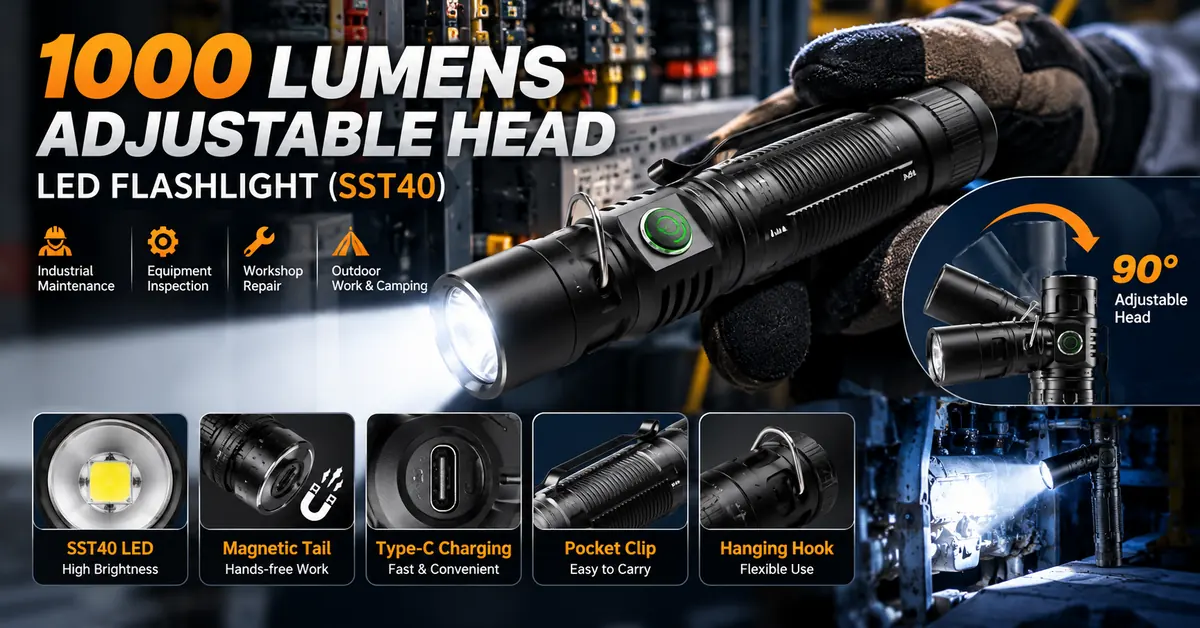
| 1000 lm adjustable-head SST40 flashlight | Adjustable head, magnetic tail, Type-C, 18650 2200mAh cell; product literature cites IP44 | Directional bench and equipment inspection | Real head positioning, charge time, output by mode, report scope |
| 1000 lm 90° SST25 right-angle flashlight | Magnetic tail, 16340 800mAh included, Type-C, five modes, 55g public claim | Tight-access checks and hands-free work | Magnet hold, strap/clip contents, runtime on selected mode |
| BT-FL8088 1500 lm SST40 flashlight | Included 21700 4000mAh battery, Type-C, magnetic tail, IPX4 stated; 106g listed | Longer task-oriented portable lighting where suitable | Sustained output, beam, cable, charging, magnet performance |
| BT-HL9101 650 lm rechargeable headlamp | SST20, red/warm side LEDs, Type-C, 1800mAh cell, 90g stated | Hands-free plant-room and close maintenance tasks | Fit, beam comfort, working time, straps, mode logic |
All figures are manufacturer-published model claims, not independently verified laboratory findings. The quote, final pack-out, active SKU, IP evidence, MOQ, and dispatch schedule must be confirmed for the actual project.
The right-angle model is worth sampling where mounting flexibility matters. BT-FL8088 is a different battery and output architecture; it should not be assumed to replace the smaller light without a task trial. The headlamp solves a different problem: it directs light with the operator's head while leaving both hands available. If a buyer needs a true wide-area freestanding work lamp or a dedicated COB folding inspection light, ask Brightenlux for its current working-light catalogue rather than inventing a model from an empty category page.
Compare Verified Portable-Light Models · Discuss MRO Sample Configurations
7. Build a Field-Service Kit Manifest, Not Just a Product List
The most distinctive purchasing document for MRO deployment is a kit manifest . It states what should be present every time a kit is issued, returned, replenished, and shipped. Without it, two facilities can receive the same nominal flashlight but different cables, straps, warning sheets, or batteries.
Create a controlled kit identification such as MRO-LIGHT-KIT-A . This is an illustrative buyer-assigned code, not an existing Brightenlux SKU. Attach a revision letter and an approved component list. A kit record can identify: primary light model, approved alternative, battery configuration, charging cable, mount or strap, carry pouch or insert, manual language, asset tag, carton quantity, and inspection reference.
For a maintenance distributor, the pack may be supplied as a service-van replenishment line. For an employer, it may be issued as equipment to an individual technician. For an OEM brand, it may be sold inside a specialized mechanical service case. The physical contents may overlap, but the identification and replenishment methods will differ.
Example of a buyer-defined MRO kit manifest
| Controlled field | Example buyer entry | Acceptance evidence |
|---|---|---|
| Kit revision | MRO-LIGHT-KIT-A, revision 01 | Revision printed on approved packing record |
| Primary light | Approved Brightenlux reference model | Model label and retained sample |
| Battery | Exact approved included cell, where applicable | Battery identification and pack verification |
| Charging | Approved Type-C cable and intended input | Charge test with agreed cable and power source |
| Mounting | Selected clip, headstrap, or compatible magnet arrangement | Accessory count and task trial |
| Documentation | English manual plus destination-market needs | Controlled artwork PDF |
| Identification | Buyer asset ID or private-label marking | Placement and abrasion review |
| Shipment | Defined unit carton and master-carton count | Packing list and random carton audit |
None of the entries above should become an automatic supplier promise. The buyer must request availability and pricing for each kit component. A practical supplier quotation will show which items are standard, which are optional, and which require development or additional testing.
8. Validate the Kit in a Real Maintenance Work Cycle
An isolated bench test will not reveal the failure modes of a deployed service kit. A more useful pilot replicates the day-to-day workflow in a controlled, nonhazardous environment: issue, carry, operate, mount, recharge, inspect, return . The buyer can run this trial with its own technicians and record the outcome, instead of relying exclusively on supplier promotional photographs. Portable work light wholesale samples should carry the proposed production revision and accessory manifest.
Stage 1 — Baseline record: Photograph the sample, record its model and revision, confirm the included cell and accessories, and log the initial charge condition. Note the intended work environment and any limitations supplied by the manufacturer.
Stage 2 — Task execution: Have representative users perform a normal maintenance inspection under appropriate safety controls. Ask whether the beam reaches the target, whether the switch can be found, and whether mounting frees a hand. Record issues that are reproducible, not only subjective likes or dislikes.
Stage 3 — Output and runtime: Select one working mode and document when it becomes unsuitable for the task. If a measured claim is essential, use a defined photometric test rather than an informal observation. Keep both results separate: laboratory runtime and practical task suitability are different kinds of evidence.
Stage 4 — Charging and storage: Return the unit to the agreed charger or cable, observe indicator behavior, and check for undue heating or connector problems. Verify that the kit slot accommodates the light without accidentally operating the switch or damaging the charging cover.
Stage 5 — Repositioning and handling: Repeat normal clip, magnet, strap, and head-adjustment movements. Inspect for loosening, wear, or loss of retention. Do not invent a universal pass/fail cycle count; agree the method and minimum result with the buyer's quality team.
Stage 6 — Pack reconciliation: Count accessories and check the manual, asset tag, and kit revision. A missing cable may be cheap but can render a rechargeable unit unavailable during the next shift.
Stage 7 — Release decision: Classify findings as accepted, accepted with documented limitations, or requiring revision. Record a retained golden sample and the agreed specification. Approval should attach to that defined build, not simply the marketing name of the light.
This operational pilot gives a portable maintenance light supplier meaningful feedback and allows the buyer to convert an attractive product into a controlled service resource.
9. QC, Production Controls, and Documentation Buyers Should Request
A wholesale purchase can fail even when the first sample works well if component revisions, assembly processes, and test boundaries are not controlled. The supplier's general factory capability matters, but the buyer also needs records connected to the specific lighting model and kit configuration .
Begin with incoming critical items: LED identity, optics, driver, switch, charging assembly, battery, magnet, clip, plastic mount, and packaging. Ask how each item is identified and whether substitutions are controlled. Then review assembly checks: component seating, polarity, screws, seals, alignment, switch operation, indicators, and visual defects. Final pack-out should match the approved manifest. In a portable work light wholesale tender, put these controls into the quality agreement rather than leaving them as verbal assurances.
A purchase-order attachment can make the release rule explicit:
- Functional inspection: Every agreed operating mode, charging indication, and switch behavior matches the approved sample.
- Mechanical inspection: Magnet, clip, strap mount, head adjustment, and charging cover behave within approved limits.
- Optical performance evidence: Output, beam characteristics, and runtime are reviewed using the defined method where required.
- Cosmetic inspection: Finish, logo, lens, assembly seams, and visible surfaces match approved acceptance examples.
- Documentation check: Battery records, destination-market statements, manual, and carton markings apply to the delivered configuration.
- Traceability: Production lot and kit revision can be linked to a future return or corrective action.
Do not use general statements such as “all products are certified for industrial use.” Instead, request model- and market-specific evidence. The IP Code described in IEC 60529 and performance reporting methods from ANSI/PLATO FL 1-2025 can inform the specification, but neither should be presented as an automatic certificate possessed by the products listed above.
For battery transport, confirm the required classification, test summary, marking, packing configuration, and carrier acceptance through the shipper and relevant specialist. The correct documents depend on the actual cell, how it is packed, transport mode, destination, and current rules. Product marketing copy is not a substitute for shipment-specific dangerous-goods review.
10. Cost Per Usable Kit: A Better Commercial Calculation
The most useful portable work light wholesale comparison is the cost of an approved and usable service kit delivered to the point where the customer needs it. A low bare-unit quote is not necessarily cheaper if another proposal includes the battery, cable, mount, manual, carton, and inspection evidence that the buyer would otherwise purchase separately.
Calculate the provisional delivered-kit cost as follows:
Delivered kit cost = approved light and included battery + required accessories + branding and packaging + quality/testing allocation + freight and duties + distribution handling.
Then estimate service cost over the intended replacement period by adding reasonable provisions for replacements, warranty handling, charging accessories, lost units, and administrative effort. Use your own observed rates or scenario assumptions; do not invent failure percentages or guarantee a payback period.
For example, Scenario A might be a standard right-angle model with a cable and simple bulk identification. Scenario B could add a logo, headstrap, molded carry insert, serial label, and printed guide. Even with the same light, the delivered price and service value differ. Ask for both configurations on the same quotation sheet rather than treating them as equivalent SKUs.
Also normalize commercial conditions. Compare the same battery inclusion, order quantity, packaging standard, currency, Incoterm, inspection responsibility, payment terms, warranty scope, spare-parts assumptions, and delivery destination. Pricing without these fields is preliminary, not a purchase-ready decision.
A practical sourcing team also asks whether spare units should be held at regional depots. The answer depends on service criticality, procurement lead time, return processes, and local availability. Maintaining a modest buffer may be sensible for uninterrupted operations, but the correct level must come from actual demand and service data rather than a universal percentage.
11. OEM/ODM Options for Distributors and Private-Label Service Kits
Brightenlux publicly presents OEM/ODM, product development, and brand customization support through its outdoor-lighting business page . For a wholesale MRO program, the first customization decisions should be operational rather than purely decorative.
Private-label scope to discuss: Logo position, finish, packaging, printed technical description, manuals, barcode labels, included cable, identification stickers, and the presence of compatible straps or clips. None should be assumed available at a fixed MOQ without a supplier quotation.
Configuration scope to discuss: Desired operating modes, LED/optic selection, battery and charging arrangements, mounting accessories, or control sequence. These may require engineering review and new samples; a customer-requested change is not automatically supported by an existing production platform.
New-development scope: Specialized bracket geometry, custom housing, a kit-specific docking arrangement, or features not present on existing products. Ask who owns the tooling, what development checkpoints are required, and which test evidence must be updated. If the proposed device enters a regulated or safety-critical application, involve qualified compliance specialists before approval.
A commercially useful OEM project has staged sign-offs: sourcing brief, sample plan, first sample, corrected sample, engineering or packaging freeze, pilot production, quality release, and shipment. Separate component changes from cosmetic changes so a late logo adjustment does not silently authorize a new battery, driver, or optic.
Before placing a repeat order, require written notice of any changes to approved LEDs, batteries, switches, driver boards, clips, magnets, housings, charging components, or accessories. A small substitution may alter performance or the validity of existing test evidence even when the outside appearance is unchanged.
Explore Brightenlux OEM/ODM Services · Send an OEM MRO Kit Brief
12. MOQ, Capacity, Lead Times, and Replenishment: What to Confirm
A supplier's broad statement about manufacturing experience does not establish the current stock, MOQ, annual capacity, sample timing, or production lead time of any proposed kit. Those must be discussed after the light and pack-out are defined. The dedicated Working Light category currently lacks visible specialist model listings, making a current catalogue and model confirmation especially important for buyers requiring a freestanding or folding work lamp.
Separate quotation timing into distinct milestones: initial availability check, sample preparation, sample delivery, branding/artwork approval, production component confirmation, pilot acceptance if applicable, volume production, final inspection, and dispatch. A single “fast delivery” promise is not sufficiently precise for a service-kit deployment spread across multiple depots. Portable work light wholesale timelines are most useful when quoted as approval and manufacturing milestones.
Ask whether lead time changes when batteries, custom plastic inserts, printed manuals, or branded cartons are included. Confirm whether an urgent replenishment can use the same approved components and whether alternate materials or cells would require reapproval. Price and delivery should be linked to a controlled revision and order quantity.
For distributors serving multiple maintenance contractors, use a replenishment worksheet with fields for customer location, kit revision, issued quantity, returned quantity, damaged or missing accessories, forecast demand, and reorder trigger. These are buyer-side operational suggestions, not features claimed to be provided by Brightenlux's website or software.
The goal is to ensure that procurement can order the same usable kit again—not just something with a similar photograph and lumen figure.
13. The Buyer-Ready RFQ: Copy These Fields Into Your Sourcing Request
A strong RFQ reduces back-and-forth because it separates what must work , what may be customized , and what the supplier still needs to confirm . Start by making the project goal clear: “Portable service lighting for industrial MRO teams working on de-energized machinery and general facility equipment.” If the task includes special environments, state that requirement explicitly rather than expecting the supplier to infer it.
For an actionable portable work light wholesale RFQ, include these fields in the first inquiry:
- Buying entity and market: Company, delivery country, customer channel, and destination language.
- Primary application: Mechanical equipment, facilities service, general industrial inspection, or field-service van kits.
- Work geometry: Typical working distance, beam area, preferred mounting location, and hands-free requirements.
- Candidate format: Handheld, adjustable-head, magnetic, right-angle, headlamp, or a separately quoted specialist work lamp.
- Power: Included cell, charge port, usable runtime, charger/cable plan, and storage routine.
- Environment and safety: Splash or dust exposure, cleaning needs, site rules, and required model-specific documents.
- Kit contents: Battery, cable, clip, strap, pouch, printed guide, labels, and carton arrangement.
- Branding: Logo, colors, packing artwork, barcode, and language requirements.
- Commercial scope: First-order quantity, estimated repeat volume, delivery term, and target schedule.
- Approval plan: Sample acceptance method, golden-sample control, permitted substitutions, and warranty process.
Ask the supplier to reply with a model-specific recommendation , a list of assumptions and unavailable requests, the proposed sample contents, MOQ by customization level, price basis, lead-time stages, and missing technical data. This is more actionable than a single request for the “best portable work light price.”
14. Frequently Asked Questions About Portable Work Light Wholesale
1. What does portable work light wholesale mean for industrial MRO buyers?
It means procuring portable task lighting in quantities appropriate for maintenance teams, industrial distributors, or equipment service programs. The useful buying unit may be a controlled kit containing a rechargeable light and specified accessories, rather than a bare lamp. The buyer should verify the task, kit contents, evidence, and reorder conditions before approving volume purchasing.
2. Are rechargeable flashlights acceptable as portable work lights?
They can be suitable for manual maintenance and localized inspection when beam, mount, control, runtime, and workplace requirements match the job. They are not automatic substitutes for broad-area floodlights, hazardous-location lamps, or dedicated precision inspection systems. Test a representative sample in the real task.
3. Which is better for service kits: an adjustable-head flashlight or a headlamp?
An adjustable-head flashlight can direct light independently of the wearer's gaze and may offer magnetic mounting. A headlamp follows the operator's head and can free both hands. The correct choice depends on work position, helmet or PPE compatibility, shadows, comfort, and approved task procedures; it is not decided by lumens alone.
4. What battery information should a wholesale buyer request?
Ask for the exact cell format and capacity, battery inclusion, charging method, runtime by mode, test conditions, indicator behavior, relevant safety and transport documentation, and substitution controls. Confirm the full production pack instead of assuming a battery is included because one product photograph shows it.
5. Can Brightenlux supply a complete custom MRO lighting kit?
Brightenlux advertises OEM/ODM and product customization discussions, but a complete kit's feasibility, contents, accessories, MOQ, and timeline need project-specific confirmation. Share a proposed kit manifest and request a quotation that distinguishes standard parts from optional or newly developed items.
6. Are magnetic portable lights safe for every industrial location?
No. The surface, positioning, electrical conditions, movement, contamination, and workplace procedures all matter. A magnet is a convenience feature, not a safety approval. Do not attach a standard flashlight to sensitive, live, hazardous, or moving equipment without appropriate authorization and a validated method.
7. How can buyers compare lumen and runtime claims fairly?
Request measured values for defined modes, battery configurations, ambient conditions, and test endpoints. The ANSI/PLATO FL 1-2025 framework offers useful terminology for reported portable-light performance, but buyers should confirm the actual method used for the offered model. Compare sustained usable light, not only initial output.
8. What does IP44 or IPX4 mean for a portable maintenance light?
It identifies specific degrees of enclosure ingress protection under a defined test approach. It does not automatically cover chemical exposure, pressure washing, repeated mechanical damage, or every outdoor condition. Request the model-specific rating and supporting evidence and confirm that ports and covers are used correctly.
9. How should bulk-order quality be approved before shipment?
Use an agreed specification, a retained golden sample, and an inspection checklist covering modes, charging, battery, mount, housing, appearance, accessories, labels, and packaging. If performance claims are commercially important, define how they will be tested and who evaluates the results. Record any substitutions before approval.
10. What information will help Brightenlux provide an accurate quotation?
Provide the destination market, intended maintenance job, preferred product format, sample quantity, estimated bulk order and reorder volumes, battery and charging needs, mounting requirements, desired accessories, branding, required documents, and requested timeline. Contact Brightenlux to confirm current model availability and the appropriate sample path.
Conclusion
A successful portable work light wholesale program for industrial MRO does more than supply bright, rechargeable devices. It establishes a workable lighting method, a controlled service-kit manifest, a repeatable issue-and-recharge process, credible quality evidence, and a quotation that includes the accessories and commercial conditions buyers actually need. A useful light should be safe for the intended environment, easy to position during the task, and simple to identify and replace across multiple service locations.
Brightenlux's portable LED flashlight portfolio and outdoor work-lighting application page provide a starting point for selecting real sample platforms. For wholesale, private-label, or OEM/ODM inquiries, share your MRO application, required kit contents, estimated quantity, target market, and acceptance conditions through the Brightenlux contact page . The right outcome is not merely a lower unit quotation: it is a clear, verifiable kit that your team can deploy, manage, and reorder with confidence.
Request Your MRO Lighting Quote · View Available Brightenlux Products