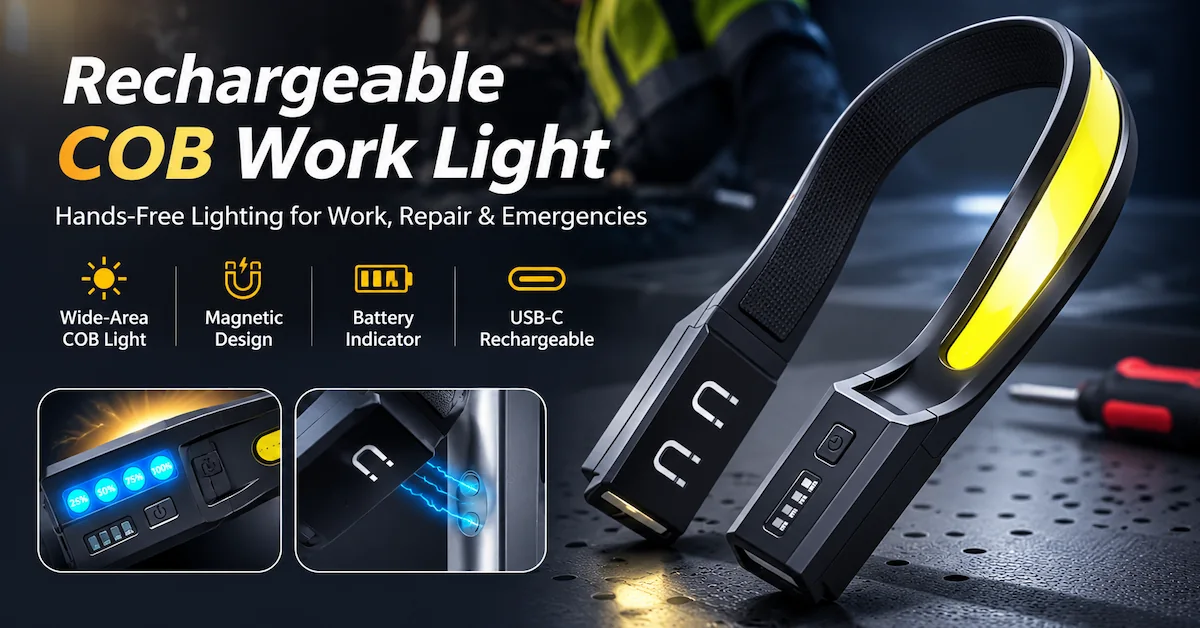


A reliable magnetic work light manufacturer should help OEM buyers evaluate mounting performance on the actual surfaces where technicians will use the light. A magnet's advertised pull force does not establish resistance to sliding, peeling, rotation, or accidental detachment. Before wholesale purchasing, buyers should test complete production-intent samples on representative painted and unpainted steel, define measurable acceptance criteria, inspect surface protection, and control magnetic components throughout production.
A magnetic LED work light can provide convenient hands-free illumination during automotive repairs, equipment inspections, and industrial maintenance. However, a product that stays securely attached to a thick steel plate during a factory demonstration may behave differently on a painted vehicle panel, curved machine housing, or vibrating workshop structure.
The customer may not complain about insufficient lumens or battery capacity. Instead, the light may slide down a vertical panel, rotate after adjustment, or leave visible marks on a finished surface. These problems cannot be evaluated from product photographs or price quotations alone.
For an effective OEM project, magnetic mounting should be specified and tested as a complete mechanical system. This article focuses on mounting and surface-protection acceptance. For broader product architecture decisions, see the Brightenlux automotive magnetic work-light selection guide.
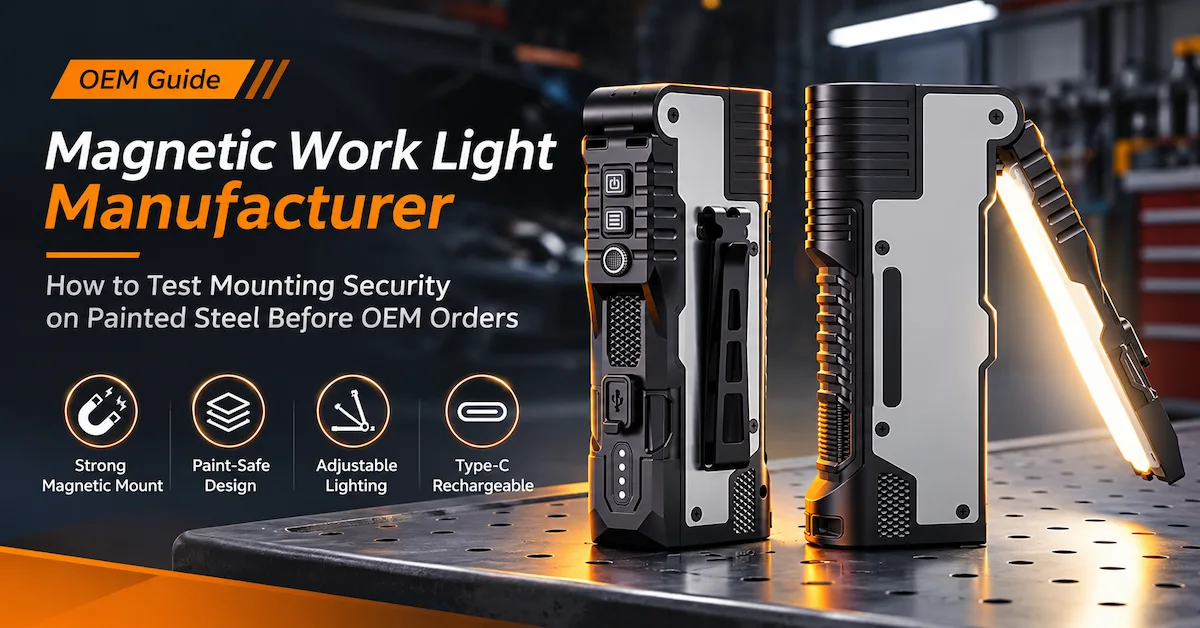
1. What Should a Magnetic Work Light Manufacturer Verify Before Bulk Production?
The first requirement is to determine how the product will be installed and used. Magnetic mounting performance depends on the entire assembly and its environment:
- Magnet material, geometry, and arrangement.
- Contact surface material and thickness.
- Paint, coatings, and protective pads.
- Surface curvature and contamination.
- Work-light weight and center of gravity.
- Lamp orientation and adjustment angle.
- Mechanical vibration and repeated handling.
- Charging cables and external loads.
A strong magnet alone cannot guarantee a stable work light. A compact magnetic-tail flashlight mounted horizontally may behave differently from a folding COB lamp with an extended head, which can increase leverage at the contact point.
Which buyers need mounting validation?
| Buyer type | Typical application | Critical purchase requirement |
|---|---|---|
| Automotive tool distributor | Engine bays and repair stations | Stable attachment without unacceptable paint damage |
| Industrial maintenance supplier | Machine housings and steel structures | Repeatable aiming and adjustment |
| Private-label tool brand | Retail rechargeable work lights | Consistent mounting quality between batches |
| Fleet maintenance supplier | Vehicle service environments | Convenient attachment and repositioning |
| Workshop equipment importer | Professional inspection tools | Documented sample acceptance criteria |
| OEM lighting brand | Customized magnetic work lights | Controlled magnet, housing, and mounting design |
The objective is to define the actual operating conditions rather than assume that every magnetic work light serves the same purpose.
2. Why Is Magnetic Pull Force Different From Real Mounting Security?
Magnetic pull force is often promoted as a headline specification, yet the measurement method matters. A typical laboratory test applies a force perpendicular to a magnet attached to suitable steel. This differs from a lamp hanging on a vertical panel or working at an angle.
K&J Magnetics' technical explanation of magnet-strength testing discusses how steel thickness, contact gaps, material, and geometry affect measured pull force. For OEM purchasing, laboratory pull force must not be confused with real mounting stability.
Direct pull-off resistance
A pull-off test measures the force needed to separate an attachment from a defined surface in a stated direction. A result obtained against thick, flat steel should not automatically be applied to thin, curved, or coated metal.
Vertical sliding resistance
On a vertical surface, gravity acts downward. The mount resists movement through magnetic attraction together with contact-material friction. A smooth or contaminated surface may allow a product with high perpendicular pull force to slide.
Peeling and rotational stability
Peeling occurs when an edge of the mounting interface begins lifting. A long inspection light or extended head can introduce significant leverage. A lamp may also stay attached but rotate, moving the beam away from the task.
| Failure mode | Potential cause | Buyer evaluation |
|---|---|---|
| Direct pull-off | Force away from the mounting surface | Controlled perpendicular separation test |
| Vertical sliding | Gravity and insufficient friction | Timed vertical hold test |
| Peeling | Off-center load and leverage | Maximum-angle mounting test |
| Rotation | Uneven loading or contact geometry | Beam-position stability test |
| Surface marking | Abrasive debris or contact material | Paint-protection inspection |
| Detachment | Impact, cable tension, vibration | Controlled disturbance test |
Procurement takeaway: Ask the supplier which failure modes are relevant and which methods can demonstrate the approved configuration under real-use conditions.
3. How Do Painted, Thin, and Curved Steel Surfaces Affect Magnetic Work Lights?
Painted vehicle panels
Paint and coating layers create a gap between a magnet and the underlying steel. The additional separation can reduce attachment force. Buyers should therefore use representative painted panels, not only clean steel blocks.
Thin sheet steel
Thin sheet metal may not support the same magnetic interaction as a thick test plate. Ask which material grade and thickness the supplier used to generate any stated holding-force figure.
Curved and irregular contact surfaces
A mount designed for flat steel may touch a curved panel only partially, introducing air gaps and leverage. Test the expected curvature, orientation, and weight distribution.
Aluminum, stainless steel, and contamination
Aluminum and other non-ferromagnetic surfaces are not suitable for a conventional magnetic mount. Some stainless steels can also be weakly magnetic. Oil, dust, and ferrous debris may impair contact or scratch painted surfaces during repositioning.
| Surface | Main concern | Suggested test |
|---|---|---|
| Thick carbon steel | Baseline attachment | Reference pull-off measurement |
| Painted sheet steel | Coating gap and paint contact | Pull-off, sliding, surface inspection |
| Thin steel panel | Reduced magnetic performance | Loaded hold and comparison |
| Curved steel panel | Partial contact and peeling | Angle and stability tests |
| Vertical panel | Gravity-driven sliding | Timed slip test |
| Machine housing | Vibration and finish | Controlled disturbance test |
| Aluminum panel | Magnetic incompatibility | Specify alternate mounting method |
These are proposed buyer tests, not universal industry pass/fail values.
4. How Should OEM Buyers Test Magnetic Holding Performance?
A repeatable evaluation provides stronger purchasing evidence than an informal demonstration. The buyer should agree on test geometry, equipment, acceptance limits, and the complete production-intent sample.
Step 1: Identify the approved sample
Record the product model, revision, magnet or mounting component, complete battery configuration, total weight, hinge position, surface grade, thickness, coating, and test conditions.
Step 2: Measure baseline pull-off resistance
Use a suitable force-measuring device and controlled fixture. Record loading direction, rate, peak force, and repeatability. The result is meaningful only with its corresponding test conditions.
Step 3: Run a vertical sliding test
Mount the complete light on representative painted steel, adjust it to its intended working position, and record downward movement or rotation over an agreed duration.
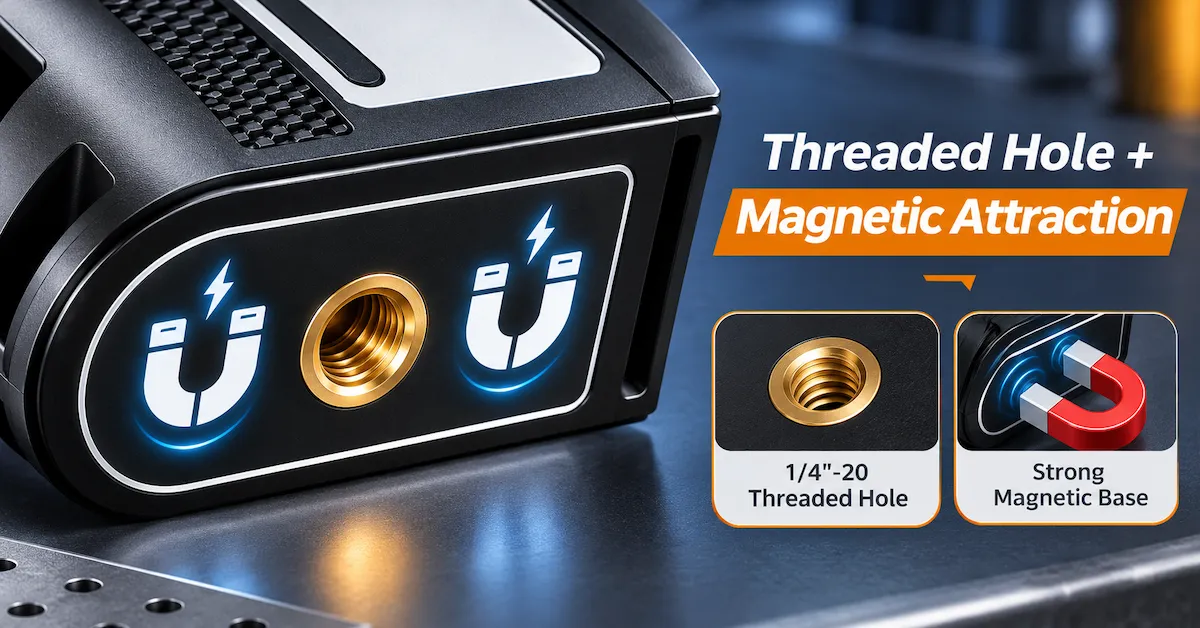
Step 4: Test maximum intended adjustment angle
Extend or angle the lamp head to the most demanding approved operating position. Check that the mount remains attached and correctly aimed.
Step 5: Test repeated repositioning
Attach, remove, and reposition the lamp for a defined number of cycles. Examine the mounting pad, housing, joint, and magnet for changes that affect function.
Step 6: Test handling and disturbances
Operate switches and make normal beam adjustments while mounted. If the product supports cable-connected operation, evaluate the approved cable configuration and its mechanical effects. Control all disturbance tests to avoid injury.
Step 7: Document acceptance
| Test | Sample setup | Buyer-defined acceptance |
|---|---|---|
| Pull-off | Approved steel fixture | Agreed minimum separation force |
| Vertical holding | Painted steel panel | No fall; movement within tolerance |
| Peeling | Maximum head angle | Remains attached as specified |
| Rotation | Normal use position | Acceptable beam direction |
| Repositioning | Repeated attach/remove | No loss of required functionality |
| Paint protection | Approved painted panel | No unacceptable marks |
| Disturbance | Controlled application fixture | No unintended detachment |
Specific numeric limits must be agreed for the product. This table is not a published magnetic-mounting standard or a Brightenlux test record.
Safety: Overhead or suspended tests require suitable secondary restraint and controlled fixtures. A magnetic work light is not automatically a certified lifting or fall-protection device.
5. How Do Product Weight and Lamp Geometry Influence Stability?
Product weight matters together with orientation and center of gravity. A simplified engineering starting point is:
For a hypothetical work light with a 0.20 kg mass, the approximate weight force is 0.20 × 9.81 = 1.96 N. If the effective moment arm in the proposed orientation is 0.12 m, the resulting moment is about 1.96 × 0.12 = 0.235 N·m.
These figures illustrate the effect of an extended lamp head. They do not establish a safe magnet rating or an actual Brightenlux specification. Friction, contact area, magnet arrangement, and external forces still determine stability.
Changes such as a larger battery, longer housing, different hinge, repositioned magnet, or added bracket should trigger an engineering impact review and, where necessary, new mounting tests.
6. Which Brightenlux Lighting Platforms Can Be Evaluated for Magnetic Work Applications?
Brightenlux publishes several rechargeable portable lights with magnetic tails. These are useful references for selected inspection tasks. They are documented flashlights rather than confirmed dedicated COB workshop lamps. Their published specifications have not been independently validated for this article.
| Published platform | Listed features | OEM evaluation focus |
|---|---|---|
| BT-FL8078 right-angle flashlight | 1000 lm SST25, 16340 800 mAh battery, Type-C, 90° head, magnetic tail | Compact contact and beam direction |
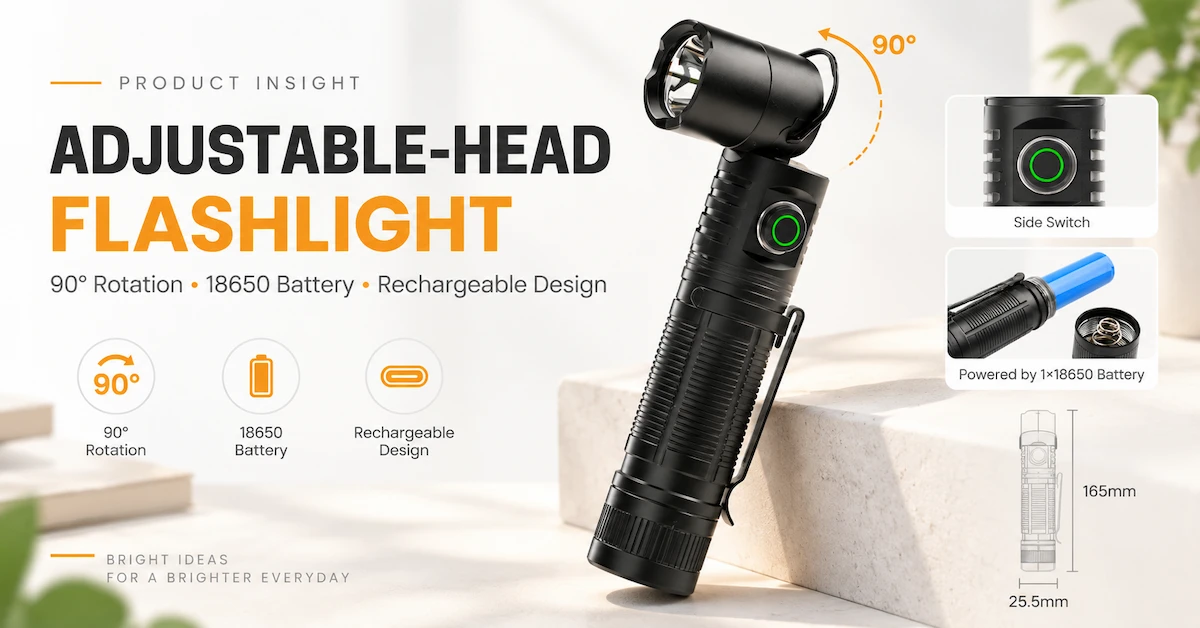
| 1000 lm SST40 adjustable-head flashlight | SST40, 18650 battery, adjustable head, magnetic tail | Angle leverage, rotation, positioning |
| BT-FL8088 rechargeable magnetic flashlight | 1500 lm SST40, 21700 4000 mAh battery, Type-C, magnetic tail | Battery mass, mounting, sustained output |
BT-FL8078 Right-Angle Flashlight
Reference platform for compact directional inspection, magnetic-tail positioning and a rechargeable 16340 battery.
See product details →1000 lm SST40 Flashlight
Useful for discussing how beam-angle adjustments influence peeling moments, rotation and mounting stability.
See product details →BT-FL8088 Magnetic Flashlight
A published higher-capacity battery configuration for considering weight, runtime and mounting trade-offs.
See product details →For a specialized COB magnetic work light, request the current catalogue, exact model, battery configuration, mounting drawings and customization feasibility. Do not assume these flashlight models can be converted to any work-lamp architecture without engineering changes.
7. How Can OEM Manufacturers Reduce Paint-Scratching Risks?
Surface protection is a real commercial concern for automotive tool brands. A magnetic mount may hold adequately yet still produce unacceptable marks on painted bodywork.
Protective contact materials
Some designs place pads or other protective interfaces between the magnet and steel. Such materials may reduce direct contact but can introduce an additional gap, affecting magnetic attraction. Mechanical and surface-protection performance must be tested together.
Ferrous particle accumulation
Small metal particles may collect on exposed magnetic surfaces. If trapped between a magnet and painted panel, they can scratch the finish during repositioning. Product instructions should address appropriate cleaning and handling.
Practical surface-inspection procedure
- Photograph a representative panel before testing.
- Clean the contact area using an approved method.
- Attach the light at the agreed working orientation.
- Reposition it according to a defined handling procedure.
- Remove the product and inspect under consistent illumination.
- Record scratches, marks or other unacceptable changes.
A stronger magnet is not always better: the design should balance adequate retention, user effort, contact materials and the risk of surface damage. Avoid describing any untested arrangement as universally scratch-proof.
8. How Should Lighting Performance Be Tested Alongside Mounting?
Mounting stability and useful illumination are connected. A lamp that stays attached but cannot aim at the required task is not a successful work-light solution.
Beam positioning and task illuminance
Record the working distance, beam orientation and illuminated area. Measure the contribution of the work light at the actual task surface instead of relying only on maximum lumens.
Sustained output and runtime
Portable lighting performance can be assessed under the ANSI/PLATO FL 1-2025 Flashlight Basic Performance Standard, which describes standardized methods and reporting for attributes such as output, distance and runtime. It does not certify magnetic mounting strength. Ask the supplier to identify the operating mode and relevant test conditions.
Approved battery and cable configuration
Battery mass and position can change the center of gravity. If the work light supports charging while mounted, evaluate the permitted cable arrangement and any resulting extra load. Do not assume operation during charging is supported.
| Evaluation | Goal | Buyer question |
|---|---|---|
| Magnetic mounting | Mechanical stability | Does the light remain positioned? |
| Beam orientation | Application fit | Can the beam reach the task? |
| Task illuminance | Useful visibility | Is the work surface adequately lit? |
| Runtime | Operating duration | Does it meet the required use cycle? |
| Controls | Ease of use | Can the lamp be operated while mounted? |
| Charging | Safe power arrangement | Is the approved method practical? |
9. What Manufacturing and Quality Controls Matter for OEM Magnetic Work Lights?
A production order should be governed by a controlled configuration and an approved sample. Critical items may include magnets and mounting hardware, protective contact materials, housing fasteners, LED modules, rechargeable batteries, charging parts, switches and adjustable joints.
Incoming and assembly checks
Verify critical component identity, magnet positioning, attachment integrity, joint operation, mechanical fit and relevant electrical functions. Even an appropriate magnet can be undermined by poor assembly.
Finished-goods inspection
For suitable attribute-based inspection, the ISO 2859-1:2026 acceptance sampling standard provides a basis for AQL-indexed lot-by-lot sampling plans. Sampling does not replace design verification or risk-based control of critical failures.
Repeat-order change control
Require notification and review of changes involving magnet grade, dimensions, pads, housing geometry, hinge mechanisms, battery weight or lighting electronics. Re-test when the updated configuration is no longer represented by the approved samples.
| Control area | Expected evidence |
|---|---|
| Product configuration | Approved model, BOM and revision |
| Magnet assembly | Component identity and inspection method |
| Mounting performance | Test records under defined conditions |
| Surface protection | Approved painted-panel inspection |
| Battery and lighting | Correct configuration and relevant records |
| Finished goods | Agreed sampling and inspection documents |
| Packaging | Approved labels, accessories and instructions |
| Repeat orders | Component-change and approval records |
10. What OEM/ODM Customization Options Should Buyers Discuss?
Brightenlux publicly offers OEM/ODM discussions for portable lighting. Feasibility and commercial terms should be confirmed for the exact model and proposed changes.
Appearance, branding and packaging
Potential requests include logo marking, body colors, product identification, retail packaging, manuals, selected accessories and market-specific information.
Magnetic mounting and mechanical revisions
A different magnetic configuration, protective pad, bracket or housing geometry may require engineering assessment, prototype work, tooling changes and additional validation. Such modifications should not be treated as simple cosmetic updates.
Electrical and lighting revisions
Changes in LED output, battery platform, charging electronics and mode logic may influence weight, temperature, runtime and overall performance. Request an impact assessment before approving production.
This is a recommended buyer workflow, not a claim that Brightenlux follows one fixed procedure or lead time for every project.
11. How Should Buyers Compare Magnetic Work Light Wholesale Quotations?
A lower unit price does not always mean a lower total purchasing cost. Request a quotation identifying the complete configuration, battery, accessories, validation, packaging and shipping conditions.
| Quotation component | What to confirm |
|---|---|
| Base product | Exact model, revision and operating modes |
| Magnetic system | Standard or custom mounting arrangement |
| Battery and charging | Type, inclusion, cables, charger, documents |
| Housing and finish | Materials, appearance and protection |
| Branding | Logo, packaging and setup charges |
| Engineering | Development, tooling and validation costs |
| Inspection | Methods, sampling and reporting |
| Freight | Carton details, Incoterm and destination |
Mounting-related failures can add costs through returns, damaged surfaces, replacement units and repeat testing. Conversely, an expensive mounting feature is not justified unless it provides value in the intended application.
Model-specific MOQ and lead time vary with product availability, component procurement, customization scope, quantity and factory scheduling. Request these terms in writing rather than assuming a universal figure.
12. What Should Be Included in a Magnetic Work Light RFQ?
An effective RFQ explains how the lamp will actually be used. Buyers should include enough information for the supplier to propose a comparable and technically feasible configuration.
| RFQ field | Buyer information to provide |
|---|---|
| Application | Automotive repair, inspection, maintenance, field service |
| Format | Magnetic flashlight, folding light, COB work lamp |
| Mounting surface | Steel type, thickness, paint, curvature |
| Orientation | Vertical, horizontal, inclined; any restricted use |
| Attachment requirements | Pull-off, sliding and positioning criteria |
| Surface protection | Contact materials and acceptable finish condition |
| Power | Battery platform, runtime, charging preferences |
| Optical performance | Beam coverage, task illumination, modes |
| Branding | Logo, colors, accessories and packaging |
| Commercial plan | Sample quantity, order forecast, country, target schedule |
| Documentation | Specification, sample tests, inspection plan |
Ask suppliers what mounting data already exist, which test surfaces can be supported, which changes require engineering approval, and how mounting components will remain consistent across repeat orders.
Turn your application into a model-specific OEM quotation
Share your mounting surface, working position, battery target and estimated order quantity. Request available product references, technical feasibility and a sample-validation plan.
13. Frequently Asked Questions About Magnetic Work Light Manufacturers
1. What should I look for in a magnetic work light manufacturer?
Look for a manufacturer that can identify the proposed product configuration, explain mounting design, provide applicable specifications and support representative sample testing. Evaluate mounting stability, lighting, battery, customization and production consistency together.
2. How can buyers verify a magnetic work light's holding strength?
Define the test surface, loading direction, product configuration and measurement method. Use controlled pull-off tests alongside sliding and positioning checks. A headline pull-force number alone does not establish performance in all positions.
3. Will a magnetic work light stick to every metal surface?
No. Attachment depends on the surface being sufficiently ferromagnetic and compatible with the mounting design. Aluminum and many other metals are unsuitable, and some stainless steels provide little attraction.
4. Can magnetic work lights damage vehicle paint?
Under some conditions they can leave marks, especially when abrasive debris or unsuitable contact materials are present. Use representative painted-panel tests and define acceptable results before approval.
5. Is a stronger magnet always better?
No. The magnet should deliver sufficient retention without unnecessary handling difficulty, cost or surface risk. Balance strength with product weight, geometry, friction and expected user behavior.
6. What is the difference between pull-off and sliding resistance?
Pull-off concerns separation away from the contact plane. Sliding concerns movement along that plane. The forces and contact behavior differ, so one measurement cannot substitute for the other.
7. Can Brightenlux supply private-label magnetic work lights?
Brightenlux publishes rechargeable magnetic-tail lighting products and describes OEM/ODM support. A dedicated work-light model, modification, MOQ or lead time must be confirmed for the requested configuration.
8. Which magnetic work light is suitable for automotive maintenance?
It depends on attachment material, working space, beam direction, task duration and ergonomics. Compact magnetic flashlights suit some local inspections; broader tasks may require a dedicated work-light design.
9. Should mounting tests be repeated after changing a battery or housing?
Changes affecting mass, center of gravity, magnet components or mounting geometry can alter stability. Review their impact and repeat tests when previous evidence no longer represents the product.
10. How do I request a wholesale magnetic work light quotation?
Provide the application, mounting surface, lighting and battery requirements, OEM needs, intended quantity and destination market. Contact Brightenlux to discuss current models, feasibility, samples and quotation conditions.
Conclusion
Choosing a magnetic work light manufacturer requires more than comparing brightness, battery capacity, magnet claims and wholesale prices. The central question is whether the complete light stays correctly positioned on the surfaces technicians actually use.
For automotive distributors, industrial maintenance suppliers and private-label brands, reliable sourcing requires pull-off, sliding, peeling, rotation, repeated-handling and surface-protection evaluations. Those requirements should become documented sample tests and controlled production specifications.
Design changes involving the battery, housing, joint or magnetic interface may affect previously approved performance. Brightenlux's existing magnetic-tail rechargeable flashlight platforms provide starting points for selected inspection tasks; a dedicated magnetic COB work-light project requires model-specific engineering confirmation.
Combine practical application tests, documented acceptance criteria and repeat-order controls to reduce sourcing uncertainty and make better-informed bulk purchasing decisions.