

Magnetic LED Flashlight Supplier Guide for Inspection Work
In inspection work, a flashlight is part of the workflow, not just a convenience. Buyers searching for a magnetic LED flashlight supplier usually need a compact light that fits tight spaces, stays useful during hands-on tasks, and supports one-handed or hands-free use. That is why sourcing teams focus on mounting, beam practicality, and handling more than decorative features. If you are comparing options, start with the product range and keep the real maintenance task in view.
Why buyers keep asking for a magnetic LED flashlight supplier
The reason this category draws attention is simple: technicians often need light and open hands at the same time. A flashlight that drops, shifts, or gets in the way slows down work inside breaker panels, utility cabinets, equipment bays, and other confined areas. A magnetic or mountable design addresses that problem by letting the user place the light near the task instead of holding it throughout the job.
For engineers and sourcing managers, the question is not whether a light turns on. It is whether the product can support real maintenance work without creating friction. In that sense, the best supplier is the one that understands inspection use, not just general consumer flashlights. The tool should feel practical from the first minute of use and still make sense after repeated service calls.
Where this product is used in inspection work
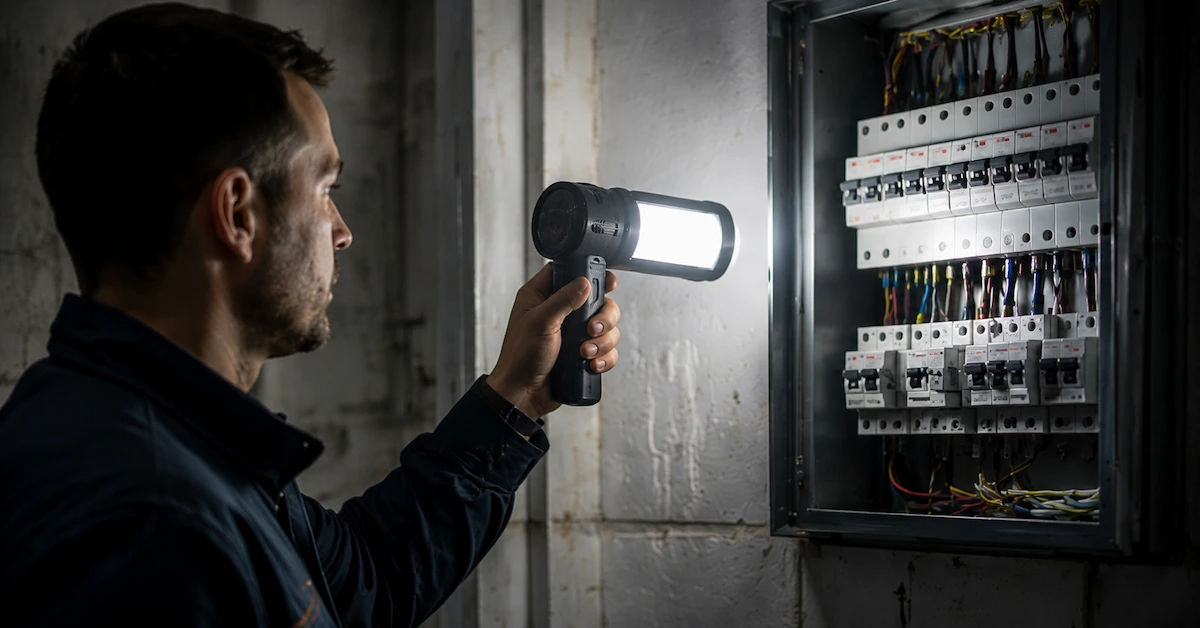
The product category shown in the source fits a common maintenance pattern: a compact flashlight or torch used for inspection, with the added benefit of magnetic or dock-like placement on a metal surface. That makes it easier to position light near the work area while keeping one hand free for tools, notes, or cable movement.
Typical use cases include service calls in electrical rooms, breaker panel inspection, labeling checks, utility cabinets, metal enclosures, basements, garages, workshops, and dim corners in plant environments. It can also help during temporary troubleshooting when ambient light is poor. These are practical tasks, so the light does not need to be flashy; it needs to be useful, portable, and easy to use in real conditions.
What to look for in the flashlight design
The source points to a compact, black, cylindrical flashlight with a rounded bezel and a hard-use appearance. That shape often works well in maintenance settings because it balances hand comfort with directional control. Buyers should care about how the body feels in the hand, how it fits in a bag, and whether it can be carried without becoming a burden.
| Buyer focus | What to verify |
|---|---|
| Inspection work | Clear close-range illumination for labels, screws, terminals, and wiring paths |
| Tight spaces | Compact body size that does not block access inside cabinets or panels |
| Hands-free use | Stable mounting or placement on metal surfaces without constant adjustment |
| Field carry | Easy storage in a tool bag, pocket, or service kit for daily use |
Beam behavior matters just as much as shape. For inspection work, buyers usually want a bright white front light that makes close details easier to see without unnecessary glare. A focused, usable beam can be more effective than a more dramatic light that looks strong on paper but feels awkward in a cabinet.
Why magnetic mounting is popular in maintenance lighting
Magnetic mounting is popular because it reduces setup time. A technician can place the light near the work area, align it toward the target, and continue working without juggling a handheld torch. That convenience is especially useful in electrical maintenance, where one hand may already be occupied with testing, holding a cover, or steadying a part.
There is still an important caveat: magnetic mounting only works well when the contact surface is suitable. Powder-coated, oily, uneven, or non-magnetic surfaces may reduce stability. Buyers should ask how the light behaves on the kinds of cabinet surfaces they use most often. If the mounting method is not secure in practice, the product may still function as a flashlight, but it will not be a strong inspection accessory.
Choosing between a flashlight supplier and a manufacturer
Some buyers search for a LED flashlight manufacturer because they want deeper customization, while others prefer a magnetic flashlight supplier because they need a simpler sourcing path and standard catalog availability. The right choice depends on the project. If the goal is to add a reliable light to maintenance kits, a stable off-the-shelf offer may be enough.
If you need packaging adjustments, a specific body color, branding, or a different mounting concept, a manufacturer may be the better place to start. In either case, a structured request helps. Ask for material details, mounting method, power arrangement if relevant, switch style, beam pattern, service part availability, and consistency across production lots. If you want to discuss a sourcing fit, you can contact us or send an inquiry.
Common mistakes buyers make
One common mistake is buying for brightness alone. For inspection work, usability matters more than headline claims. A light that is difficult to place, uncomfortable to hold, or awkward in a cabinet may be less useful than a simpler model. Buyers should focus on how the product performs in the actual task environment.
Another mistake is ignoring the working conditions. Utility rooms, workshops, and basements can be hard on tools, and repeated handling exposes weak switches, flimsy clips, or awkward mounts. A third mistake is over-specifying the product. More features are not always better if the team only needs reliable everyday lighting. The better approach is to define the job first, then match the light to it.
What to ask before placing a bulk order
Before placing a bulk order, buyers should first confirm the intended use. Is the light meant for electrical panel inspection, warehouse service, emergency kits, or general maintenance? That answer changes what matters most. A good supplier conversation starts with the task, not with a catalog picture.
Ask how the light is held or mounted on metal surfaces, whether it is meant for handheld use, mounted use, or both, and how the beam behaves in close-quarter work. It also helps to check whether the body is compact enough for tool bags and belt carry, and how the supplier handles packaging and consistency. A sample tested in a real cabinet usually tells more than a page of specifications.
FAQ for sourcing teams
Is a magnetic light always better than a handheld one?
No. A magnetic setup is useful when hands-free lighting matters, but some technicians prefer a simple handheld torch for quick checks. The best choice depends on the task, the space, and how often the user needs to reposition the light during inspection.
Should we prioritize metal body construction?
Not necessarily, but durability should stay in the discussion. A hard-use shell, whether metal or reinforced polymer, is usually more suitable for service work than a fragile consumer-style body. The key is whether the product can handle repeated field use.
Can one light cover both inspection and emergency use?
Often yes, as long as the beam, mounting, and handling remain practical. The product should be simple enough for daily service work and reliable enough to stay in a kit until needed. In this category, versatility is valuable when it does not reduce usability.
What should we test in a sample?
Test how the light fits in the hand, how it mounts on a typical metal surface, and whether the beam helps inside a cabinet rather than only on an open table. Also check whether the body size suits your service kit and whether the product feels consistent and dependable.