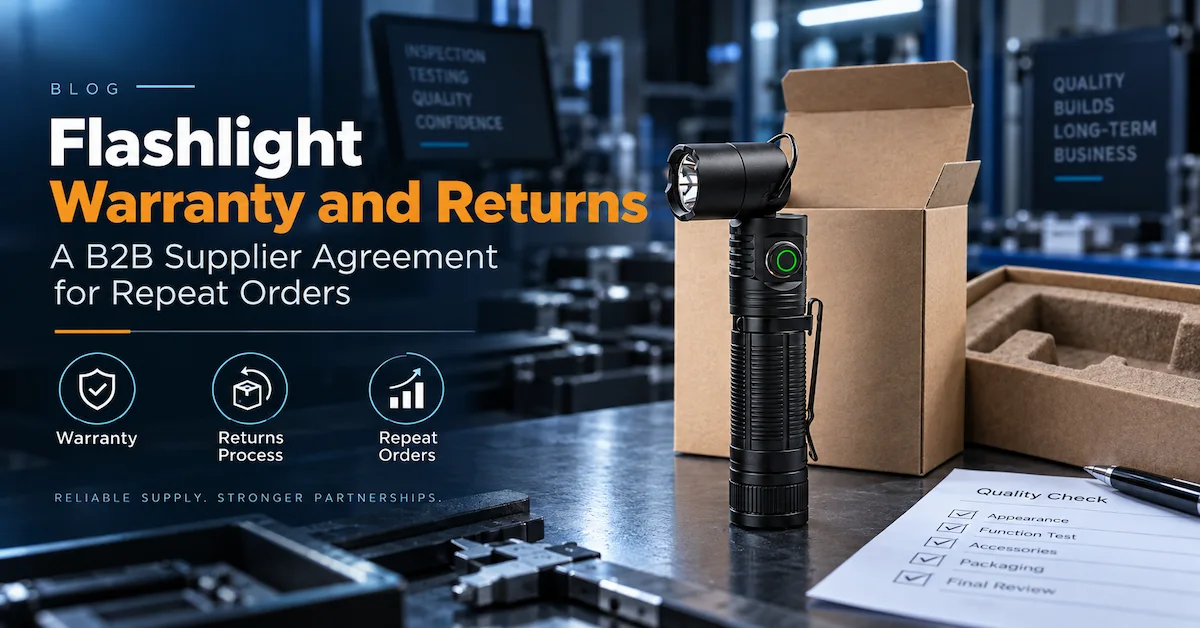


A reliable long beam flashlight supplier should provide more than a flashlight with an impressive advertised beam distance. Overseas brands and industrial distributors should evaluate measured peak beam intensity, useful target visibility, optical consistency, sustained output, battery reliability and repeatable production quality. A published 600m beam claim should be supported by appropriate testing of the exact product configuration before it is used in commercial marketing or approved for bulk purchasing.
1. What Makes a Flashlight Truly Long Beam?
A long beam flashlight is designed to concentrate light into a comparatively narrow beam that can travel a significant distance. It is commonly used for outdoor observation, large property inspection, perimeter checks and applications where the user needs to illuminate targets farther away than an ordinary utility flashlight would comfortably support.
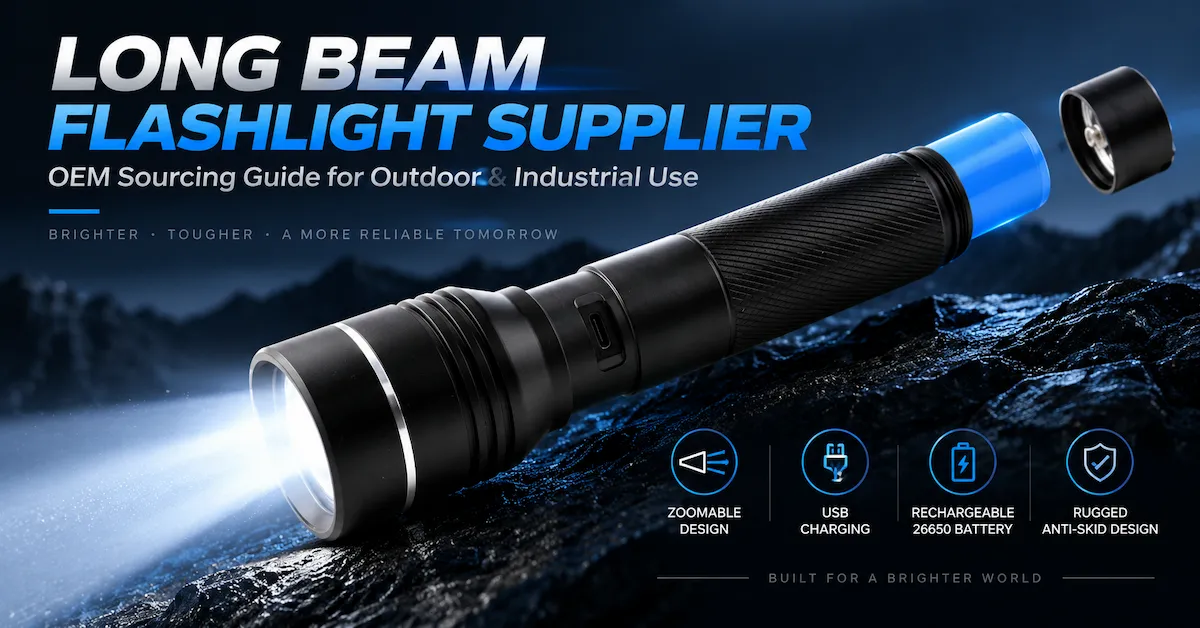
However, long-distance flashlight performance should not be judged by maximum lumens alone. Two products with similar lumen ratings may deliver very different beam distances because they use different reflectors, lenses, emitters and optical configurations.
For overseas importers and professional lighting distributors, the key question is not simply how bright a flashlight appears in promotional photographs. The purchasing decision should consider how effectively the beam illuminates a real target, how much surrounding area remains visible, and whether the lighting performance can be maintained during typical use.
An experienced long beam flashlight supplier should understand the relationship between luminous flux, peak beam intensity, reflector geometry, electrical drive conditions and thermal management.
These technical factors affect the performance of every flashlight in a product range. They also influence manufacturing consistency and the accuracy of retail packaging claims.
A factory may be capable of assembling a powerful flashlight, but that does not automatically mean that every unit will deliver identical beam intensity. LED alignment, reflector position, battery characteristics and driver tolerances can introduce variation.
Professional OEM sourcing therefore requires a clearly defined specification, an approved sample, a suitable testing procedure and a repeatable quality-control system.
2. Brightenlux Long Beam Flashlight Models Compared
Brightenlux offers a number of rechargeable LED flashlight designs relevant to long-distance lighting. Some published product listings describe beam distances of up to 600 meters, while other models emphasize adjustable beam patterns, higher lumen output or additional power functions.
These products give brands and distributors different starting points for OEM development. The following comparison illustrates how lumen output, power systems and optical design can influence product positioning.
| Product | Published Output | Published Beam Distance | Battery System | Potential Application |
|---|---|---|---|---|
| 500 Lumen Long Beam Flashlight | 500 lm | Up to 600m | 18650 rechargeable | Compact long-distance lighting |
| BT-FL8112 | 1000 lm | Up to 600m | 18650 rechargeable | Outdoor observation and portable inspection |
| BT-FL8114 | 2000 lm | Up to 600m | 26650 rechargeable | Long-range focused lighting |
| BT-FL8101 | 3000 lm | Up to 300m | 26650 / AA configurations | Adjustable-focus outdoor lighting |
The values shown above are manufacturer-published product specifications. They should be used for preliminary product comparison rather than treated as independent verification of delivered performance.
The comparison reveals an important purchasing principle: a higher lumen rating does not automatically mean greater beam distance. A flashlight producing 500 lumens may have a strongly focused optical system, while a 3000-lumen product may distribute more of its total output over a wider area.
Importers should decide whether their customers need concentrated distance lighting, adjustable focus, broad illumination or a combination of these features.
Explore the published Brightenlux 2000-lumen focused flashlight to understand one of the company's long-range product configurations.
For buyers seeking a higher total output with adjustable focus, compare the Brightenlux 3000-lumen rechargeable flashlight .
3. What Does a 600m Flashlight Beam Claim Actually Mean?
A 600-meter beam-distance rating can be useful for comparing flashlights when it is produced under a consistent measurement standard. However, it is important to understand what that distance represents.
In the ANSI/PLATO FL 1 measurement framework, beam distance is associated with the distance at which central illuminance falls to approximately 0.25 lux.
That level of illumination does not necessarily mean that a user can clearly recognize a person, identify a small object or read a label at the specified distance.
Actual recognition depends on target size, contrast, weather, background lighting, the user's eyesight and the distribution of light within the beam.
For buyers evaluating published beam-distance claims, the inverse-square relationship provides a useful theoretical reference.
Illuminance is related to beam intensity and distance through the approximate formula:
Illuminance (lux) = Intensity (candela) / Distance² (meters²)
For a 600m beam-distance claim under a 0.25-lux threshold:
Required peak intensity ≈ 0.25 × 600 × 600 = 90,000 candela.
This calculation gives a theoretical benchmark for a conventional 600m beam-distance specification.
It is not a measured result for any particular Brightenlux flashlight. The supplier should provide the appropriate model-specific photometric evidence before a buyer repeats such a claim in marketing materials.
For OEM purchasing, ask the factory to identify the measured peak candela, the testing method, the operating mode, the battery condition and the sample revision used to calculate beam distance.
4. Lumens, Candela and Optical Design: Why Beam Concentration Matters
Understanding the distinction between lumens and candela is essential when sourcing long-distance flashlights.
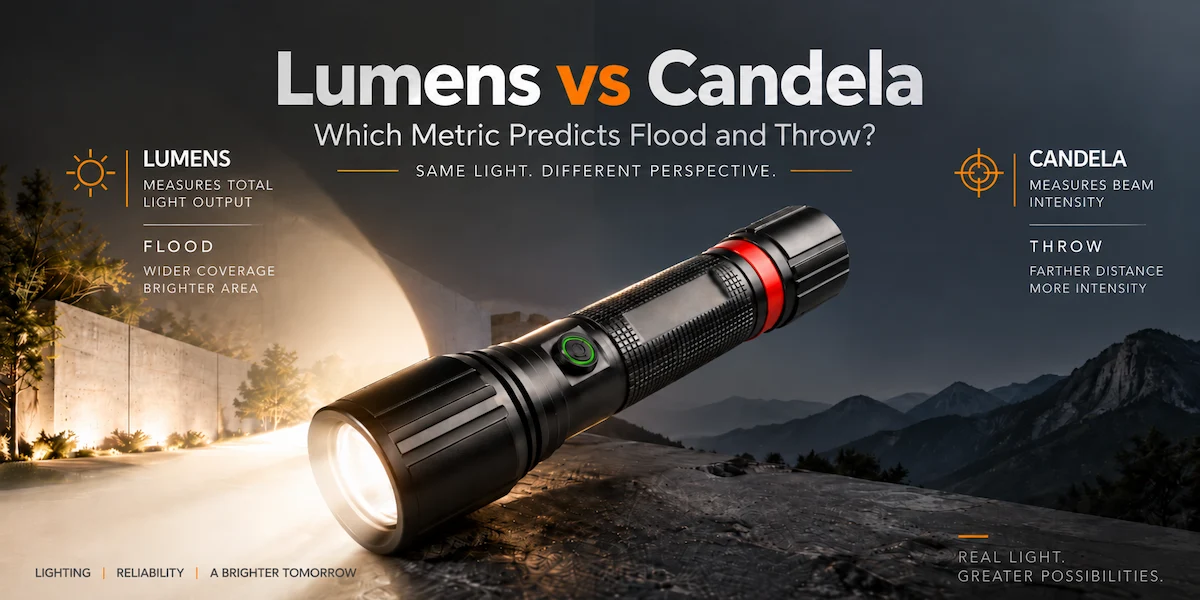
Lumens measure total visible luminous flux. Candela measures luminous intensity in a particular direction.
A high-lumen flashlight may provide excellent area lighting without producing an especially long beam. Conversely, a focused optical system may concentrate a smaller amount of light into a narrow central hotspot.
Reflector diameter, reflector depth, lens geometry, LED emitting area and component alignment all influence the final distribution.
The optical assembly must work with the electrical driver and thermal system. Simply installing a different LED does not guarantee an improvement in distance performance.
For a supplier comparison, request beam measurements and images taken under identical conditions.
A fixed camera exposure, identical target distance and controlled battery condition can reveal meaningful differences between product samples.
The beam should also provide sufficient surrounding visibility for the intended application.
A narrowly concentrated beam may help with distant spotting but be less comfortable for walking or close-range maintenance.
Buyers should therefore evaluate the relationship between hotspot, spill lighting and usable field illumination rather than choosing a product exclusively from its published maximum distance.
5. How Should Importers Test a Long Beam Flashlight Sample?
Before placing a large wholesale order, buyers should request representative samples and test them against the intended application.
An effective sample evaluation includes photometric, electrical, thermal, mechanical and user-experience checks.
| Test Category | Evaluation Method | Why It Matters |
|---|---|---|
| Beam Intensity | Measure peak candela under defined conditions | Supports distance calculations |
| Beam Distribution | Compare hotspot and spill at fixed distances | Determines real application suitability |
| Runtime | Record brightness over time | Identifies thermal step-down and battery limitations |
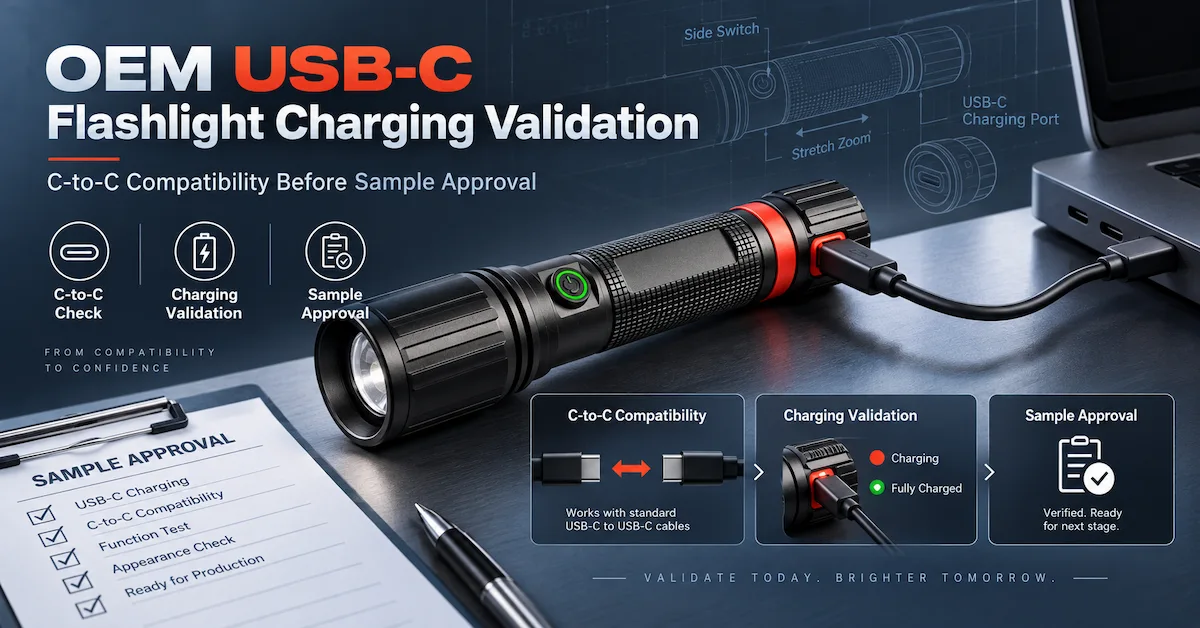
| Charging | Test compatible USB-C cables and power supplies | Reduces charging complaints |
| Mechanical Quality | Inspect switches, focus assemblies and closures | Supports product reliability |
| Ingress Protection | Request matching model-specific test evidence | Supports environmental claims |
| Packaging | Check included accessories and printed information | Reduces commercial disputes |
Buyers should document the sample identification, battery specification, measurement instruments, ambient temperature and test date.
This creates a reference for later discussions with the supplier and provides evidence if future production differs from the approved sample.
A sample that looks impressive during the first few seconds may behave differently after prolonged operation.
Therefore, record the brightness curve over the time period that reflects normal customer use.
For a distributor serving professional customers, the useful performance after thermal stabilization may be more commercially important than the maximum initial output.
6. Sustained Output, Heat Management and Runtime
Long-distance flashlights may use high-power LEDs and concentrated optical systems that generate substantial heat during operation.
The driver, LED mounting, thermal interfaces and housing work together to maintain acceptable operating conditions.
A flashlight may reduce output after a period of high-mode operation to limit internal temperature.
This behavior can be part of a suitable thermal protection strategy. However, it should be understood and documented before the product is sold with a performance claim.
A runtime specification is not sufficient unless the operating mode and measurement conditions are identified.
A model may operate for several hours at reduced brightness while providing a much shorter period of maximum output.
OEM buyers should request output-versus-time records for the relevant lighting modes.
These records help determine whether a flashlight is suitable for patrol work, outdoor observation or extended facility inspections.
Thermal design also influences ergonomics. The flashlight should be evaluated under realistic handling conditions.
Surface temperature, grip comfort and switching behavior are important for users wearing gloves or operating the flashlight repeatedly.
7. Rechargeable Battery Selection for Long-Range Flashlights
Battery selection influences runtime, product dimensions, charging convenience, shipment requirements and customer experience.
Long-range flashlight products may use 18650, 21700 or 26650 rechargeable lithium-ion batteries.
Each battery format presents different trade-offs in size, capacity, handling and sourcing availability.
The battery must be compatible with the approved electronic driver and charging system.
A higher published capacity does not automatically guarantee proportionally longer operating time at high output.
Actual runtime depends on LED power, driver efficiency, temperature, battery quality and discharge behavior.
For bulk orders, define the approved battery specification and request documentation supporting the selected cell.
Changes to battery suppliers or cell specifications should be managed through an agreed component-approval process.
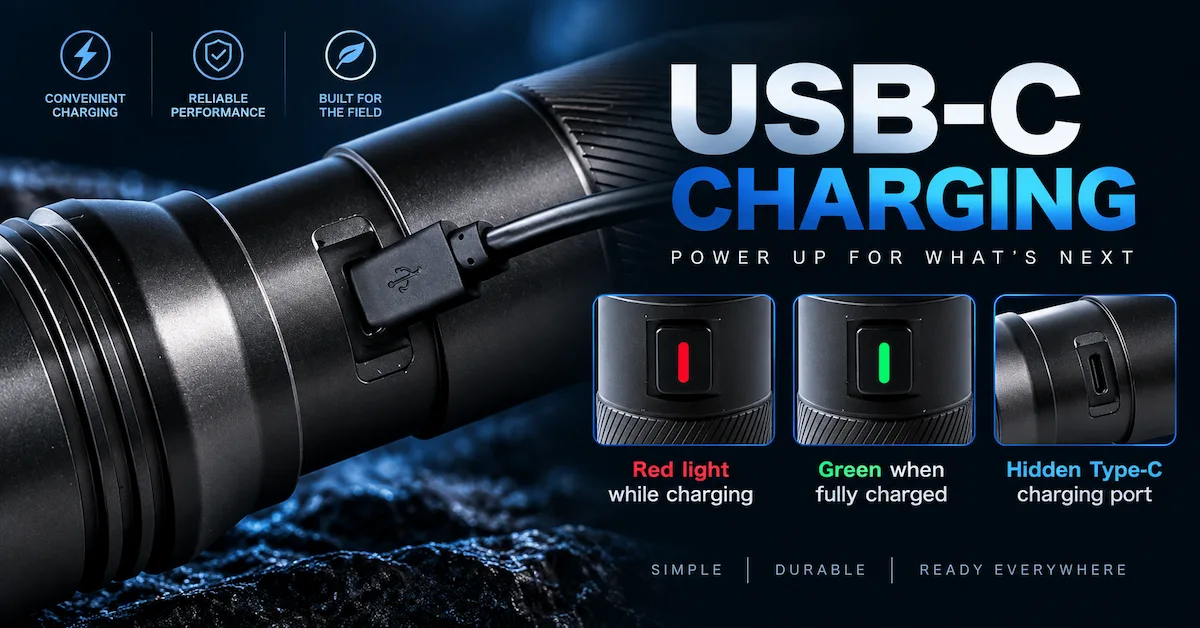
USB-C charging must also be evaluated for the intended destination market.
A USB-C connector alone does not guarantee compatibility with every charger or charging cable.
Test the actual approved flashlight with representative power supplies, cables and charging conditions.
Buyers should confirm battery-included status, charging indicators, charge time and any applicable transport documentation.
8. Which Buyers Need Long Beam Flashlights?
Outdoor Equipment Brands
Outdoor equipment brands may sell long-beam flashlights for camping, night observation and remote-area activities.
Their customers often value rechargeable power, portability, weather protection and straightforward operation.
For these products, a balanced combination of beam distance, spill illumination and runtime may be preferable to maximum central intensity alone.
Industrial Equipment Distributors
Industrial distributors may supply flashlights for large warehouses, equipment inspections and general facility operations.
Their buyers typically need consistent product quality, clear operating instructions and reliable repeat orders.
The flashlight should be tested in representative work environments before it is positioned as professional equipment.
Security and Patrol Equipment Suppliers
Patrol-related buyers may prioritize beam concentration, rapid switching, grip comfort and sufficient operating time.
However, a published 600m beam-distance claim should not be used as a promise of clear identification at that distance.
The application should determine the required illumination, beam distribution and product testing.
Private-Label Retail Brands
Private-label brands often need a differentiated product range rather than several nearly identical flashlights with different names.
A suitable assortment may combine focused long-range models, adjustable-focus flashlights and rechargeable utility lighting.
This creates clear buying choices based on use rather than relying only on increasing lumen ratings.
Looking for an OEM Long Beam Flashlight Supplier?
Send Brightenlux your target beam distance, application, preferred rechargeable battery, branding requirements, order quantity and destination market for a model-specific sourcing discussion.
Request a Custom Flashlight Quotation →9. OEM/ODM Long Beam Flashlight Customization
OEM and ODM projects differ in the scope of engineering and manufacturing changes.
Private-label orders may involve logo printing, packaging design, instruction manuals and selected cosmetic details.
More complex OEM projects can involve changes to optics, LED selection, driver behavior, battery configuration or mechanical components.
These changes may affect output, beam distance, heat management, water resistance and product compliance.
Therefore, modified versions should be assessed against the relevant requirements before mass production.
An efficient project begins with a written product brief.
The brief should identify target users, intended applications, beam requirements, battery preferences, packaging, target market and approximate purchase volume.
The supplier should identify which requirements can be met through an existing product platform and which require engineering review.
After sample evaluation, buyers should approve a reference configuration and agree on how future component changes will be communicated.
Brightenlux provides information about its business and OEM capabilities on its official company introduction page .
10. Quality Control and Compliance for Bulk Orders
Factory quality control is essential when supplying long-range flashlights to overseas brands and distributors.
The finished product depends on the interaction of electrical, mechanical and optical parts.
An incoming component check may include LEDs, drivers, batteries, lenses, reflectors, switches, charging ports and mechanical housings.
Assembly inspection should address LED positioning, optical alignment, connections, seals and mechanical workmanship.
Finished-unit checks should verify basic lighting modes, charging indicators, switching behavior, appearance and packaging contents.
For performance-related claims, buyers should ask which measurements are performed on every unit and which are conducted through sampling or external testing.
The inspection plan must match the application and order risk.
Documentation should also match the actual product configuration.
Factory-level statements about testing, certification or quality-management practices do not prove that every model has an identical approval.
Importers should request specific documents for the product and market concerned.
Where an ingress protection rating is claimed, verify the test scope and the configuration used during testing.
For rechargeable models, confirm the relevant lithium-battery transport information before shipment.
11. Long Beam Flashlight Wholesale Pricing and MOQ
Wholesale prices depend on product architecture, components, order quantity, customization, testing and packaging.
A high-output focused flashlight may have different cost drivers from a zoom flashlight with a power-bank function.
Optical components, LEDs, drivers, rechargeable cells, aluminum housings and manufacturing processes all influence the quotation.
The exact minimum order quantity also depends on whether the buyer chooses a standard configuration, private-label packaging or a customized product.
A new housing or electronic design can introduce tooling, development and testing costs.
Buyers should request quantity-based quotations using the same technical specification and accessories.
Compare what is included in every quotation, such as batteries, charging cables, mounts, retail cartons and documentation.
The lowest unit price is not necessarily the lowest delivered cost.
Shipping, inspection, duties, warranty support and possible product returns also affect commercial value.
A repeatable, verified flashlight configuration helps reduce uncertainty in future orders.
12. RFQ Checklist for Overseas Importers
A structured request for quotation makes it easier to compare long beam flashlight suppliers and avoids misunderstandings during development.
- Target application: Outdoor observation, patrol, facility inspection or retail use.
- Beam requirement: Target distance, peak candela, spot size and useful illumination.
- Product reference: Existing Brightenlux model or defined reference configuration.
- Lighting system: LED, driver, modes, beam pattern and output.
- Battery and charging: Approved cell format, capacity, USB-C requirements and runtime expectations.
- Housing: Dimensions, weight, finish, controls and environmental requirements.
- Customization: Logo, colors, packaging, manual and accessories.
- Quality verification: Golden sample, testing, inspection and component control.
- Commercial terms: MOQ, price breaks, sample costs, lead time and shipping terms.
Send the completed RFQ through the Brightenlux contact page and request a model-specific response identifying available features and items requiring additional development.
13. Frequently Asked Questions
1. What is a long beam flashlight supplier?
A long beam flashlight supplier provides portable lights designed for concentrated illumination at distance. Professional suppliers should be able to explain optical performance, power systems, product quality and OEM options.
2. Is a 600m flashlight able to identify objects at 600 meters?
Not necessarily. A conventional beam-distance rating describes a low illumination threshold. Actual identification depends on target contrast, atmospheric conditions and visual requirements.
3. How much candela corresponds to a 600m beam rating?
Using a 0.25-lux threshold and ideal inverse-square calculation, 600 meters corresponds to approximately 90,000 candela. This is a theoretical reference, not a tested result for a specific flashlight.
4. Are lumens or candela more important for long-distance lighting?
Candela is more directly associated with beam intensity and distance. Lumens describe total visible light output. Both should be evaluated alongside beam shape and sustained performance.
5. Why can a lower-lumen flashlight have a longer beam?
A concentrated reflector or optical design can direct a greater proportion of light toward a narrow target. As a result, a lower-lumen flashlight may achieve a longer published beam distance than a broader high-lumen light.
6. Can Brightenlux provide OEM long beam flashlights?
Brightenlux publicly describes OEM/ODM services. The precise customization options depend on the selected product and should be confirmed through a technical discussion and current quotation.
7. Which battery is best for a long-range flashlight?
18650, 21700 and 26650 battery formats serve different size and capacity requirements. The correct choice depends on performance, ergonomics, charging design and availability.
8. How should buyers verify beam distance?
Request peak-candela results, the relevant measurement method, the test mode, battery condition and sample identification. A field demonstration can help evaluate practical usability.
9. What is the MOQ for wholesale long beam flashlights?
MOQ varies by model, branding requirements, components and development scope. Request a current quotation instead of assuming that a single minimum applies to all flashlight models.
10. What should be approved before bulk production?
Approve the representative sample, technical specification, critical components, test requirements, packaging, quality criteria, pricing, timeline and change-control procedure.
Conclusion
Choosing a reliable long beam flashlight supplier requires more than comparing catalog beam-distance figures. Overseas importers, distributors and private-label brands should evaluate actual optical performance, measured peak candela, sustained brightness, battery reliability, product durability and manufacturing consistency.
Brightenlux provides several rechargeable flashlight platforms with published long-distance lighting specifications. These products offer useful starting points for comparing focused-beam and adjustable-focus designs, but buyers should confirm performance through representative samples and appropriate supporting documentation.
For a successful OEM sourcing project, begin with the target application, prepare a clear technical RFQ, evaluate the sample and agree on product specifications before placing a large order.
If your company is planning a long-range flashlight wholesale program or private-label product range, contact Brightenlux to discuss OEM/ODM long beam flashlight sourcing and request a configuration-specific quotation based on your required beam distance, battery system, branding and target order quantity.