

A suitable LED inspection light supplier helps buyers match illumination to the actual defect, surface, viewing distance, work position, and inspection method—not simply choose the highest-lumen lamp. For electronics rework and manual surface checks, portable rechargeable lights can provide flexible, localized illumination. For microscopic examination, calibrated color assessment, or automated optical inspection (AOI), specialist lighting and measurement equipment may still be necessary.
For distributors, electronics maintenance suppliers, industrial buyers, and private-label brands, the practical objective is to specify a light that operators can position repeatably, use comfortably, and obtain consistently across bulk orders. This guide focuses on portable manual inspection support , using verified Brightenlux lighting products as real sourcing examples.
1. Define the Inspection Task Before Choosing the Light
An inspection lamp is useful when it makes a relevant feature easier to distinguish from its surroundings. That might mean revealing a scratch through a shallow-angle reflection, seeing into a connector cavity, or reducing shadows across an assembly. The same lamp and beam position will not work equally well for every task.
Start by defining five items: what must be found , the material or surface , the working distance , how the operator or camera views the part , and how long the light must operate . A handheld spot beam may be excellent for a brief field check but frustrating on a reflective PCB if it creates a bright hotspot that hides adjacent details.
Who benefits from portable inspection lighting?
Portable lights are relevant to electronics service technicians, repair stations, assembly-line spot checks, field-maintenance teams, tool distributors, and mobile quality-control staff. They are less suitable as stand-alone substitutes for microscope ring lights, fixed diffuse inspection panels, calibrated color-viewing booths, or synchronized machine-vision illuminators. A capable supplier should be willing to make that distinction.
2. Electronics Inspection Applications: PCB Rework, Connectors, and Assemblies
PCB assembly and solder-joint review
During manual PCB inspection, the technician may need to view connector seating, component orientation, visible solder bridges, flux residue, or foreign material. Moving a directional light around the board can change reflections and help identify suspicious areas for closer examination. Use an appropriate magnifier or microscope when the feature is too small for unaided visual assessment; illumination alone does not establish solder-joint quality or reveal hidden defects.
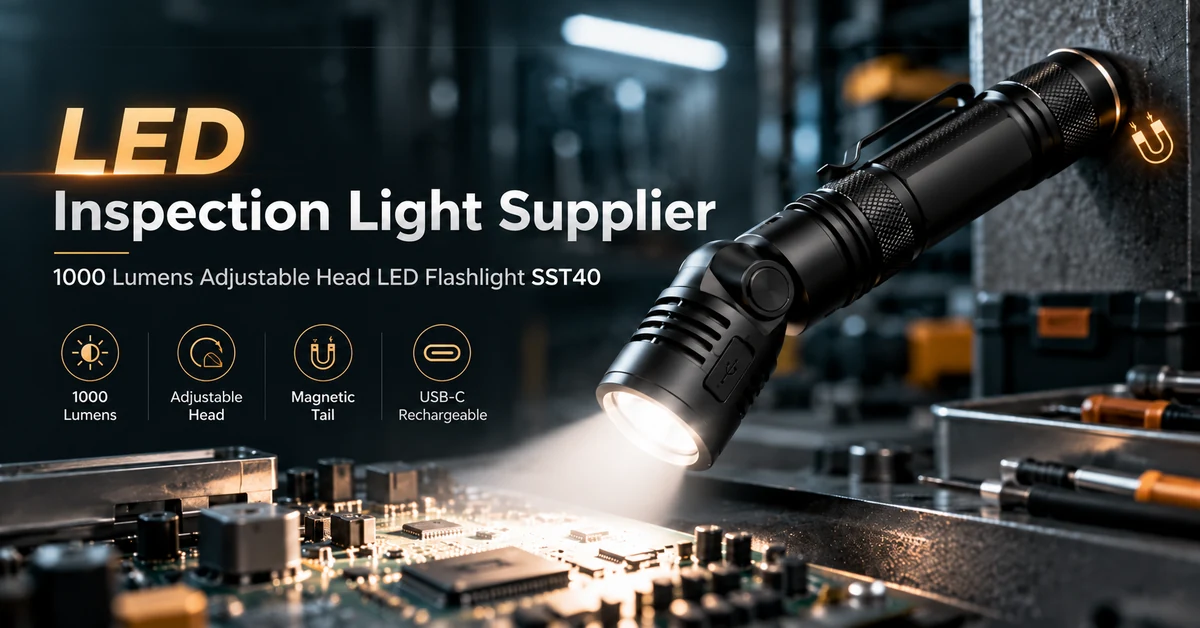
For a bench-side check, consider an adjustable-head or right-angle light that can be positioned outside the operator's hand path. Keep the beam out of the observer's direct line of sight and avoid flooding glossy solder joints with unnecessary brightness.
Connector cavities, wire terminations, and equipment enclosures
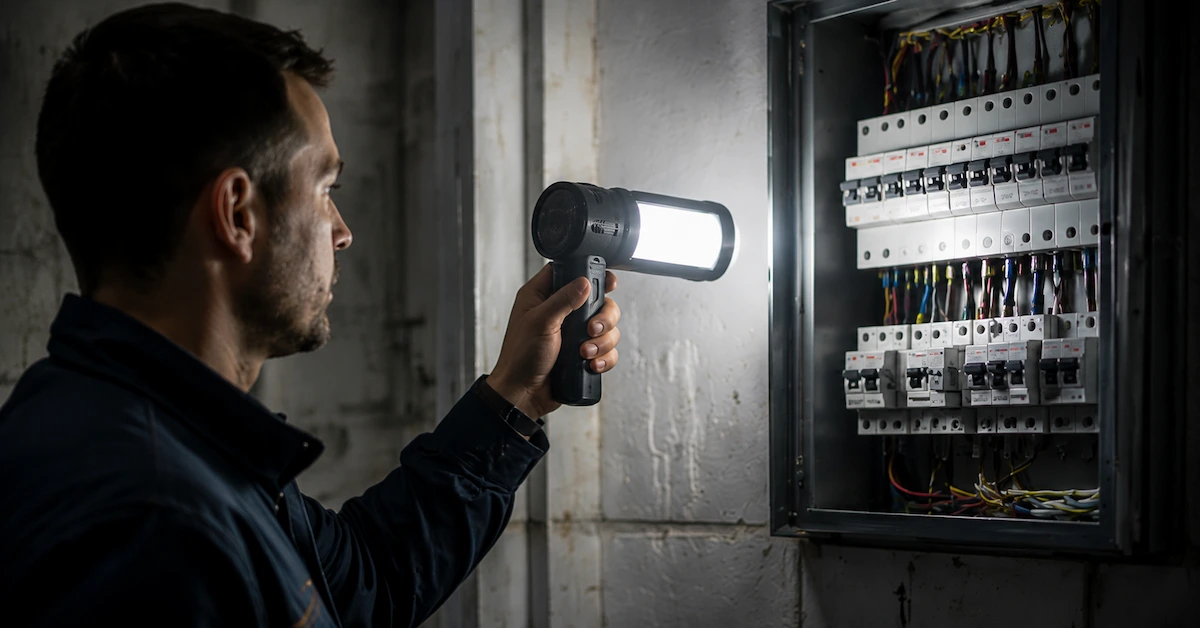
Recessed connectors, cable routes, and cabinet interiors present a different problem: shadows and limited access. A compact right-angle light can illuminate a cavity from the side, while a headlamp allows a technician to keep both hands on tools. In electrically exposed equipment, follow the site's isolation, electrical-safety, and ESD procedures; a metal-bodied or magnetic flashlight is not automatically approved for contact with live circuits or ESD-sensitive work areas.
Rework, maintenance, and field diagnostics
At repair stations, operators repeatedly reposition lights, tools, microscopes, and components. Charging convenience, a stable magnet, an accessible switch, and usable medium/low modes may matter more than maximum brightness. For mobile teams, rechargeable models reduce disposable-battery reliance, but battery condition and runtime still require verification in the intended operating mode.
3. Surface Inspection: Match the Light Angle to the Defect
Surface quality control is not one task. The lighting needed to reveal a shallow scratch on aluminum differs from the lighting needed to judge the color of a painted plastic enclosure.
- Machined metal and coated housings: Move a directional beam to a low, grazing angle. Tiny ridges or scratches may produce contrasting highlights and shadows. Examine from more than one direction because defect visibility changes with orientation.
- Glossy or polished parts: Reflections can saturate the viewing area. Softer, more diffuse illumination is often preferable for general appearance checks; a directional light can then be added for local defect investigation.
- Plastic components and molded parts: Use consistent viewing conditions when checking scuffs, sink marks, flash, or surface texture. Compare against an approved physical defect standard rather than only a photograph.
- Painted surfaces and coatings: A portable light can assist visual screening for streaks, dust inclusions, and uneven appearance. It cannot measure coating thickness or certify color accuracy without appropriate instruments and controlled viewing conditions.
- Glass and transparent covers: Test multiple angles and backgrounds. Glare and reflections may obscure contamination or marks; a purpose-built transmitted or diffuse arrangement may be required.
The purchasing principle is straightforward: select the geometry that improves defect contrast, then choose a product format that can maintain that geometry during use .
4. Quick Selection Matrix: What Lighting Works for Each Check?
| Inspection job | Useful illumination approach | Portable-light role | When specialist equipment is needed |
|---|---|---|---|
| PCB component placement, connector seating | Directed light with controlled angle | Spot checks and rework illumination | Magnification or AOI for fine/hidden features |
| Recessed terminals and cabinet wiring | Compact, aimable beam | Right-angle light or headlamp for access | Electrical/ESD controls still apply |
| Fine scratches on metal housings | Low-angle, directional illumination | Moveable flashlight can vary reflection | Repeatable grading may require a fixed fixture |
| Gloss, color, or coating appearance | Uniform, diffuse, controlled-color light | Portable light only for preliminary screening | Color booth, gloss meter, or coating gauge as applicable |
| Reflective small parts under microscope | Even light around the viewing area | Portable light is usually supplementary | Microscope ring, coaxial, or dome lighting |
| Automated camera-based defect detection | Stable, geometrically controlled lighting | Standard flashlight is not a substitute | Dedicated machine-vision illuminator and controller |
This distinction helps buyers avoid over-specifying a mobile task light or under-specifying a precision quality-control station.
5. What Should an LED Inspection Light Supplier Verify Beyond Lumens?
Beam pattern, angle, and working-distance illuminance
Lumens describe total emitted visible light; lux describes the light reaching an area. A high-lumen narrow beam may be too harsh for close inspection, while a modest, well-positioned beam can be more useful. Ask for photos or measurements at the actual working distance, including hotspot size, spill, and shadow behavior. Beam adjustability is particularly helpful when the inspection target changes position.
Glare, diffusion, and color rendition
A glossy PCB, polished metal part, or coated enclosure can reflect direct light into an observer's eye. Test beam direction first, then consider diffusion or a different light format. If the task includes color judgments, request correlated color temperature (CCT) and color-rendering data relevant to the intended method. A cool-white LED or a warm/cool mode does not by itself prove color accuracy or a particular CRI value.
Stable output, runtime, and camera interaction
Compare usable brightness over the working period, not only the output immediately after switching on. Battery state, thermal regulation, and selected modes can change performance. If staff photograph defects or use cameras, evaluate flicker or banding under the actual camera settings; do not assume that every rechargeable LED lamp is flicker-free.
Positioning, comfort, and workplace safety
Check weight, angle adjustment, magnet contact surface, switch access, charging-port protection, and how securely the product remains in place. A magnetic base should be tested on representative surfaces and kept clear of sensitive components or procedures where magnetic materials are restricted. Review site-specific electrical, ESD, chemical, and environmental requirements before approval.
6. Brightenlux Portable Lighting Platforms Worth Sampling
Brightenlux manufactures portable LED lighting and offers OEM/ODM discussions for international buyers. Its public product range includes several rechargeable models with features that may be useful for manual inspection support . They are not presented here as dedicated, metrology-grade, ESD-certified, microscope, or AOI lighting systems.
| Published product | Verified headline configuration | Potential manual-inspection use | Check during sampling |
|---|---|---|---|
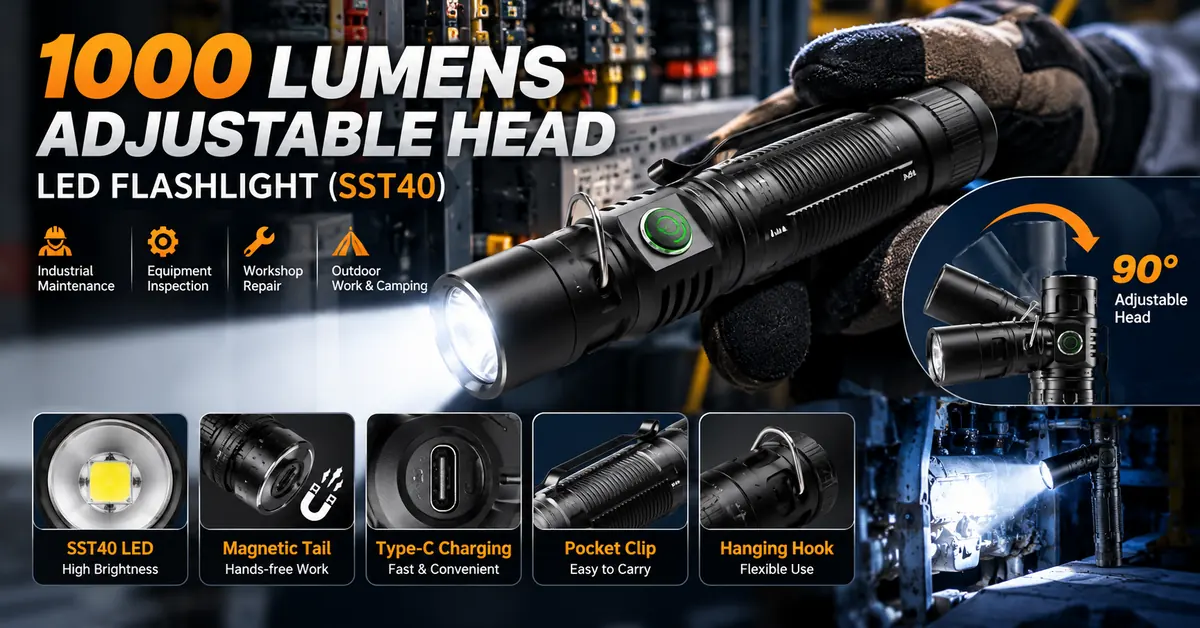
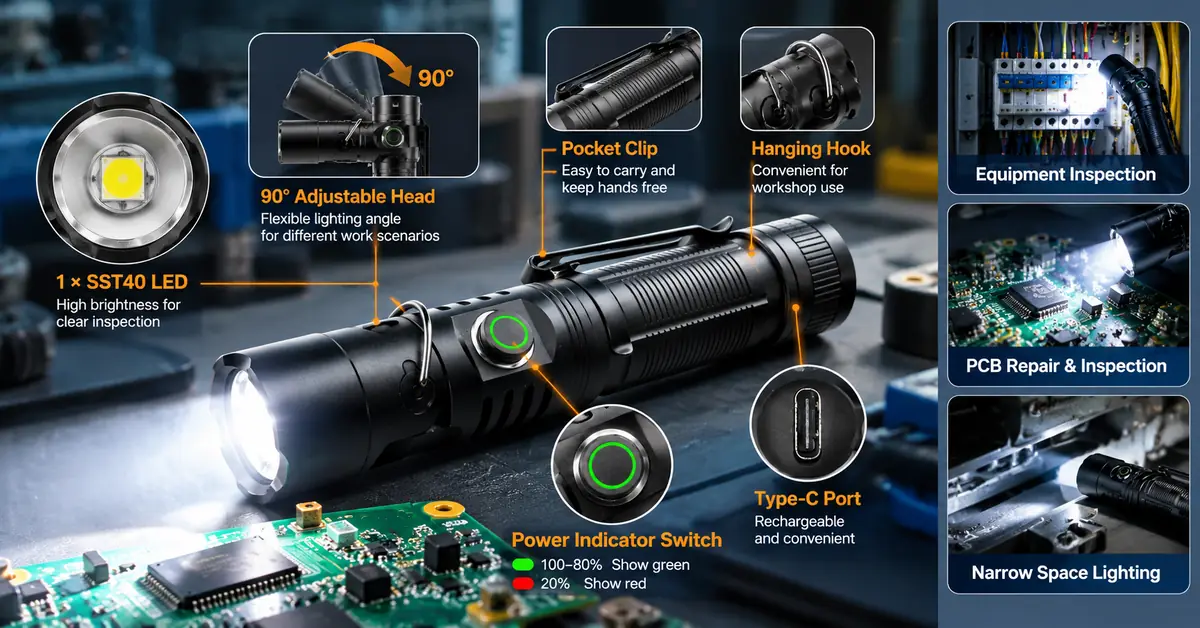
| 1000 lm adjustable-head SST40 flashlight | Adjustable head, magnetic tail, USB-C, 18650 2200mAh, IP44 | Aimable lighting around equipment and workbenches | Reflection, mounting angle, runtime by mode |
| BT-FL8078 1000 lm 90° flashlight | SST25, 16340 800mAh, USB-C, magnetic tail, IPX4, 55g | Close access, cabinet checks, clip/headstrap use | Hotspot, glare, magnet stability, task duration |
| 700 lm compact magnetic 90° flashlight | SST20, rechargeable USB-C, magnetic tail, 55g | Light-duty mobile checks and tight spaces | Usable low mode, mounting convenience |
| BT-HL9105C COB sensor headlamp | 500+ lm stated, warm/cool COB, motion sensor, 1100mAh rechargeable or 3×AAA, IP67 listed | Hands-free general assembly and maintenance lighting | Beam spread, comfort, sensor response, supporting IP evidence |
Specifications above reflect the individual public product pages; confirm the quoted SKU, revision, included accessories, performance evidence, and availability for any production order. No listed lumen output establishes inspection accuracy.
For buyers who need a compact directional device, the BT-FL8078 right-angle platform is an appropriate starting sample , not an automatic final recommendation. Buyers who need broader hands-free illumination can evaluate a COB headlamp, but should compare it with a proper fixed bench light if repeatable surface grading is required.
7. A Six-Step Sample Validation Plan for Electronics and Surface QC
A repeatable test on actual parts is more informative than a catalog photo. Ask an LED inspection light supplier to support a sample assessment before placing a bulk order. Use the following buyer-led process:
- Define the defects. Prepare reference parts with approved examples of scratches, residues, misalignment, or appearance issues. Include acceptable and unacceptable samples where available.
- Set the viewing conditions. Record ambient light, working distance, viewing angle, operator position, and whether magnification is used.
- Compare beam positions and modes. Move the portable lamp around the target and record which setup reveals relevant details without excessive glare. Use consistent settings for comparisons.
- Test actual operating duration. Check sustained output, control behavior, recharge performance, and comfort through the expected work period.
- Review the working environment. Check ESD and electrical procedures, mounting stability, contact with sensitive surfaces, and applicable ingress or cleaning requirements. Request evidence for any claimed rating.
- Approve a controlled sample. Record model, battery configuration, LED and optic, mode sequence, accessories, packaging, photos, and agreed acceptance criteria before ordering.
If the requirement is repeatable automated defect detection, involve the camera or vision-system integrator and trial purpose-built lighting separately. Portable handheld lighting should not be used to imply AOI or metrology capability without validated evidence.
8. Manufacturing, QC, and Documentation: What a Supplier Should Prove
An LED inspection light supplier should be evaluated on production consistency as well as the sample's brightness. A procurement-ready review can cover housing and lens materials, LED and driver configuration, battery identity, charging circuit, switch durability, alignment, assembly workmanship, and the quality of sealing where an IP claim is relevant.
Ask for the model-specific inspection plan: what is checked at incoming inspection, assembly, final function testing, and shipment release? Relevant checks may include charging operation, lighting modes, visible finish, angle adjustment, accessories, and packaging. Photometric, ingress, thermal, or reliability claims require appropriately defined test methods and reports; a generic factory certificate does not prove every SKU meets the same conditions.
Brightenlux describes product-development support and manufacturing quality control on its About Us page . Buyers should still connect any supplied reports, battery documents, and declarations to the exact proposed configuration and destination market. Do not assume CE, RoHS, ESD suitability, or a particular test method applies automatically to every portable-light model.
9. OEM/ODM, Cost, MOQ, and Repeat-Order Risk
For private-label and wholesale projects, ask the LED inspection light supplier to classify customization into three levels. Branding changes may involve logo, retail packaging, manuals, and accessory presentation. Configuration changes may involve LED option, modes, battery, or optics and require a technical review. New mechanical or optical designs may require additional development, tooling, validation, and lead-time discussion.
Make quotations comparable by confirming whether they include the battery, USB cable, charger, headstrap, clips, magnet, custom packaging, printing setup, tooling, testing, and shipping terms. Verify minimum order quantities and timelines for the selected configuration rather than assuming one MOQ covers every option.
Before repeat orders, define change-control expectations for the LED, optic, battery, charging electronics, magnet, enclosure, and packaging. Substituting a component can alter beam shape, output, weight, operating time, or test applicability even if the product photograph looks unchanged.
What to include in a useful RFQ
Send Brightenlux an RFQ specifying target market and buyer channel; inspection task and representative surfaces; preferred handheld, magnetic, or head-worn format; working distance and required beam spread; runtime and charging preferences; glare or color-assessment concerns; first order and annual quantity; logo and packaging needs; documentation requirements; and target launch schedule . Indicate whether the product is intended for informal visual checks or a controlled inspection process. Those two uses require different acceptance criteria.
10. FAQ: Questions B2B Buyers Ask About Inspection Lighting
1. Can a rechargeable flashlight be used as an LED inspection light?
Yes, for suitable manual visual checks where portable, aimable lighting improves visibility. Its usefulness should be demonstrated on the actual part and defect. It does not automatically replace a microscope lamp, calibrated inspection fixture, or vision-system light.
2. Is higher lumen output always better for PCB inspection?
No. Close-range glare and hotspots can obscure solder joints or markings. Compare usable illuminance, beam shape, low/medium modes, and viewing angle at the intended work distance.
3. Which light is useful for inspecting scratches on metal?
A directional light aimed from a shallow angle can make small surface irregularities easier to see. Test multiple directions; for repeatable grading, define the illumination fixture and approved reference samples.
4. Do I need high CRI for surface inspection?
If judging color or subtle appearance differences, color rendition and controlled viewing conditions matter. Request CCT and rendering evidence for the actual lamp. Brightness or selectable warm/cool modes do not establish a CRI rating.
5. Is a magnetic inspection flashlight suitable for electronics benches?
It can provide convenient positioning, but only where the mount, magnetic field, enclosure, and workplace safety procedures allow it. Do not assume ESD-safe or electrically insulated construction without appropriate qualification.
6. Can portable LED lights replace ring lights or AOI illumination?
Generally not for repeatable microscope viewing or automated inspection. Ring, dome, coaxial, and other dedicated lights control direction, uniformity, and often timing in ways that standard handheld flashlights do not.
7. How should I compare battery options for inspection use?
Check operating time at the selected mode, battery configuration, charging time, connector compatibility, replacement policy, and transport documentation. A nominal cell capacity is not a measured runtime result.
8. Does an IP rating prove the lamp is suitable for industrial quality control?
No. IP ratings concern defined ingress-protection conditions and do not establish optical accuracy, ESD suitability, chemical resistance, or safety for energized electrical work. Check the actual product and test evidence.
9. Can Brightenlux support private-label or OEM lighting orders?
Brightenlux advertises OEM/ODM and customization support. Feasible changes, tooling, sample scope, MOQ, test requirements, and lead time must be confirmed for the selected product and order.
10. What should I send when requesting an inspection-light sample?
Provide the inspected material, defect type, work distance, beam preference, preferred mounting, runtime, destination market, estimated quantity, branding needs, and any required evidence. Photos of the actual work position are especially helpful.
Conclusion
Choosing an LED inspection light supplier for electronics assembly or surface quality control starts with the inspection method, not the largest lumen number. For portable manual checks, prioritize beam control, glare management, positioning, usable runtime, workplace suitability, and repeatable product quality. For microscopic, color-critical, or automated measurements, specify the appropriate dedicated inspection system instead of expecting a general-purpose flashlight to perform every role.
Brightenlux offers rechargeable magnetic and right-angle LED flashlight options that can form the starting point for a practical sample comparison. To discuss an OEM/ODM or wholesale project, contact the Brightenlux team with your inspection task, preferred configuration, destination market, and estimated order volume.