

LED Flashlight Supplier Scorecard: How B2B Buyers Compare Quotes, Samples, and Delivery
Choosing an LED flashlight supplier is a process-control decision, not a catalogue contest. A dependable supplier should translate an application into a controlled specification, quote the same scope as its competitors, produce representative samples, disclose changes, and repeat the approved result in bulk production. Buyers can compare those abilities with a weighted scorecard, but legal identity, payment security, product safety, and critical quality failures should remain non-negotiable gates.
This guide is for importers, distributors, private-label brands, promotional-product companies, retailers, industrial buyers, and product teams that need a repeatable way to shortlist suppliers. It focuses on the commercial and operational work between an initial enquiry and a stable supply relationship. For a deeper review of optical, battery, charging, thermal, ingress-protection, and construction decisions, use the LED flashlight manufacturer guide as a technical companion.
The short answer: what should buyers compare?
Compare suppliers on seven areas: requirement interpretation, sample evidence, quality and change control, commercial transparency, delivery planning, compliance support, and after-sales response. Normalise every quotation before comparing unit prices. Then test samples against one written specification, approve a controlled reference sample, run a pilot order where risk justifies it, and measure the supplier after shipment. A polished sample is useful evidence, but it is not proof that the same result will appear in every production lot.
- Start with the application. The user's job, environment, duty cycle, target market, and sales channel determine the product.
- Send one controlled RFQ. If suppliers quote different batteries, accessories, tests, packages, or trade terms, their prices are not comparable.
- Use gates before scores. A high total score must not compensate for an unverifiable company, unsafe product, payment anomaly, or refusal to control changes.
- Approve evidence, not adjectives. Ask for drawings, test conditions, component controls, inspection records, and milestone dates instead of accepting "high quality" or "best price."
- Keep evaluating after the order. Delivery accuracy, defect containment, corrective action, change notices, and document quality reveal more than a sales presentation.
Supplier, manufacturer, trading company, or sourcing partner?
The word supplier describes the commercial relationship, not necessarily the factory ownership. An LED flashlight supplier may be a direct manufacturer, a trading company, a sourcing organisation, or a manufacturer that outsources selected operations. None of those structures is automatically good or bad. The buyer needs to understand who performs the work, who controls the specification, and who is contractually responsible when something changes.
| Supplier model | Potential value | Questions the buyer must resolve | Often suitable when |
|---|---|---|---|
| Direct manufacturer | Process access, engineering communication, and direct production planning | Which processes are in-house, which are outsourced, and who controls critical sub-suppliers? | The program needs repeat production, customisation, or detailed process control |
| Trading company | Broader category access, consolidated sourcing, language support, and flexible commercial service | Who makes the proposed model, can the buyer verify that factory, and how are changes communicated? | The buyer needs mixed products, smaller programs, or one commercial interface |
| Sourcing or development partner | Supplier discovery, project management, inspection coordination, and category integration | How is the partner paid, which factories are used, and who owns drawings, tooling, and product records? | The buyer lacks local resources or is coordinating several components and factories |
| Hybrid manufacturer | In-house assembly combined with specialist external processes | Which external operations affect safety, performance, finish, or lead time, and how are they approved? | Specialist coatings, batteries, electronics, tooling, or packaging are part of the program |
A buyer should not reject a supplier simply because it uses outside specialists. Modern products often depend on a network of component and process providers. The important issue is control: approved sources, incoming inspection, traceability, change notification, defect containment, and clear responsibility. A supplier that openly maps its supply chain may be easier to manage than one that claims to make everything but cannot explain where critical parts come from.
Build an LED flashlight supplier scorecard before requesting quotes
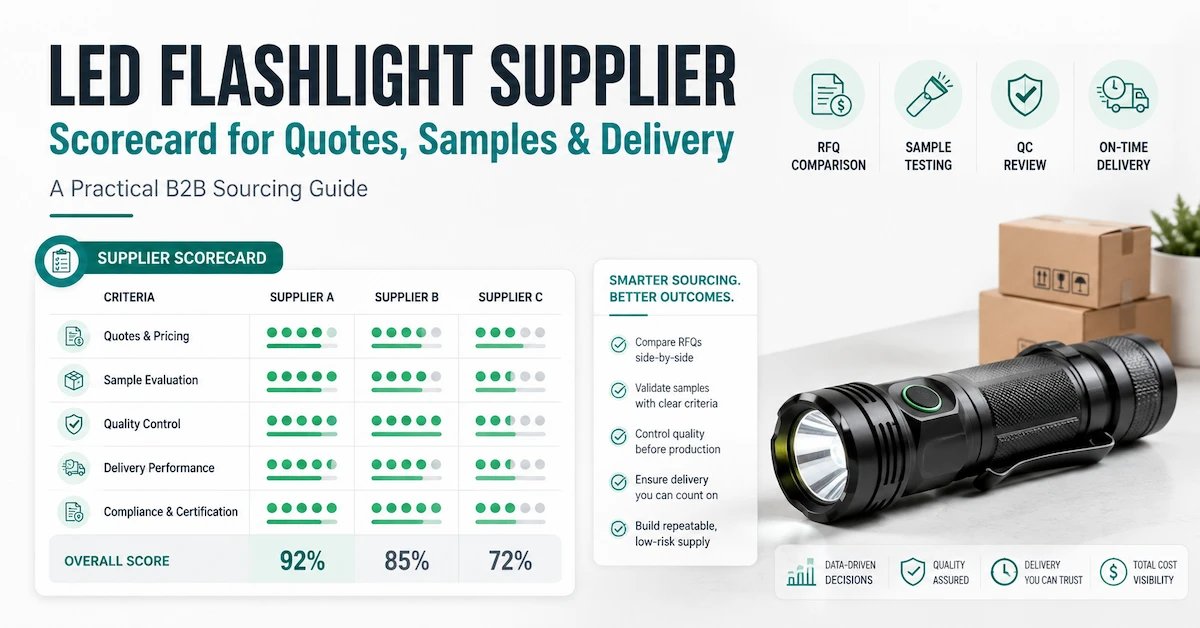
A scorecard prevents the loudest salesperson or lowest headline price from deciding the project. Create it before quotations arrive, when the team can still agree on priorities without defending a preferred supplier. The weighting below is an illustrative 100-point model, not an industry standard. Adjust it for the product, market, order value, safety exposure, customisation level, and cost of failure.
| Evaluation area | Illustrative weight | Evidence to request | What a weak response looks like |
|---|---|---|---|
| Requirement interpretation | 15 | Completed RFQ, assumptions list, open questions, proposed specification, and exclusions | Immediate price with no questions or silent substitutions |
| Sample and technical evidence | 20 | Defined sample configuration, test conditions, drawings, component identification, and repeat samples | One hand-selected sample with no configuration record |
| Quality and change control | 20 | Inspection plan, critical-to-quality list, traceability, nonconformance process, and change-request method | Quality is described only as final visual inspection |
| Commercial transparency | 15 | Itemised quotation, Incoterm and named place, tooling terms, payment details, and cost-change logic | Low unit price with missing battery, package, test, or freight scope |
| Delivery and capacity control | 15 | Milestone plan, material lead times, capacity assumptions, holiday risks, and escalation route | A single ship date that is not connected to approvals or materials |
| Compliance and document support | 10 | Product-specific reports, model and component match, declaration responsibilities, battery transport records, and document revision | Logos or generic certificates unrelated to the offered configuration |
| After-sales and corrective action | 5 | Warranty handling, spare-parts approach, response ownership, containment, root-cause, and corrective-action records | A promise to replace defects without investigating recurrence |
Score only evidence that your team has actually reviewed. A confident answer without a document, sample, process record, or observable practice should not receive the same score as verified capability. Record the evidence date and reviewer so the scorecard can be updated when the product or supplier changes.
Use pass/fail gates alongside the weighted score. Typical gates include verified contracting identity, approved payment beneficiary, agreement on critical safety requirements, a sample that meets mandatory criteria, relevant market-access evidence, and acceptance of written change control. These gates protect the buyer from a mathematical mistake: allowing several minor strengths to cancel one unacceptable risk.
Step 1: write an RFQ that suppliers can answer consistently
A useful request for quotation does more than name a flashlight and quantity. It states what the buyer knows, identifies what the supplier must propose, and separates mandatory requirements from preferences. If the project team is still uncertain, say so. A supplier's questions and trade-off explanations are part of the evaluation.
Include the intended user, primary task, operating environment, target countries, sales channel, order quantity, annual forecast, launch window, and expected product life. Describe the preferred form factor, beam purpose, output modes, runtime objective, battery format, charging interface, controls, indicator behaviour, materials, finish, dimensions, weight target, accessories, branding, packaging, labels, manuals, and warranty approach. State which requirements are fixed and which may be optimised.
Performance claims must include conditions. "Long runtime" is not a testable requirement. Define the mode, output criterion, starting battery state, temperature range where relevant, and whether step-down behaviour is acceptable. "Waterproof" is also incomplete. Identify the use environment and required evidence rather than asking the supplier to choose an impressive rating. If an IP code is claimed, its meaning and test method should be understood in relation to IEC 60529.
Ask every supplier to return the same quotation fields:
- Supplier legal name, quotation issuer, manufacturing location, and proposed production site.
- Model number and full offered configuration, including battery and accessories.
- Unit price at defined quantity breaks, currency, quotation validity, and Incoterm with named place.
- MOQ by product, colour, logo, package, battery, and any custom component.
- Sample cost, sample lead time, development charge, tooling charge, and refund conditions if any.
- Packaging scope, master-carton assumptions, labelling, manual, and barcode responsibilities.
- Testing and compliance documents included, excluded, or requiring separate payment.
- Production lead-time milestones and the approvals that start each clock.
- Payment terms, beneficiary identity, inspection right, and shipment-document scope.
- Warranty, defect handling, spare parts, and corrective-action process.
Issue the RFQ with a revision number and response deadline. When a requirement changes, update the revision and send it to every active bidder. Do not let different versions continue through email threads. Otherwise, the cheapest offer may simply be pricing an older or narrower product.
Step 2: compare total landed scope, not the unit price
The lowest unit price may represent the lowest cost, but only after the scope is normalised. Build a comparison sheet that shows what is included and excluded. Separate recurring unit cost from one-time development and setup charges. Then estimate the costs the buyer will pay outside the supplier's invoice.
| Cost layer | Questions to normalise | Common source of a false comparison |
|---|---|---|
| Product configuration | Are LED, driver, battery, charging cable, seals, finish, and accessories equivalent? | One quote excludes the battery or uses a different cell and electronics |
| Branding and retail pack | Are logo method, colour, inserts, labels, manual, inner package, and master carton included? | A plain bulk pack is compared with a finished retail program |
| Development and setup | Are artwork, samples, tooling, fixtures, programming, testing, and packaging setup separate? | One-time charges appear only after the supplier is selected |
| Quality assurance | Who pays for product testing, inspection, re-inspection, and failed-lot correction? | The quotation assumes no independent inspection or corrective work |
| Logistics and import | What Incoterm and named place apply, and who pays freight, insurance, handling, duty, and tax? | EXW, FOB, and delivered prices are placed in one column without adjustment |
| Failure and lifecycle | What are the expected costs of returns, rework, replacements, spare stock, disposal, and delayed launch? | Purchase price is treated as the complete cost of ownership |
Use the current ICC Incoterms rules and write both the rule and named place into the quotation and contract. An Incoterm allocates defined delivery tasks, costs, and risks; it does not replace product specifications, payment terms, title-transfer language, inspection rights, or remedies.
Ask why a price changes. A legitimate reduction may come from a standard finish, larger order, simplified package, approved component alternative, longer schedule, consolidated production, or different trade term. A price that falls without an explained scope change deserves investigation. The objective is not to force every supplier to the same number. It is to understand what each number buys.
Step 3: test whether the sample represents the offer
A sample is useful only when its identity is clear. Record the model, date, supplier, firmware where applicable, LED, battery, driver or charging configuration, materials, finish, accessories, and package. Photograph and label each sample. If a sample is hand-built or uses temporary components, the supplier should disclose that before testing.
Test several units when the decision risk warrants it. One sample can reveal a design problem, but it cannot describe variation. Compare units for beam appearance, switch behaviour, mode sequence, current draw, charging behaviour, indicator logic, heat, noise, finish, dimensions, weight, seal assembly, fasteners, accessories, and packaging. Use the actual application, not only a short desk inspection.
Portable-lighting performance claims should use defined methods and conditions. The ANSI/PLATO FL 1 information published by PLATO provides context for common claims such as light output, runtime, beam distance, impact resistance, and water resistance. Buyers should confirm which edition or method applies, who performed the test, and whether the tested configuration matches the offered product.
Rechargeable products require extra attention. Check the exact cell or pack, protection approach, polarity, connectors, charging input, charging time, indicator states, behaviour with expected cables and power sources, low-voltage behaviour, standby drain, and temperature during representative use. Do not deliberately create hazardous battery faults without qualified equipment, procedures, and personnel.
Create a sample log with four outcomes: pass, fail, conditional pass, or not tested. A conditional pass must identify the required correction, owner, due date, and verification method. "Supplier will improve" is not a closure record. Retest the revised sample and update the configuration rather than relying on conversation history.
Step 4: turn the approved sample into a production definition
Many sourcing failures begin after a good sample because the sample was treated as the entire specification. A physical unit cannot show hidden component limits, approved alternates, process controls, firmware, colour tolerance, packaging files, test conditions, or acceptance criteria. It also cannot explain which features are intentional and which are sample variation.
Build an approval package that may include:
- A signed or otherwise controlled golden sample with a unique reference.
- Product drawing, dimensions, tolerances, materials, finish, markings, and assembly details.
- Controlled critical-component list covering LED, optics, driver, charging parts, cell or pack, seals, switches, and safety-relevant materials.
- Approved alternatives and a rule that prevents unapproved substitution.
- Firmware or mode-sequence revision where electronics are programmable.
- Performance requirements with test methods, conditions, sample size, and acceptance limits.
- Artwork, colour reference, label, manual, barcode, retail package, master carton, and pallet requirements.
- Inspection checklist with defect classes and the agreed sampling or inspection plan.
- Destination-market document list and responsibility matrix.
Revision control matters more than document volume. Each file should have an owner, version, approval date, and connection to the purchase order. The LED flashlight supplier should acknowledge the approved revision before purchasing critical material or starting mass assembly.
Step 5: assess production planning and delivery credibility
Lead time is a chain of events, not a number printed beside the price. Ask the supplier to separate requirement review, sample development, tooling or artwork, buyer approval, material purchase, incoming inspection, pilot build, main assembly, testing, packaging, final inspection, corrective work, and shipment booking.
Identify which tasks can run in parallel and which cannot start until an approval is complete. Imported or customised components, lithium batteries, printed packaging, surface finishing, and peak-season capacity may create different constraints. The supplier should state assumptions instead of promising a ship date before the scope is frozen.
Capacity claims also need context. A monthly number is meaningless without the product mix, shifts, bottleneck process, yield, existing commitments, and material availability. For a high-risk or time-sensitive order, review the line plan, critical materials, backup equipment or process, and escalation owner. A realistic plan with visible constraints is more valuable than an aggressive date with no recovery path.
Agree on a status-report rhythm and a small set of evidence-based milestones. Useful updates may include material readiness, packaging approval, pilot completion, open defects, corrective-action status, production quantity, inspection booking, shipment booking, and document readiness. Avoid reports that stay "on schedule" until the final week without showing what has actually been completed.
Step 6: control changes before they reach the shipment
Cost, availability, quality improvement, and obsolescence can all create legitimate changes. The problem is not change itself; it is an unreviewed change. Require the supplier to request approval before changing critical components, sub-suppliers, materials, dimensions, finish, tooling, process, firmware, battery, packaging, labels, or production location.
A change request should identify the reason, old and new states, affected orders and lots, risk assessment, validation evidence, document updates, timing, inventory disposition, and rollback plan where appropriate. The buyer should decide whether the change requires a new sample, partial testing, full requalification, compliance review, retailer notification, or no additional action.
Keep change approval separate from routine order communication. A salesperson's message saying that a replacement is "same quality" is not an engineering approval. Name the people authorised to approve technical, commercial, packaging, and schedule changes. Record the effective lot so later complaints can be traced to the correct configuration.
Step 7: use a pilot order to test the system
A pilot order is not necessary for every stock purchase, but it is useful when the product is customised, the supplier is new, the compliance exposure is meaningful, the launch is important, or the cost of failure is high. The pilot should use the intended materials, processes, work instructions, fixtures, tests, operators, packaging, and records as far as practical. Otherwise it tests another system.
Review first-off units before the full run proceeds. Confirm assembly sequence, cosmetic standard, functional tests, charging checks, seal installation, torque or fastening controls where relevant, labels, package fit, and traceability. Record defects by cause, not just quantity. A small pilot that produces several unrelated defects may reveal an unstable process even when every unit is reworked to pass.
Close pilot issues before mass production. Each closure should show containment of affected material, root cause, corrective action, verification, and any revised document or training. If the schedule does not allow proper closure, the project team should openly accept, reduce, or avoid the risk rather than letting urgency make the decision invisibly.
Step 8: inspect the order against written acceptance rules
Inspection should confirm the contracted product, not invent requirements at the factory door. Define the inspection stage, lot, sample selection method, defect categories, tests, equipment, documents, packaging checks, and acceptance rules before production. If the buyer uses a recognised sampling standard, cite the exact agreed plan and edition in the inspection instruction.
Typical checks may cover quantity, identity, dimensions, appearance, finish, markings, mode sequence, beam function, charging, indicators, accessories, package content, labels, barcode readability, carton condition, and buyer-defined performance tests. Some requirements need laboratory equipment or longer-duration testing and cannot be replaced by a short pre-shipment inspection.
A failed inspection needs a disposition process. Decide whether the lot will be sorted, reworked, retested, re-inspected, accepted under a documented concession, or rejected. The supplier should identify root cause and affected scope. Shipping a failed lot because the vessel cutoff is close transfers the schedule problem to customers, returns, and brand reputation.
Compliance evidence must match the exact product
There is no universal certificate package for every flashlight. Requirements depend on the product, battery, charger or adapter, radio functions if any, destination, buyer role, claims, and sales channel. Retailers and industrial customers may add their own specifications. Build a market-specific responsibility matrix with qualified compliance support instead of asking only whether the product has "CE" or "FCC."
Check the model number, applicant, manufacturer, photographs, ratings, battery, charger, components, standards, dates, and report scope. A genuine report for another product may still be irrelevant. When the configuration changes, review whether the evidence remains applicable.
Lithium batteries create transport obligations separate from marketing claims. The UNECE lithium-battery transport resources provide official context, including UN 38.3 information. Confirm who supplies the cell or pack, which configuration was tested, what transport documents are required, and who is responsible for packaging and shipment preparation.
For products placed on the EU market, the General Product Safety Regulation is one part of the applicable framework; other product, battery, chemical, waste, and market-specific requirements may also apply. The supplier can provide evidence and technical support, but the buyer should not assume that a factory certificate transfers every legal responsibility.
MOQ and negotiation: separate the constraints
There is no single MOQ that defines a good LED flashlight supplier. Minimums may come from assembly economics, LED or battery purchasing, colour finishing, logo processes, printed packaging, accessories, firmware setup, testing, or custom tooling. Ask which decision creates each minimum and whether a standard option can reduce it.
Negotiate the whole program rather than pushing only the unit price. Possible variables include order quantity, forecast visibility, standard colours, shared components, package complexity, payment timing, delivery window, inspection arrangement, spare-parts allowance, tooling ownership, and price-review triggers. A concession in one area normally has a cost or benefit elsewhere.
For a first order, a smaller controlled quantity may provide more information than a large price-driven commitment. The buyer learns how the supplier handles approvals, materials, production updates, inspection findings, documents, shipment, and after-sales issues. The supplier learns whether the buyer makes timely decisions and maintains a stable specification. That operating fit matters in repeat business.
Measure supplier performance after shipment
Supplier selection does not end when the purchase order is awarded. Create a quarterly or order-based review using metrics that the buyer can calculate consistently. Define each metric before collecting it; otherwise, teams will argue about the numbers instead of improving the process.
| Performance area | Possible measure | Definition to agree | Management question |
|---|---|---|---|
| Delivery | On-time delivery rate | Required date, allowed window, quantity rule, and responsibility for buyer-caused delay | Are delays visible early enough to recover? |
| Incoming quality | Defect or rejected-lot rate | Inspection point, defect definition, sample basis, and treatment of rework | Are repeated defects decreasing? |
| Field quality | Verified return or complaint rate | Sales denominator, time window, excluded damage, and evidence required | Do factory controls address real user failures? |
| Corrective action | Containment and closure time | Start event, required stages, approval owner, and recurrence check | Does the supplier prevent the same failure? |
| Change control | Approved versus unapproved changes | Which changes require notice and what counts as approval? | Can the buyer trust configuration history? |
| Commercial accuracy | Invoice, quantity, and document accuracy | Error types, correction time, and effect on customs or receiving | Is administrative work creating hidden cost? |
Set targets according to the product and business rather than copying an arbitrary benchmark. Review trends, major incidents, and corrective actions alongside the score. A supplier with one severe safety or integrity failure may require escalation even when its average metrics look acceptable.
Red flags that should pause the sourcing decision
- Unclear company identity. The website, quotation, invoice, licence, factory, and bank beneficiary cannot be connected.
- No questions before quoting. The supplier gives a precise price and delivery date without resolving an incomplete specification.
- Configuration drift. Model numbers, batteries, reports, sample labels, and quotation details do not match.
- Hidden exclusions. Battery, accessories, package, testing, inspection, or freight appears only after price comparison.
- One perfect sample. The supplier cannot produce repeat samples or explain how the approved configuration will be controlled.
- Resistance to change control. Critical substitutions are described as routine purchasing decisions that do not require buyer approval.
- Unsupported performance claims. Lumen, runtime, beam distance, impact, or ingress claims have no defined method or matching evidence.
- Payment redirection. An urgent request changes the beneficiary without verification through a trusted channel.
- Schedule without milestones. The supplier promises a ship date but cannot show material, approval, production, or inspection dependencies.
- Repair without prevention. Defects are sorted or replaced, but root cause and recurrence control are absent.
A red flag is a reason to investigate, not always an automatic rejection. Several connected inconsistencies are more serious than one clerical error. Record the question, evidence, owner, and deadline. Pause payment, production, or shipment when the unresolved issue affects legal identity, safety, critical quality, or payment security.
How Brightenlux can support an LED flashlight sourcing program
Ningbo Brightenlux Electric Appliance Co., Ltd. presents itself as a Zhejiang-based lighting manufacturer established in 2014. Its public company profile states that the operation covers more than 10,000 square metres, employs more than 150 people, and serves buyers in more than 50 countries. The published range includes LED flashlights, headlamps, bicycle lights, work lights, camping lights, night lights, and other outdoor lighting products.
A broad range can help distributors and private-label brands coordinate related portable-lighting categories. It does not remove product-level qualification. Buyers should ask Brightenlux to identify the proposed model, manufacturing scope, battery and electronic configuration, customisation options, sample plan, available evidence, quality checkpoints, change controls, and delivery milestones for the specific program.
To receive a useful first response, send the application, destination market, order quantity, annual forecast, preferred battery and charging method, performance goals, branding, packaging, accessories, evidence requirements, and launch date. The team can then discuss whether an existing platform, private-label variation, or deeper OEM/ODM project is the right starting point. Use the Brightenlux contact page to submit a structured RFQ.
A 15-point decision checklist
- Define the user, job, environment, target market, channel, quantity, and launch window.
- Separate mandatory requirements from preferences and supplier-proposed choices.
- Send one revision-controlled RFQ to every shortlisted supplier.
- Verify the contracting entity, production site, invoice entity, and payment beneficiary.
- Map in-house, outsourced, and purchased operations for the proposed model.
- Normalise product, battery, accessories, package, tests, trade term, and one-time charges.
- Score evidence across technical, quality, commercial, delivery, compliance, and service areas.
- Apply pass/fail gates for identity, payment, safety, mandatory performance, and change control.
- Test identified samples against the same written criteria and intended application.
- Freeze a golden sample plus drawings, critical components, limits, artwork, and package files.
- Build a destination-market compliance and transport responsibility matrix.
- Approve a milestone plan that links material purchase and production to buyer approvals.
- Run a pilot build when customisation, risk, or order value justifies it.
- Inspect the production lot using pre-agreed requirements and disposition rules.
- Review delivery, defects, corrective action, changes, documents, and field feedback after shipment.
Frequently asked questions
What is the difference between an LED flashlight supplier and a manufacturer?
A manufacturer performs defined production operations, while a supplier is the party selling and supporting the product. One company may be both. A trading or sourcing company can also be a legitimate supplier. Buyers should identify who makes the proposed model, who controls critical components and changes, and who carries contractual responsibility.
How many suppliers should I include in an RFQ?
Use enough qualified candidates to compare capability and commercial fit without creating a review workload your team cannot handle. The right number depends on project complexity, timing, available supplier knowledge, and risk. A small, verified shortlist with one controlled RFQ usually produces better evidence than a mass enquiry with inconsistent answers.
What should I send to get an accurate flashlight quotation?
Send the application, target market, quantity, forecast, required product configuration, battery, charging, performance criteria, branding, packaging, accessories, evidence needs, delivery window, inspection expectation, and requested Incoterm. Mark unknown items so the supplier can propose options and state assumptions.
Can the lowest-priced LED flashlight supplier still be the best choice?
Yes, when the configuration, quality controls, documents, delivery terms, service, and risk are genuinely equivalent. First normalise every quote and account for tooling, testing, inspection, logistics, import, rework, returns, and delay. A lower price caused by a smart standardisation choice is different from a lower price caused by missing scope.
How do I know mass production will match the sample?
Combine the golden sample with controlled drawings, critical-component rules, approved alternatives, firmware, performance limits, artwork, packaging, inspection criteria, and written change approval. Use representative samples, a pilot build where appropriate, production inspection, and traceability. A physical sample alone cannot define every variable needed for repeat production.
Which certificates should a flashlight supplier provide?
The required evidence depends on the exact product, battery, charger, functions, destination, buyer role, claims, and sales channel. Ask for documents that match the proposed model and configuration, verify their scope, and obtain qualified compliance advice. Generic certificate lists and unrelated reports are not a reliable approval method.
How should I manage an LED flashlight supplier after the first order?
Review on-time delivery, incoming defects, verified field complaints, corrective-action speed and recurrence, approved changes, document accuracy, and commercial responsiveness. Define each metric and escalation rule in advance. Use the review to agree actions, owners, due dates, and evidence of closure.
Final takeaway
The right LED flashlight supplier is not simply the company with the largest range, strongest claim, lowest MOQ, or fastest quotation. It is the partner that can understand the use case, expose assumptions, quote a complete scope, identify the sample, control production variables, provide relevant evidence, communicate changes, and respond when results differ from the plan.
Make the selection process visible: one RFQ, one comparison basis, a weighted scorecard, non-negotiable gates, controlled samples, an approval package, a milestone plan, inspection rules, and post-shipment metrics. That structure gives procurement, engineering, quality, compliance, and sales teams a common decision record. It also gives the supplier a fair opportunity to show real capability instead of competing through vague promises.
For an OEM, ODM, wholesale, or private-label enquiry, send Brightenlux a structured sourcing brief with the application, market, quantity, battery preference, performance needs, branding, package, required evidence, and schedule.
References and verification resources
- PLATO: ANSI/PLATO FL 1 portable-lighting standard information.
- IEC 60529: Degrees of protection provided by enclosures (IP Code).
- UNECE lithium-battery transport resources.
- International Chamber of Commerce: Incoterms rules.
- EUR-Lex: Regulation (EU) 2023/988 on general product safety.
- Brightenlux company profile.