

LED Flashlight Supplier Guide for Compact Outdoor Lights
Choosing an LED flashlight supplier is not only about finding a factory that can make a light. For B2B buyers, the real goal is to source a compact outdoor product that works reliably in the user’s hand, on a strap, or in field conditions. A right-angle utility light, like the product shown, depends on details that are easy to miss in a catalog: grip texture, clip stability, switch placement, beam usefulness, and wet-weather readiness. This guide explains how sourcing teams can evaluate compact LED flashlights more carefully before moving from sample review to larger purchasing decisions.
Why Compact Outdoor Flashlights Need Careful Supplier Evaluation
A flashlight may look simple, but compact outdoor lights are practical tools, not decorative accessories. They may be clipped to a backpack strap, handled in wet conditions, used around a tent, or needed during field repair. In those moments, small design choices become important. A slippery body, weak clip, or confusing switch can make the product feel unreliable even if the LED itself performs as expected.
For engineers, sourcing managers, and product teams, the key question is not whether a supplier can produce a flashlight. The better question is whether they understand the intended use case. A desk light, penlight, and right-angle outdoor utility light are different sourcing projects. The supplier should be able to discuss construction, carry method, beam behavior, and usability without relying only on broad marketing claims.
What the Right-Angle Product Design Suggests
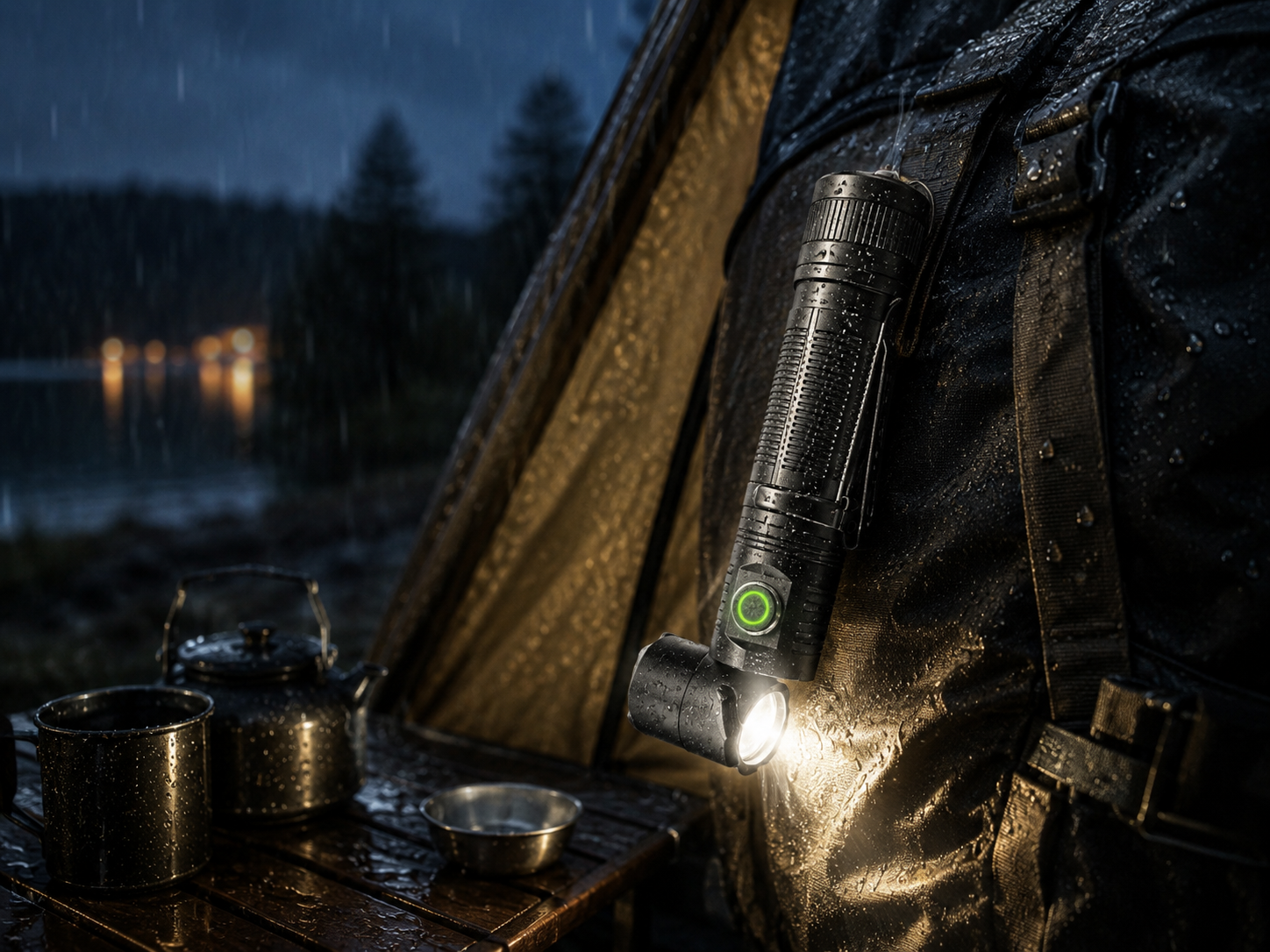
The product in the source image is a handheld torch-style light with a right-angle head, textured black body, side clip, and a visible switch or indicator near the lower section. It is attached to outdoor gear and appears in wet surroundings. Those visible details point toward hands-free outdoor illumination, camping, hiking, emergency use, field repair, and general task lighting near packs or tents.
The right-angle form factor changes how buyers should evaluate the product. Instead of being held like a standard straight flashlight, it may be clipped vertically to webbing, a pocket edge, or a backpack strap while aiming the beam forward. That means the clip is not just an accessory. The body needs grip, the head angle needs to make sense, and the switch must be reachable when the light is mounted or handled with cold fingers.
Core Supplier Checks Before Comparing Samples
Before comparing suppliers, define the job the flashlight must do. A compact LED flashlight used for navigation may need a different beam character than one used for close-range repair. A light carried on gear may need a stronger attachment design than one stored in a drawer. Without this context, buyers often compare surface features instead of performance in use.
| Check | Why it matters |
|---|---|
| Product-category experience | Outdoor and utility lights require different thinking than generic consumer electronics. |
| Housing texture | Ribbing and matte finishes can improve handling in rain, dirt, or glove use. |
| Clip stability | A loose or bending clip can make the whole light frustrating in field use. |
| Switch usability | The control should be easy to find and operate without causing accidental activation. |
| Wet-use claims | Photos with water droplets are not the same as verified test information. |
Buyers reviewing options can also browse Brightenlux lighting categories at Brightenlux products to compare available product directions before sending detailed requirements.
Housing, Finish, Clip, and Switch Details
The visible product uses a cylindrical body with textured ribbing and a matte-to-semi-matte black finish. In sourcing terms, this is more than styling. A compact outdoor flashlight should be easy to grip, resistant to routine handling marks, and practical when wet or dirty. If your project requires an aluminum flashlight supplier, confirm why aluminum is needed. Metal construction may support rigidity or thermal behavior, but it can also influence weight, cost, and product feel.
The side clip deserves the same attention as the housing. If the light must attach to webbing, a backpack strap, belt, or MOLLE-style gear, request samples and test them on real carry points. Catalog photos do not reveal whether the clip slides, bends, or interferes with grip. The switch or indicator also matters. A control that is hard to locate in the dark, difficult with gloves, or too easy to activate accidentally can create real user frustration.
Beam Use, Portability, and Outdoor Durability Questions
Many buyers start by asking for the brightest compact light, but brightness alone does not define usefulness. A narrow spot beam may help with navigation, while a wider spill can be better for campsite work or repairs. Runtime and output stability matter, but the source information does not provide verified figures, so sourcing teams should request those details directly rather than assuming performance from appearance.
Portability is equally important. A small light that rides comfortably on a strap may be more useful than a larger option that is awkward to carry. The image shows water droplets, suggesting wet-weather use, but that does not prove a specific protection rating. Ask the supplier to explain sealing strategy, assembly controls, test basis, and limitations if water exposure is part of the requirement. For project-specific questions, buyers can reach Brightenlux through contact us.
Common Sourcing Mistakes to Avoid
One common mistake is treating compact flashlights as commodities. Two products can look similar online but behave differently in rain, cold, vibration, or repeated attachment to gear. Skipping hands-on sample review increases the risk of approving a light with a weak clip, awkward balance, poor grip, or switch placement that makes sense on paper but not in the field.
Another mistake is under-specifying the finish and carry method. A glossy body may look clean in a studio image, while a textured surface may work better during wet or dirty use. Likewise, if an aluminum body is requested, the supplier should understand the functional reason behind that choice. Aluminum should not be treated only as an upgrade label. For a right-angle outdoor flashlight, the body, clip, head position, and switch layout should be evaluated as one integrated product.
Practical Questions Before You Place an Order
Before moving forward, ask how the housing is made and finished, even if the supplier does not disclose every internal process. Ask how the switch is assembled and checked. Ask whether the clip is replaceable or integrated. Ask how the product feels after repeated attachment and removal from webbing or a strap. These questions reveal whether the supplier understands actual use conditions.
It is also useful to compare multiple body styles under the same scenario. A slim body may be easier to carry, while a larger grip can be easier with wet hands. A strong beam may be useful outdoors, but too much glare can be uncomfortable for close work. If the product is part of a planned sourcing program, share the carry method, beam expectation, and environmental concerns through a formal inquiry so the supplier can respond around the real application.
FAQ for B2B Flashlight Buyers
Is a right-angle flashlight better for outdoor use?
A right-angle flashlight can be better when the user needs hands-free lighting or wants to clip the light to a strap, pocket, or gear panel. The angled head helps aim the beam while the body remains mounted, making it useful for camping, repair work, hiking support, and emergency tasks.
Should buyers prioritize brightness or portability?
For compact outdoor lights, portability and beam usefulness often matter more than raw brightness alone. A light that is easy to carry, quick to aim, and comfortable on gear may deliver better real-world value than a brighter model that feels bulky, awkward, or poorly balanced during use.
Can water resistance be judged from product photos?
No. A photo showing droplets or wet conditions can suggest intended outdoor use, but it does not prove a specific protection level. If water exposure is important, ask the supplier for the stated protection basis, test conditions, limitations, and how sealing is controlled during assembly.
When does an aluminum flashlight body make sense?
An aluminum body can make sense when the project needs rigidity, a durable feel, or certain thermal characteristics. However, it is not automatically the best choice for every compact flashlight. The right housing depends on carry style, expected handling, product weight goals, and the overall cost target.