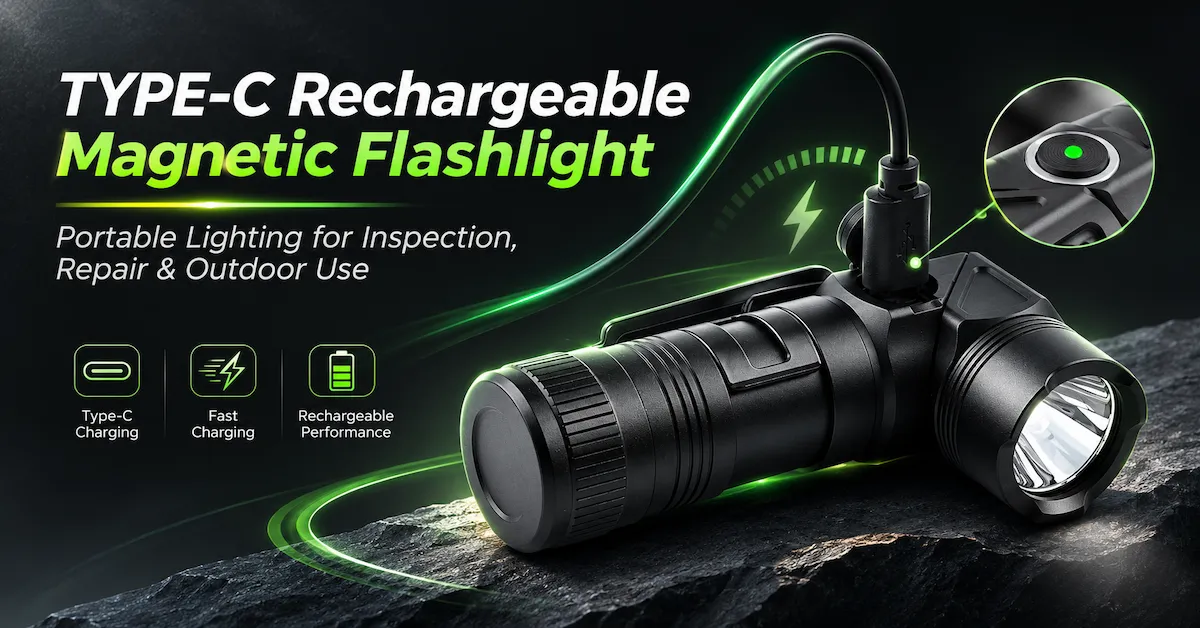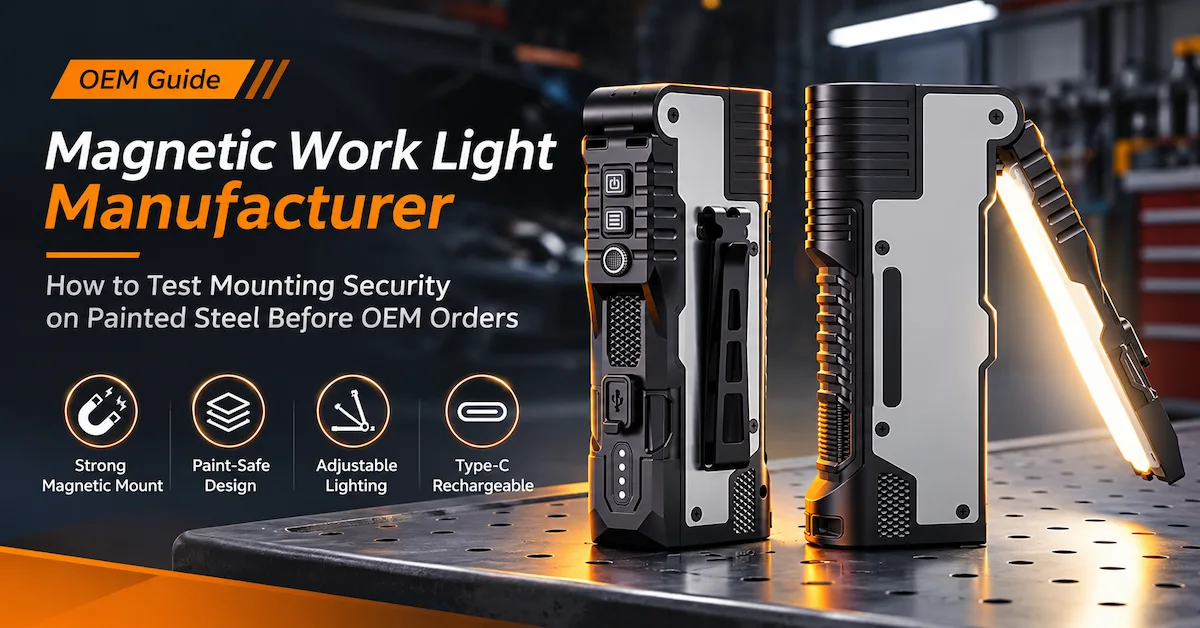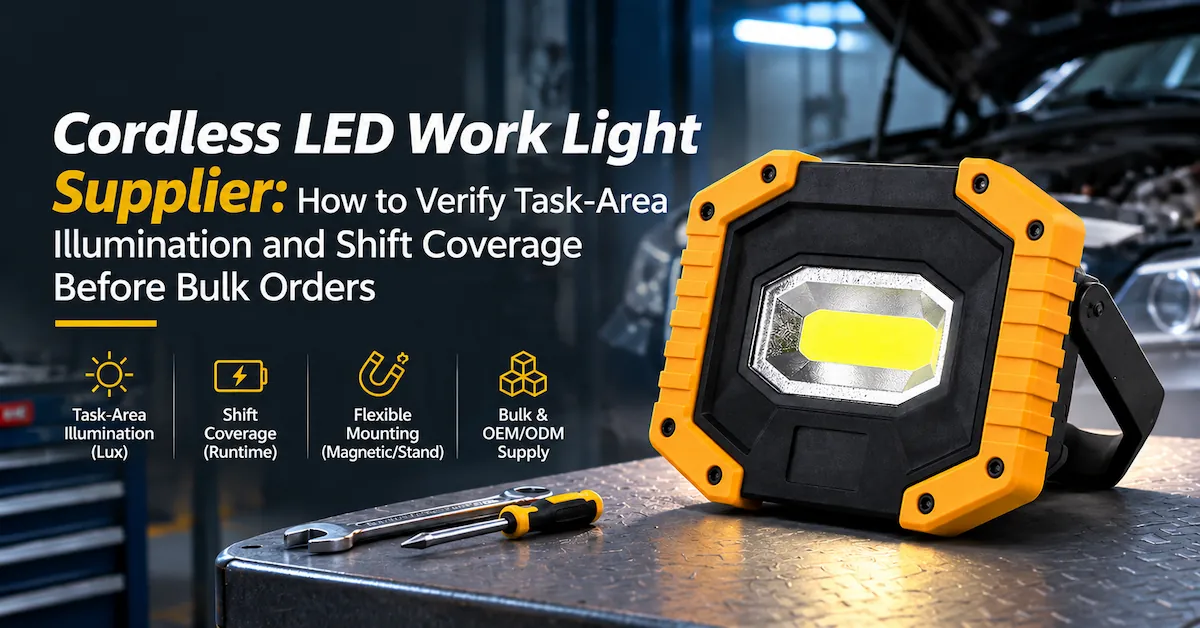


Quick Answer: An industrial LED work light supplier should help buyers select portable lighting suitable for maintenance tasks where local equipment power is isolated or unavailable. Before bulk purchasing, define the actual work positions, verify task-area illumination and useful operating time, evaluate hands-free mounting, and establish charging and deployment arrangements. Portable task lights must complement—not replace—required energy-isolation procedures, emergency lighting, or specialized electrical safety equipment.
Planned equipment shutdowns create a distinct lighting challenge for industrial maintenance teams.
During normal production, workers may rely on overhead lights, machine-mounted lamps, or convenient nearby power outlets. When equipment is isolated for servicing, some of those lighting sources may become unavailable.
Technicians still need to read component labels, inspect accessible mechanical parts, identify fasteners, and perform authorized maintenance activities.
A portable LED work light can support these tasks when its power system, beam pattern, positioning method, and operating duration match the actual working conditions.
However, a high lumen rating alone cannot establish that a light will perform effectively during a shutdown.
A product may deliver sufficient brightness but be difficult to mount inside an equipment enclosure. Another may have convenient magnetic attachment but require charging before the planned work period ends.
For industrial equipment distributors, maintenance contractors, and private-label lighting brands, the purchasing question is therefore:
How can you select and deploy industrial work lights that remain practical during planned equipment maintenance without relying on the power source being isolated?
This guide provides a structured sourcing and deployment method, using documented Brightenlux portable lighting products as reference platforms.
1. What Makes Planned Shutdown Lighting Different From General Workshop Lighting?
Planned shutdown maintenance involves a controlled work schedule in which machinery or systems are taken out of service.
During this period, personnel may need portable lighting for inspection, mechanical maintenance, cleaning, component replacement, or other authorized servicing activities.
The lighting plan should reflect the work rather than assume that existing factory illumination will always be available.
Lighting without relying on isolated equipment
A portable rechargeable light can operate independently of the machine being serviced.
This may be useful when local machine lighting or nearby equipment-powered outlets cannot be used.
However, not every shutdown removes power from the entire workshop.
The buyer should identify which lighting circuits remain available and which cannot be used during the planned activity.
Restricted working positions
Industrial machinery may contain narrow inspection openings, obstructed maintenance points, and surfaces that create difficult shadows.
A large floodlight may be inappropriate for a small machine compartment, while a narrow-beam flashlight may be insufficient for a broad workbench.
Temporary maintenance activities
Shutdown activities often have defined start and completion windows.
The purchasing team should evaluate whether the chosen lighting can support the required tasks throughout those windows, including any planned movement between work positions.
Suitable and unsuitable applications
This guide addresses portable task lighting for general industrial maintenance in environments where the selected product is appropriate.
It does not establish suitability for hazardous classified locations, confined-space entry, potentially explosive atmospheres, or work requiring specially certified electrical equipment.
Those applications require separate hazard assessment and appropriate equipment selection.
2. What Safety Boundaries Must Industrial Buyers Understand?
Portable task lighting should be planned alongside workplace safety requirements, not treated as a substitute for them.
Three different functions must be distinguished.
Task lighting
Task lighting helps a technician see the specific area where authorized work is being performed.
A rechargeable work light, magnetic flashlight, or headlamp may serve this purpose when its construction and operating conditions are suitable.
Energy isolation and lockout/tagout
For applicable U.S. industrial maintenance activities, OSHA 29 CFR 1910.147, the Control of Hazardous Energy standard, establishes requirements addressing unexpected energization, startup, and release of stored energy.
Portable lighting does not isolate machinery, verify electrical absence of voltage, or replace lockout/tagout controls.
Authorized personnel must follow the applicable energy-control procedures independently of their lighting selection.
Emergency and exit-route lighting
Portable inspection lights are not automatically approved emergency luminaires.
For U.S. workplaces, OSHA 29 CFR 1910.37 requires, among other provisions, adequate lighting of exit routes and proper functioning of relevant emergency safeguards.
An ordinary rechargeable flashlight should not be presented as a replacement for required exit-route lighting.
Requirements differ by country, facility, and activity. Buyers should confirm local workplace rules with the responsible safety professionals.
Industrial Lighting Function Comparison
| Lighting Function | Primary Purpose | Purchasing Consideration |
|---|---|---|
| Portable task light | Illuminate an authorized maintenance task | Beam, positioning, runtime, handling |
| General factory lighting | Provide normal facility illumination | Facility lighting design |
| Emergency/exit lighting | Support required emergency visibility and egress | Applicable building and workplace requirements |
| Hazardous-location light | Serve an appropriately classified environment | Specific equipment approvals and suitability |
Procurement takeaway: A general-purpose industrial LED work light should only be purchased for applications supported by its actual specifications and evidence.
3. How Should Buyers Map Lighting Needs Before a Planned Shutdown?
An industrial lighting purchasing program should begin with a work-position map.
The objective is to determine where light is needed and how technicians will use it.
Step 1: Identify the maintenance activities
List the planned tasks that require additional illumination.
Examples may include:
- Mechanical component inspection.
- Equipment housing access.
- General maintenance-bench work.
- Inspection of accessible fasteners and markings.
- Servicing of safely isolated machinery.
- Visual checks performed under authorized maintenance procedures.
Step 2: Record the working position
For each task, identify the user's position and available space.
A technician working beside a large machine may have different lighting requirements from one examining a narrow opening.
Step 3: Identify the existing illumination
Confirm which normal lighting sources remain available.
Avoid assuming that a nearby outlet or machine-integrated lamp will remain usable during isolation.
Step 4: Establish the required operating period
Record how long the light must provide useful illumination.
The intended period should reflect the maintenance work rather than an arbitrary battery-runtime target.
Step 5: Select the positioning method
Potential options include magnetic attachment, a clip, a hook, an approved stand, handheld operation, or a wearable headlamp.
Each option should be evaluated for the actual task.
Shutdown Lighting Requirement Matrix
| Maintenance Activity | Main Lighting Need | Possible Portable Format | Verification Priority |
|---|---|---|---|
| Mechanical equipment inspection | Directional illumination | Adjustable-head flashlight | Beam positioning |
| Narrow machinery access | Compact light source | Right-angle inspection light | Physical clearance |
| Two-handed servicing | Hands-free illumination | Headlamp or approved mounted light | Stability and ergonomics |
| Maintenance bench | Wider task coverage | Portable area or COB work light | Illuminance and glare |
| Mobile maintenance checks | Easy repositioning | Rechargeable flashlight | Controls and battery status |
The matrix is a planning tool. It does not imply that every lighting format is available as a standard Brightenlux model.
4. Which Technical Specifications Matter Most During Equipment Isolation?
A useful specification must describe what the light needs to accomplish at the work position.
It should not rely exclusively on advertised maximum brightness.
Useful task-area illumination
Lumens measure luminous flux, while lux describes illuminance received at a surface.
A light with a concentrated beam can provide a bright hotspot but leave the surrounding maintenance area in shadow.
Buyers should assess illumination at the actual working distance.
Beam distribution
Focused beams can support localized inspection.
Flood-oriented lighting may be more useful for larger nearby surfaces.
The best configuration depends on the target area, surrounding obstacles, and viewing direction.
Sustained operating time
Battery capacity alone does not establish useful runtime.
Operating mode, driver behavior, temperature, and battery condition influence how long a light maintains adequate output.
Charging and power compatibility
The supplier should identify the approved battery configuration and supported charging input.
A USB-C connector does not automatically establish fast-charging capability or compatibility with every power source.
Mounting and controls
Buttons should be accessible in the intended working position.
Mounting mechanisms should keep the light appropriately aimed without interfering with the work.
Recommended Industrial Work Light Specification
| Specification | Buyer Requirement | Verification |
|---|---|---|
| Work application | Defined maintenance task | Application brief |
| Lighting format | Directional, broad-area, or wearable | Product sample |
| Working distance | Actual task geometry | Representative setup |
| Illuminance | Buyer-defined useful lighting level | Task-plane measurement |
| Operating mode | Approved normal working mode | Functional test |
| Runtime | Required useful operating period | Mode-specific runtime test |
| Battery | Approved type and configuration | Technical specification |
| Charging | Compatible input and accessories | Charging test |
| Mounting | Suitable for the working position | Stability assessment |
| Environmental conditions | Expected dust, moisture and handling | Product-specific evidence |
| OEM configuration | Approved model and components | Controlled specification |
The supplier should distinguish published specifications from independently verified measurements and buyer-proposed requirements.
5. Which Portable Lighting Formats Work Best for Industrial Maintenance?
Different lighting formats serve different maintenance activities.
A supplier should help buyers understand those differences rather than recommend the same model for every task.
Adjustable-head rechargeable flashlights
An adjustable-head flashlight allows users to direct the beam toward a component without necessarily changing the position of the entire light.
This can be useful when the lamp is placed on a suitable surface or securely mounted.
Buyers should verify the adjustment mechanism and beam direction.
Magnetic right-angle flashlights
Right-angle lights can provide directional illumination in compact spaces.
A magnetic tail may support temporary attachment to suitable ferromagnetic surfaces.
However, magnetic attachment depends on material, contact conditions, orientation, and product geometry.
Rechargeable LED headlamps
Headlamps allow illumination to follow the user's head movement.
They may be useful when a technician needs both hands for authorized work.
Buyers should evaluate beam comfort, weight, strap fit, and control accessibility.
Portable COB or area work lights
Dedicated COB work lights can provide broader illumination when designed with suitable optics.
Their suitability depends on physical dimensions, positioning, battery configuration, and beam distribution.
Lighting Format Comparison
| Product Format | Potential Advantage | Limitation to Verify |
|---|---|---|
| Adjustable-head flashlight | Flexible directional beam | Joint stability and beam coverage |
| Magnetic right-angle flashlight | Compact hands-free positioning | Surface compatibility |
| Rechargeable headlamp | Mobile hands-free lighting | Glare, comfort and runtime |
| COB inspection light | Potentially broad close-range beam | Mounting and sustained output |
| Portable area light | Wider nearby work area | Size, power and positioning |
Supplier selection principle: Choose the format that fits the authorized maintenance activity, then compare technical performance and commercial terms.
6. Which Brightenlux Products Can Buyers Evaluate for Industrial Task Lighting?
Ningbo Brightenlux Electric Appliance Co., Ltd. publishes rechargeable portable lighting products and describes OEM/ODM support for outdoor, work, repair, and field-service applications.
Its work and repair lighting solutions page provides a starting point for discussing industrial lighting requirements.
The publicly documented products below can serve as reference platforms for selected manual maintenance tasks.
They are not presented as certified hazardous-location lights or as a confirmed range of dedicated industrial COB workshop lamps.
Brightenlux Portable Lighting Platform Comparison
| Product | Manufacturer-Published Features | Potential Maintenance Application |
|---|---|---|
| BT-FL8078 Right-Angle Flashlight | SST25, up to 1000lm, 16340 800mAh battery, magnetic tail, Type-C | Compact equipment inspection |
| 1000lm SST40 Adjustable-Head Flashlight | Adjustable head, magnetic tail, 18650 2200mAh battery, Type-C | Directional mechanical maintenance |
| BT-FL8088 Rechargeable Flashlight | SST40, up to 1500lm, 21700 4000mAh battery, Type-C | Portable localized work lighting |
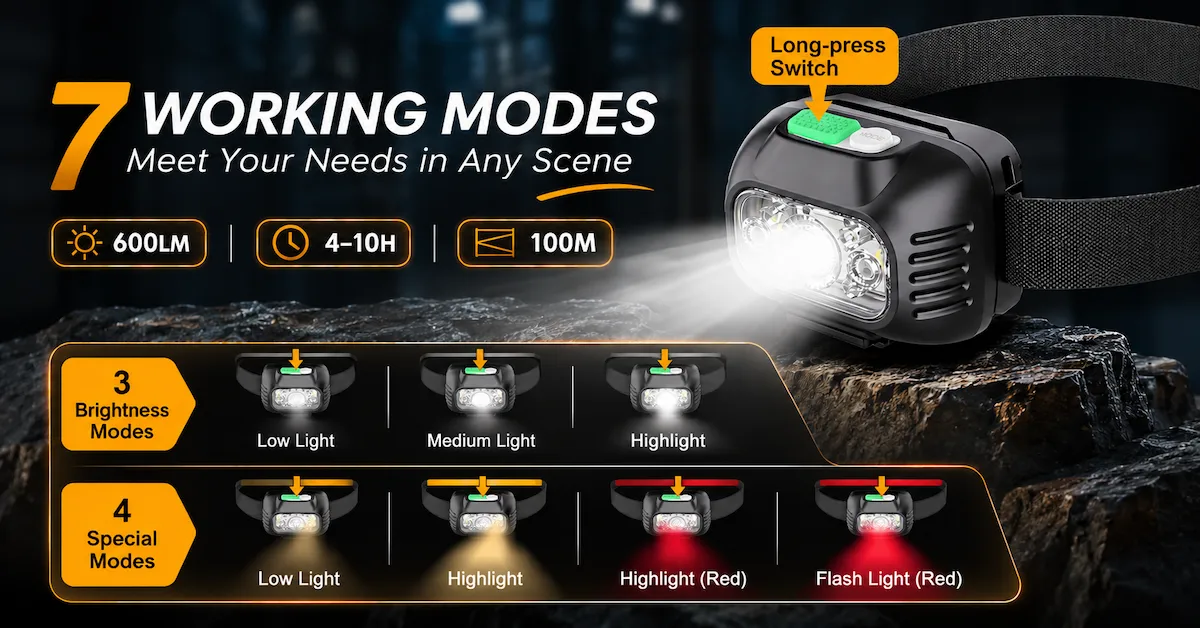
| 650lm SST20 Rechargeable Headlamp | SST20, 1800mAh battery, Type-C, additional red/warm modes | Mobile hands-free inspection |
All values are manufacturer-published specifications and should be confirmed for the exact proposed order.
BT-FL8078: Compact inspection lighting
The Brightenlux BT-FL8078 Right-Angle Rechargeable Flashlight uses a 90-degree head configuration and magnetic tail.
Its published product information identifies a rechargeable 16340 battery, Type-C charging, and headstrap-related accessories.
For industrial buyers, this is a reference platform for evaluating compact illumination where working space is limited.
The buyer should verify its application fit and operating time at the required brightness.
SST40 adjustable-head flashlight
The Brightenlux 1000-Lumen SST40 Adjustable-Head Flashlight combines an adjustable head with a magnetic tail and rechargeable battery system.
Its architecture may be evaluated for directional inspection of safely isolated machinery.
Important checks include adjustment stability, mounting conditions, useful illumination, and mode-specific runtime.
BT-FL8088: Rechargeable portable lighting
The Brightenlux BT-FL8088 Rechargeable Flashlight uses a published 21700 battery configuration.
It provides another reference for comparing power systems and portable lighting arrangements.
The buyer should verify the actual runtime, charging conditions, and task suitability rather than relying only on the battery capacity.
SST20 rechargeable headlamp
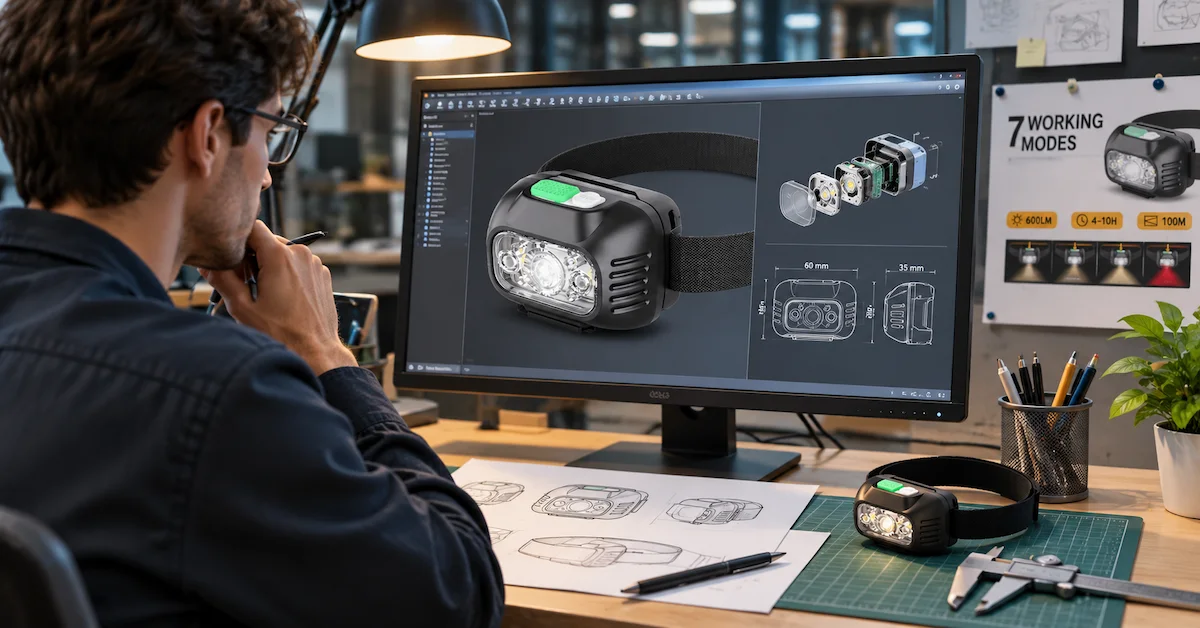
The Brightenlux 650-Lumen SST20 Rechargeable Headlamp offers wearable lighting with several operating modes.
This type of product may suit maintenance activities requiring free hands.
Buyers should assess fit, comfort, beam direction, and the actual working environment.
What about dedicated industrial work lights?
Brightenlux's public Working Light category currently does not provide a visible list of dedicated specialist models.
Buyers requiring a folding COB lamp, freestanding area light, or other specialized format should request the current catalogue and confirm the actual proposed model.
Explore Brightenlux Portable Lighting Products
7. How Should Buyers Verify Battery Performance for Shutdown Maintenance?
The goal is to establish whether the selected product maintains useful lighting for the intended task.
A maximum working-time figure without operating conditions is insufficient for precise procurement decisions.
Define the required lighting mode
Record which mode technicians will actually use.
A product may remain switched on for longer in a low-output mode than at maximum brightness.
Record the battery configuration
The approved battery model, capacity, nominal voltage, and protection arrangement should be documented.
Different cells with the same physical form factor may have different performance.
Evaluate light output over time
A useful test can record task-plane illumination or another agreed lighting metric at defined intervals.
This helps buyers identify whether output decreases below the level needed for the task.
Confirm the charging arrangement
Charging should be performed from an approved, available supply away from any prohibited or isolated power source.
If a product is intended to operate while charging, that capability must be explicitly supported by the design and evaluated separately.
Request standardized performance evidence
The ANSI/PLATO FL 1-2025 Flashlight Basic Performance Standard provides standardized performance testing and reporting methods for applicable portable lighting products, including flashlights, headlamps, spotlights, and area lights.
Relevant attributes include output, runtime, beam distance, and specified durability characteristics.
The standard helps buyers interpret published performance measurements, but it does not prove a particular model has passed the applicable tests.
Runtime Verification Record
| Test Field | Required Information |
|---|---|
| Sample identification | Model and revision |
| Battery | Approved configuration |
| Charging | Initial charge condition and method |
| Operating mode | Exact mode selected |
| Working setup | Distance, position and conditions |
| Lighting measurement | Agreed output or illuminance metric |
| Test interval | Defined observation schedule |
| Acceptance endpoint | Minimum useful lighting criterion |
| Result | Actual measured usable duration |
Battery runtime should be compared with the maintenance task requirements, not treated as a universal product-ranking number.
8. How Should Industrial Buyers Stage Portable Lighting Before Shutdown Work?
Preparing lighting before the maintenance window can reduce uncertainty once work begins.
The purchasing team should coordinate the lighting requirements with the facility's authorized maintenance personnel.
Before the planned work period
Confirm that the approved products are available, appropriately charged, and assigned to the intended work positions.
Inspect the housing, charging ports, switches, mounting accessories, and visible battery condition according to the manufacturer's instructions.
Identify the approved charging location and any available replacement or contingency equipment.
During the maintenance period
Technicians should use the light only within its approved operating limitations.
The product should be positioned without obstructing machinery access, protective devices, walkways, or authorized work procedures.
If a light cannot provide adequate visibility, the task should be reassessed under the facility's safety procedures rather than continued under unsuitable illumination.
After the maintenance period
Inspect the portable lights for damage or contamination.
Record any charging problems, broken mounting components, abnormal controls, or other issues requiring attention.
Equipment should be recovered from maintenance areas before the machinery is returned to service, as required by the applicable work procedures.
Suggested Shutdown Lighting Readiness Checklist
| Stage | Buyer or Site Check |
|---|---|
| Planning | Work positions and lighting requirements defined |
| Before deployment | Approved model and battery confirmed |
| Initial inspection | No unacceptable visible damage |
| Functional check | Switches and lighting modes operate correctly |
| Charging preparation | Approved charging supply available |
| Placement | Safe and practical positioning confirmed |
| Maintenance period | Lighting remains suitable for the task |
| Completion | Equipment recovered and condition checked |
| Return to inventory | Charging and maintenance needs recorded |
This is a suggested equipment-readiness framework. It does not replace the employer's equipment-isolation, permit, safety or restart procedures.
9. What Materials and Quality Controls Matter for Industrial Maintenance Lighting?
Portable work lights may be repeatedly handled, transported, repositioned, and charged.
The appropriate construction depends on the product and intended environment.
Housing materials
Aluminum housings can provide mechanical strength and a thermal path when properly designed.
Engineering plastics can support complex shapes and help manage weight.
Neither material should be assumed superior without evaluating the complete assembly.
Mounting components
Magnetic tails, clips, straps, and adjustable joints should match the approved configuration.
Their functionality must be evaluated under representative conditions.
Charging and battery components
The battery and charging circuitry influence operating performance.
A supplier should identify critical electrical components and control relevant substitutions.
Enclosure protection
If the product has an advertised IP rating, buyers should request evidence applying to the actual model.
Water resistance does not automatically establish chemical resistance, impact durability, or suitability for a hazardous environment.
Production quality control
A suitable manufacturing discussion should cover:
- Incoming component identification.
- Mechanical and electrical assembly checks.
- Lighting and charging functionality.
- Product revision control.
- Finished-goods inspection.
- Packaging accuracy.
- Relevant product and battery documentation.
Industrial Work Light Quality Matrix
| Control Area | Evidence to Request |
|---|---|
| Product identity | Approved model and revision |
| LED and optics | Approved components and configuration |
| Battery | Approved cell or pack |
| Charging | Functional test results |
| Controls | Mode and switch verification |
| Mounting | Agreed stability checks |
| Housing | Material and appearance specification |
| Environmental claims | Relevant model-specific evidence |
| Production inspection | Agreed acceptance records |
| Repeat orders | Change and traceability records |
The buyer should distinguish laboratory qualification tests from routine production inspection.
Not every unit needs destructive testing, but critical production characteristics must remain controlled.
10. What OEM/ODM Support Should Industrial Buyers Discuss?
Brightenlux publicly offers OEM/ODM discussions for portable lighting products and international buyers.
For a planned-shutdown lighting program, product requirements should be based on the specific tasks and sales channel.
Branding and packaging
Potential requirements include logos, product colors, packaging, manuals, identification labels, and approved accessory combinations.
The factory should confirm what is available for each model.
Functional customization
Buyers may request different lighting modes, optical arrangements, mounting accessories, or battery configurations.
Such changes can require engineering assessment and additional testing.
Production configuration
Before a bulk order, the buyer should approve the exact product revision and relevant components.
If an OEM modification affects battery, optics, housing, or mounting, previous test evidence may need to be reviewed.
Recommended OEM Development Workflow
Application brief → Product-platform review → Sample selection → Shutdown task trial → Engineering assessment → Production-intent sample approval → Quality inspection → Shipment
This is a recommended procurement process rather than a claim about Brightenlux's fixed internal production procedure.
Capacity and lead time
A supplier's general manufacturing experience does not establish the availability of a particular model or a guaranteed production schedule.
Ask for model-specific MOQ, sample timing, engineering requirements, manufacturing lead time, and delivery arrangements.
Any quoted schedule should identify which stages depend on product approval, components, or customization.
11. How Should Buyers Compare the Total Cost of Industrial Work Lights?
The lowest unit price may not provide the best value for an industrial maintenance program.
However, a more expensive light is not automatically a better purchasing decision.
The commercial comparison should reflect the complete approved configuration and its intended use.
Cost categories
| Cost Element | Purchasing Question |
|---|---|
| Lighting unit | Which exact product is included? |
| Battery | Is the approved battery included? |
| Charging accessories | Which cables or adapters are supplied? |
| Mounting accessories | Are clips, straps, or holders included? |
| OEM branding | Which customization charges apply? |
| Engineering | Are modifications required? |
| Testing | Which tests are included? |
| Inspection | What acceptance procedure is agreed? |
| Logistics | What shipping terms and costs apply? |
| Support | What replacement or service conditions apply? |
Compare complete delivered cost
A useful commercial framework is:
Total purchasing cost = Product units + Approved accessories + Customization + Testing and inspection + Logistics + Applicable duties and taxes
Where appropriate, buyers may also evaluate expected replacement and maintenance costs.
Avoid misleading supplier comparisons
Two work lights should not be compared solely by wattage or maximum lumens.
A directional inspection flashlight and broad-area work lamp may solve different tasks.
Similarly, quotations with different battery inclusion, charging accessories, or OEM requirements are not equivalent.
The buyer should compare proposals against one controlled requirement document.
12. What Should Be Included in an Industrial LED Work Light RFQ?
A clear RFQ helps the supplier understand the intended maintenance activity and propose an appropriate product.
It should identify the environmental limits and evidence needed before sample approval.
Recommended Industrial Lighting RFQ
| RFQ Field | Information to Provide |
|---|---|
| Buyer | Company, country, distribution channel |
| End-user application | Plant shutdown, mechanical maintenance, inspection |
| Power conditions | Available and isolated power sources |
| Lighting format | Directional, wearable, magnetic, broad-area |
| Work position | Distance, area, mounting and orientation |
| Runtime | Required useful operating period |
| Battery | Preferred configuration and charging |
| Environment | Dust, moisture, temperature and handling |
| Restrictions | Hazardous-area or other special requirements |
| Product testing | Application trial and acceptance criteria |
| OEM customization | Logo, accessories, packaging and components |
| Quality control | Samples, inspection and repeat-order control |
| Commercial | Quantity, MOQ, quotation basis and timeline |
Questions to ask before approval
A purchasing team should request confirmation of:
- Which existing product platforms are relevant to the maintenance tasks?
- Which specifications are published and which have supporting test evidence?
- What battery and charging arrangements are available?
- Which mounting options are included or require development?
- What operating conditions and limitations apply?
- Can representative samples be provided for application evaluation?
- What OEM customization is possible for the selected model?
- How will production consistency, MOQ and delivery be confirmed?
Discuss your project with Brightenlux
Ningbo Brightenlux Electric Appliance Co., Ltd. provides portable LED lighting products and discusses OEM/ODM development for international customers.
For an industrial maintenance project, buyers should describe the equipment environment, work positions, required lighting duration, and intended purchasing quantity.
Brightenlux can then be asked to identify relevant existing products and clarify the customization and validation requirements for the proposed order.
Explore Brightenlux Lighting Products
13. Frequently Asked Questions About Industrial LED Work Light Suppliers
1. What should I look for in an industrial LED work light supplier?
Look for a supplier that can identify the proposed product configuration, explain its intended applications, provide relevant performance information, and support representative sample testing. For bulk procurement, confirm battery and charging specifications, mounting arrangements, manufacturing consistency, OEM options, MOQ and delivery conditions.
2. Can rechargeable work lights be used during planned equipment shutdowns?
They may provide suitable portable task lighting where their power supply and construction are appropriate for the work environment. However, they must not replace energy-isolation controls, required emergency lighting, or specialized equipment approvals. The facility's authorized personnel should determine suitable use conditions.
3. What is the difference between industrial work lighting and emergency lighting?
Industrial portable work lighting supports specific maintenance or inspection tasks. Emergency lighting and exit-route lighting have different safety functions and applicable requirements. A rechargeable flashlight does not automatically qualify as a compliant emergency-lighting system.
4. Are magnetic LED work lights suitable for factory maintenance?
They can be useful when the intended mounting surface is sufficiently ferromagnetic and the product remains stable in the required orientation. Buyers should test actual mounting conditions and ensure the light does not interfere with maintenance access or safety procedures.
5. How many lumens does an industrial work light need?
There is no universal lumen requirement for every industrial maintenance task. The useful lighting level depends on beam distribution, working distance, task size, ambient illumination, and visual requirements. Buyers should assess representative samples at the actual work position.
6. What battery characteristics matter for shutdown maintenance lighting?
Important characteristics include approved cell or pack configuration, useful operating time, charging compatibility, battery condition, and product behavior during discharge. Published maximum runtime should not be assumed to apply at maximum brightness or under every environmental condition.
7. Does an IP rating make a portable work light suitable for every factory environment?
No. An IP rating addresses specified enclosure protection characteristics. It does not automatically establish suitability for hazardous locations, chemical exposure, heavy impact, or other specialized industrial conditions. Buyers should verify the relevant requirements separately.
8. Can Brightenlux provide OEM industrial work lights?
Brightenlux publicly offers OEM/ODM portable lighting support and has documented flashlight and headlamp platforms relevant to selected maintenance applications. Dedicated industrial work-light availability, technical modifications, compliance evidence, MOQ and production timelines require confirmation for the proposed model.
9. How should buyers test work-light samples before bulk purchasing?
Define representative maintenance tasks and operating conditions. Evaluate illumination, beam positioning, controls, mounting, charging, useful runtime, physical handling and relevant environmental requirements. Document the exact sample configuration and establish acceptance criteria before approving production.
10. How can I request an industrial LED work light wholesale quotation?
Provide the intended application, power-availability conditions, lighting format, operating-time requirements, mounting needs, destination market, customization preferences, and estimated purchasing quantity. Contact Brightenlux to request current product options, available specifications, samples and commercial terms.
Conclusion
Choosing an industrial LED work light supplier requires more than comparing advertised lumens, battery capacities, product photographs, and factory quotations.
For planned equipment shutdowns, the key purchasing question is whether the selected portable lights can provide useful illumination at authorized maintenance positions without depending on unavailable or isolated equipment power.
A practical sourcing process should begin with the maintenance tasks, identify suitable lighting formats, verify representative samples, and establish clear operating and quality requirements.
Buyers should distinguish ordinary task lighting from required emergency and exit-route lighting and ensure that all work remains subject to the applicable safety procedures.
Product selection should also consider mounting, charging, sustained output, component control, and the supplier's ability to reproduce the approved configuration.
Brightenlux provides rechargeable portable lighting platforms and OEM/ODM support discussions for overseas buyers.
For industrial distributors, maintenance contractors, and private-label brands, the most valuable next step is to define the exact maintenance application and request a model-specific proposal.
A clear RFQ, practical lighting trial, and documented acceptance plan help buyers compare suppliers more effectively and make informed bulk purchasing decisions.
Explore industrial lighting options: Brightenlux LED Lighting Products
Review work-light applications: Brightenlux Work and Repair Lighting
Start your sourcing project: Request an Industrial LED Work Light Supplier Quote
Plan your next maintenance-lighting sourcing project
Start with verified product platforms and a model-specific quotation rather than unqualified lumen or runtime claims.
Request a Quote →View Work & Repair Applications →