

Short answer: Choose the supplier that can prove a controlled product build, useful sustained light, repeatable battery and charging configuration, documented inspection, and a realistic commercial plan for your market. Score the evidence before comparing unit price.
When a purchasing team searches for an LED work light manufacturer, it is usually trying to solve a concrete sourcing problem: a mechanic needs stable illumination inside an engine bay, a maintenance distributor needs a dependable private-label range, or a field-service manager needs a light that can be charged and used repeatedly away from a bench. The search is commercial investigation, not casual browsing. The best supplier comparison therefore starts with the work cycle and the evidence behind the proposed build.
This guide is written for importers, tool brands, automotive distributors, industrial-supply companies and regional wholesalers. It gives you a scorecard for comparing an LED work light supplier with another factory or trading company. It also explains what Brightenlux public pages can and cannot prove. The public site presents Brightenlux as a portable-light brand with product references and a contact path; the exact work-light catalogue, MOQ and production plan still belong in the RFQ conversation.
Who is this guide for, and what should a good answer contain?
A decision-maker should be able to extract the answer from the first screen: identify the job, state the required light behaviour, compare the supplier's evidence, test a production-intent sample and normalize the landed quote. A page that only says “high quality” does not answer a procurement question. A useful manufacturer response names the LED or optical platform, battery and charge arrangement, housing material, controls, mounting method, inspection method, packaging scope, change-control rule and the items still waiting for confirmation.
The word manufacturer also needs care. Some companies design, assemble and test the product themselves; some coordinate an approved component network; some resell a catalogue body with a logo. None of those models is automatically wrong. The buyer needs to know who owns the specification, who approves substitutions and who will correct a failure in the next batch. That is why a capability scorecard is more valuable than an attractive factory photograph.
1. Translate the buyer question into a work cycle
Start by writing the customer's day in plain language. “The technician carries the lamp in a service bag, places it on a metal panel, works for twenty minutes, moves it to a plastic trim area, checks a connector under the dashboard, then charges it from a vehicle USB outlet.” This sentence exposes requirements that a lumen number hides: a magnetic tail, a stable base, a beam that does not blind the user, gloves-compatible control, and a charge port that can be reached without dismantling the setup.
For an industrial maintenance buyer, the cycle may be longer and less predictable. The light could hang from a cabinet, remain on medium output for an hour, spend the night in a cold van, and be expected to start after a week in storage. For a roadside service brand, weight and rapid repositioning may matter more than a large battery. Put the cycle, not a generic adjective, in the first line of the RFQ. The supplier can then recommend a platform and identify the trade-offs.
Define the useful end point. Does “runtime” mean until the LED turns off, until brightness falls to a specified percentage, or until the user says the task is no longer comfortable? A credible rechargeable LED work light manufacturer will ask this question because a short high-output burst and a stable medium work mode are different commercial promises. Record mode, battery, ambient condition and test method for every number that may appear on a package.
2. Build a supplier comparison scorecard
Give every candidate the same questions and the same evidence labels. “Confirmed” means a current document or a measured production-intent sample supports the statement. “Published reference” means a public product page states it, but the buyer still needs to confirm that the proposed work-light configuration is the same. “Open” means the supplier has not yet supplied enough information. This language prevents a catalogue claim from quietly becoming an acceptance criterion.
| Score area | What to request | Strong evidence | Red flag |
|---|---|---|---|
| Product ownership | Who controls LED, driver, battery, housing and accessory changes? | Named owner, model code, revision history and change notice | The sales reply cannot identify the production owner |
| Optical performance | How are beam, output and step-down measured? | Mode-specific report with method, time and sample ID | Only a peak lumen graphic is supplied |
| Power system | Cell identity, protection, charge input and pack-out | Cell model, Wh data, charging test and logistics review | “18650” is given without source or protection details |
| Manufacturing control | Incoming, in-process and final checks | Process map, batch traceability and inspection record | Factory photos with no controlled checklist |
| Commercial fit | MOQ, tooling, artwork, lead time and reorder rule | Written quotation with scope and assumptions | Unit price changes when packaging or battery is discussed |
| After-sales | Warranty evidence and failure triage | Return workflow, batch code and response owner | Every failure is treated as user error |
Weight the score according to the risk of your channel. A mechanic's tool brand may give battery consistency and switch durability more points than cosmetic customization. A retail importer may give packaging, barcode, manuals and carton efficiency more weight. A utility contractor may prioritize sustained illumination, mounting and documentation. The score is not a universal ranking; it is a transparent way to explain why one supplier fits this program.
Send your work-light requirements for a supplier comparison
3. Compare a manufacturer with a trading company fairly
A trading company can be useful when it has a long-standing factory network, understands export documents and manages a broad assortment. A direct factory can be useful when the buyer needs engineering changes, sample control or a repeat-order agreement. Ask the same operational questions to both: who owns the BOM, who handles a changed cell, who signs the golden sample, who can show a process record, and who is accountable when a carton says one thing but the product does another.
Look for a coherent answer across sales, engineering and quality. If the sales quotation says Type-C charging, the sample and manual should show the same port. If the product page says a battery is included, the pack list and shipping classification should agree. If a supplier cannot answer immediately, that is not automatically a failure; a disciplined response that labels the item “to confirm” is safer than an instant promise with no owner.
For China sourcing, location alone is not evidence. Ask where the proposed unit is assembled, where the cell is sourced, how the LED and driver are checked, and whether the same line can repeat the build after the first order. A capable LED work light manufacturer China program should make the physical and commercial chain understandable to your purchasing and quality teams.
4. Use public Brightenlux references without overclaiming
The following public references are useful for a first technical conversation. They are portable lights rather than a statement that the public Working Light category currently lists a dedicated work-light SKU. Use them to compare battery formats, charging interfaces, controls and magnetic or hands-free concepts, then ask Brightenlux which current platform can support your work-light brief.
| Public reference | Published detail | Useful discussion | Confirm before quoting |
|---|---|---|---|
| 1000-lumen right-angle magnetic light | SST25 LED; 5 modes; magnetic tail; Type-C; 800mAh 16340 included; 55g; public page states 2–3 hours | Compact inspection, hands-free positioning and vehicle-kit size | Exact mode runtime, work-light availability, accessory pack, MOQ and sample measurement |
| 1000-lumen red-mode magnetic light | SST25; white/red modes; magnetic tail; Type-C; 18650 included; head strap/plastic mount | White plus red task or low-glare discussion | Cell source, mode sequence, sustained output, current quotation and carton data |
| 1500-lumen 21700 magnetic-tail light | SST40; 4000mAh 21700 included; Type-C; multiple modes; 106g; public page states up to 8 hours | Higher-capacity step-up and runtime test design | Mode behind “up to” claim, thermal step-down, battery documents and availability |
| 1000-lumen OSRAM P9 light | OSRAM P9; twist-out Type-C port; IP44 stated; 18650 not included by default | Battery-included versus battery-excluded pack-out | Exact IP evidence, cell variant, accessories, logistics and private-label scope |
The comparison is valuable because it reveals the questions behind a product page. A compact 16340 platform may be right for a short inspection but wrong for an eight-hour maintenance shift. A 21700 platform may add useful capacity but change weight and carton economics. A battery-excluded variant can reduce shipping complexity yet create a compatibility question for the customer. A buyer should compare complete delivered configurations, not isolated body prices.
5. Check optics, LED selection and useful illumination
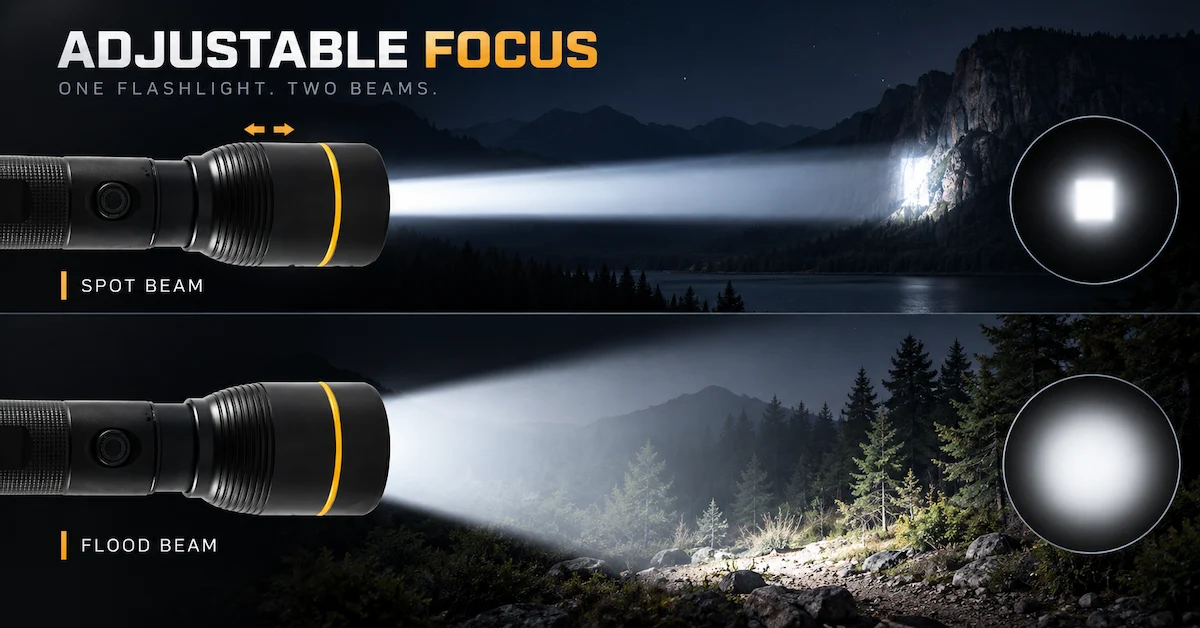
The LED part number is only the beginning. Ask what the user needs to see: a broad area, a close inspection patch, a long reach down a bay, or a combination of white and red light. Beam shape, hotspot, spill, tint, glare and colour appearance affect whether a technician can read a label or spot a leak. A supplier that discusses these trade-offs is more useful than one that repeats the highest lumen figure.
Request a simple mode chart with the output at switch-on, after stabilization and at the agreed end point. Ask whether the driver steps down because of temperature, battery voltage or a programmed timer. Run the proposed sample on a reflective metal panel, a matte plastic surface and a dark cavity. These three surfaces expose uncomfortable glare, a weak peripheral beam or an overly narrow hotspot that a marketing photo will not show.
For a portable LED work light supplier, ergonomics and optics belong in one review. A beam that looks excellent on a wall can be awkward when the lamp is clipped near the user's face. A right-angle body can illuminate a hand-held inspection area while keeping the switch accessible. Document the position, distance and task so the factory can reproduce the feedback.
6. Review materials, heat path and mechanical design
Ask the supplier to name the housing material, lens material, reflector or optic, seals, buttons, clips, magnets and fasteners for the proposed configuration. “Aluminium body” is not a complete material statement; it does not tell you the grade, finish, wall thickness or heat path. “Impact resistant” is not a test method. The goal is not to demand an expensive laboratory program for every SKU, but to know which statements are measured and which are design intent.
Use the work cycle to inspect mechanical decisions. A magnet must hold the intended load on the intended surface, not only on a clean steel plate in a showroom. A clip must survive repeated insertion into a service pocket. A stand must stay stable when a cable is attached. A switch should be findable with gloves and should resist accidental activation in a packed bag. These are straightforward checks, yet they often decide whether a light earns a second order.
Thermal behaviour is part of the user experience and the battery system. Run the light for the required duration, record output changes and measure touch points. Ask whether charging and operation can occur together and whether a protective step-down is visible to the user. Do not copy an IP or temperature rating from a similar body. Confirm the exact production-intent configuration and the market evidence that supports the claim.
7. Treat the battery and charging system as a controlled product
A rechargeable light is a small power system, not a shell with a cell hidden inside. Record chemistry, nominal voltage, rated capacity, protection circuit, approved source, terminal style and whether the cell is contained in or packed with the equipment. “18650” and “21700” describe a form factor; they do not identify a complete approved cell. If the supplier proposes an alternative, compare charge behaviour, useful runtime, mass, documentation and shipping configuration before accepting it.
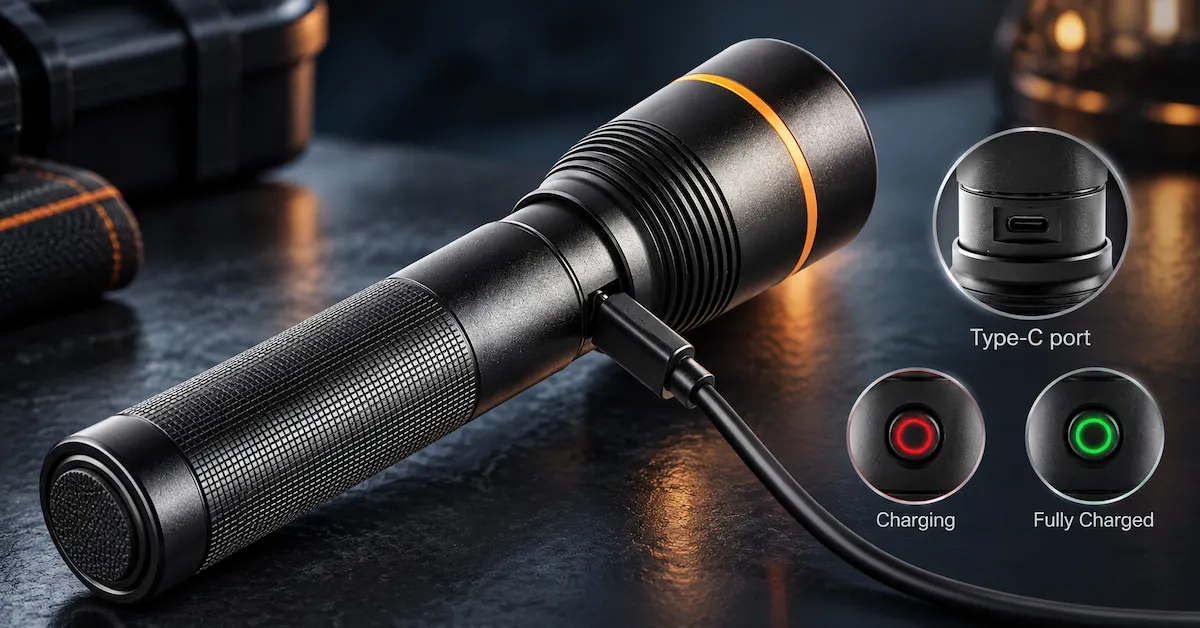
Test the port with the power sources customers actually use: a vehicle outlet, a shared USB-C station and a common wall adapter. Note the cable, indicator colours, full-charge behaviour, low-battery warning, charge interruption and operation while plugged in. Do not infer fast charging from the shape of the connector. Ask for the input profile and a measured charge-time method.
For battery shipments, provide the freight specialist with the cell identity, watt-hours, pack-out, carton construction, labels and current route requirements. The IATA lithium-battery guidance is a reference for the review, not a substitute for a route-specific decision. A supplier should be willing to confirm the exact build and supply the documents needed by the carrier and destination market.
8. Demand factory evidence, not only factory language
Original evidence can be compact. Ask for a production-line photograph tied to the model, a sample label, a short assembly or charging-check clip, an incoming inspection record, a mode test sheet, packaging photos and a real sample. These items do not need to expose confidential customer information. They simply connect the product promise to a controlled process. Save the files with a date, model code and revision so the evidence remains useful during a reorder.
A strong OEM LED work light manufacturer can explain what happens when a component changes. The answer should cover engineering review, sample impact, retesting, artwork and customer approval. If the driver changes, the output and thermal result may change. If the cell changes, runtime, weight and transport documents may change. A change-notice rule protects both sides from an apparently cheaper substitution that creates a return wave.
Ask for traceability at the level your channel needs. A professional tool brand may need a batch code linked to cell and driver lots. A smaller importer may only need the approved sample, production date and final inspection record. The right level is the one that lets you investigate a customer complaint without guessing which build was shipped.
9. Compare MOQ, lead time and packaging as one commercial decision
MOQ is not just a number printed beside a price. Ask what quantity is required for a standard body, a logo, a custom colour, a new insert, a barcode or a new mould. Separate sample quantity, pilot quantity and repeat-order quantity. A supplier may support a low first run while requiring a higher carton or colour minimum. Put every assumption into the quotation so the landed cost can be compared honestly.
Lead time should identify the clock that starts it. Does the quoted period begin after artwork approval, deposit, battery confirmation, component arrival or golden-sample sign-off? Ask for a simple milestone plan: engineering response, sample dispatch, artwork proof, material release, assembly, inspection and shipment. A transparent schedule lets the buyer protect a launch date without pretending every project follows the same calendar.
Packaging is part of product performance. The carton needs to describe the actual battery and charging configuration, protect the switch and port, fit the included accessories and survive the agreed distribution route. Compare inner pack, master carton, barcode, manual, warning labels, pallet quantity and spare-part policy. If the product is private label, make the package proof part of the same approval record as the physical sample.
| Commercial line | Question to put in the RFQ | What to save in the approval file |
|---|---|---|
| MOQ | Which minimum applies to sample, pilot, logo, colour, carton and repeat order? | Dated quotation with quantities and assumptions |
| Lead time | What event starts the clock and what can delay it? | Milestone plan and named owner |
| Packaging | What is included: cable, cell, manual, barcode, carton and inserts? | Approved dieline, pack list and photos |
| Inspection | Which checks happen before release and who signs them? | Inspection checklist and sample report |
| Reorder | How are approved components and artwork preserved? | Golden sample, BOM revision and change rule |
10. Calculate total cost and service risk
The cheapest lamp body is rarely the cheapest program. Add battery and protection, cable or charger, logo method, packaging, sample and artwork, inspection, freight, duty, damage allowance, warranty reserve and customer-support effort. Then compare products at the same delivered scope. A battery-excluded quote may look lower but create a compatibility question. A higher-capacity model may look more expensive but reduce the number of SKUs needed for a shift-based customer.
Create a simple cost-to-serve model. Estimate how many customer questions the package will create, how many returns might need triage, and which spare parts or replacement policies are realistic. The model is not a forecast of failure; it is a way to prevent a low unit price from hiding post-sale work. Share the assumptions with the supplier so the quotation can be improved rather than argued over.
For wholesale LED work lights, make the range understandable to the distributor. Give each SKU a job, a confirmed battery story, a price position and a reason to exist. An entry model can cover short checks, a core model can cover daily service, and a higher-capacity model can serve longer work cycles. Avoid adding variants that differ only in a hidden component or an unimportant colour.
11. Run a representative sample audit
A sample audit should mimic the customer, not a desk. Put on work gloves. Carry the lamp in the proposed bag. Use the switch without looking. Place it on steel, plastic and a sloped surface. Charge it from the intended source. Run the relevant mode for the relevant time. Photograph the setup and record the model, battery, cable and ambient condition. If the sample does not pass, write a deviation and request a controlled revision rather than a vague promise to “improve quality.”
Repeat the checks after a simple handling sequence: pack and unpack the light, connect and disconnect the cable, operate the switch, move the magnet or stand, and store it for a short period before restarting. This exposes port covers, clips, buttons and memory behaviour. It also gives your sales team concrete language for the listing. “The sample was tested on a steel cabinet with gloves” is more useful than “designed for professionals.”
Use a golden sample for the pilot and reorder. Photograph the front, rear, controls, charge port, accessory pack and carton. Record the agreed output mode, battery and pack-out. Store the sample in a way that protects the finish and label. A golden sample does not freeze every cosmetic detail forever; it makes any change visible and deliberate.
12. Ask about after-sales and failure triage
A distributor needs a process for a light that will not charge, steps down early, loses its magnet or arrives with a damaged switch. Ask what evidence the supplier needs: batch code, symptom, cable, power source, indicator sequence, photos and a short video. Agree on who decides whether the issue is a cell, board, port, cable, assembly or instruction problem. A clear triage path protects the customer relationship and helps engineering find patterns.
A responsible cordless LED work light supplier will also discuss aged stock and change control. Batteries stored for long periods can behave differently from fresh cells. A new driver or cable can alter customer experience. Ask how inventory age is tracked and how a critical replacement is communicated. The goal is not to eliminate every variation; it is to prevent an unrecorded variation from becoming a surprise.
When a buyer needs a branded finish, accessory change or new mounting detail, include a custom LED work light supplier review in the same comparison. Ask what is truly custom, what is a controlled catalogue option and which change would require tooling or a new sample. This keeps customization connected to evidence, quantity and the reorder plan.
13. RFQ template for a high-quality buyer inquiry
A focused RFQ produces a focused answer. Include destination country and channel, user type, work cycle, illuminated area, target mode and useful runtime, preferred battery architecture, charge source, mounting method, weight or size limit, target price band, first order quantity, forecast, logo and package needs, inspection expectation, launch date and open compliance questions. Add links to any reference product, but state which features are required and which are only inspiration.
- Use case and duty cycle: who uses the lamp, where, for how long and with what gloves or tools?
- Optical target: beam width, glare tolerance, colour appearance, mode sequence and useful end point.
- Power target: cell type, included or excluded battery, charging source, indicators and service plan.
- Mechanical target: magnet, clip, stand, right-angle format, drop or handling expectations and preferred materials.
- Commercial target: sample quantity, pilot quantity, MOQ, logo, packaging, barcode, terms and delivery date.
- Evidence request: sample-specific test sheet, battery information, pack list, inspection plan and change-notice rule.
Request a Brightenlux LED work-light RFQ review
Frequently asked questions from buyers
What is the first question to ask an LED work light manufacturer?
Ask the supplier to restate the work cycle and identify which proposed platform supports it. This tests understanding before price. Then ask which details are published references and which have been measured on the production-intent sample. A supplier that can separate those categories is easier to qualify.
Is a brighter LED automatically a better work light?
No. Brightness must be useful at the task. Beam shape, glare, sustained output, heat, battery size and control behaviour all matter. A comfortable medium mode that lasts through the repair can outperform a short peak mode in a real service kit.
What should a buyer verify on a rechargeable sample?
Verify the exact cell, charge input, cable, indicator, mode sequence, runtime method, thermal behaviour, port handling and battery pack-out. Record the source and condition of every test. Do not let a different cell or charger enter the approval record unnoticed.
How can I compare a factory and a trading company?
Give both the same technical, evidence and commercial questions. Compare who owns the BOM, who approves substitutions, who signs the golden sample and who resolves a failure. A trading partner with controlled factory accountability can be a fit; a direct factory without communication discipline may not be.
What does “LED work light manufacturer China” tell me?
It tells you a location and a search category, not the capability of a specific supplier. Confirm assembly responsibility, component control, battery documentation, quality records, MOQ, lead time and after-sales ownership for the exact model.
Which product evidence is most valuable for a first comparison?
A real sample, a mode-specific test record, a current pack list, a process or inspection record, and a clear response to a component-change question. These items connect the product promise to the build and reveal how the supplier works when details become difficult.
Should I ask for a custom work light immediately?
Start with the job and the acceptance criteria. A standard or lightly modified platform may meet the need faster and with lower risk. Move to a fully custom body, optics or tooling only when the work cycle, channel and forecast justify the added engineering and approval time.
The decision: evidence first, price second
A dependable LED work light program is a chain of decisions: the job defines the beam and controls; the beam and duty cycle define the LED, driver and battery; the battery defines charging, thermal behaviour and logistics; the approved build defines the package, inspection and repeat order. A supplier comparison that skips one of those links can produce a cheap first shipment and an expensive customer problem.
Use the scorecard, public product references and RFQ template to make the next conversation specific. Tell Brightenlux your market, work cycle, target quantity, mounting need, battery preference, package scope and launch date. The team can then identify which current platform is relevant, what must be sampled, which data is already public and which MOQ, lead time, testing and shipping details need a fresh quotation.
Start a qualified LED work-light inquiry with Brightenlux
14. Use a buyer-side acceptance worksheet
A buyer-side worksheet keeps a supplier response from becoming a pile of attachments that nobody can interpret. Give each requirement an identifier, a short plain-language description, the proposed value, the evidence source, the person responsible and a status. For example, “OPT-03: medium mode remains useful for the stated inspection period” can point to a dated sample video, a measured output record and the name of the reviewer. This makes the technical conversation easier for purchasing colleagues who do not work with LEDs every day.
Keep commercial questions beside physical questions. A sample may pass the beam review and still fail the target weight or carton count. A package may look right while the included cable is missing. A quotation may meet the unit price but omit the artwork setup or the inspection cost. One worksheet lets the buyer see whether a “pass” is genuine or depends on an open assumption. It also gives the supplier a fair list of points to close before the purchase order.
Suggested fields for the worksheet
- Requirement ID and owner
- Buyer target and allowed range
- Supplier proposal and revision
- Evidence type: public page, document, sample or measured test
- Pass condition and date
- Open risk, next action and due date
- Impact on MOQ, lead time, price or packaging
15. Ask for a controlled sample video
A short sample video can answer questions that a studio photograph cannot. Ask the supplier to show the model code, battery or pack, charge port, indicator, switch sequence, mount and a timed task. The video should use the proposed production-intent sample, not an unlabelled demonstration unit. Request a simple spoken or written test setup: ambient condition, distance, mode and the point at which the observation was made.
Use the video as evidence, not as a replacement for a physical sample. A camera can make a beam look brighter, hide heat or omit a weak accessory. Its value is that it fixes the context of a response and gives the buyer an early look at controls and packaging. Save the original file, date and model code. When a later sample arrives, compare the same actions and note whether the change was expected.
16. Plan a small field trial before a large order
A field trial can involve five to ten representative users rather than a formal research program. Give each person the same task card and ask them to use the lamp in the proposed environment. Capture time to first useful light, repositioning, switch errors, charging questions, glare comments and any part that feels fragile. Ask one final question: would you put this light back in your kit for the next job? The answer is not a statistical product rating, but it can reveal a design issue before inventory is committed.
Keep the trial fair. Do not let a user compare an uncharged unit with a fully charged one or a high mode with a medium-mode requirement. Record the sample code and the battery used. If the trial identifies a change, classify it: safety or compliance, core function, usability, cosmetic or optional. Core functional changes belong in the sample and acceptance record; optional preferences can inform the next variant.
17. Protect product claims across sales channels
An approved claim should be copied consistently to the website, carton, manual, distributor sheet and quotation. Create a claim table with the exact wording, model scope, evidence source, review date and owner. “Up to eight hours” is not equivalent to “eight hours at full output.” “Magnetic” is not equivalent to “holds a specified load on every surface.” Precise language prevents sales enthusiasm from creating a promise the sample cannot support.
Give customer service a short answer for every limitation. Explain which battery is included, which cable is required, whether operation while charging is supported, what the low-battery signal means and how the product should be stored. These answers can be placed in a FAQ, package insert or distributor training note. A buyer who sees the same explanation in every channel is less likely to interpret a practical limitation as a defect.
18. Build a reorder forecast that the factory can use
A forecast does not need to be perfect to be helpful. Give the supplier a base case, a high case and a timing window. Separate launch quantity from replenishment quantity and identify seasonal or project-driven peaks. Tell the factory which components have the longest exposure: a custom mould, a special colour, a battery source, a carton print or a new accessory. This allows a production conversation without turning an estimate into a purchase commitment.
Ask how the supplier will reserve or replace critical components. A battery source may change; a driver may be discontinued; a package printer may have a minimum. The response should explain notice, alternatives, sample impact and the point at which the buyer must approve a revision. Forecasting is therefore part of quality control: it gives both sides time to protect the approved build.
19. Keep a practical warranty reserve
A warranty reserve is a planning number, not an admission that a product will fail. Estimate the cost of a replacement unit, battery, cable, freight, inspection and customer-service time. Then decide how returns will be triaged. A compact distributor may prefer replacement over repair; a professional-tool brand may prefer a spare-part path. The supplier should know the policy before the first shipment so the remedy matches the channel.
Review warranty data by symptom and batch, not only by percentage. “Will not charge” could be a cell, cable, port, adapter, indicator or instruction issue. “Too dim” could be a mode expectation, a thermal step-down, a reflector, a battery state or a damaged optic. A shared failure vocabulary helps Brightenlux identify whether the corrective action belongs in the product, the package or the training material.
20. A final supplier decision meeting
Hold the final supplier comparison with the scorecard visible. Ask each candidate to explain the top three open risks and the evidence that would close them. Review the sample, the quotation, the pilot schedule, the battery pack-out, the package proof and the change-control rule in the same meeting. If a key answer depends on a future “factory confirmation,” record the owner and date rather than treating it as complete.
Choose the supplier whose response is coherent and repeatable, not merely the supplier with the best first number. A credible team can say where the product is strong, where a trade-off exists and what the buyer must confirm. That candour reduces surprise. It also gives a purchasing team a defensible reason to select a manufacturer when a cheaper offer cannot provide comparable evidence.
Submit a complete LED work-light supplier comparison brief
Keep the final comparison useful after the purchase order is issued. Save the accepted scorecard with the purchase order, inspection plan and first shipment record. At reorder time, review the same score areas and mark what changed: battery source, packaging, output evidence, lead time, warranty pattern or customer job. This turns a one-time supplier decision into a living qualification file and gives the next buyer a clear starting point.