

How to Choose a Professional Outdoor Lighting Manufacturer in China
Finding a professional outdoor lighting manufacturer China can be difficult when the product brief is still broad. A buyer may begin with a need for emergency response lighting, then discover that the available suppliers mainly produce sports field lighting, high mast lighting, architectural fixtures, or portable work lights. The first decision is therefore not simply which factory offers the lowest quotation. It is whether the manufacturer understands the lighting category, operating conditions, and performance risks that matter in the intended application.
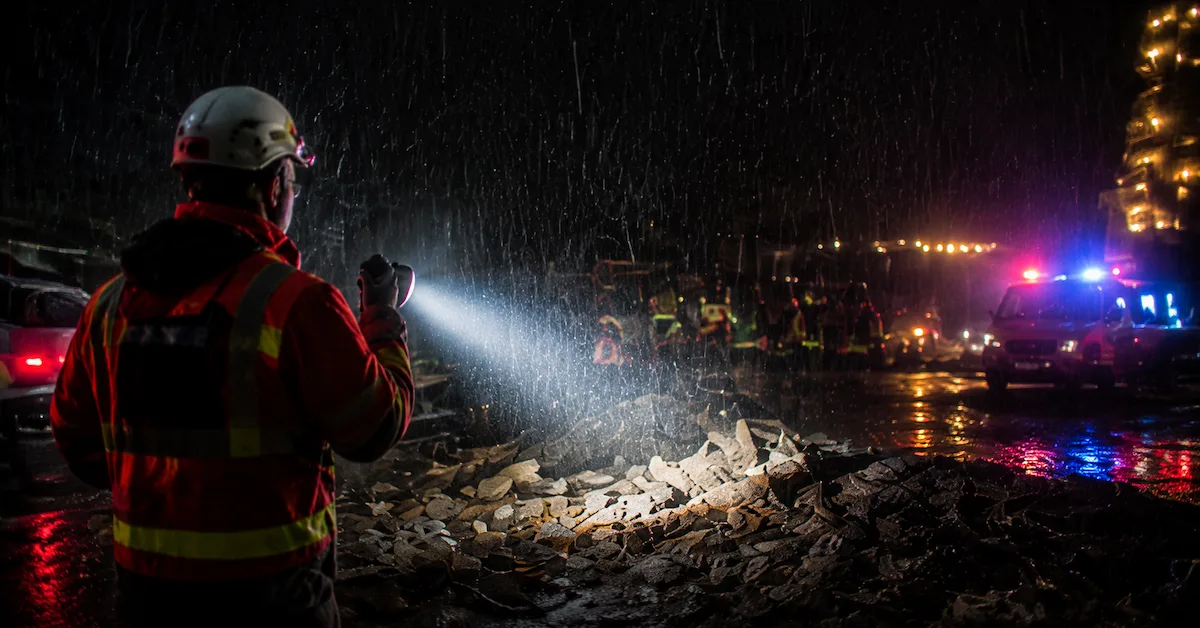
This article focuses on that decision. It uses a portable, directional work light as the practical reference point: a compact handheld light shown illuminating rubble and a work area during a rainy nighttime emergency response. The same selection principles also help when comparing suppliers of larger outdoor systems. The goal is to help sourcing managers and product teams separate a suitable manufacturing partner from a supplier that only appears relevant because its catalogue contains the word “outdoor.”
Start with the lighting problem, not the product name
Outdoor lighting is exposed to conditions that indoor lighting rarely has to manage. Rain, mud, dust, vibration, poor visibility, gloves, vehicle movement, and unplanned handling can all affect whether a light remains useful. In an emergency or construction environment, a product may be dropped, carried for long periods, switched on repeatedly, or used while the operator is wearing protective equipment.
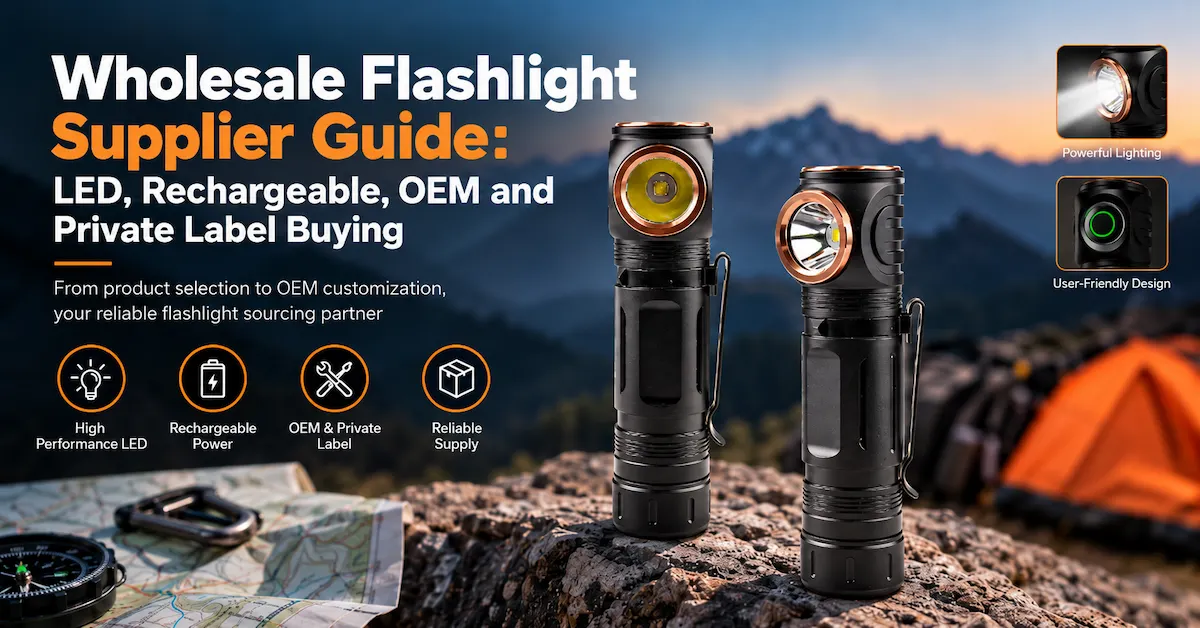
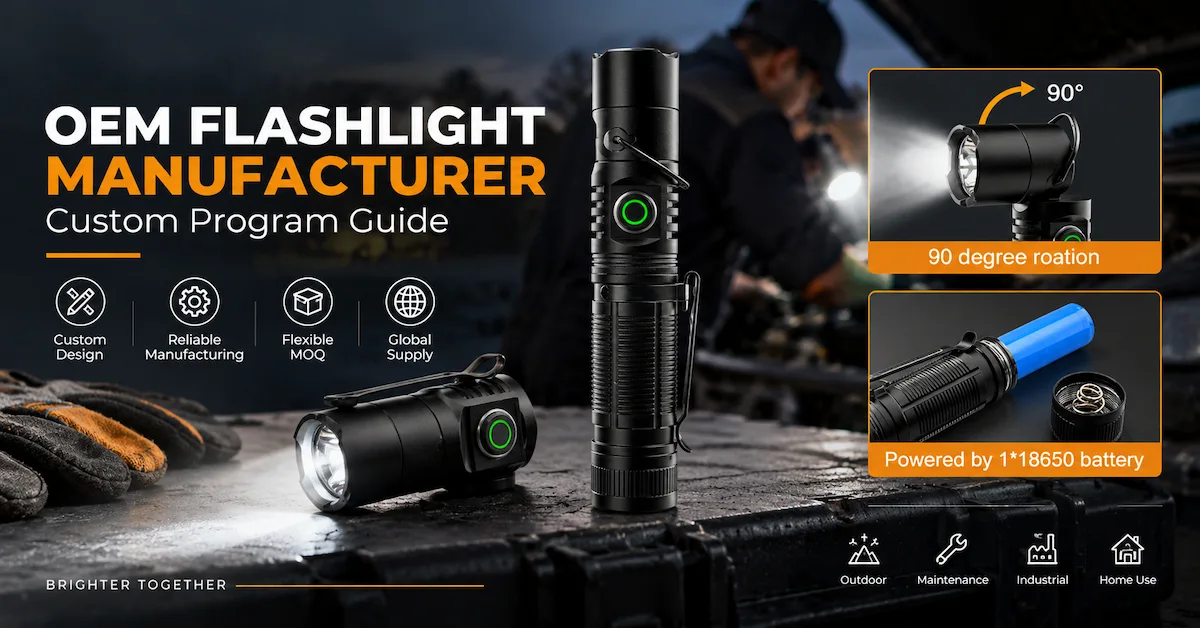
The reference product appears to be a handheld flashlight or portable work light. It has a compact cylindrical or pistol-grip form, a front light head, and a clearly visible focused white beam. That makes it more suitable for directional inspection than for evenly lighting a large area. It may be relevant to search-and-rescue teams, firefighters, police and emergency crews, road-maintenance workers, utility technicians, and construction contractors.
That distinction matters. A focused beam can help an operator inspect rubble, a roadside incident, or a dark industrial area. It should not automatically be treated as a replacement for a floodlight, a temporary area light, or a permanent high mast lighting system. Buyers who fail to define this difference often receive a product that is technically functional but poorly matched to the job.
Quick comparison: match the supplier to the application
| Application | Typical lighting objective | Supplier questions |
|---|---|---|
| Portable emergency or inspection light | Directional illumination for people moving through dark or obstructed areas | Can the supplier provide a compact handheld design, practical controls, and a suitable power system? |
| Sports field lighting | Broad, controlled illumination across a defined playing surface | Does the supplier understand mounting, aiming, glare control, and uniform coverage? |
| High mast lighting | Large-area illumination from elevated structures | Can the supplier address installation, maintenance access, optical distribution, and system integration? |
| Industrial or construction inspection | Reliable task lighting in changing, sometimes harsh conditions | How does the supplier define durability, handling, charging, and operating requirements? |
This comparison is deliberately simple. It is not a substitute for a technical specification, but it prevents a common sourcing error: judging every outdoor lighting product by the same criteria.
What to verify in a portable outdoor light
Beam function and optical purpose
The visible beam in the reference image is directional. Ask the manufacturer to describe the intended beam pattern in practical terms rather than relying only on a headline lumen figure. Is the beam narrow and concentrated for searching, or wider for close-range work? Is there a defined hotspot, useful peripheral light, or adjustable focus? The answer should reflect how the operator will actually use the device.
A supplier should also be able to explain the light head, lens arrangement, reflector or optical components, and control logic at an appropriate level of detail. The image does not confirm the LED type, lens material, beam distance, or brightness, so none of these should be accepted without documentation or a sample evaluation.
Housing and handling
The product appears dark-colored, but the image does not verify whether the housing is molded polymer, aluminum, rubberized material, or a combination of materials. That is a useful warning for buyers: appearance is not a material specification.
For a handheld emergency light, examine grip diameter, balance, switch placement, glove operation, and the possibility of accidental activation in a vehicle or equipment bag. If the design is intended for use around rain and debris, inspect seams, the front light head, charging or battery access, and any control openings. These areas deserve more attention than a polished catalogue photograph usually provides.
Power and operating routine
Battery type, capacity, charging method, runtime, and charging indicators are unknown for the pictured product and must be confirmed directly. Do not accept “long runtime” as a sufficient answer. Ask the supplier to define the operating mode, brightness level, test conditions, and what happens as the battery discharges.
For emergency teams, charging logistics can be as important as illumination. A crew may need to recharge several units in a vehicle, at a depot, or from a portable power source. A product that performs well in a short demonstration may be inconvenient if its charging arrangement does not fit the user’s workflow.
How to assess a professional outdoor lighting manufacturer
A capable supplier should ask questions before issuing a final recommendation. The conversation should cover application, weather exposure, expected handling, duty cycle, mounting or carrying method, required beam type, power source, packaging, and the intended market. A factory that immediately proposes the same lamp for a rescue crew, a sports field, and a high mast installation may be simplifying the problem too aggressively.
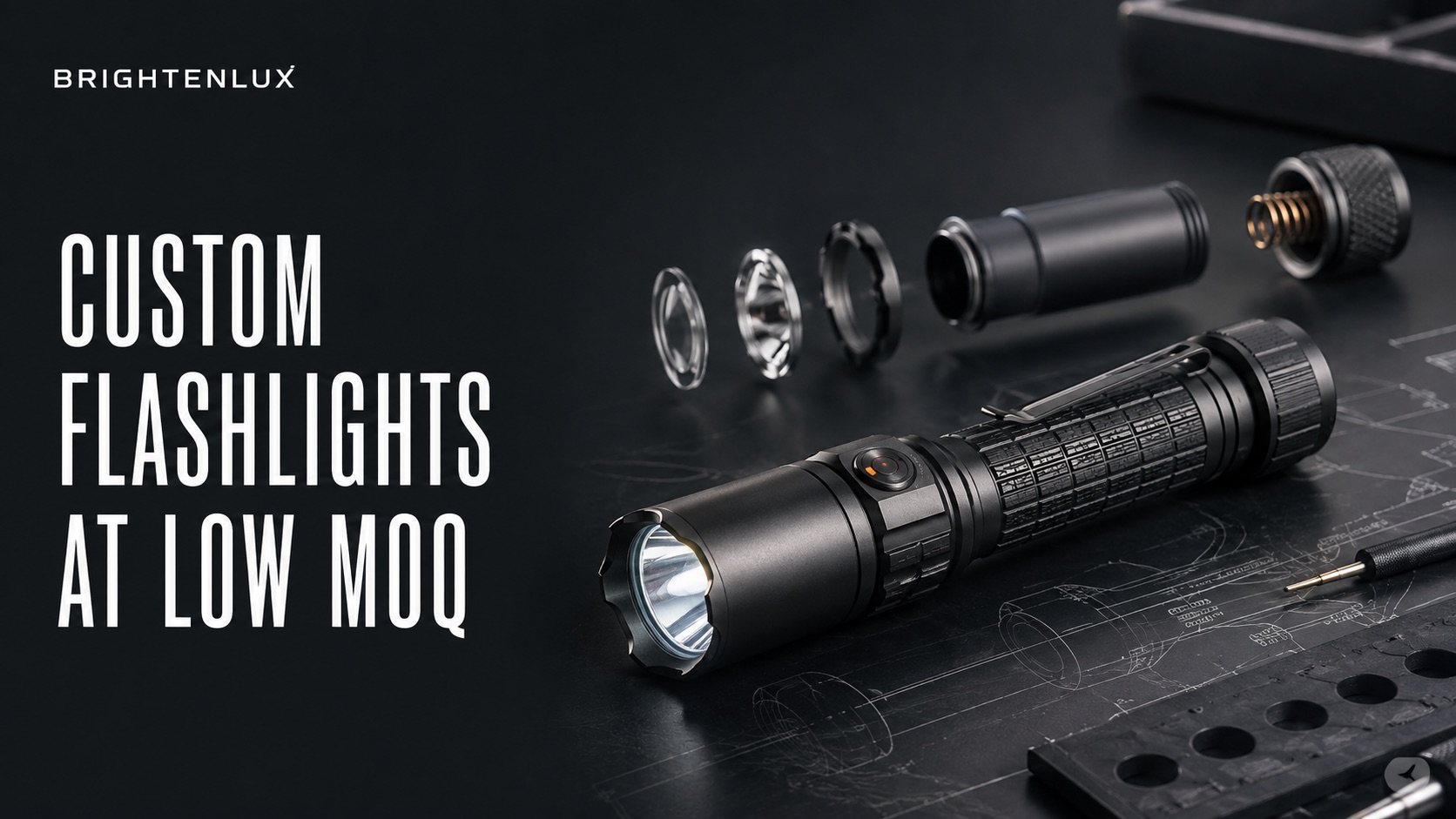
For portable lighting, request clear product drawings, a bill of the main components, operating instructions, sample units, and available test documentation. If the supplier offers customization, ask which changes are standard engineering work and which would require new tooling or a different production process. Possible manufacturing methods may include molded polymer housings, machined or die-cast metal components, and LED or electronic assembly, but the correct process depends on the actual design and should be confirmed rather than assumed.
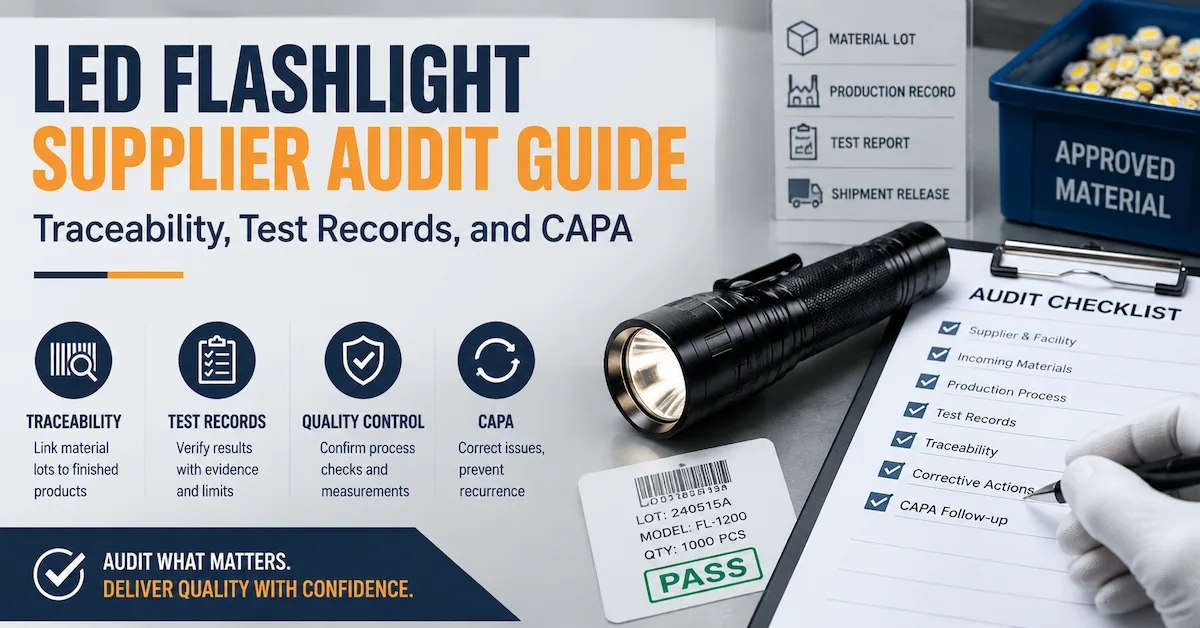
It is also sensible to distinguish manufacturing capability from trading capability. Ask where assembly takes place, who controls incoming components, how design changes are recorded, and how production samples are compared with approved samples. These questions are especially important when the product will be used by emergency, utility, or construction personnel, where an inconsistent switch, seal, connector, or battery compartment can create operational frustration.
Common mistakes in outdoor lighting sourcing
- Choosing by image alone: A bright beam in a dark photograph demonstrates directional illumination, but it does not verify brightness, distance, runtime, impact resistance, ingress protection, or operating temperature.
- Confusing portable and fixed lighting: A handheld work light is not automatically suitable for a sports field or high mast application. Optical distribution, mounting, maintenance, and coverage are different problems.
- Requesting only a lumen number: Output without beam pattern, runtime, and operating conditions gives an incomplete picture.
- Ignoring user handling: Switch location, grip, weight, charging access, and use with gloves can determine whether a product is practical in the field.
- Assuming compliance claims: Certifications and protection ratings should be requested as specific documents for the offered model. They should not be inferred from the product category or supplier description.
One practical caution: avoid writing a specification around features that are merely visible in a photograph. The pictured light clearly produces a focused white beam in rain and darkness. It does not, by itself, prove waterproof construction, impact resistance, a rechargeable battery, or any particular certification.
A practical buyer brief for the first supplier enquiry
A useful enquiry should describe the operating scene before asking for a price. State whether the light is for emergency response, rescue operations, disaster-site assessment, road-incident response, industrial inspection, or construction work. Explain whether the user needs a concentrated beam, close-range work illumination, or both.
Then request the information needed to compare offers consistently:
- Overall dimensions, weight, housing materials, and visible control layout
- Beam description, output data, and available operating modes
- Battery type, capacity, charging method, and runtime by mode
- Environmental and handling data, including any documented protection or impact testing
- Sample availability and the method used to confirm production consistency
- Packaging, labelling, and any requested branding or design changes
- Technical drawings and the process for approving revisions
For larger projects, add mounting, aiming, optical distribution, maintenance access, and site layout requirements. Those details are fundamental for sports field lighting and high mast lighting, and they should not be treated as afterthoughts.
Frequently asked questions
Is the pictured product definitely a flashlight?
No. It appears to be a handheld flashlight or portable work light, but the image does not confirm the exact product identity, brand, dimensions, controls, battery arrangement, or internal construction.
Can the same manufacturer supply sports field lighting or high mast lighting?
Possibly, but this must be verified through the supplier’s actual product range, engineering resources, and project experience. Portable directional lighting and large-area fixed systems involve different optical, mechanical, installation, and maintenance requirements.
What should be confirmed before approving a sample?
Confirm the intended beam function, brightness measurement method, runtime conditions, charging arrangement, housing materials, environmental claims, control operation, and any required documentation. Use the approved sample as the reference for later production.
Next step: send a use-case-led RFQ
The strongest first step is not to ask a professional outdoor lighting manufacturer in China for its “best outdoor lamp.” Send a short, use-case-led RFQ that explains the environment, user, beam requirement, power routine, handling conditions, and documentation needed. Include photographs or sketches only as references, not as complete specifications.
For the portable light shown here, begin by asking suppliers to confirm whether they can provide a compact directional work light for emergency, rescue, road-response, industrial, or construction use. Compare their technical questions as carefully as their quotations. A supplier that identifies unknowns, proposes a relevant sample, and documents the product clearly is usually offering a more dependable path than one that simply promises a brighter beam.