

How to Evaluate a Professional Outdoor Lighting Manufacturer in China for Handheld and Outdoor Applications
Choosing a professional outdoor lighting manufacturer China is not simply a matter of comparing beam brightness or selecting the lowest quoted price. For buyers evaluating a handheld flashlight or searchlight for fishing, campsite use, outdoor work, equipment inspection, or emergency preparedness, the more important question is whether the supplier can consistently control the light engine, optical system, enclosure, battery electronics, assembly, and verification process. This article explains what can be assessed from a product concept like the pictured handheld directional light, what remains unknown, and how to prepare a more useful supplier inquiry.
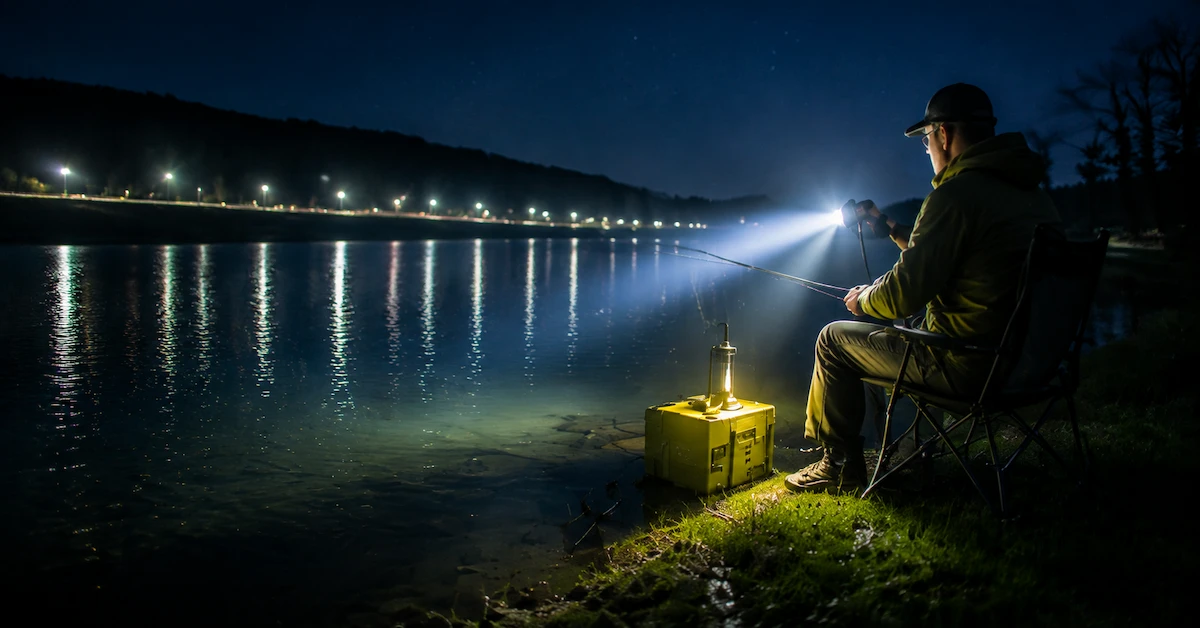
The product shown appears to be a compact, handheld flashlight or searchlight producing a concentrated white beam across a nighttime outdoor scene. It may suit situations where a user needs to illuminate a distant area rather than spread light broadly around a room or pathway. A separate yellow rectangular piece of equipment is visible nearby, but its function cannot be confirmed from the image. It should not automatically be described as a generator, battery pack, charger, or power supply.
What the Product Appears to Be—and What It Is Not Yet
At a visible level, the main unit has a cylindrical or pistol-grip form and is being operated with one hand. The concentrated beam suggests an LED light engine paired with a reflector or optical lens, although the exact LED, reflector geometry, and lens material are not verifiable. The housing may be molded polymer or another lightweight enclosure, but that also requires confirmation from the manufacturer.
This distinction matters because a handheld searchlight has a different design brief from fixed architectural outdoor lighting. A fixed luminaire may be judged primarily on mounting, ingress protection, thermal management, photometric distribution, and long-term exposure to weather. A handheld product adds other concerns: grip comfort, switch placement, battery access, charging, drop resistance, operating time, and the ability to aim the beam quickly. A supplier experienced in one category may not automatically have equal strength in the other.
The image does show a directional beam operating outdoors at night. It does not verify lumens, beam distance, runtime, battery chemistry, charging method, waterproof rating, impact rating, operating temperature, dimensions, weight, emergency signaling modes, or certifications. A disciplined buyer keeps those items open until the supplier provides technical documentation and, where relevant, samples for testing.
Quick Reference: Questions to Resolve Before Supplier Comparison
| Decision area | What is visible or likely | What the buyer must confirm |
|---|---|---|
| Light function | Concentrated white beam for directional illumination | Beam pattern, measured output, beam distance, color characteristics, and control modes |
| Power system | Likely battery-powered electronics | Battery type, capacity, replaceability, charging interface, protection circuit, and charging instructions |
| Housing | Compact handheld enclosure | Material, dimensions, grip design, sealing method, impact resistance, and service access |
| Outdoor use | Shown operating at night near water | Actual water resistance, corrosion considerations, temperature range, and test method |
| Accessory equipment | Separate yellow case or portable unit is present | Its identity, purpose, electrical relationship, and whether it is included in the quotation |
How the Light Engine and Optics Affect Real Use
For a directional flashlight, the LED alone does not determine practical performance. The reflector or lens shapes the beam, while the enclosure and thermal path influence how consistently the unit performs during use. A narrow beam may help a shoreline worker identify a distant object, but it can be less convenient for close-range tasks. A wider beam may improve campsite visibility while reducing reach.
Ask the supplier for a beam profile or photometric information rather than accepting a single headline brightness figure. The useful questions are practical: Is the beam concentrated in the center? Is there excessive spill? Does the pattern change as the battery voltage falls? Is there visible flicker in lower modes? If the product is intended for inspection or search activity, glare and aiming comfort can matter as much as maximum output.
Thermal management also deserves attention. A compact enclosure has limited surface area for heat dissipation. If the manufacturer has selected a high-output LED, the buyer should ask how heat is transferred away from the light engine and whether output is regulated or reduced during extended operation. Do not assume that a bright first impression represents sustained performance.
Housing, Controls, and Outdoor Durability
The product appears easy to hold and aim, but an image cannot show whether the grip remains secure with wet hands or gloves. For night fishing, shoreline work, and emergency kits, control placement should be reviewed in the context of actual use. Can the user switch modes without looking down? Is the power button protected against accidental activation in a bag? Can the battery compartment be opened without damaging a seal?
Outdoor buyers should request the specific test basis behind any claim of water resistance or impact resistance. A supplier may use familiar rating language, but the buyer still needs to know which product configuration was tested and whether the test applies to the assembled production unit. Seals, switches, charging ports, and battery doors are common weak points. Exposure near salt water adds a corrosion concern that a simple nighttime demonstration does not answer.
Material selection should also be discussed without assuming the answer. A molded polymer housing may reduce weight and improve handling, while a metal enclosure may contribute to heat spreading but add mass. Neither is automatically better. The decision depends on the duty cycle, handling environment, target cost, and repair or replacement strategy.
Separating Handheld Lighting from Fixed Outdoor Projects
Some buyers begin with a broad outdoor lighting requirement and later discover that their supplier specializes in a different product family. A landscape lighting manufacturer may be well suited to pathway, garden, façade, or site illumination, but that does not prove competence in battery-powered handheld products. Conversely, a factory experienced with portable flashlights may not have the optical distribution data, mounting systems, or long-duration thermal design required for fixed luminaires.
The same caution applies when a supplier presents itself as a China lighting manufacturer with a wide catalog. Catalog breadth is useful for initial screening, but it is not a substitute for evidence of process control. Ask which components are produced in-house, which are sourced, how incoming parts are checked, and how changes are controlled after approval. If the product is customized, clarify whether the supplier is modifying an existing platform or developing a new housing, optical assembly, and circuit design.
A Practical RFQ Checklist
A useful inquiry should describe the operating environment and acceptance criteria before asking for a price. Include the intended applications—such as outdoor work, inspection, fishing, campsite illumination, or emergency preparedness—and state whether a concentrated beam or more general illumination is preferred.
- Request product dimensions, weight, housing material, switch layout, and battery access details.
- Ask for measured light output, beam information, runtime by operating mode, and the conditions used for measurement.
- Specify the desired charging method and ask whether the battery is replaceable or integrated.
- Request details for water exposure, impact testing, operating temperature, and corrosion considerations.
- Clarify whether the yellow portable equipment shown is part of the product package or an unrelated item.
- Ask for sample availability, drawing approval steps, packaging details, and the process for handling nonconforming units.
Do not let a supplier fill unknown fields with optimistic assumptions. If a rating, certification, or performance value is not yet available, mark it as pending validation. That is more useful than placing an unverified claim in a purchase specification.
Common Buyer Mistakes
The first mistake is judging a flashlight from a photograph or short demonstration. A visible beam confirms that the unit produces directional light; it does not establish runtime, sealing, durability, or production consistency. The second is comparing prices before defining the battery, optical, and testing requirements. Two visually similar products may contain materially different electronics and controls.
Another frequent error is treating the accessory beside the flashlight as part of the system without confirming its identity. If the yellow unit is included, the quotation should state its function, interface, responsibility, and packaging. If it is not included, it should be removed from the product description to prevent confusion during sampling and shipment.
FAQ
Is this product suitable for rescue use?
It may be useful where a bright directional beam is needed, but the visible information does not verify rescue certification, signaling functions, flotation, waterproof performance, or other specialized requirements. Those features must be specified and tested separately.
Can the product be used near water?
The image shows nighttime outdoor operation near water, but that is not proof of water resistance. Request the manufacturer’s applicable test information and confirm whether the design is intended for splash, rain, immersion, or saltwater exposure.
Should buyers choose a flashlight supplier or a broader outdoor lighting supplier?
Choose based on the product’s real engineering needs. A portable light requires competence in battery electronics, handheld ergonomics, optics, and enclosure durability. A fixed outdoor project may require different expertise in mounting, photometric distribution, thermal design, and weather exposure.
Next Step: Turn the Image Into a Verifiable Specification
The pictured flashlight is a useful starting concept, especially for directional illumination during outdoor work, fishing, campsite activity, inspection, or emergency preparation. The next step is not to assign unverified specifications to it. Prepare a short technical brief, identify the required operating conditions, and ask shortlisted suppliers to separate confirmed data from estimates. A capable professional outdoor lighting manufacturer China should be able to explain the product architecture, identify unknowns, provide samples or technical evidence where appropriate, and discuss how production quality will be maintained after approval.