

High Lumen Flashlight Manufacturer for Industrial Inspection
Industrial buyers searching for a high lumen flashlight manufacturer are usually solving a visibility problem, not buying a casual torch. Maintenance teams need to inspect machine interiors, check fasteners, confirm alignment, view dark recesses, and keep work moving where overhead lighting cannot reach. In these settings, brightness alone is not enough. A useful inspection light must combine controlled output, practical handling, and dependable performance in real work areas. For distributors, contractors, and facility procurement teams, the right supplier should understand how portable lighting supports inspection accuracy, safety routines, and repeatable purchasing.
Why Industrial Buyers Need More Than a Generic Torch
A generic handheld torch may look acceptable in a catalog, but industrial inspection places different demands on a light. A technician may need to see oily edges, worn fasteners, narrow cavities, rails, brackets, housings, or moving assemblies with very little room for error. If the beam is weak, defects may be missed. If the beam is too uncontrolled, fine detail can be washed out instead of clarified.
That is why buyers should look beyond a lumen claim and ask how the light behaves during maintenance work. Beam pattern, portability, switch usability, and everyday durability all affect whether the tool helps or frustrates the user. A strong supplier should be able to discuss these tradeoffs clearly and recommend products according to the inspection scene, not only according to maximum brightness.
Reading the Real Inspection Scene
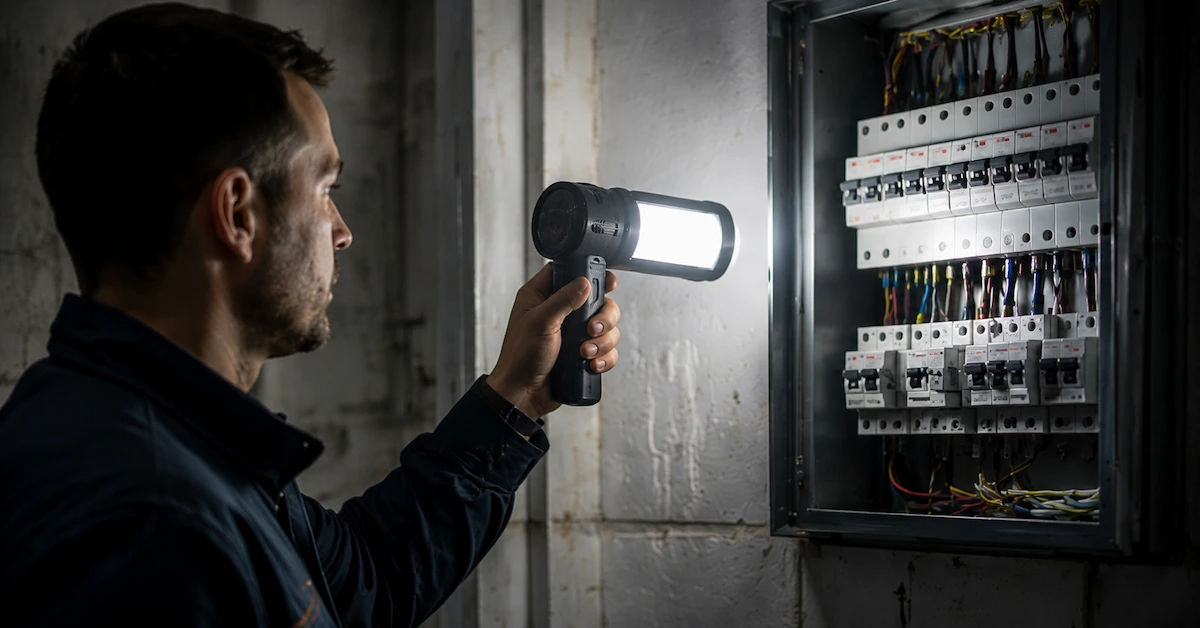
The source scene shows a worker using a compact handheld flashlight while inspecting heavy industrial equipment. The worker is not using the light as a consumer accessory; the light supports maintenance or troubleshooting. The equipment includes visible structural elements such as rails, brackets, housings, and a motor or drive assembly, reminding buyers that inspections often happen in cramped, partly blocked areas where fixed lighting is insufficient.
The worker is also shown with PPE, including a hard hat and safety glasses. That detail matters for B2B sourcing because the flashlight must fit a workplace environment. It should be easy to aim, practical to carry between stations, and useful when the technician needs to verify part placement, locate wear, or see behind assemblies. Industrial readiness is more important than showroom appearance.
Core Factors to Compare Before Choosing a Supplier
When evaluating a portable inspection flashlight, start with the job rather than the product label. A maintenance team may need close-range clarity, controlled illumination, and simple operation while standing near machinery. The supplier should help match the light to those tasks instead of offering only feature names.
| Factor | What to Check |
|---|---|
| Beam quality | Bright enough for dark machine interiors, but controlled enough to preserve fine detail. |
| Form factor | Compact handheld designs are easier to aim into tight spaces than bulky lamps. |
| Handling | Switches and grip should remain practical during routine inspection work. |
| Durability | Ask how the housing tolerates daily handling, tool bags, and industrial surfaces. |
| Power approach | Clarify battery, charging, or replacement logic without assuming unspecified performance. |
For a broader view of available lighting categories, buyers can review Brightenlux products before preparing a sourcing shortlist.
What a High Lumen Flashlight Manufacturer Should Understand
A high lumen flashlight manufacturer serving industrial customers should think beyond retail packaging. The end user may be a maintenance technician, reliability engineer, equipment setter, or contractor moving between lines. These users need a tool that helps them work faster without becoming another item that needs constant attention.
The manufacturer should be able to explain beam focus, behavior in dusty or dim areas, body handling, and suitability for field-service or plant-maintenance workflows. If the supplier also has experience associated with tactical flashlight manufacturing, that may suggest familiarity with rugged housings and directional beams. Even so, industrial buyers should verify suitability for maintenance tasks. A tactical-style beam is not automatically the right choice for reading labels, spotting residue, or examining a rail or drive assembly at close range.
Design Details That Matter More Than Marketing Language
The available source does not identify exact material, ingress rating, battery chemistry, certifications, or measured test results, so those details should not be assumed. However, buyers can still evaluate practical design questions before committing to a wholesale or project purchase. The switch should be easy to use and should not feel fragile. The lens and front area should be suitable for routine contact with machine surfaces and tool bags.
Beam stability is also important during inspection. A light that flickers when moved or lightly jostled can interrupt troubleshooting and reduce confidence. Comfort matters too. A compact body is helpful only if the grip supports real handling. If the flashlight feels slippery or awkward, workers may set it down instead of using it continuously. For application-specific questions, sourcing teams can contact Brightenlux through the contact page.
When Portable Flashlight Wholesale Makes Business Sense
Portable flashlight wholesale becomes relevant when lights are issued across a maintenance team, included in service kits, or distributed through B2B channels. In those cases, consistency is more valuable than a one-time bargain. Workers benefit when each unit has familiar beam behavior, similar activation feel, and a predictable power approach. That reduces confusion and helps teams use the tool without repeated retraining.
Wholesale buyers should also consider replacement logic. A low-cost product can become expensive if it creates downtime, compatibility issues, or complaints from technicians. Repeatability matters because maintenance managers do not want different batches of the same model to behave differently. Before placing a larger order, buyers should discuss application needs and procurement plans. For project discussions or quotation requests, use the Brightenlux inquiry page.
Common Sourcing Mistakes and Better Questions
The most common mistake is buying on brightness alone. High output helps in dark industrial environments, but it must suit the distance, angle, and surface being inspected. Too much uncontrolled spill can make seams, bolts, and wear points harder to judge. A focused, appropriate beam may be more useful than a brighter but less controlled one.
Another mistake is assuming rugged styling proves industrial suitability. The photographed environment includes metal structures and likely hard surfaces where impacts, dust, or contamination may occur. Buyers should ask how the tool handles daily work realities. A third mistake is excluding end users from selection. Maintenance crews quickly notice practical flaws, such as awkward switch placement, a rolling body shape, or a beam that is too broad for precision checks.
Useful supplier questions include: What beam pattern best supports inspection? How is the light intended for maintenance rather than consumer use? Can product behavior remain consistent across multiple units? What procurement support is available for teams, kits, or recurring replacement?
FAQ
Is a higher lumen rating always better for maintenance inspection?
No. High output can help in dark industrial spaces, but the beam must suit the inspection distance and surface. If the light creates excessive spill or glare, small defects may become harder to see. Buyers should evaluate beam control as carefully as brightness.
Can a tactical flashlight manufacturer support industrial sourcing?
Possibly, but buyers should verify the actual application fit. Tactical-style products may overlap with industrial needs in brightness or rugged handling, yet maintenance work often requires close-range clarity, glove-friendly operation, and controlled viewing of parts, labels, residue, fasteners, and narrow machine areas.
Why choose a compact handheld inspection light instead of a larger lamp?
A compact handheld flashlight can be aimed into tight machine spaces and carried easily between workstations. For troubleshooting, that flexibility is valuable because the worker may need to inspect around brackets, housings, rails, or drive assemblies where a larger lamp is harder to position.
What should buyers prepare before contacting a supplier?
Define the work scene first: inspection, troubleshooting, preventive maintenance, field service, or kit assembly. Then describe the environment, handling needs, and purchasing quantity expectations. This helps the manufacturer recommend a suitable product approach without relying on vague claims or unsupported specifications.