

Spot vs flood headlamp OEM selection starts with the wearer’s task
A headlamp with spot and flood states is useful when those states serve different parts of the wearer’s job. The purchase needs three answers: which distribution covers the nearby work, which serves the farther target, and whether the wearer can change between them without disrupting the task. Evaluate the proposed battery and wearing arrangement as part of that choice.
Brightenlux lists a dual-SST20 platform with focus, flood and combined white-light states. It also lists an OSRAM P8 platform with a main light and auxiliary arrays. These are two different conversations for an OEM buyer. The first starts with named beam states; the second starts with sources whose useful roles still need clarification.
The distinction matters to a tool brand writing instructions or an importer preparing retail specifications. A customer will not use the product as a list of LEDs. The customer will read something nearby, look toward another object, move the head and reach for a control. A useful sample request describes those actions rather than relying on the broad promise of versatile hands-free lighting.
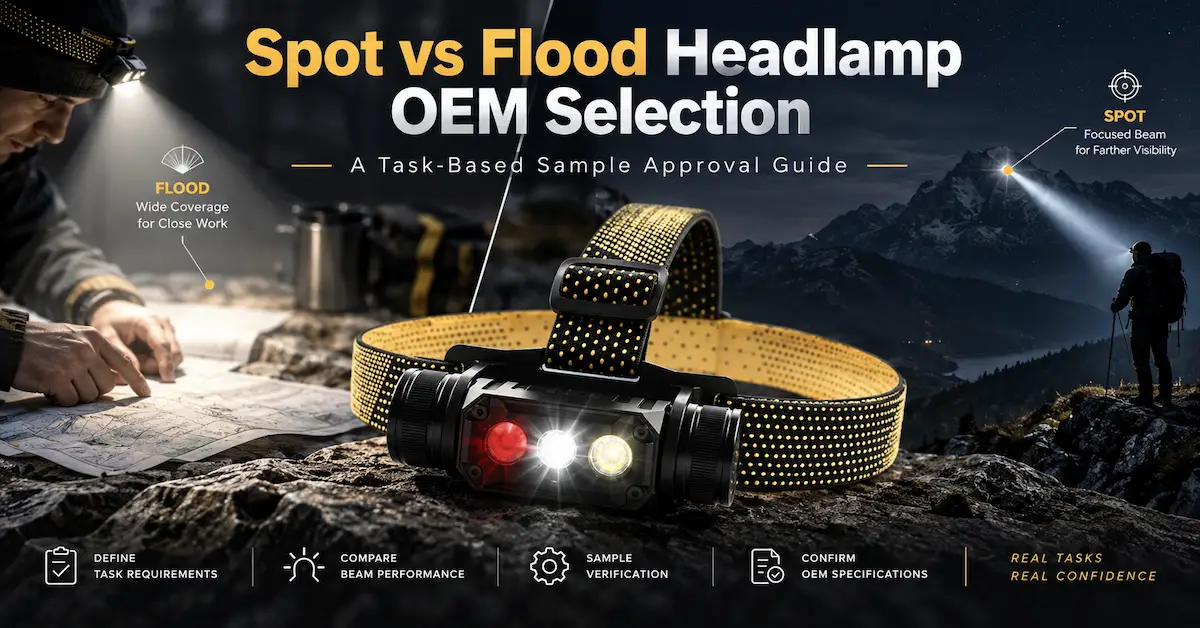
This guide uses the current official descriptions to build that request. Its task table, wearer checks and approval matrix are proposed buyer tools, not results from completed trials. The manufacturing photograph shows general context; the concept image illustrates a review setting. Neither supplies measured beam performance.
Start with what the two listed platforms actually offer
The dual-SST20 page names white focus and flood operation. Its published single-press sequence moves through high and medium focus, followed by high and medium flood. Double press selects a combined group with high and medium states. That is a concrete starting point for discussing a near-to-far task transition.
The P8 page takes another approach. It describes an OSRAM P8 main source, fifteen cool-white 2835 LEDs and two warm-white 3030 LEDs, with main and side controls described separately. The main-light levels are High, Medium and Low. The side description includes cool-white levels and warm-white states. Source count alone cannot tell the buyer the coverage of either arrangement.
| Official product description | Listed light and control arrangement | Listed power and construction | Question for the proposed order |
|---|---|---|---|
| Dual-SST20 focus/flood headlamp | 1,200-lumen headline; two SST20 LEDs; focus and flood High/Medium states; both LEDs High/Medium through double press; an RGB LED | Included 18650 2,200 mAh battery; Type-C; PMMA lens; aluminum and ABS body, TPR base and adjustable elastic headstrap | What coverage, output and operating-time evidence applies to each quoted white-light state and wearing position? |
| OSRAM P8 main-light and auxiliary-array headlamp | 650+ lumen headline; OSRAM P8 main source, 15 cool-white 2835 LEDs and two warm-white 3030 LEDs; main and side controls described separately | Included 1,100 mAh lithium battery or three AAA batteries not included; Type-C charging | Which source, mode and battery combination delivers the requested near-work and farther-target roles? |
The headlines also differ: 1,200 lumens for the dual-SST20 platform and 650+ lumens for the P8 platform. They are published manufacturer statements. The descriptions do not establish the illumination on the buyer’s panel, the output of each individual state or the light retained during a particular work session.
A sensible enquiry about the SST20 platform therefore asks which state the headline describes, then requests the information relevant to the states the user needs. An enquiry about the P8 platform asks how the main and auxiliary sources serve those tasks. Ranking the products by the two headline numbers would bypass both questions.
The battery choice is similarly specific. The SST20 listing identifies an included 18650 battery at 2,200 mAh. The P8 listing offers an included 1,100 mAh lithium battery or three AAA batteries that are not included. The buyer’s comparison needs the arrangement supplied in the quotation, with a separate response for an alternative power arrangement.
Materials help identify the SST20 configuration: PMMA lens, aluminum and ABS body, TPR base and adjustable elastic headstrap. The lens material is not a beam map. The base description is not a finding about retention or comfort. Those questions remain attached to the actual assembled sample and the intended wearer.
The public P8 wording also contains a warm-white “Half” label. Its precise meaning needs confirmation in the supplied mode description. Procurement should not turn that label into a measured percentage of output or an assumption about the number of sources operating. Plain explanations of the supplied states are useful inputs for the eventual instructions.
Likewise, “High” is a state label rather than a common performance value across the source groups. High focus and high flood still need their own descriptions for the target. The P8 main-light label cannot provide the missing value for its side array, or for the SST20 platform.
A focused enquiry can say: Identify the white-light state behind the headline, describe the states proposed for our near and farther tasks, and separate the battery arrangements in your reply. That wording asks the supplier to resolve the actual configuration choices. It neither invents missing measurements nor assumes that every available source will be useful.
The two product links give Ningbo Brightenlux Electric Appliance Co., Ltd. a recognizable starting point for the enquiry. The buyer can name the platform, power arrangement and desired white-light states, then explain the task. The missing information becomes a short set of answerable questions rather than an invitation to recommend the largest lumen figure.
The close task determines the useful flood requirement
A headlamp can illuminate a wall impressively while leaving a nearby working detail awkward to see. The wearer’s hands, the target surface and the position below the eyes all influence that result. For a tool-kit product, these details may matter more than the farthest advertised range.
A part number requires readable characters. A panel requires useful coverage at several positions. A component inside a recess adds obstruction and aiming. Describe the required detail first, followed by the target distance and the area that matters. The supplier then has a task to discuss, rather than only a brightness preference.
Working posture changes the picture. A bench target sits below the line of sight. A cabinet target can involve leaning or turning. An object straight ahead has another relationship to the lamp. A bare target viewed with the headlamp held in a hand does not reproduce those wearing positions.
For the broader area, the edges belong in the request. The middle may be easily visible while a label or connection near the boundary remains unclear. A simple target layout showing the important points lets both parties understand what the word “wide” needs to mean for this project.
Flood is not automatically preferable for every nearby detail. A small recess may benefit from concentration. A broad panel may benefit from a spread of useful light. The criterion is completion of the task in the normal position, with the actual obstructions present.
Surface appearance belongs in that trial. A pale background makes an easy display; a reflective label or dark component may reveal a different limitation. A representative surface is therefore more useful than a blank wall when the buying decision concerns reading, locating or examining a specific feature.
The tool brand can express this as a short application brief: identify the detail, its position, the normal wearer posture and the white-light state proposed for it. An outdoor importer can use the same format for ordinary close preparation tasks. Neither needs to claim that one beam solves every activity in the product’s marketing list.
Duration completes the close-work requirement. A setting intended for a session needs information through that session. The brightest state at activation may not be the practical state used at the hands, and its maximum should not inherit a duration from another setting without support.
The farther task decides whether spot or combined light adds value
The second task supplies the reason for another beam. A user might read a nearby detail, observe an object farther away and return to the first detail. That sequence tests concentration, useful target width and the effort needed to move between states.
| Task to evaluate | Beam role to investigate | What the sample must make visible | Transition or tradeoff to record |
|---|---|---|---|
| Read a nearby label or examine a small assembly | Flood or a suitably restrained spot, according to the target | The required detail without a distracting central reflection | Whether tilt or head position must change to keep the detail visible |
| Work across a broader area with both hands | Flood coverage over the actual working area | Important points at the centre and boundaries, including with hands present | Edge darkness, hand shadows and loss of coverage during normal movement |
| Locate or observe a defined object farther away | Spot with an appropriate target width | The agreed object under the stated viewing conditions | Aiming effort and the route back to the near-work setting |
| Alternate between a central target and surrounding activity | Separately selectable spot and flood, or a useful combined setting | The target and the required surrounding reference area | Control steps, wrong-mode selections and changes in usable illumination |
| Work beside or communicate with another person | An appropriately aimed and controlled setting | The wearer’s task while avoiding unnecessary direct glare toward the other person | Whether dimming, downward tilt or switching off is practical |
Size belongs beside distance for the farther target. Locating a small object differs from searching across a wider area. A still photograph of a precisely aimed hotspot does not explain the movement involved in a search. If scanning is part of the intended use, it belongs in the sample activity.
The time spent on each task establishes priority. A platform used mainly for near work needs a suitable near-work state even when occasional farther reach is desirable. A product intended mainly for farther observation may treat close coverage as the supporting requirement. That balance helps the supplier explain a tradeoff.
Combined operation is a separate option, not an automatic improvement. Central concentration and nearby light can be helpful together. Bright reflections near the wearer can also compete with the farther detail. The proposed target and surrounding surfaces settle which effect matters.
For the dual-SST20 listing, the combined group is explicitly described. The sample question concerns its useful overlap, the route into it and its operating information on the quoted battery. For the P8 arrangement, the buyer first needs to establish which source combinations are available and which distribution each produces.
A dual beam headlamp supplier can answer these questions with a configuration explanation and relevant beam information. Two emitters, two colours and two useful beam roles are not interchangeable descriptions. The quotation should make clear which functions are actually being offered.
The moderate states deserve attention here too. A maximum can be useful for a short observation, while a lower state may serve longer use. The buyer’s request can identify both without assuming that a single published headline describes the whole sequence.
An importer comparing platform options should also consider the instructions required to make the feature usable. A product that offers the desired states still needs a clear route between them. Extra functions carry value when the customer can understand and use them for the intended task.
A worn sample exposes problems that a fixture cannot describe
Photometric measurement and a wearer trial serve different purposes. A fixture provides a stable arrangement for the configured lamp. A wearer looks down, reaches, turns and returns. The product can have sound optical measurements while remaining inconvenient for the particular sequence the buyer has chosen.
The trial target should contain the required detail and the boundary positions identified in the brief. A side photograph can document distance, lamp position and posture. It explains the setup; it does not measure the light depicted in the image.
Fitting begins with the supplied instructions, strap and base. A participant selecting a normal position reveals something different from an observer placing the lamp at a carefully optimized angle. Initial fitting effort and later loss of position can then be distinguished.
The hands and tools enter the close task because they can interrupt the light path. A surface that looks satisfactory before the action starts may become partly obscured during it. A prepared panel or inactive assembly can preserve relevant geometry and texture without turning the sample session into work on live equipment.
Looking from the nearby target to the farther one and back reveals how the beam follows normal movement. An unsuccessful observation may concern distribution, position or the control transition. Calling all of those findings “not bright enough” would give the supplier little help in addressing them.
The separation in HSE’s Lighting at work, HSG38, second edition (1997) is useful when a target is difficult to read: light on the work, glare, reflections and shadows are different questions. A printed code outside the lit area presents a different problem from one masked by a reflection. HSG38 supplies general workplace guidance, not headlamp certification or prescribed pass values for this trial.
A target detail makes the result understandable
A printed code, marked position or defined boundary gives the observer an outcome to compare with a reference. “The area looks bright” does not establish that the required detail was identified. The target turns a broad impression into a task result that can be discussed.
A wearer who remembers the printed code can answer correctly on the next sample without seeing it better.Equivalent target variants or an agreed trial order can reduce that problem. The comparison needs to show which variant and sequence each participant used, so a reviewer can tell whether remembered content could have influenced the result.
The observation can identify why the required detail was missed: outside the beam, blocked by a hand, masked by a reflection or visible only after repositioning. That explanation gives the supplier a specific question about distribution, obstruction or fitting. A preference for the brighter-looking background leaves those possible causes unresolved.
Different wearers may expose different fitting problems. The buyer therefore selects participants and repeats according to the intended users and task, rather than treating a comfortable fit on one person as a conclusion for the range.Participants perform the agreed actions and describe the difficulty they encounter. This proposed method sets no statistically validated sample size.
Where instrument readings are needed, they retain their own method, units and positions. A correctly read code is application information, not a lumen measurement. A picture of the target is setup information, not an inferred optical angle.
The trial should identify what the prepared target represents and what it omits. That makes the resulting decision usable without quietly extending it to a different operation. Required PPE, site lighting and approved procedures remain the responsibility of the relevant application owner.
Helmet height, tilt and surrounding people change the selection
A helmet introduces a specific equipment combination. Bare-head fit does not resolve the fit on that helmet. The manufacturer-approved attachment method, intended position and organization’s requirements belong in the enquiry before the buyer treats “helmet compatible” as a settled feature.
The purchasing trial is not authorization to modify protective equipment. Compatibility comes from the responsible supplier or equipment owner and the applicable manufacturer instructions. The headlamp can then be evaluated in the approved arrangement.
Mounting higher or farther forward can change the light path. A brim may obstruct the useful beam. The actual equipment combination shows whether the required target remains illuminated, rather than assuming that a forehead demonstration transfers directly.
Tilt range is helpful only when it includes a stable useful position. The task check concerns the position at which the wearer can work in the normal posture. A promotional graphic cannot establish a measured mechanical or optical angle for that setup.
Initial adjustment and repeated compensation are different findings. One fitting adjustment may be ordinary use. Continually moving the lamp to follow the same detail indicates another issue. Separating them helps decide whether a change to the base, strap or distribution addresses the observed problem.
An unusual head position adopted solely to keep the detail in the beam is worth examining against the original brief. The trial is not ergonomic certification, but it can expose that mismatch. A revised sample still needs to complete the task; improved appearance on the background alone is inconclusive.
Required eye protection is part of the combination where relevant. The fitting arrangement or reflections may affect the visual task. The observation applies to that combination and does not certify the headlamp and eyewear together.
Peripheral coverage also needs a reference. An adjacent tool position or surrounding feature can be included in the setup. Its visibility in the tested arrangement is a useful finding. It does not describe the wearer’s entire field of vision or promise awareness in every activity.
Another person sees the beam from another position. A controlled representation of an ordinary handover or conversation can examine whether downward tilt, a lower state or switching off is practical, without intentional exposure to a bright source.
The useful conclusion identifies the setting, orientation, relative positions and adjustment that addresses the difficulty. It supplies neither a universal numerical comfort limit nor an unrestricted glare-free claim. A general headlamp listing also cannot establish hazardous-atmosphere, road-use or other special equipment approval.
The mode map needs to work while attention is on the task
The SST20 product page provides more than an emitter count: it gives a published route through focus and flood states and into combined operation. The buyer can use that description to prepare a transition test, while confirming the proposed build’s startup state and off behavior.
The P8 description instead introduces main and side controls. Its source arrangement and levels give useful questions for the supplier, but the full supplied sequence still needs an understandable explanation. The warm-white “Half” wording especially needs definition rather than a purchaser’s interpretation.
The trial follows the actual near-to-far-to-near sequence. The participant selects the intended states while looking at the task. Actions, wrong selections and changes in attention show the effort involved. These are observations proposed for a trial, not results already obtained for either listing.
Beam selection and level selection have different purposes. A user looking for flood needs to know that the source group has changed. A user reducing output within flood has another aim. Instructions work better when their terms correspond to the actual state map.
The hand equipment specified in the brief can change control access. A button convenient with bare fingers may be less convenient with a particular glove. The relevant glove or condition gives the supplier an answerable question, rather than an unqualified request for glove-friendly operation.
A break in the task makes the next switch-on part of the workflow. For the proposed SST20 or P8 build, the supplier can explain the state reached on resuming and the steps back to the required white-light mode. The trial then examines that behavior where it matters to the job. Housing appearance and a similar product name do not establish startup or memory logic.
Combined light requires its own transition if it is part of the offer. The buyer needs to know how the user reaches it and how the useful distribution changes. The published double-press group on the SST20 platform gives a starting point for this check, not a completed application result.
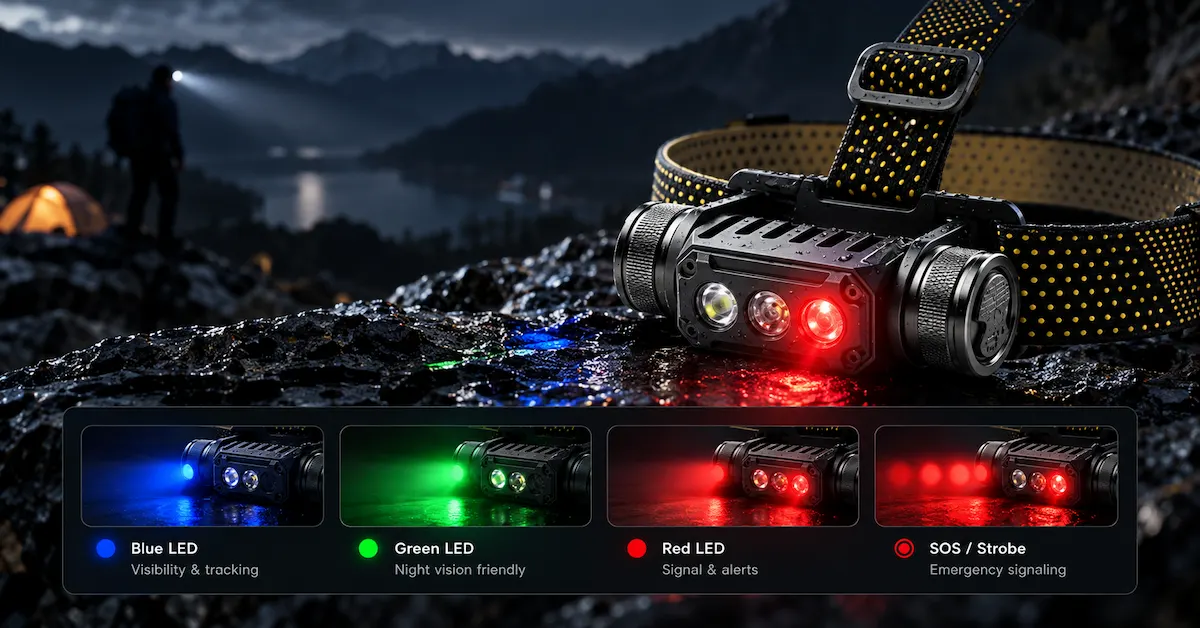
Coloured or flashing functions can remain outside a white-light trial when they are unrelated to the brief. They do not establish spot or flood usefulness. Any benefits promoted for those functions require their own basis in the instructions and commercial description.
A control criterion can specify the agreed starting state, the intended flood or focus state and the hand equipment used to select it. The buyer and supplier can then agree how much time, how many errors and how many repetitions are acceptable for that transition. These are project choices. The observation needs that criterion beside it before either party can call the transition a pass.
Request a task-based headlamp sample matrix
For a quotation on the SST20 or P8 platform, the model and battery option identify the build under discussion. The task description supplies distances, area dimensions, wearing equipment, required white-light states and switching sequence. Market, quantity, branding, packaging and timeline explain the commercial project. The buyer also identifies the reports needed to resolve the choice.
Mode-specific output and runtime belong in the quotation
A retail statement about useful flood operation needs information about that state. A statement about combined operation needs its own basis. The battery, starting condition and elapsed time identify what the output and duration figures describe; a maximum placed beside the longest runtime can otherwise imply a pairing that has not been established.
PLATO’s official public FL 1-2025 testing guidance distinguishes non-SDEB modes from Short-Duration Elevated Brightness. Output, peak intensity and distance measurements use 30 seconds to two minutes after activation for non-SDEB and one to ten seconds for SDEB.
The runtime figure answers a defined endpoint question. For ordinary modes, output measured at 30 seconds sets the reference; runtime ends when output reaches 10 percent of that reference. SDEB runs from activation to 90 percent of the maximum measured in its initial one-to-ten-second window. A buyer needing useful flood illumination through a work session still needs information about that requirement; the published endpoint does not establish it.
The application check consequently includes operating time. A task completed just after activation does not resolve a longer requirement. Repeating it at the agreed operating points connects the supplied mode to the period for which the user needs it.
| Acceptance area | Proposed sample check | Record retained | Buyer must define before testing |
|---|---|---|---|
| Near-work coverage | View required centre and boundary details with hands and tools in normal positions | Configuration, target layout, posture, setting and observed omissions | Required details, area and acceptable task outcome |
| Farther-target role | Locate and observe the agreed target, then return to near work | Distance, viewing conditions, aiming and control observations | Target size, distance and what successful observation means |
| Mounting and retention | Perform representative looking, reaching and returning movements | Approved equipment arrangement and changes in beam position | Permitted fit, adjustments and movement during the task |
| Beam switching | Follow the agreed near/spot/combined sequence with specified hand equipment | Actions, selected states, errors and interruptions | Required sequence and any project-specific acceptance limits |
| Shared-space interaction | Evaluate normal relative positions and a practical dim/tilt/off response | State, orientation, observations and effective adjustment | Representative interaction and acceptable behavior |
| Useful operating period | Repeat task checks at agreed points through the required session | Battery, mode, elapsed time, illumination evidence and task result | Duration and required illumination or task criterion |
The matrix is deliberately buyer-defined. Its observations become pass decisions only against an agreed outcome. An identified target and required action can settle a disagreement more effectively than two interpretations of “the area is visible.”
A missing result can still lead to a practical decision. If combined-mode information is unavailable, the parties can obtain it, change the requirement or restrict the planned statement. If a mounting arrangement remains unevaluated, its compatibility and trial stay open. Neither gap should disappear into a general sample pass.
The trial packet should lead back to the observation
The proposed packet identifies a run, date, observer role, sample and configuration revision. Power arrangement, selected state and operating time explain what was examined. These are fields for the trial team to complete, not a completed test record supplied with this article.
The setup description can refer to the target drawing, detail, distance, posture and mounting equipment. A project-appropriate participant identifier distinguishes trials without suggesting that all users will obtain an identical result. Gloves, eye protection and relevant surroundings belong with the setup when they affect interpretation.
Original files have different roles. A photograph can document fitting; a video can show a transition; a measurement file requires units, positions and method information. Identifiable links to those files let a reviewer examine the relevant observation instead of relying on a folder labelled only “sample testing.”
The summary states the criterion examined, the outcome and any departure from the intended setup. Missing conditions or recordings remain visible as limits. A repeat on a revised sample can use the same target and criterion, with the changed configuration identified. This is a proposed route to attributable information, not evidence that Brightenlux or a customer has performed the trial.
A wide beam headlamp OEM specification should resolve the quotation
The RFQ joins the intended task to a supplied build. It shows which requirements are fixed, which features are preferences and which alternatives merit consideration. That gives suppliers the same question to answer instead of letting each quotation choose its own most favourable comparison fields.
| RFQ input | Buyer supplies | Supplier returns |
|---|---|---|
| Task and user | Primary and secondary activities, target details and representative users | Proposed platform and explanation of beam roles |
| Geometry | Viewing distances, area dimensions, postures and nearby obstructions | Available beam information and proposed application checks |
| Wearing arrangement | Headwear, approved helmet or mounting equipment and relevant eye protection | Confirmed supplied strap/base and compatibility information |
| Controls | Required white-light states, transition sequence and hand equipment | Mode map, startup behavior and proposed control trial |
| Power and duration | Battery arrangement and required operating period by task | Quoted configuration and available mode-specific evidence |
| Approval and commercial scope | Acceptance matrix, market, quantity, branding, packaging and timeline | Deviations, sample plan, evidence gaps and quotation basis |
An alternative lens, strap or battery can be worthwhile if its effect is clear. A higher maximum does not answer a coverage problem.A lower price achieved with another included battery is not directly comparable until the configuration difference and its implications are understood.
The supplier’s response can distinguish information already available from work still needed. A relevant output report might exist while the buyer’s equipment combination still needs a trial. This separates the remaining questions and any sample-development work before the order is accepted.
Packaging also determines which questions matter. “Dual beam” can describe a feature. A stated working area, distance or duration needs an identified basis on the selected configuration. The product and content teams should agree which statements they intend to use before requesting the information to support them.
Timing in the enquiry describes the buyer’s desired milestones: configuration confirmation, samples, review and order planning. The supplier answers those milestones for the project. MOQ, customization availability and lead time are not universal commitments established by this guide.
The task map and acceptance matrix can be attachments. The opening enquiry can then explain the platform and the few unresolved decisions that determine the purchase. This is easier to answer than a long list of features whose importance is unclear.
A simpler platform remains a legitimate alternative if it completes the required sequence or if the buyer accepts a stated change. A more elaborate platform needs an application benefit. Requiring the same reply fields for both makes the tradeoff visible.
Task acceptance, claim acceptance and readiness to order can be separate decisions. A sample may satisfy the close-work activity while a proposed duration statement still lacks support. That partial result can move the project forward without presenting the unfinished statement as approved.
Each open question has a responsible party and a way to close it. Product management can define the target area; the supplier can identify an applicable report; the equipment owner can confirm a mounting arrangement. The purpose is a decision, not an unexplained pending label attached to a circulating sample.
The final answers must describe one build. A substitution made during the discussion can affect earlier information. Written confirmation of the selected optic, power arrangement, strap and control sequence gives the quotation and sample a common identity before release.
The approved configuration is the reference for the next order
The sample shows what was selected. Its configuration, target layout, mode map and observations explain why it was selected. Both are useful when a later discussion concerns a changed component or a different task result.
Changes follow the requirements they affect. Optics can alter distribution; the strap or base can alter position; controls can alter the transition; power can alter operating information. Identifying the affected requirement tells the parties what needs another review.
A strap revision may call for fitting and retention checks. A changed white-light state may need new operating information and instructions. The scope is agreed between supplier and buyer, rather than assuming that every change requires either a complete restart or no review.
Production checks have their own scope. A sample report, a routine function inspection and individual optical measurement describe different activities. The order identifies the checks performed and the treatment of exceptions. The proposed wearer matrix is not proof that every delivered unit undergoes it.
Instructions should match the supplied state map. Spot, focus, flood and combined need meanings that a user can relate to the controls. A familiar product name does not make an earlier mode diagram correct for a revised build.
Website, packaging and distributor information describe the same selected configuration. Another variant’s higher headline should not migrate into that SKU. The applicable mode, battery and supporting information keep the commercial description connected to the purchase.
FAQ
1. Would flood be preferable for every nearby task?
A broad work area may benefit from flood; a recessed detail may benefit from concentration. Target size, surface, obstruction and wearing position settle the application question. The state that completes the task is more useful than a rule based only on its label.
2. What does a two-LED description establish?
Source count. Useful beam roles still need a configuration explanation and information about their distributions. Two sources can have similar patterns, different patterns or different colours. None of those arrangements guarantees the required target coverage.
3. When should combined light enter the specification?
When it serves a need that separate states do not complete conveniently. Overlap, reflections, control access and operating duration belong in the check. Availability alone does not make combined operation a necessary feature.
4. What makes the helmet question specific?
The helmet, approved attachment method and lamp position. Compatibility is confirmed with the responsible supplier or equipment owner. The trial uses that combination under the applicable instructions and organizational requirements; it does not authorize modifying protective equipment.
5. Which details belong in a wide-beam requirement?
Target area, distance, posture, important details and operating period. Centre and boundary observations include the normal hands and tools.A beam-angle label can be useful information while still leaving those task questions unanswered.
6. Can a maximum inherit another mode’s runtime?
Only when the supporting information establishes that pairing on the supplied build. Mode-specific output and duration remain identifiable. A short elevated state and a lower continuous state describe different uses.
7. What can a check involving another person show?
Representative relative positions, settings and a practical dim, tilt or off response in a controlled trial. It avoids intentional exposure to a bright source. One favourable observation cannot establish unrestricted glare-free performance.
8. Why include the material names in the enquiry?
They help identify the proposed configuration. Comfort, retention and order-relevant durability require their own information or checks. A PMMA or aluminum description is not a wearer result.
9. What should the first sample response contain?
The supplied configuration and mode map, applicable output and duration information, and the checks needed to settle the task choice. Distinguishing available information from gaps makes proposed new work clear without implying that it has been completed.
10. When does a reorder need another review?
When a change affects an accepted requirement, including optics, fitting, controls or power. The earlier sample and explanation provide the baseline. The changed build determines which information or checks need updating.
Conclusion
Spot vs flood headlamp OEM selection connects beam roles with a wearer’s task. Approval needs an identified build, useful coverage, practical transitions and a suitable mounting arrangement. Optical reports and task observations support different parts of that decision.
Send Brightenlux the proposed model, tasks, distances, wearing equipment, modes, battery preference, quantity, market, branding, packaging and timeline for a configuration and sample evidence plan.