

A solar emergency light manufacturer should be able to show how a proposed lamp delivers useful illumination when mains power is unavailable, sunlight is limited, and a buyer needs the same approved product across many shipments. The purchase decision begins with an energy budget—lighting watts, operating hours, battery reserve, solar harvest, and charging losses—not a catalogue claim of “super bright” or “all-night solar power.” An emergency-ready design must also be simple to operate, safe to store and charge, and supported by traceable test evidence.
This guide is for emergency-kit importers, outdoor and preparedness brands, wholesalers, off-grid retailers, humanitarian procurement teams, and facilities buyers sourcing portable backup lighting. It offers a buyer-led three-night validation method, not a guarantee that any specific product will last three nights. For commercial and regulatory clarity, portable lanterns discussed here are distinct from permanently installed, code-required emergency escape lighting.
1. Why Three-Night Readiness Is a Better Procurement Question Than Maximum Lumens
Emergency lighting is bought for interruptions to normal life. A household may need a modest room light while cooking and checking on family members. A shelter may need portable table lighting when normal electricity is disrupted. A field maintenance team might carry lamps to a remote site where recharging is uncertain. In each case, a bright product photo does not explain whether the light remains useful after sunset, after an overcast day, or after being stored for several months.
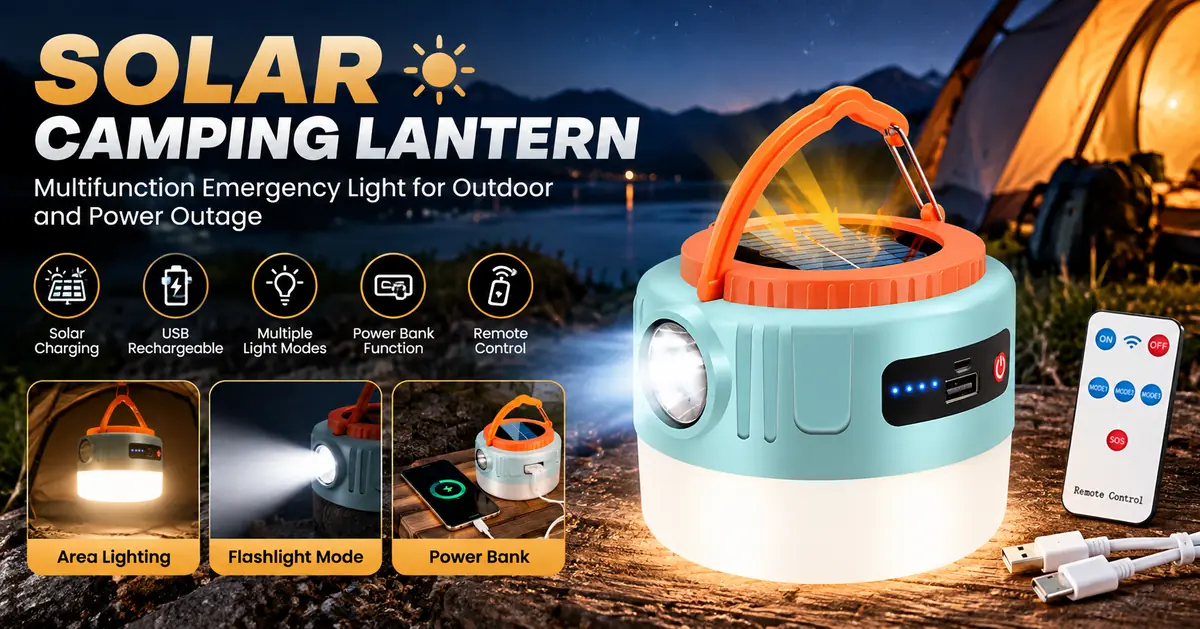
A three-night backup scenario is a useful procurement exercise because it exposes the interaction between runtime, battery capacity, and solar charging. The number three is an illustrative buyer planning horizon—not an industry-wide requirement, and not a published Brightenlux runtime guarantee. A buyer may instead define one, two, five, or more nights according to the intended users, local weather, available backup power, and criticality of the task.
The first step is to define usable illumination. Do people need a soft, diffused light for five hours per evening, or a concentrated beam for twenty minutes of equipment checking? Does the lamp have a low mode that remains comfortable indoors? How many people will use each unit? A true application brief records the work and environment before specifying the panel or battery.
A low-output lantern with predictable control can be more appropriate for long blackouts than a high-output lamp that spends its reserve quickly. That is a design choice to validate, not an invitation to understate light requirements. If a specific room illuminance or task visibility is necessary, an engineer or user trial must define it.
2. Who Should Source Portable Solar Emergency Lamps—and Who Should Not
The most relevant buyers include private-label emergency supply brands, importers creating seasonal preparedness assortments, camping and hardware distributors, NGOs evaluating portable lighting kits, field-service suppliers, and retailers looking for products that remain useful beyond ordinary camping. These buyers tend to care about repeatable pack-out, realistic charging instructions, manageable warranty claims, and the ability to reorder an unchanged approved configuration.
A portable solar lantern may fit household blackouts, outdoor camps, temporary workspace illumination, remote cabins, or non-critical backup kits. It does not automatically qualify as an approved fixed emergency luminaire for evacuation routes, exit signs, fire-alarm systems, or other code-controlled life-safety installations. Requirements such as IEC 60598-2-22:2021, Luminaires—Part 2-22: Particular requirements—Luminaires for emergency lighting, may become relevant for actual emergency lighting equipment within its scope. A general camping lantern should not be marketed as compliant without a separate product-specific assessment and evidence.
Likewise, an item described as “solar” may have a small panel intended for supplemental charging only. It should not be positioned as an indefinitely self-sustaining light without a verified energy model and low-sun trial. When the user depends on lighting for critical procedures, define independent backup arrangements appropriate to that use.
3. Start With the Complete Energy Chain: Solar Panel, Controller, Battery, LED
A solar emergency light manufacturer is effectively proposing a small power system. Daylight enters a photovoltaic module, a controller manages charging and battery protection, stored energy drives the LED, and the user selects how quickly that reserve is consumed. Any weak link can shorten the operating window.
Panel and installation. Ask for panel rated power in watts under its specified test conditions, cell type, physical area, mounting orientation, and whether the panel is integrated or separate. For portable products, verify that the user can expose the panel to sunlight without simultaneously leaving the battery or lamp in an unsafe temperature environment. A panel under glass, shade, fabric, or a building overhang may produce much less energy than the label implies.
Charge controller. Request details about solar-input limits, charge termination, under-voltage protection, reverse polarity protection where applicable, and low-battery behaviour. The circuit must work with the selected cell chemistry and solar module. A USB charging input, if offered, should be specified separately from the solar input.
Battery. Capacity in milliamp-hours cannot be compared meaningfully without voltage and configuration. Ask for nominal watt-hours, cell chemistry, pack arrangement, overcharge/overdischarge protection, usable-energy assumptions, temperature limits, and storage guidance. A 6600mAh capacity label does not by itself reveal the watt-hours delivered to the LED.
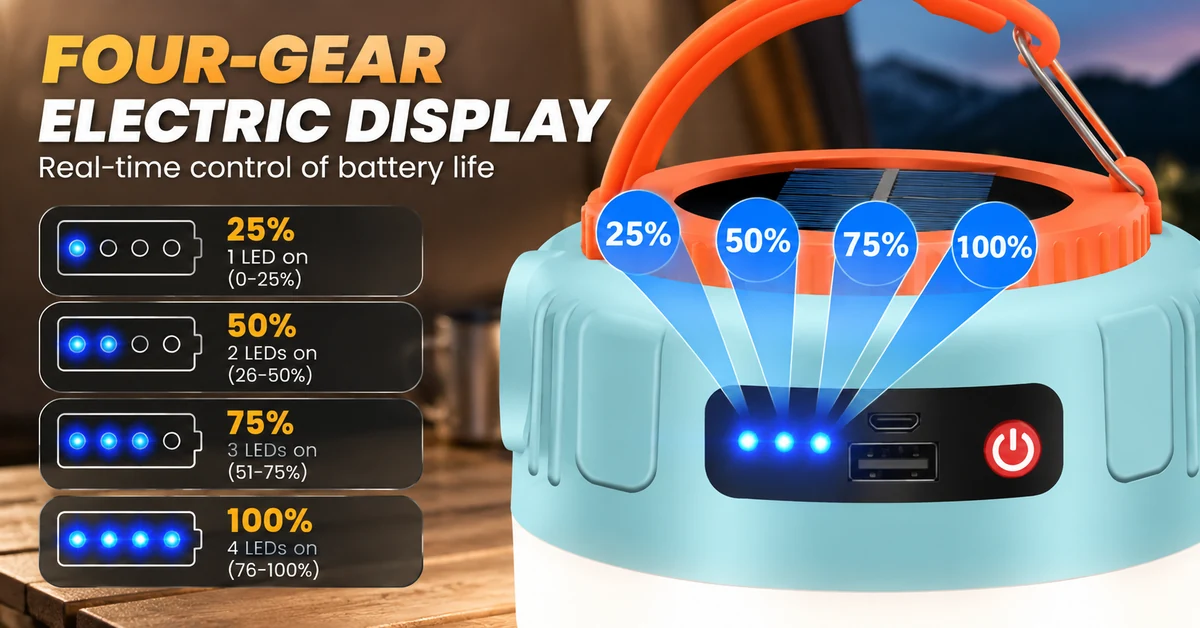
Light engine and user controls. An LED, driver, diffuser, and switch create the useful output. Record mode-specific power draw, steady-state output, runtime, and any automatic dimming. Red, warm, cool or flashing modes are product-specific; do not assume every candidate includes them.
Mechanical system. Confirm the hanging hook, carrying handle, standing base, sealing, connector cover, and replacement/service method. A technically capable battery system can still disappoint users if the lantern tips over or its charging cover is difficult to close.
4. A Worked Three-Night Energy Budget—Illustrative, Not a Product Claim
When reviewing a solar emergency light manufacturer quotation, begin with a clearly labelled hypothetical scenario. Suppose the buyer needs a portable lantern drawing 4 W at the selected continuous mode, used for 5 hours each night, for 3 nights. The energy consumed by the LED system is therefore 4 W × 5 h × 3 = 60 Wh across the three-night window. These values are chosen for demonstration only; they are not specifications of Brightenlux PL4134 or any other model.
If the procurement brief assumes that 80% of nominal battery energy is usable at the relevant load and conditions, the corresponding nominal storage requirement is approximately 60 Wh ÷ 0.80 = 75 Wh. That factor is a buyer assumption combining reserve and relevant losses, not a universal discharge recommendation. Real capacity must account for controller limits, battery condition, temperature, aging, and actual driver efficiency. A sample test should confirm the achievable result.
Now add potential solar replenishment. A hypothetical 10 W panel receiving 4 equivalent peak-sun hours in a favorable day would collect 10 W × 4 h = 40 Wh before relevant system losses. If the model assumes 75% net usable charging efficiency under that defined scenario, estimated battery input is 30 Wh. That may cover one 20 Wh evening in a favorable day, but the result will be much lower in poor weather, shade, wrong orientation, or limited winter daylight.
The calculations lead to an essential distinction:
- Autonomy without sun means how long the approved battery supports the defined lighting load with no charging input.
- Solar recovery means how much useful battery energy can be restored under specified sunlight, panel position, temperature, and control conditions.
- Long-term sustainability means whether charging can replenish actual average consumption over the relevant seasonal pattern, not merely on one clear day.
No honest three-night claim can be drawn from panel wattage alone. The National Renewable Energy Laboratory/National Laboratory of the Rockies PVWatts methodology documents the influence of soiling, shading, wiring, mismatch and other losses in solar system estimates. PVWatts is intended for larger PV-system modeling, not direct certification of a pocket lantern, but its treatment of real-world losses is a useful reminder when setting a conservative small-product test plan.
5. What to Measure in a Solar-Charging Trial
For a solar emergency light manufacturer, the statement “charges in sunlight” is not a complete specification. Request a solar-input report that states irradiance or test condition, panel orientation, temperature, starting battery state, charging duration, measured input power or energy, and recovered usable light output. When the objective is battery recharge, record watt-hours rather than only the presence of a charging indicator.
For side-by-side sourcing tests, charge two candidates under the same controlled exposure and compare energy harvested. Then repeat with less favorable conditions—perhaps a reduced irradiance profile, partial shade, or shorter available window—using a method approved by the technical team. A brief solar-panel demonstration beneath a bright indoor lamp does not establish daily solar yield.
A good test record also reports charge priority if a lamp can receive USB and solar power: can both be connected, which input is preferred, and how does the controller prevent unwanted behaviour? This must be verified on the proposed configuration. Never infer this logic from a USB-C port photograph.
A brand may choose to advertise “solar charging support” rather than “fully solar powered” when the panel is intended as a backup source. That positioning can reduce consumer confusion and returns while remaining commercially attractive for outdoor and emergency-preparedness channels.
6. Design for Weak Sun, Storage, and Low-Battery Behaviour
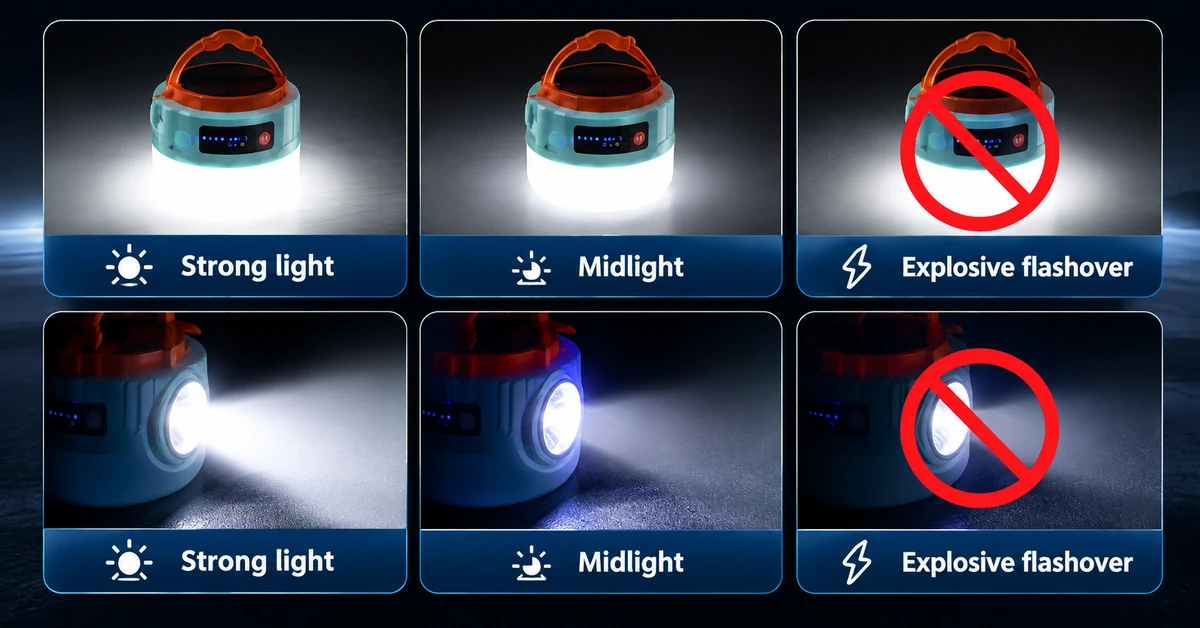
For a buyer assessing a solar emergency light manufacturer, the most revealing test is often what happens when charging is insufficient. Some designs may reduce brightness automatically, switch to a low mode, display a warning, or shut off after reaching a battery-protection threshold. These behaviours are not universally better or worse; they must fit the user and be explained clearly in the manual.
Ask for a low-state-of-charge sequence: the point at which the product warns the user, how much useful light remains, whether the selected mode changes, and what the user must do next. Avoid treating “hours to zero light” as identical to “hours of useful emergency illumination.”
Long-term storage adds another requirement. A packed emergency light may remain in a cupboard, car kit, stockroom, or distribution centre for months. The buyer should determine required storage temperature, periodic charge checks, shelf maintenance, handling of deep discharge, and how the battery state is reported at deployment. These procedures must be based on the approved cell/pack and manufacturer instructions; no universal storage interval is promised here.
If a rechargeable lamp also offers a USB power-bank output, verify its output power and the energy it removes from the battery. Phone charging may compromise light availability during a blackout. A prudent specification can reserve a minimum lighting budget or present the trade-off in clear operating instructions.
7. Real Brightenlux Product References: Solar Prospect and Backup Alternatives
Brightenlux's Solar Light category and Emergency Light category currently show no individual goods on the official independent site. Therefore, this article does not invent an on-site solar-emergency product page. Its Outdoor Lighting page supports discussions about OEM/ODM product direction, customization, and development, but availability of a new solar specification must be confirmed.
There is a useful additional clue from the manufacturer's public marketplace presence: a Ningbo Brightenlux Electric Appliance Co., Ltd. listing identifies PL4134 as a solar-themed portable camping lantern and advertises a lithium-battery format and an IP55 claim. That marketplace listing is a supplier assertion requiring confirmation of current availability, panel rating, actual charging circuit, battery watt-hours, test documents, and IP evidence. The listing's lamp wattage is not evidence of photovoltaic panel wattage, and no three-night performance claim is established. Request a current technical sheet directly from Brightenlux before using this reference in a retail specification.
Meanwhile, the official site provides real non-solar backup-lighting references useful when building a complete preparedness assortment:
| Brightenlux Reference | Confirmed Source-Level Product Direction | Useful Role in a Backup Program | Solar Status / Open Questions |
|---|---|---|---|
| PL4134 — solar-themed camping lantern | Manufacturer's marketplace listing describes solar lantern; lithium battery and IP55 are listing-level claims | Candidate solar sample for feasibility review | No corresponding independent-site SKU; PV wattage, usable Wh, solar test and report must be confirmed |
| BT-PL4031R 2000 lm rechargeable lantern | Manufacturer lists COB, three 2200mAh cells (6600mAh total claimed), five light modes, dimming, power-bank feature, IP44 | USB-rechargeable non-solar emergency area-light alternative | Solar charging is not established for this model; confirm Wh, output by mode and battery documentation |
| BT-PL4030 1000 lm dry-battery lantern | Manufacturer lists 3 × D cells (not included), three white-light modes, dimming, IP44 | Replaceable-battery non-solar fallback for long-storage kits | No solar panel; confirm mode-specific usable runtime, cell inclusion and IP evidence |
| 1000 lm USB-rechargeable camping lantern | Published rechargeable lantern with battery and power-bank functionality | Alternative portable non-solar lighting format | Verify complete technical sheet, current availability and no unsupported solar claim |
These examples are deliberately separated. An OEM buyer may choose a solar lantern as the lead product and a dry-battery or USB-rechargeable lantern as a backup or complementary SKU. Do not apply solar claims, IP ratings, battery sizes or certifications from one model to another.
8. Compare Three OEM Program Concepts Before Committing to a Solar Tooling Design
An effective solar emergency light manufacturer proposal should describe more than a single sample. For buyers preparing wholesale assortments, a short concept matrix shows which features create real use value and which create engineering or cost risk. The following concepts are buyer-defined configurations, not confirmed Brightenlux catalog SKUs.
| Proposed Concept | Primary Use | Charging / Reserve Philosophy | Main Validation Priority | Commercial Trade-off |
|---|---|---|---|---|
| A — Portable solar/USB lantern | Household and camping blackout backup | Solar as supplementary recovery; documented wired charging | Charge input, low-mode autonomy, readable instructions | Panel area vs enclosure size; accessory cost |
| B — Three-night reserve kit | Preparedness brands and contingency programs | Larger usable energy reserve with conservatively specified solar input | Zero-sun autonomy; weak-sun recovery; storage readiness | Battery weight, pack cost, transport and verification |
| C — Field kit with backup source | Remote service teams and distributors | Solar product plus independently qualified non-solar fallback | Kit components, issue/return procedure and replacement availability | Two power systems, documentation and logistics |
The correct choice depends on the destination market, price tier, expected users, and access to sunlight or power. A household preparedness retailer may prefer simple controls, a hanging point, and clear low-mode instructions. A remote field buyer may emphasize replaceable parts, tracking labels, longer storage intervals, and battery transport documentation.
Avoid building an oversized specification simply because every feature sounds attractive. A new panel enclosure, higher-capacity battery, USB output, flashing mode, motion sensor, and custom bracket can each add components, testing, and potential failure points. Pilot the smallest configuration that solves the identified job, then use field evidence to decide which upgrades justify development.
9. Engineering Review: Waterproofing, Heat, Switches, and Solar Panel Integration
A solar emergency light manufacturer's mechanical design affects both energy input and survival in outdoor use. The panel must receive sunlight; the battery and electronics must remain within their approved operating limits; and the assembled product must resist the environmental exposure that its carton promises. These needs sometimes compete.
A panel fixed flush to a lantern top may be easy to carry but difficult to aim at low winter sun. A separate panel can offer more placement flexibility but introduces a cable and connector that require sealing and strain relief. Neither design is automatically superior. Ask the manufacturer to show the actual installation method and to validate it in the intended environment.
Review potential ingress points: lens-to-housing joint, panel laminate edge, switch boot, USB port, battery access, screw bosses and cable entry. IEC 60529, Degrees of protection provided by enclosures (IP Code), offers a technical framework for defined water and dust ingress classifications. IP44 or IP55 statements must be tied to the particular enclosure and report; they do not grant universal submersion, salt-water, pressure-washer or chemical resistance.
Also examine heat. Panels, dark enclosures and batteries may sit in strong sunlight while charging, while the LED and driver generate heat during operation. Ask for temperature limits, thermal protection behaviour and safe placement instructions. Do not assume “charges outdoors” means the product can be left in any high-temperature location without limitation.
For brands serving storm and blackout markets, usability matters: readable mode labels, easy carry handles, stable bases, accessible charging covers, and protective packing. Test controls with unfamiliar users and include clear charging and storage warnings. A solar emergency lantern should not require a technical expert to operate during a power outage.
10. A Buyer-Ready Technical Specification Sheet
Convert the project into a controlled RFQ rather than asking a solar emergency light manufacturer only for the “best solar emergency light price.” Where a numerical value is unknown, label it supplier to confirm, specify the required test method, and decide who will approve the result. The following fields make proposals from different suppliers genuinely comparable.
| Field | Buyer Must Define | Supplier Must Provide |
|---|---|---|
| Intended use | Household blackout, camping backup, remote work or non-critical kit | Recommended format and stated limitations |
| Lighting job | Target area, useful mode, operating hours per night | Mode-specific LED output, power draw and runtime evidence |
| Solar system | Install location, season, panel orientation, expected sunlight | Rated PV watts, test condition, charging input and installation details |
| Battery reserve | Nights without usable solar; required end-of-life performance assumption | Chemistry, nominal Wh, usable-energy criteria, protection and service policy |
| Alternative input | USB, replaceable cell or other backup source needed | Exact connectors, power limits and charging priority |
| Low-battery response | Warning, minimum usable mode and user action | Tested control sequence and cutoff behaviour |
| Environment | Rain, dust, storage and cleaning assumptions | IP evidence, temperature limits and installation instructions |
| Packaging and branding | Logo, manual, kit contents, language, barcode | Controlled pack-out, artwork proof and revision identifier |
| Quality and shipping | Target market, inspection and transport route | Test reports, lot traceability, battery/transport documents and timelines |
This table is intentionally technical. A supplier that responds with only a retail photo and a lumen figure has not yet provided enough information for an evidence-backed three-night specification. The next step is a sample plan covering the missing fields.
11. A Ten-Step Qualification Protocol for Solar Emergency Lighting
Step 1 — Identify the sample. Record exact model, revision, panel, battery, driver, LEDs, accessories, cable, and packaging. Photograph the received product and keep a reference copy of its specification.
Step 2 — Measure the intended light mode. Define output and power draw for the mode customers will use during a blackout. Do not use the brief peak-brightness measurement as a substitute for sustained output.
Step 3 — Establish a known starting charge. Charge using the manufacturer's approved method and record electrical conditions. An indicator showing “full” is useful but may not provide a quantified energy reference on its own.
Step 4 — Run the zero-sun autonomy test. Operate the lantern for the defined nightly window without solar or USB recharging. Repeat for the selected number of nights, recording output, battery behaviour and the point at which lighting ceases to meet the application requirement.
Step 5 — Test solar recovery separately. Use documented irradiance, panel angle, temperature and charge duration. Measure recovered usable energy or the equivalent verified battery change. Record weather assumptions in outdoor trials.
Step 6 — Introduce weak-sun conditions. Repeat with a reduced daylight exposure profile. Observe whether the lamp enters a lower mode, alerts the user or fails to meet the requested service window. Report the limitations honestly.
Step 7 — Test alternative charging and auxiliary outputs. Where the product offers USB input or power-bank output, verify the actual voltage/current and the effect on the lighting reserve. Do not assume a pictured USB connector supports every charging protocol.
Step 8 — Review mechanical and environmental durability. Check the panel edge, seals, switches, cable strain, carrying/hanging structures and the IP claim with a suitable defined method. Inspect for fogging or delayed functional issues after wet exposure.
Step 9 — Review storage, labeling and transport. Confirm battery identity, safety instructions, pack-out, periodic-maintenance needs and appropriate shipping documents. Evaluate what happens after prolonged permitted storage rather than testing only a brand-new charged sample.
Step 10 — Freeze the approved build. Keep a golden sample, versioned bill of materials, test results, carton artwork and change-control rules. Reorder only against an identified revision; retest affected functions after changes to the panel, battery, controller, LED, seals or charging parts.
These tests belong in the buyer/manufacturer qualification agreement. They are proposed steps, not claims that Brightenlux has already passed each one on PL4134 or any other solar-emergency product.
12. QC During Production: Prevent a Good Sample From Becoming an Inconsistent Shipment
A solar emergency light manufacturer must explain how it will reproduce the energy and lighting system after approval. A laboratory sample can perform well while a later batch uses a different panel cell, battery, charge controller, or diffuser. The buyer should therefore define which components are critical-to-quality and how substitutions are reviewed.
Incoming inspection may verify PV module identity and visual condition, cell/pack documentation, control-board revision, LED and optic specification, gasket dimensions and charging parts. Assembly controls should address connector polarity, fastener/adhesive process, panel attachment, battery wiring, sealing and functional safety. Final checks should include mode operation, charge indication, appearance, accessories, carton details and traceability.
Not every finished unit needs a destructive environmental test. Instead, establish a reasonable inspection and verification plan based on risk and accepted quality procedures. The supplier should tell the buyer which checks are performed on every unit, which are sampled, and which reports are issued at initial qualification or when the design changes.
One crucial rule: no undocumented substitutions to the PV module, battery, protection circuit, LED driver or charging port. A less expensive panel with a similar appearance can change solar yield. A battery from a different source can affect performance and required shipping evidence. The manufacturing agreement should specify notification, approval, and any necessary retesting before such changes are adopted.
For Brightenlux, the relevant public manufacturing support is described on its About Us and Outdoor Lighting pages. Those pages establish the company's stated business direction; they are not independent proof of solar-lantern production capacity or project-specific test compliance.
13. Standards and Compliance: Do Not Confuse Backup Kits With Building-Life-Safety Equipment
The term emergency light is broad in commercial search but can be narrow in regulation. A portable camping lantern marketed for household power outages and a permanent building emergency escape luminaire may face very different requirements. Buyers must define the sales claim and target market before printing an approval symbol.
IEC 60598-2-22:2021 specifies particular requirements for emergency lighting luminaires within its scope, including relevant battery and operation considerations. A solar camping light does not automatically fall into or satisfy that category merely because it can be used during a blackout. If a buyer intends the product for regulated emergency evacuation, obtain qualified engineering and compliance advice and appropriate model-specific evidence.
IEC 60529 concerns defined degrees of enclosure protection. It is relevant when a manufacturer asserts IP44, IP55 or another code, but the report must cover the actual assembled product. UN Manual of Tests and Criteria, Part III, subsection 38.3, is relevant to lithium-cell and battery transport requirements; obtain the appropriate battery test summary and shipment documents for the actual configuration and destination. These references describe different aspects of product suitability and should not be collapsed into a single “internationally certified” sentence.
Claims such as “all-night,” “three-night emergency backup,” “all-weather,” “fast solar charging,” or “fully autonomous” must each have a clear test definition. Your importer or brand team should review the evidence and permitted wording for its own market before publication. Compliance cannot be established by copying a competitor's badge into a carton design.
14. MOQ, OEM/ODM and Private-Label Opportunities
Brightenlux offers OEM/ODM and branding discussions across portable outdoor lighting, but a new solar emergency light program may involve more than logo printing. Packaging changes can be relatively straightforward on an existing approved platform. A new panel, charge controller, cell pack, or enclosure geometry may require development and additional tests. The correct MOQ depends on the exact configuration, components, printing method, tooling and current production plan.
For a private-label pilot, keep the technical build unchanged where possible and test the packaging, instructions, user demand and field feedback. For configuration adaptation, discuss panel mounting, charging options, mode behaviour, battery and handles with engineering sign-off. For a new ODM project, ask who owns tooling, prototype milestones, revision control and evidence for the final design. Do not assume that all levels of customization share the same minimum order or lead time.
A strong solar emergency light supplier will also address the end-user experience printed on the box. The package should explain how to position the panel, what typical solar charging depends on, how to check battery state, whether USB charging is included, how to store the light, and what limitations apply during poor weather.
If a marketplace listing advertises customization thresholds or certification labels, treat them as listing-level statements until a current quotation confirms the actual product, packaging, order size and applicable evidence. This is especially important when an independent-site category has no published SKU to cross-reference.
15. Landed Cost, Warranty Risk and Replenishment Planning
Price comparison must use a complete, comparable system. A solar lantern quote may include the PV panel, battery, charging board, hooks and cable, while another price excludes a cable, a separate panel or retail packaging. A non-solar lantern should not be treated as the same product simply because it provides a similar lumen figure.
Create a landed-cost model covering lamp and panel + battery + charging accessories + branded packaging + development/testing allocations + freight, duties and handling + expected warranty service. If the buyer proposes a spare battery or dry-cell fallback, account for that separately. Real warranty assumptions should come from observed field data or reasonable scenarios, not fabricated manufacturer failure statistics.
Also consider storage and replenishment. An emergency assortment can sit in stock for months before a seasonal spike in demand. Confirm when batteries need maintenance, how cartons identify the correct revision, and whether a replacement panel, charging cable or battery can be supplied for the approved model. Ask how the supplier handles a component discontinuation between first shipment and reorder.
A lower purchase price is not useful if the delivered product fails to recharge during ordinary use or if the retail claims trigger excessive returns. For a distributor, the best total-cost discussion is therefore linked to documented energy performance, honest instructions, controlled parts and predictable repeat supply.
16. A Quote-Ready RFQ to Send to Brightenlux
Before contacting Brightenlux as a prospective solar emergency light manufacturer, define the target country and application. A complete RFQ gives the company an opportunity to recommend an existing solar prospect, a non-solar backup alternative or a new development path without guessing. It also makes it possible to say clearly what is not yet available.
Include your buyer type and destination market; household, camping, shelter or remote-work use; required light area and mode; operating hours per night; number of nights without sun; seasonal solar assumptions and panel position; desired battery chemistry and nominal Wh; USB/alternative charging needs; ingress and temperature expectations; packaging language; logo/artwork; initial and forecast quantity; target timing; and any required documents.
Ask for an itemized response containing: recommended model or project reference; current stock/development status; solar panel test data; mode-by-mode power and runtime; battery specification; sample plan; critical-component list; MOQ for each customization; price terms; production milestones; and unresolved technical points.
If PL4134 is offered, specifically request its current datasheet and confirm whether its published solar product description represents the exact quoted assembly. Ask for the PV module wattage, usable battery Wh, charge input, solar-recovery curve, runtime under a defined mode, and IP report rather than extrapolating from the marketplace title.
17. Frequently Asked Questions About Solar Emergency Light Manufacturing
1. How do I evaluate a solar emergency light manufacturer for B2B procurement?
Define the user scenario and the number of nights of useful light required, then request a model-specific solar panel rating, battery watt-hours, mode power, charging results, storage instructions, quality plan and market documents. A supplier that explains assumptions and limits is easier to evaluate than one offering an unsupported “all-night” promise.
2. Can a portable solar lantern run for three nights without sunlight?
Only if the approved battery has enough usable energy for the selected output and hours, under the relevant temperature and aging conditions. Three-night operation is not inherent in the word solar. Verify it through a zero-sun autonomy test before printing the claim.
3. Is a 10 W LED lantern the same as a lantern with a 10 W solar panel?
No. LED load wattage and photovoltaic panel rated wattage describe different parts of the energy system. A marketplace specification for lamp power does not establish solar-panel output. Ask for separate measured or specified values with units and test conditions.
4. Does a larger battery always make a better solar emergency light?
Not automatically. A bigger battery may increase reserve but can require more charging time, additional panel area, different protection electronics, and more enclosure space. The battery, panel, controller and output profile must be designed and evaluated together.
5. Can solar charging replace USB charging during a prolonged blackout?
That depends on panel size, weather, orientation, available daylight and the nightly load. Small integrated panels often need conservative expectations. A buyer should test solar recovery and decide whether USB charging or an independent backup is part of the intended product architecture.
6. Does Brightenlux sell a verified solar emergency lantern on its independent website?
The current Solar Light and Emergency Light category pages show no individual products. A Brightenlux marketplace listing describes PL4134 as a solar camping lantern, but its present availability and technical evidence must be confirmed with the manufacturer. Do not assign an unverified solar SKU to an unrelated independent-site product page.
7. Are Brightenlux BT-PL4031R or BT-PL4030 solar-powered lanterns?
Their official product pages establish rechargeable and dry-battery lighting configurations, respectively, not solar panels. They may be useful non-solar backup choices, but no solar charging function should be attributed to those models without new verified documentation.
8. What does an IP55 label mean for a solar emergency lamp?
It describes a particular solid-object/dust and water-jet protection classification under defined test conditions. It does not mean unlimited immersion or resistance to all chemicals and high-pressure cleaning. Ask for the report covering the exact enclosure and port-cover configuration being sold.
9. Can a solar camping light be used as a regulated emergency exit luminaire?
Not merely because it lights a room during a power outage. Regulated escape lighting has applicable design, installation, performance and testing requirements. A portable lantern must not be promoted as a code-compliant replacement without the appropriate separate assessment and approvals.
10. What should I send Brightenlux to get a useful OEM/ODM quotation?
Provide the destination market, user, nightly operating hours, target autonomy, sunlight assumptions, lighting format, battery and solar preferences, required documentation, sample and bulk quantities, branding, packaging and intended schedule. Contact Brightenlux to confirm current products and feasible development options.
Conclusion
Choosing a solar emergency light manufacturer means selecting a partner able to connect usable illumination, stored energy, realistic solar charging, low-sun limitations, safety evidence and repeatable production. The meaningful purchasing test is not how brightly a sample lights up for a few minutes; it is whether the approved product fulfils a clearly defined backup scenario, communicates its limits honestly, and can be reproduced with the same critical parts and quality controls.
Brightenlux offers portable outdoor lighting manufacturing and OEM/ODM discussions, with verified non-solar camping lantern products on its official product pages and a solar-themed PL4134 marketplace reference that requires model-specific confirmation. To evaluate a solar program, share your blackout duration, lighting modes, panel and battery goals, target market, packaging needs and expected order volumes through Brightenlux Contact Us. The right next step is a current technical proposal and controlled sample—not an unsupported promise of three-night operation.