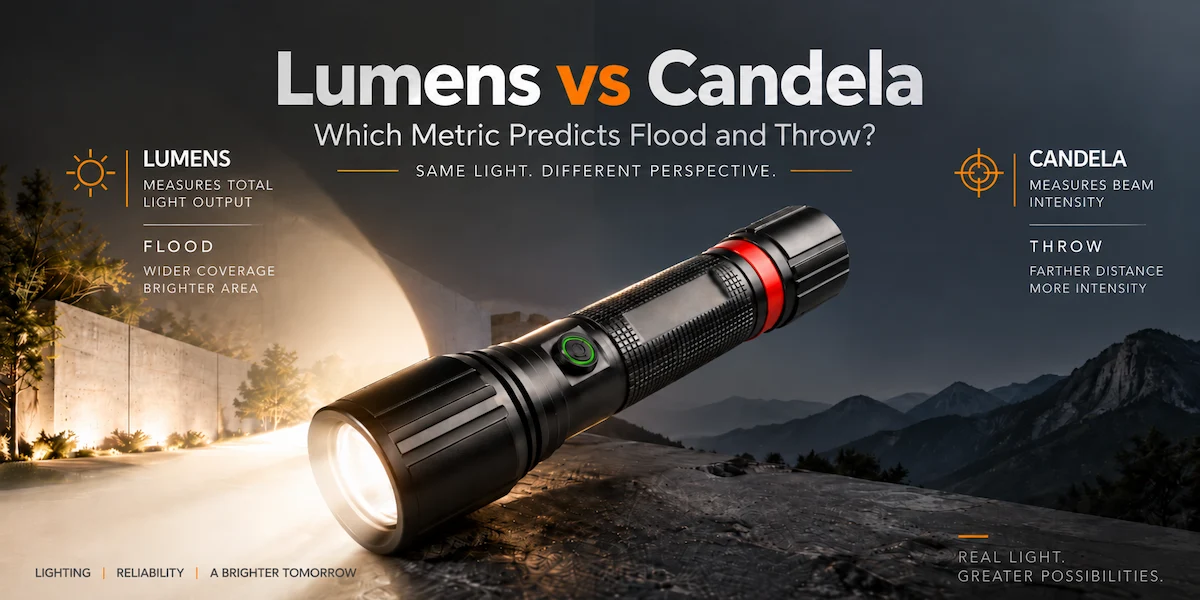


A reliable rechargeable flashlight for camping supplier should offer the right beam and carry format for trail navigation, campsite tasks and emergency backup—not merely the highest lumen number. Shortlist a verified platform, check usable runtime at a named mode, test the exact USB-C and backup-battery system, confirm the weather-protection evidence, approve the packaging and battery documents, then agree on component and shipment quality controls before a wholesale order.
Finding a rechargeable flashlight for camping supplier sounds like a simple catalog search until an outdoor retailer begins planning an actual product range. The same shopper who wants a light trail torch may also need to find gear inside a tent, check a vehicle in the rain, or keep a battery-backed light available during a power outage. Those jobs differ. One product cannot be judged by the word “rechargeable,” a peak lumen claim or a hero photograph showing a distant beam.
For an importer or private-label brand, the commercial risk is wider than choosing the wrong brightness. Customers may return a flashlight because the battery was not included, their common USB-C charger does not work as expected, the switch always passes through strobe, the narrow beam is uncomfortable for campsite cooking, or an IP claim was interpreted as permission to submerge the product. These problems can begin long before mass production, inside an incomplete request for quotation.
This guide uses genuine Brightenlux catalog models as sourcing references. The specifications below are manufacturer-published claims; an approved sample and matching test evidence are still necessary for packaging or wholesale commitments. Brightenlux is Ningbo Brightenlux Electric Appliance Co., Ltd., a Zhejiang-based manufacturer established in 2014 that describes LED flashlights, headlamps, camping lights and other outdoor lighting products on its About Us page. The goal here is to connect these existing product platforms to real outdoor retail decisions without inventing orders, test results or factory capabilities.
1. What Should a Rechargeable Camping Flashlight Actually Do?
Begin with the user’s evening rather than the supplier’s brightest model. A camper walking from the parking area to a tent needs directional illumination aimed at obstacles. Someone preparing food or looking for equipment needs softer, broader light. A customer packing a car for a road trip may need a flashlight that works after weeks in storage, without depending entirely on a wall outlet. Three related lighting needs can therefore support three distinct product choices.
Trail and path lighting rewards a controllable beam that reveals the ground ahead while retaining enough spill to see roots, rocks and the path edges. Extremely concentrated long-range beams can be impressive for spotting but awkward underfoot. A medium setting that maintains useful brightness for the length of a walk may deliver more value than an extremely bright short-duration mode.
Close campsite tasks emphasize beam comfort, one-handed operation and carry convenience. A wrist lanyard, clip or magnetic mount can help, depending on the environment. A magnet should never be marketed as a universal attachment solution: tents and aluminum vehicles may offer no suitable steel surface, and magnets should be kept away from equipment or situations where attachment is unsafe.
Backup and emergency use rewards clear battery indicators, practical low modes, sensible charging instructions and a plan for long storage. Dual-power architecture—when verified for the specific model—may be a meaningful differentiator because the user can switch to an appropriate disposable-cell option when recharging is unavailable. Battery compatibility and adapters must be checked physically rather than inferred from photographs.
A purchaser can give a supplier a much more useful brief than “waterproof camping flashlight, 2,000 lumens.” A better request states: “Compact handheld light for family car camping, usable on a medium setting through an evening, USB-C charging in the vehicle, a broad beam for tents and an optional backup-power method.” Those details allow the supplier to recommend an architecture and identify conflicts before the first sample is shipped.
2. Who Buys Rechargeable Camping Flashlights, and What Matters to Each Channel?
Outdoor specialty retailers need assortment clarity. Their customers should understand immediately why an entry model, an all-rounder and a premium power-bank flashlight belong on the same shelf. A product manager should avoid selecting several almost-identical black aluminum torches solely because the advertised lumens increase in regular steps. Different purposes create better merchandising than arbitrary numeric tiers.
Importers selling through hardware chains may prioritize durable packaging, simple instructions, consistent barcodes and low return rates. E-commerce private-label brands may need stronger differentiation through battery backup, power-bank functionality or a tested mounting system, while also carefully controlling customer expectations in photographs and listings. Camping-kit assemblers may care more about battery inclusion, pack size, safe storage and accessory completeness than extreme output.
Distributors serving campsites, holiday parks or outdoor activity operators may emphasize repeat purchase consistency, easy charging, staff instructions and replacement policy. These are potential buyer needs, not claims that Brightenlux already supplies those particular customer groups. Every channel should validate its destination-market rules, packaging languages and support arrangements before launch.
Segmenting by task also improves keyword targeting. A buyer searching for a “dual power camping flashlight wholesale” is investigating charging resilience. Someone searching “private label rechargeable camping flashlight” is closer to branding and production terms. “Lightweight USB-C camping flashlight” signals a size and usability problem. The blog should answer those questions clearly and lead readers to suitable product pages rather than repeating the same factory sales pitch in every section.
3. Brightenlux Rechargeable Camping Flashlights: Verified Product Comparison
Brightenlux publishes several products that can be evaluated for camping retail. The comparison deliberately separates flashlight roles from lantern roles and calls out battery-included status. Values below are official catalog descriptions, not independent laboratory findings; buyers should request up-to-date drawings, unit weights, BOMs and sample test records for their intended SKU.
| Reference Product | Published Lighting & Power | Camping-Oriented Benefit | Verification Priority |
|---|---|---|---|
| 500 lm SST20 pocket flashlight | Twist zoom; built-in 900mAh rechargeable cell; optional AA power; 55g; USB-C | Lightweight add-on for backpack, family kit and short trail use | Confirm AA switching method, actual low-mode runtime and splash-test scope |
| BT-FL8104 1000 lm twist-focus model | 18650 2200mAh included or 3 AAA; USB-C; zoom; up to 4h; IP67 claimed | Versatile car-camping and emergency range candidate | Test alternative-power adapter, charge compatibility and IP evidence |
| 1500 lm dual-power / power-bank model | 18650 2600mAh included or 4 AAA; C-to-C charging; adjustable focus; power-bank function | Premium outdoor SKU with battery backup and device charging | Check power-bank output and effect on remaining flashlight runtime |
| BT-FL8088 1500 lm SST40 magnetic model | 21700 4000mAh included; USB-C; magnetic tail; headstrap; 106g; IPX4 claimed | Hands-free campsite repair and utility tasks | Test magnet retention, headstrap comfort and mode-specific runtime |
| BT-FL8101 3000 lm zoom / power bank | 26650 4000mAh included or 6 AA; C-to-C charging; up to 300m; IP67 claimed; 340g | Feature-rich vehicle or family-camping premium option | Check carry weight, lower-mode runtime, cell pack-out and claimed IP test |
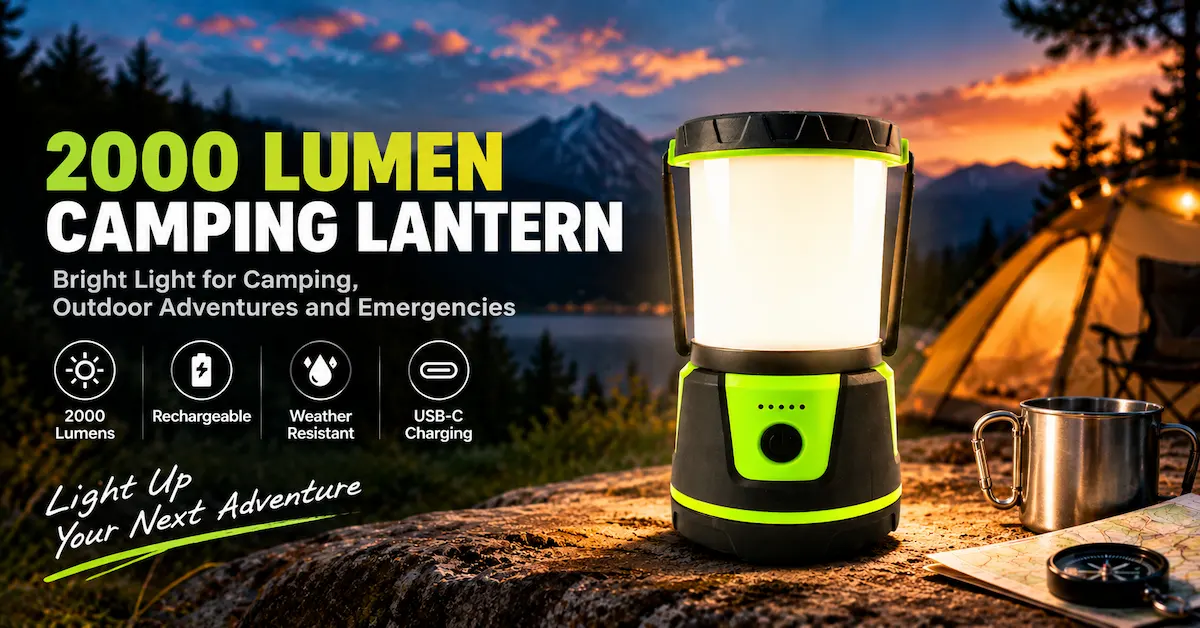
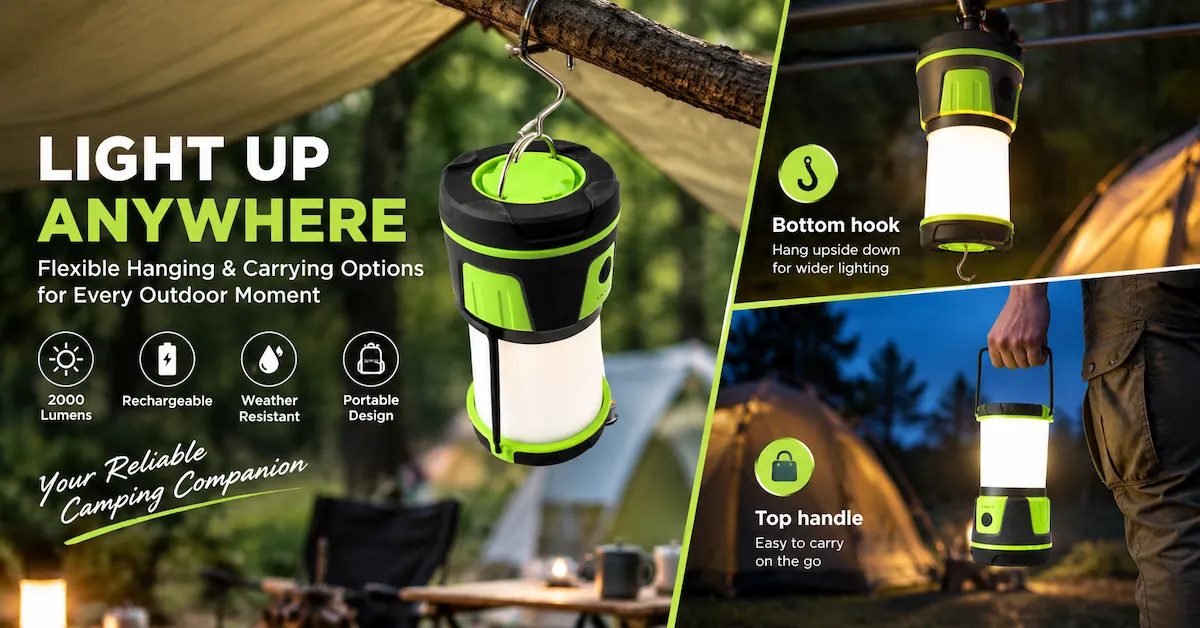
| BT-PL4031R 2000 lm camping lantern | COB area light; 3 × 2200mAh cells; white/red modes; dimming; power bank; IP44 claimed | Complementary tent or campsite area-lighting product, not a flashlight | Verify area-light runtime, diffusion, hanging stability and battery documents |
The distinction between 55g pocket carry and a 340g high-output body matters during a multi-hour outdoor activity. The BT-FL8101 may be more appropriate as a car-camping premium item than as a minimal backpacking torch. Similarly, an IP67 catalog declaration should be supported by an applicable report for the actual design, and it does not make the flashlight appropriate for arbitrary underwater use.
4. Which Brightenlux Models Fit an OEM Camping Assortment?
500-Lumen SST20 Dual-Power Pocket Flashlight
The official listing describes a 55g body, adjustable focus, integrated 900mAh rechargeable cell and AA battery support. Test the power-change procedure and keep water-resistance claims conservative until a report is available.
View Official 500-Lumen Flashlight →BT-FL8104 | 1000-Lumen Twist-Focus Flashlight
An included 18650 battery, AAA alternative, USB-C charging, adjustable beam, indicator and power-bank description make this a useful candidate for family car camping. Confirm the exact tested configuration.
View Official 1000-Lumen Model →1500-Lumen USB-C / Power-Bank Flashlight
Published 18650 or four-AAA architecture, C-to-C charging, adjustable focus and device-charging output. Useful for an outdoor retail tier where emergency flexibility is a priority.
View Official 1500-Lumen Dual-Power Model →BT-FL8088 | 1500-Lumen SST40 Magnetic Tail
The 21700 cell, magnetic tail and included headstrap provide several carry or mounting approaches. Check actual usefulness on a campsite, where compatible steel surfaces are not guaranteed.
View Official Magnetic Model →BT-FL8101 | 3000-Lumen Zoom and Power Bank
The catalog describes a 26650 cell or six-AA supply, USB-C charging, battery status indicator and power-bank function. Position as a larger multipurpose torch, not a minimal hiking accessory.
View Official 3000-Lumen Model →BT-PL4031R | 2000-Lumen Rechargeable Camping Lantern
COB illumination, white/red modes, dimming, listed power-bank capability and an IP44 claim make this a cross-sell for campsites requiring broad stationary light.
View Official Rechargeable Lantern →An assortment should have a reason for each product to exist. For an opening private-label program, an importer could evaluate three roles: lightweight pocket light, general-purpose dual-power flashlight and a separate area lantern. A larger premium power-bank flashlight can be added when retail demand and packaging economics justify it. This is a product-range planning suggestion, not a claim about Brightenlux's prescribed assortment or current inventory availability.
5. Rechargeable Flashlight vs Camping Lantern: Do Not Sell Them as Substitutes
One of the most useful distinctions a camping-lighting supplier can explain is the difference between directional and area lighting. A flashlight uses a beam to help the user see a particular place: a trail, the inside of a bag, a wheel, or the entrance to a campsite. A lantern distributes light around a table or tent. Even an adjustable-zoom torch may produce glare, strong shadows or inconvenient orientation when used as the only stationary area light.
For the buyer, this supports complementary merchandising rather than a confused claim that a single torch replaces a complete campsite lighting setup. A family car-camping bundle might include a rechargeable handheld light for moving around and an area lantern for eating, organizing gear or playing games. Backpackers have different weight constraints and may prefer a small headlamp plus a compact torch; there is no universal product combination.
Brightenlux lists a 1000-lumen rechargeable camping lantern with a 4000mAh battery and power-bank function as well as the 2000-lumen BT-PL4031R. These are useful for comparing camping area-lighting architectures, although actual modes, batteries, measured brightness and bundle compatibility must be specified at SKU level.
A product page should explain what each type does well, rather than stacking keywords such as “camping torch, lantern, emergency lamp, professional rescue light” onto one item. A dedicated category page for Brightenlux camping lights can help readers move from directional flashlight requirements into area-lighting options without losing their buying context.
6. Evaluate Useful Beam Performance, Not Only Headline Lumens
Camping customers use light at different distances: under one meter while searching a bag, a few meters around a tent, and farther along a path. A flashlight can deliver a strong center spot but little light at the edges, leaving a user repeatedly sweeping the beam to understand the ground. A broader beam may be more comfortable for campsite chores even with a lower peak rating.
When testing samples, photograph the beam at fixed positions and camera exposure. Mark practical use distances and compare center intensity, spill, dark rings and glare. If a model has adjustable focus, operate the zoom repeatedly and verify that it holds its selected position after handling. The advertised beam distance may be useful for comparison, but it is not a guarantee of human recognition at that distance.
Specify the purpose of each mode. Low can support map reading or tent tasks while saving energy; medium may be the normal trail-setting benchmark; high serves temporary additional visibility; and strobe may be reserved for specific signaling needs. A difficult switch sequence that forces users through flashing modes during routine operation can frustrate buyers, especially around children and shared campsite spaces.
For a technical RFQ, request output-versus-time records with battery state, ambient conditions and selected mode identified. The ANSI/PLATO FL 1-2025 portable-light performance standard offers a relevant framework for consistent output, runtime, beam-distance and related reporting; the fact that the standard exists does not establish compliance or certification for any Brightenlux model. A brand should approve only claims supported by its exact production configuration.
Buyers should also check color quality and comfort. A cool, high-intensity beam may give a dramatic marketing image without providing the most pleasant conditions for cooking or reading. If color identification matters, request data on the actual LED color temperature and color-rendering characteristics rather than assuming all white LEDs are equivalent. A more useful beam can become a convincing product distinction for an outdoor retailer even where the lumen figure stays unchanged.
7. Rechargeable Batteries and Backup Power: The Key Camping Trade-Off
Rechargeable convenience is attractive when campers have a vehicle socket, power station or other planned charging access. It reduces dependency on frequent disposable battery purchases and can support additional functions such as power-bank output. But the more remote the trip, the more important the charging strategy becomes. “USB-C rechargeable” by itself is not a plan for three nights without power.
The verified Brightenlux models demonstrate several architectures. The compact 500-lumen product describes a built-in 900mAh rechargeable battery plus AA capability. BT-FL8104 lists a 2200mAh 18650 or three AAA cells. The 1500-lumen power-bank model lists a 2600mAh 18650 or four AAA cells. BT-FL8101 lists a 4000mAh 26650 or six AA cells. These are not interchangeable platforms; cell dimensions, voltage behavior, adapters, housing size and user instructions all differ.
Ask the supplier to demonstrate each supported power configuration. Does the alternate battery fit directly, or is a carrier required? Is the carrier included? Does output or mode availability change when disposable cells are used? Can the charging interface ever attempt to recharge a disposable cell, or is that electronically and physically prevented? These questions belong in the sample-approval process, especially when consumer-facing packaging promotes emergency backup.
Capacity in mAh should not be presented as a universal runtime. Voltage, discharge conditions, electronic efficiency and mode selection also affect useful operating time. Buyers may compare cell energy in watt-hours when nominal voltage is established, but should still prioritize measured output-versus-time records. A 4000mAh figure does not mean a flashlight will run twice as long as a 2000mAh product if its LED drive and operating mode are different.
For storage and safety, request clear instructions on charging before a trip, suitable temperature range, inspection for damage, periodic battery checks and proper handling. Do not assume a lithium-powered emergency light can remain unused for years and be fully ready without maintenance. The correct care schedule should come from the approved cell and finished-product documentation rather than a generic statement in a sales brochure.
8. USB-C, Charging Indicators and Power-Bank Features Need Real Testing
USB Type-C is a helpful common interface, but the connector shape does not prove support for every cable or charger. A flashlight may work with a USB-A-to-C cable while behaving differently with a USB-C-to-C lead or a charger that expects particular USB-C signaling. If the retail package says “USB-C rechargeable,” define the compatible source and cable conditions; if it says “C-to-C charging,” test the actual shipped circuit accordingly.
At sample stage, confirm charging starts reliably from a low battery, terminates as intended and displays appropriate indicators. Check what the indicator shows if a cable is disconnected and reconnected. Inspect a twist-out port mechanism for wear, interference and correct closing. If an ingress-protection claim depends on closing a charge port, the manual and product graphics must make that limitation understandable.
Power-bank capability adds a different purchase decision. The BT-FL8104, the 1500-lumen dual-power model, BT-FL8101 and the camping lantern products advertise device-charging functions. A responsible importer should test the output port, cable orientation, compatible recipient devices, discharge protection and battery left for illumination after charging another device. A power-bank badge on a box is not enough to establish how many phone charges a customer should expect.
Ask the supplier to state charging and output energy specifications, permitted operating conditions and any relevant restrictions. Test the flashlight while its power-bank feature is active only if simultaneous use is explicitly supported. If the product must stop illumination or restrict output during charging for safety, that may be a sensible design decision—but it must be accurately communicated.
In consumer support, many apparently defective rechargeable products turn out to have unclear cable expectations, difficult-to-find charge ports or missing batteries. The operating guide should specify battery-included status, approved power source, indicator meanings, charge-port operation and what to do if a deeply discharged light does not start immediately. Clear instructions can be as valuable as one additional lighting mode.
9. Weather Resistance, Dust and Durability: Read IP Ratings Carefully
Camping involves damp grass, packed equipment, rain, dust and accidental impacts. That does not mean every camping torch needs the same protection level, but the rating must match realistic use. The official Brightenlux listings describe IPX4 for the BT-FL8088, IP67 for BT-FL8104 and BT-FL8101, and IP44 for the BT-PL4031R lantern. The compact 500-lumen page describes splash resistance without presenting the same explicit IP number in its descriptive content.
IP classifications relate to defined test conditions for the assembled enclosure. IPX4 addresses water splashing without declaring a dust digit, IP44 includes a solid-object protection digit and a water-splash protection digit, and IP67 refers to dust-tight construction and temporary immersion under specified conditions. None means that every chemical exposure, drop, prolonged underwater use or improper charging-port position is covered.
For private-label approval, request a test report linked to the model and hardware revision the supplier intends to ship. If a battery door, zoom head, gasket, lens or USB-C closure is changed, ask whether the previous test still represents the new design. A buyer should not copy an IP icon from one product page onto another without configuration-specific evidence.
Mechanical testing should fit the customer. Check switch access while wearing gloves, grip after damp handling, threads and battery closure after repeated use, and any clip, strap or magnet attachment. A field trial in ordinary campsite conditions can expose a design weakness that is not apparent on a clean desk. Where higher-level drop or environmental claims are essential to a retail contract, agree in advance on the test method and acceptable outcome.
Environmental durability is also a marketing discipline. “Weather-resistant when the charging port is correctly closed” is clearer than “fully waterproof in all conditions.” Transparent wording reduces avoidable returns and helps the distributor defend its claims during retailer review.
10. Carry Comfort, Light Modes, Storage and Responsible Use
A product can meet electrical specifications and still frustrate customers. Hiking users notice mass and grip before they notice the LED model. A 55g pocket flashlight and a 340g large-body flashlight should not be advertised to the same customer without explaining their different carry roles. Test whether the torch fits a glove compartment, side pocket, daypack loop or included holster. Confirm that the switch is reachable while wearing the gloves typical of the target market.
Control logic is a frequent source of customer feedback. Ask whether the light remembers the last mode, whether it can start directly in a low setting, and whether accidental strobe activation is likely. Test a dark-adapted user entering a tent: a bright initial flash can be intrusive even if it produces an impressive lumen number. Not every buyer needs the same setting, but each should know what the approved interface actually does.
Battery storage and user safety belong in the documentation. Explain that damaged or swollen batteries should not be used and that charging instructions must be followed. Avoid implying that a flashlight is appropriate for hazardous explosive atmospheres without matching approvals. Similarly, a strobe mode is not automatically a recognized safety or rescue signaling system.
Include the human consequences in the purchasing scorecard: can a customer understand the basic controls without opening the manual; can the product be safely packed after use; are spare batteries, accessories and charging cables easy to identify? These practical questions often distinguish a high-retention outdoor product from a commodity catalog item.
11. OEM/ODM Development: From Camping Use Case to Approved Product
Brightenlux describes OEM/ODM work and a broader portable-lighting manufacturing business. The scope of a particular custom order still needs direct confirmation. Logo printing on an existing flashlight is not the same technical project as changing a charging board, LED, battery carrier or enclosure. Buyers should choose the smallest level of modification that produces a meaningful market difference.
Step 1: Build a User-Centered Brief
Specify the camper profile, typical trip length, charging access, required carry weight, target selling price, sales geography and expected order volume. Identify mandatory features separately from optional ones. For example, a two-day trail kit may require compact mass and low-mode endurance; a family car-camping flashlight may prioritize dual power and a wider beam. Include what the product must not imply, such as unsupported submersion or emergency-service certifications.
Step 2: Select an Existing Platform Before Commissioning New Tooling
Request samples of one or two relevant catalog models. Compare the 500-lumen compact product with BT-FL8104 for a basic rechargeable range; compare the 1500-lumen dual-power model with BT-FL8101 for a power-bank-focused tier. Do not ask for a new mold simply to reproduce a feature already available in an approved platform. If a custom part is genuinely necessary, ask what changes to testing and tooling it creates.
Step 3: Freeze Performance and Packaging Together
Record the LED and optics, driver and modes, battery model, charging interface, housing and seals, clip or lanyard, accessories, logo, artwork, manuals and labeling. Define the test procedure for every headline claim. A golden sample and a controlled bill of materials prevent a later batch from quietly shipping with a different battery, driver or lens that changes performance.
Step 4: Pilot, Inspect and Sign Off the Commercial Shipment
Where risk and quantity justify it, use a pre-production build to verify assembly consistency and retail pack-out. Agree which tests are performed on every unit and which are sampled. Review the approved shipping documentation before cartons are sealed. Require written communication and re-approval if critical components change.
For broader background, Brightenlux's rechargeable flashlight manufacturer guide describes the general sourcing considerations. This article narrows that framework to camping-specific battery resilience, carry use and range design; both should lead into a model-specific quotation rather than assuming universal factory options.
12. Camping Flashlight Sample Testing and Quality-Control Checklist
An importer's purchasing team can begin with the following matrix. These are recommended buyer checks, not assertions that Brightenlux currently performs every named test. Set numerical limits and inspection sample sizes according to the product, retailer contract and agreed risk level. Ask for photographs and records tied to the approved sample revision.
| Area | Suggested Approval Test | Evidence or Acceptance Question |
|---|---|---|
| Usable beam | Compare spot and flood at fixed distances under constant camera exposure | Is the beam appropriate for path and close campsite tasks? |
| Output over time | Run low, medium and high modes on approved batteries | What is the measured curve, step-down and end criterion? |
| Backup battery | Install every advertised disposable-cell configuration | Is the carrier included, polarity clear and safe behavior confirmed? |
| USB-C charging | Check common A-to-C and C-to-C combinations where relevant | Does the charge indicator and termination behave as specified? |
| Power bank | Supply a defined phone or test load and observe remaining light energy | Are output ratings and limitations accurately stated? |
| Ingress protection | Use the test method relevant to the claimed IP rating | Does the report match the current charging-port and seal revision? |
| Human factors | Operate with gloves and normal accessories in representative camp tasks | Is the switch intuitive and carrying comfortable? |
| Packaging and batch | Compare shipped carton against signed artwork and BOM | Are batteries, adapters, cables, manuals and labels correct? |
A test that simply checks whether a flashlight turns on does not establish its runtime, charger compatibility or IP rating. Likewise, a satisfactory pre-production sample does not prove every production unit is identical. The inspection plan should address variation, component substitutions and packaging count. Keep photographs of the approved battery, connectors and accessories in the production file so a reorder can be compared against evidence rather than memory.
13. What Compliance and Lithium-Battery Documents Should Importers Request?
Product compliance cannot be reduced to a list of impressive logos. Requirements depend on the sales country, actual electrical design, battery, packaging, and customer channel. Brightenlux's company material discusses international business and relevant quality or compliance activities, but it does not establish that every flashlight carries every declaration or laboratory report a destination market might require.
For portable-light performance, ANSI/PLATO FL 1-2025 provides recognized test-and-report concepts. For enclosure ingress protection, IEC 60529 is relevant to the IP rating. For portable lithium battery safety, appropriate cell and battery standards may apply depending on design and market. A retailer may also require its own chemical, labeling, packaging or performance records. Request a document list specific to the current SKU rather than borrowing reports from another product.
Rechargeable flashlights containing or packed with lithium cells are subject to applicable transport rules. The UN Manual of Tests and Criteria, subsection 38.3, is relevant to battery transport testing. IATA's lithium-battery guidance and the latest applicable dangerous-goods provisions should be checked with the logistics provider for air shipments. Availability of an appropriate test summary matters, but it does not follow that a paper copy must physically accompany every shipment in every circumstance.
Ask the supplier to match the battery model, cell identity, test summary, package configuration and shipping declaration to the ordered product. Distinguish cells inside equipment from cells packed separately. If an OEM change substitutes a cell or changes the pack configuration, have the transport specialist review the documentation before shipment arrangements are finalized.
For private-label buyers, packaging needs a final review for battery-included status, safe charging instructions, country-specific labeling and claims. Avoid statements such as “certified waterproof,” “ten hours at full power” or “charges a phone twice” unless a suitable document or test result supports that exact version and condition.
14. Wholesale Price, MOQ and the Economics of a Camping Lighting Range
There is no honest universal MOQ or unit price for a customized rechargeable camping flashlight. A standard catalog version, logo-printed model, altered battery pack and new enclosure each create different purchasing economics. Brightenlux's general OEM capability is not a substitute for a model-specific written quotation. Ask for unit prices at realistic quantity tiers, sample fees, artwork costs, tooling charges where applicable, and a delivery timeline that includes component procurement and inspection.
Normalize quotations before comparing them. A flashlight without its rechargeable cell is not financially equivalent to one with a verified cell included. Likewise, a dual-power product can be mispriced if its dry-battery carrier, cable or strap is omitted from the quote. Use one component and packaging matrix so each supplier responds to the same requirements.
The meaningful financial measure is landed cost per saleable unit, taking into account product price, accessories, inspections, shipping, duties and a reasonable plan for defects and returns. Customer service costs also rise when the charging instructions or backup-battery method are confusing. Spending modestly on a clearer user guide or better sample approval may be commercially wiser than adding another rarely used lighting mode.
Range architecture deserves the same discipline. For a new outdoor private label, three distinct roles may be easier to stock than five overlapping lumen variants: a compact lightweight product, a dual-power core model, and a complementary lantern. Add a premium power-bank flashlight only where target customers want it and the higher battery and freight costs are justified.
A launch plan should also account for shelf photography and search descriptions. Feature comparisons such as “55g pocket carry” or “includes a 21700 cell and magnetic tail” are more specific than generic claims of “best camping light.” Use those details only for the exact SKU where they are published and confirm the final configuration before printing or uploading retailer data.
15. Copy-Ready RFQ Checklist for a Rechargeable Camping Flashlight Supplier
Send the same structured request to shortlisted suppliers. Ask them to mark each requirement standard, available with modification, requires development, or not available. This reduces quotation rounds and makes an OEM discussion more productive.
- Buyer and destination: company, target country, retail channel, first order, estimated annual demand and launch schedule.
- Camping user job: trail navigation, family campsite, hiking pack, emergency storage or vehicle kit.
- Reference models: select a published Brightenlux 500, 1000, 1500 or 3000-lumen flashlight and identify a lantern only if area lighting is needed.
- Light performance: usable beam spread, output by mode, measured runtime, preferred switch logic and required thermal behavior.
- Power system: exact rechargeable cell, included status, optional AA/AAA carrier, safe power switching and charging requirements.
- USB-C and power bank: cable/input compatibility, charging indicator, output port, supported loads and manual language.
- Physical requirements: size, weight, IP rating, housing finish, clip, headstrap, lanyard, magnet and carry case if relevant.
- OEM/ODM scope: logo, box artwork, labeling, manuals, color, accessories and any requested electronics modification.
- Quality and compliance: approved golden sample, test reports, cell documents, inspection agreement and change-control rules.
- Commercial quote: MOQ by option, price tiers, sample fees, tooling, Incoterms, manufacturing milestones and shipment documents.
With this brief, a buyer can contact Brightenlux through its official inquiry page and ask for a concrete comparison of available configurations. Keep the quotation, approved drawings, inspection plan and artwork in one revision-controlled file for subsequent orders.
Source Camping-Ready Rechargeable Flashlights with Brightenlux
Describe your outdoor customer, preferred reference model, USB-C and backup-power expectations, branding, destination market and forecast order quantity. Request a model-specific sample plan, current specifications and OEM/wholesale quotation.
Request Your OEM Camping Flashlight Quote →16. Frequently Asked Questions for Camping Flashlight Wholesale Buyers
1. What should I look for in a rechargeable flashlight for camping supplier?
Look for suitable existing models, clear battery-included information, dependable USB-C behavior, practical beam modes, verified weather protection, and consistent production documents. A supplier should help you choose a product for the camping task, then demonstrate that the approved battery, driver, seals, packaging and accessories can be repeated in later orders.
2. Is a rechargeable flashlight or camping lantern better for a campsite?
They solve different problems. A flashlight directs light toward a trail, vehicle, bag or nearby obstacle. A lantern illuminates a wider stationary area such as a table or tent. Retailers may offer both in a coherent assortment rather than promise that one narrow-beam torch will perform every area-lighting task.
3. Which rechargeable flashlight is best for a lightweight camping kit?
A compact model with an appropriate low mode, easy carrying and a clear charging procedure is a sensible starting point. Brightenlux's 500-lumen SST20 flashlight is listed at 55g with integrated rechargeable and AA-power options. Sample testing should confirm its alternate-power method, runtime and real weather suitability before any retail claim.
4. Are 18650, 21700 and 26650 batteries interchangeable?
No. They are different cylindrical cell formats with distinct physical dimensions and potentially different approved product arrangements. A flashlight must be designed for its supported cells. Do not promote interchangeability or adapt a battery system without verifying electrical limits, physical fit, protection, charging and transport documentation.
5. Does USB-C mean every charger will work with the flashlight?
No. USB-C identifies a connector family, not every supported power-negotiation or cable behavior. Test the approved product with representative USB-A-to-C and USB-C-to-C setups as appropriate, and specify the compatible charger characteristics in the user guide. A product listing alone may not describe those details completely.
6. Can a dual-power flashlight recharge its disposable AA or AAA cells?
Disposable alkaline batteries must not be treated as rechargeable. Dual-power functionality means the product supports defined alternative supplies, not that every inserted cell can be charged. The exact architecture should prevent unsafe charging behavior and have clear manual instructions. Buyers must confirm the approved adapter and switching method for their chosen model.
7. How many lumens do campers need?
There is no universal target. Close-up tent work usually benefits from comfortable low output and useful flood distribution, while walking needs a stable medium beam and appropriate path visibility. Higher maximum output can help for occasional distance tasks but may increase heat, mass or drain. Evaluate beam and runtime under the actual user scenario.
8. Does an IP67 camping flashlight mean waterproof in every situation?
No. IP67 refers to defined dust and temporary immersion testing for a particular assembled product. It is not an assurance of indefinite underwater use, chemical resistance or unchanged protection with an open charge port. Ask for the test report matching the exact hardware revision and tell customers how to close all relevant seals.
9. What can be customized for a private-label camping flashlight?
Potential projects range from logo and retail packaging to accessories and technically feasible changes in modes, battery, optics or housing. Brightenlux advertises OEM/ODM capabilities, but availability and minimum quantity must be confirmed per model. More substantial changes require new samples, engineering review and sometimes renewed testing.
10. What is the normal MOQ for wholesale rechargeable camping flashlights?
No single MOQ can be responsibly inferred for every Brightenlux configuration. Standard items, branded cartons, custom colors and redesigned electronics may have different thresholds and costs. Ask for written pricing at the actual forecast quantity, with packaging, batteries and one-time tooling identified separately.
11. What battery documents should an importer request?
Request the approved cell specification and traceability, appropriate safety and transport evidence, and relevant UN 38.3 test-summary information as applicable. Shipping requirements also depend on whether cells are installed in equipment or packed separately. Confirm the final document set with the logistics provider and destination market.
12. How can a retailer reduce returns from rechargeable camping flashlights?
Approve the exact retail configuration through task-based testing, check charging and low-mode runtime, verify included batteries and adapters, keep labels consistent with results, and write clear setup instructions. Store golden-sample and BOM records so repeat orders do not silently change. Those controls protect brand trust more effectively than unsupported superlatives.
Conclusion
A dependable rechargeable flashlight for camping supplier should help outdoor brands solve specific user jobs, not simply sell more lumens. Trail lighting calls for a comfortable controlled beam; campsite tasks may need broader illumination or a separate lantern; emergency use needs a credible battery and charging plan. USB-C, power-bank output, magnetic mounting and dual-power operation can differentiate an assortment, but only when each feature is verified and properly explained.
Brightenlux's published rechargeable range provides several useful sourcing starting points, from a 55g 500-lumen pocket model to dual-power 1000- and 1500-lumen flashlights, a magnetic 21700 platform and a larger 3000-lumen model. The company's rechargeable lanterns can complement—not replace—handheld products for stationary area lighting. Choose the platform that matches your customer, request sample evidence, freeze the specification and prepare market-appropriate labels and battery shipping documents.
If you are building a private-label camping-lighting range or comparing wholesale offers, contact Brightenlux to discuss rechargeable camping flashlight OEM sourcing. Share your intended user, target price tier, preferred power system, packaging needs, destination country and expected quantity. A specific brief is the shortest route to a meaningful sample evaluation and a quotation you can compare.