

Outdoor Lighting Manufacturer Guide for Roadway Projects
An outdoor lighting manufacturer is often contacted when a project team needs a road to be brighter at night. In reality, roadway lighting is not only a brightness question. It affects driver reaction, pedestrian comfort, lane orientation, and how clearly a corridor can be understood after dark. A fixture may turn on and still leave the road feeling uneven, harsh, or underlit. For municipal buyers, engineers, contractors, and developers, the better question is whether the complete lighting system fits the road type, pole arrangement, surrounding environment, and long-term maintenance needs.
Roadway Lighting Is a System, Not a Fixture Purchase
Outdoor roadway lighting should be evaluated as a coordinated infrastructure system. A streetlight head is only one part of the result. Pole height, cantilever arm projection, mounting position, spacing, and the road geometry all influence how light reaches lanes, sidewalks, medians, and turning zones. If one element is unsuitable, the corridor can develop dark gaps or overly concentrated bright areas.
This is why buyers usually need more than a fixture quotation. They need a supplier conversation that covers layout, structure, maintenance access, and visual consistency. For project teams comparing options, it is useful to review available outdoor lighting categories first, then request a system-based proposal through Brightenlux products or a direct project inquiry.
What the Roadway Layout Reveals
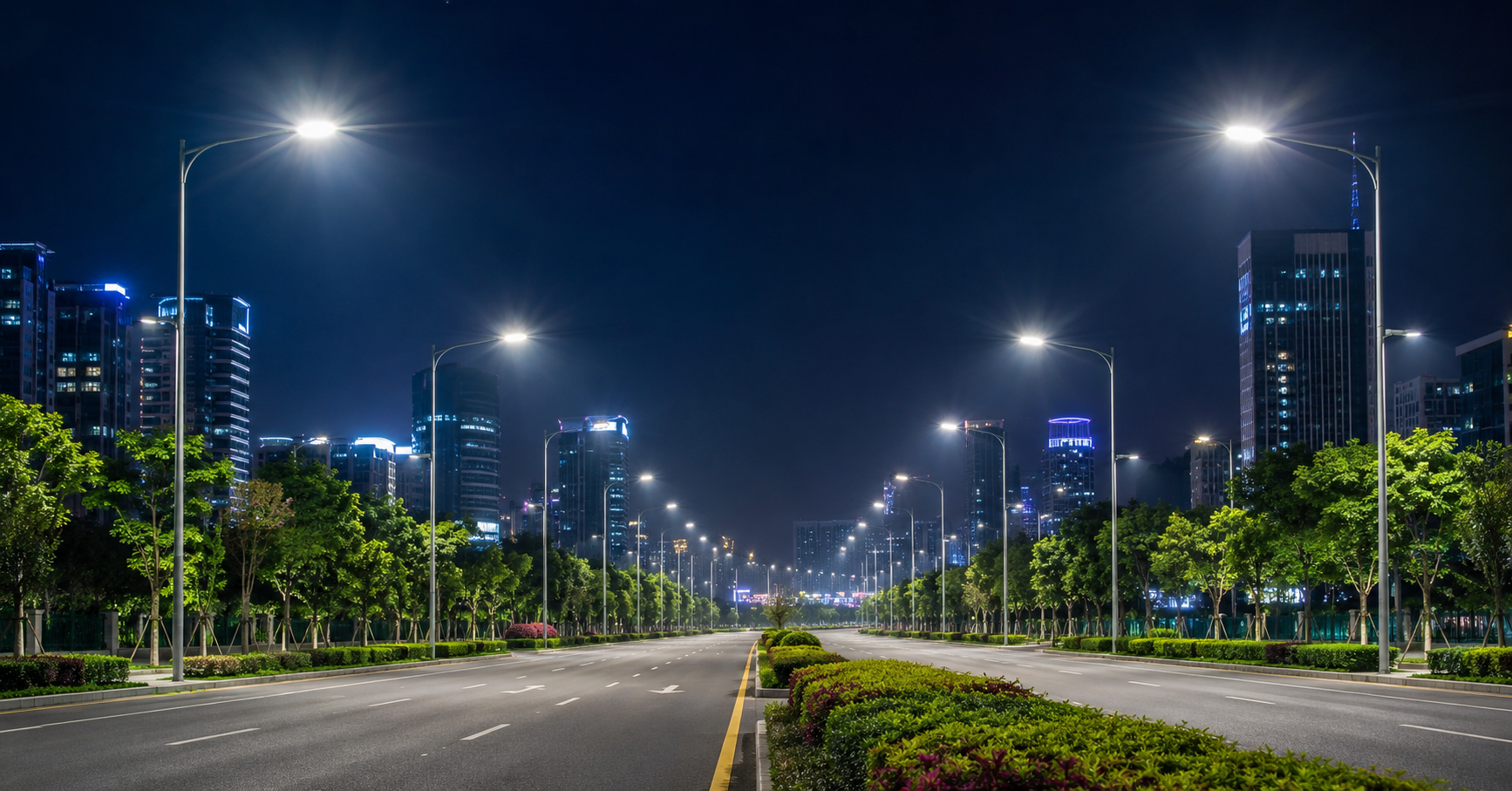
The source installation shows a municipal or commercial outdoor street lighting system for a multi-lane urban roadway or avenue. The layout includes tall single-pole streetlight posts with curved cantilever arms extending over the carriageway. Lamp heads are mounted at the ends of the arms, and the poles are arranged along both sides of the boulevard and near the central median.
This type of symmetrical corridor layout is common where continuous illumination is required instead of isolated pools of light. For sourcing teams, the key message is clear: the fixture alone does not define the project outcome. Pole geometry, arm reach, and spacing must work together to support the intended lighting coverage across the full road section.
Why Uniform Pole Spacing Matters
Uniform pole spacing may sound simple, but it often separates a polished roadway project from one that feels improvised. When poles are evenly arranged along both sides of a boulevard, drivers experience a more consistent visual rhythm. This helps orientation through long corridors, particularly on arterial streets, business districts, campus roads, industrial parks, and planned developments.
Symmetry also signals that the project is intended for continuous roadway illumination rather than decorative accent lighting. Buyers should ask whether the selected streetlight family, pole dimension, and arm shape can maintain that consistency without creating glare or leaving darker gaps between fixtures. The best result comes from a layout that supports visibility and visual balance at the same time.
LED Street Lighting: Useful, but Confirm the Specification
The image suggests modern LED streetlights because the lamp heads appear compact and the light output appears bright white. That is a reasonable industry inference, but it should remain an inference unless confirmed by project documentation. Outdoor infrastructure can be visually misleading, and similar housing shapes may be used across different lamp technologies.
If the fixtures are LED, typical advantages include directional control, lower maintenance frequency compared with older lamp types, and easier integration into strategies that prioritize uniformity. However, procurement teams should not assume smart-control readiness, solar compatibility, sensor integration, wattage, lumen output, color temperature, or IP rating from appearance alone. An experienced LED outdoor lighting manufacturer should clearly separate confirmed specifications from optional features.
Key Selection Criteria for Roadway Projects
When evaluating an outdoor light manufacturer, the conversation should move beyond the lamp head. The system must suit the roadway width, pole arrangement, maintenance approach, and environmental exposure. A clean modern appearance is useful, but it is not a substitute for documented specifications.
| Criteria | What buyers should confirm |
|---|---|
| Coverage pattern | Whether light reaches lanes, sidewalks, and median areas without hard edges. |
| Pole geometry | Whether pole height and arm projection match the required road area. |
| Visual consistency | Whether the corridor keeps a steady rhythm near intersections and breaks. |
| Maintenance access | Whether service can be performed without unnecessary traffic disruption. |
| Outdoor finish | Whether material and finish are documented for the site environment. |
The poles appear to be metal, likely steel or aluminum, with a smooth light gray, galvanized, or painted finish. The exact coating, grade, or corrosion protection cannot be verified from the image alone, so buyers should request written material specifications.
Problems a Roadway Lighting System Should Solve
A roadway lighting project is designed to solve several needs at once. The most visible goal is improved vehicle visibility at night. However, the system should also help pedestrians and cyclists understand the street environment, support recognition of crossing areas, and keep turning points and medians legible after dark.
There is also an urban design benefit. On a boulevard or avenue, a balanced lighting corridor can make the public realm feel intentional and complete. This matters for municipal renewal, commercial frontage, and development projects where nighttime appearance affects user confidence. In these settings, outdoor lighting is not only a utility. It becomes part of the streetscape identity and the experience of moving through the corridor.
Common Procurement Mistakes to Avoid
One common mistake is treating roadway lighting as a fixture-only purchase. A lamp head may look suitable in isolation but still fail if pole spacing is too wide, arm projection is mismatched, or beam distribution does not suit the road width. The result may be darker zones near medians, curb edges, or lane transitions.
Another mistake is judging mainly by appearance. Bright white light and smooth poles can create a strong first impression, but performance across the full road section matters more. Buyers should also avoid assuming unconfirmed details such as LED technology, smart controls, solar integration, pole height, arm length, wattage, color temperature, or rating. These details should be requested early, preferably before product selection becomes focused on visuals alone.
How to Evaluate a Roadway Lighting Supplier
The best supplier for this type of project is not necessarily the one with the largest catalog. It is the manufacturer that can translate a roadway requirement into a coherent system proposal. That means discussing pole options, mounting configuration, fixture selection, finish choices, expected coverage behavior, and maintenance planning without relying on vague marketing claims.
Project teams should request the complete outdoor lighting package rather than the streetlight head alone. The package should identify the pole, arm, fixture, and relevant installation details. If a project involves a boulevard, avenue, campus road, industrial park, or business district, buyers can share requirements through Brightenlux inquiry or contact the team through Brightenlux contact for further discussion.
FAQ for Roadway and Streetscape Buyers
Is every modern streetlight automatically LED?
No. Many contemporary streetlights use LED technology, and compact lamp heads with bright white output may suggest LED use. However, appearance alone is not proof. Procurement teams should confirm lamp type, electrical specification, and any optional functions in writing before approving the roadway lighting package.
Why are poles used on both sides of a boulevard?
Dual-sided pole alignment helps create more continuous illumination across a wider roadway corridor. It can improve visual balance, support driver orientation, and reduce the feeling of isolated bright and dark zones. The final result still depends on pole height, arm projection, fixture distribution, and spacing.
Can this type of lighting system work outside city roads?
Yes. Similar outdoor street lighting systems can be used in campuses, industrial parks, business districts, planned developments, and other large road corridors. The layout should always be adapted to the lane count, pedestrian areas, access needs, and surrounding site conditions instead of copied without review.
What should buyers ask an outdoor lighting manufacturer first?
Start by asking for a complete system proposal, not only a fixture photo or lamp head price. Confirm pole dimensions, arm arrangement, fixture type, finish, maintenance access, and any assumptions about LED technology, controls, or solar integration before moving toward approval.