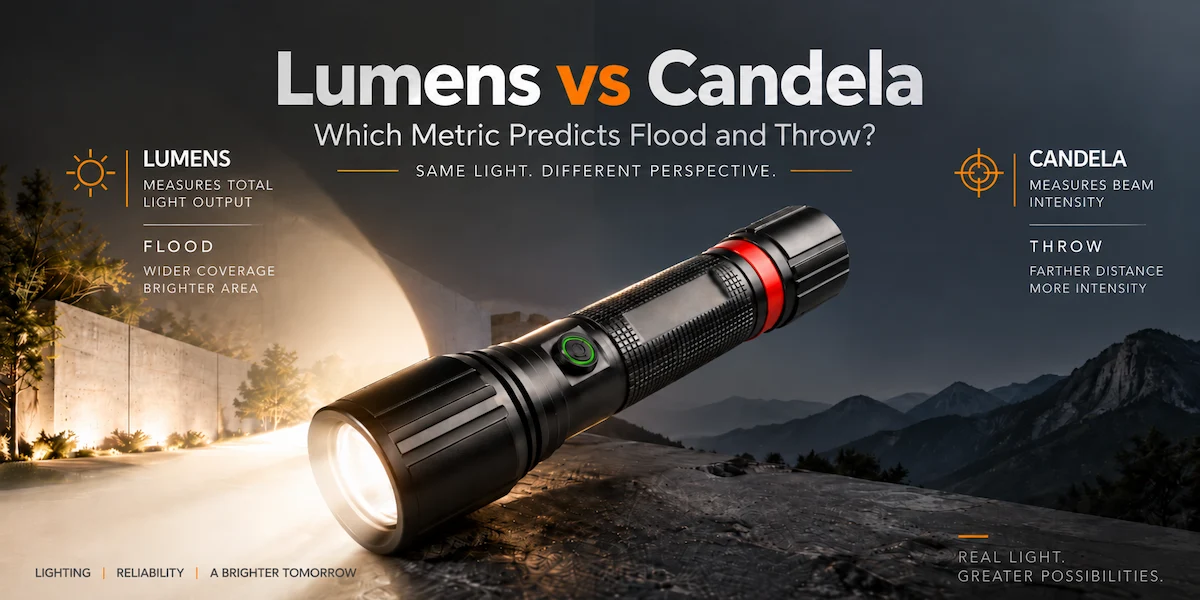


Quick answer for buyers: An emergency flashlight for power outage supplier should help importers build a layered kit: an accessible handheld flashlight for moving around, a lantern for room-wide illumination, a headlamp for hands-free tasks, and an independent battery or charging backup. Evaluate whether each product starts reliably after storage, how long it provides useful light on a specified mode, how alternate cells work, and whether the approved components can be repeated in bulk production. Brightenlux publishes examples of these product formats, but each catalog rating should be verified against the actual OEM sample.
When the electricity stops working, the most valuable flashlight is not necessarily the one with the highest brightness setting. It is the light that a household can find immediately, operate without confusion, and keep running long enough to move safely, inspect a problem, or wait for the power to return. That reality changes how an importer should evaluate an emergency flashlight for power outage supplier. A product can appear impressive on a retail card and still be a poor backup tool if its battery has been neglected, its charging interface is hard to use, or its brightest mode empties the cell much faster than customers expect.
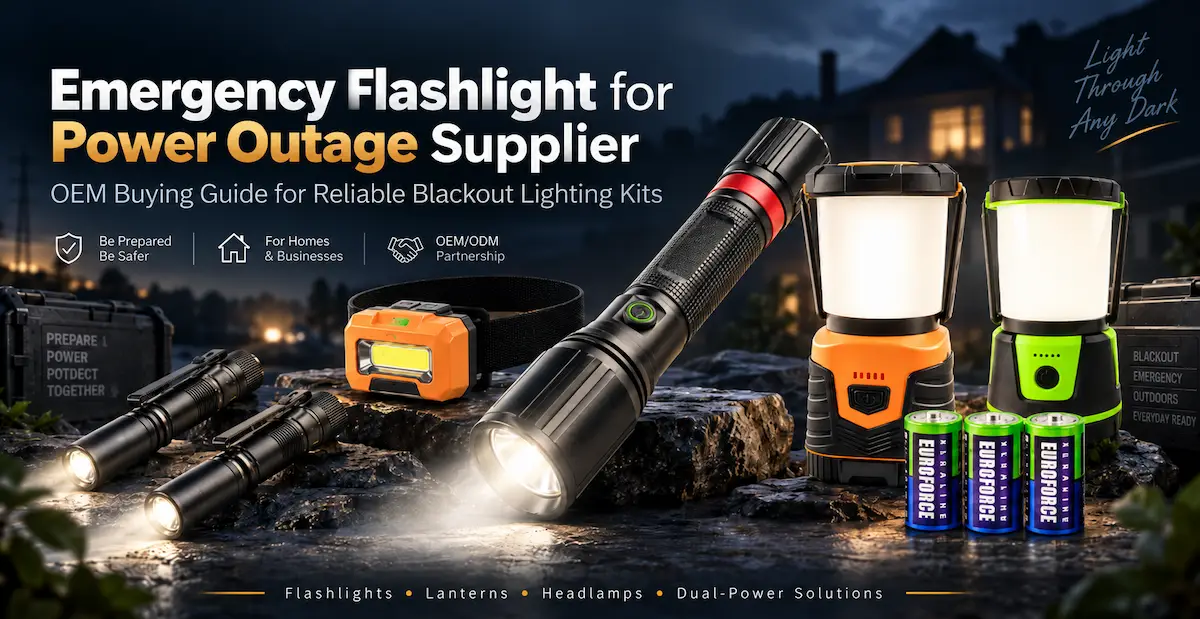
Brightenlux, the outdoor lighting business of Ningbo Brightenlux Electric Appliance Co., Ltd., publishes rechargeable and dual-power flashlights, battery-operated lanterns, rechargeable camping lanterns, and hybrid-power headlamps. These families provide useful starting points for a blackout-focused OEM range. The company describes lighting manufacturing and OEM/ODM support on its official company page. That establishes a credible product context, but not the MOQ, stock availability, quality results or certifications of a particular new private-label order.
This sourcing guide is written for overseas hardware distributors, preparedness-kit brands, importers, retail chains and institutional procurement teams. It does not present fictional laboratory tests or invent past customers. Instead, it connects published Brightenlux model information with a buyer-controlled method for choosing, testing, packing and reordering dependable emergency lights. The central question is practical: what will remain useful when charging access, working visibility and customer patience are limited?
1. Why a Power-Outage Flashlight Is Different from an Everyday Torch
A light used every night provides frequent feedback. If the battery is low, the user discovers it during normal operation and can recharge it. A blackout flashlight might sit in a drawer for months. Its first important test happens when the home is already dark. That makes readiness after storage, intuitive operation and a realistic energy plan especially important. A product with a large lumen figure but no clear standby-maintenance instructions can create false confidence.
An outage also produces several lighting tasks. People need a narrow or moderately broad beam to find doorways, medication, supplies or pets. They may need a stationary light for a kitchen table or a shared room. Someone checking an accessible utility space or carrying water may require two free hands. These needs favor a combination of flashlight, lantern and headlamp over a single oversized torch advertised as suitable for every emergency.
For B2B buyers, the consequences extend into product positioning and returns. A hardware-store customer may expect AA or AAA backup cells to work immediately. A preparedness retailer may advertise a particular low-mode runtime. A municipal or institutional customer may demand stable reorder specifications and precise kit inventories. The supplier must therefore make battery format, included accessories, operating instructions, tested limits and component changes explicit.
Emergency flashlights are not replacements for code-compliant building emergency illumination, exit signs, medically necessary backup power, or certified hazardous-location equipment. Those are different requirements. Position ordinary portable lights honestly as supplemental household, vehicle or utility lighting, and obtain separate professional advice where a regulated application is involved.
2. Build a Four-Layer Blackout Lighting Kit Rather Than Relying on One Product
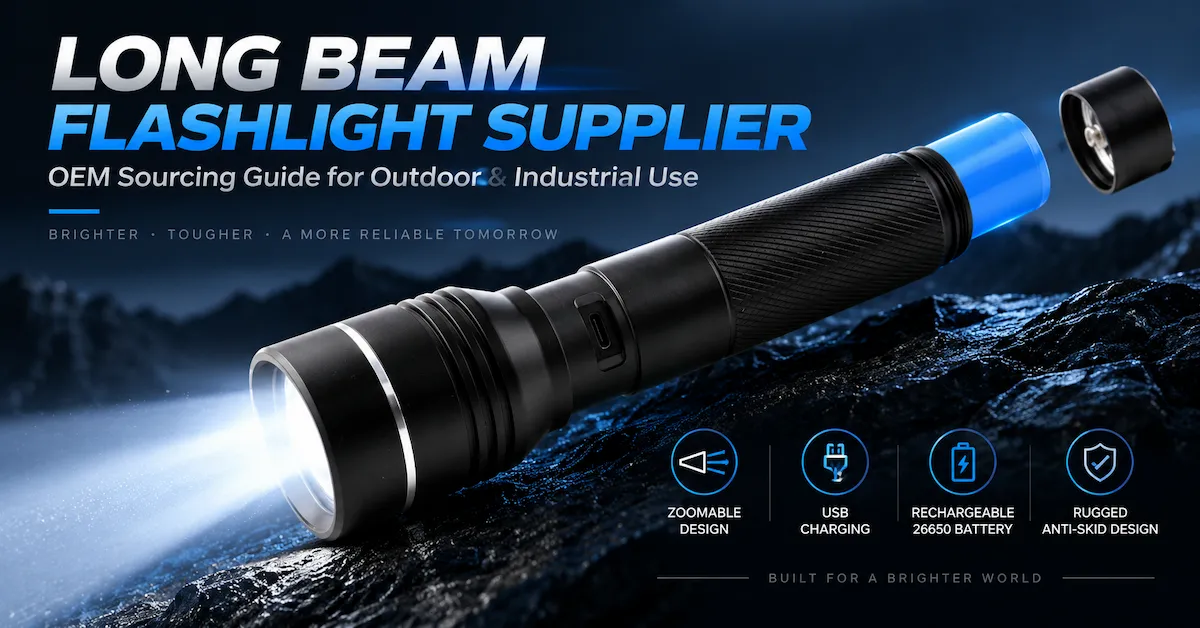
Layer one: a familiar handheld flashlight. The first light should be easy to locate and operate without reading a manual. A low setting can be useful for navigating a home, while a brighter mode helps illuminate a more distant area temporarily. Smaller size, comfortable grip and straightforward battery instructions may be more important here than extreme beam reach. This is often the most logical core SKU for a mass-market emergency kit.
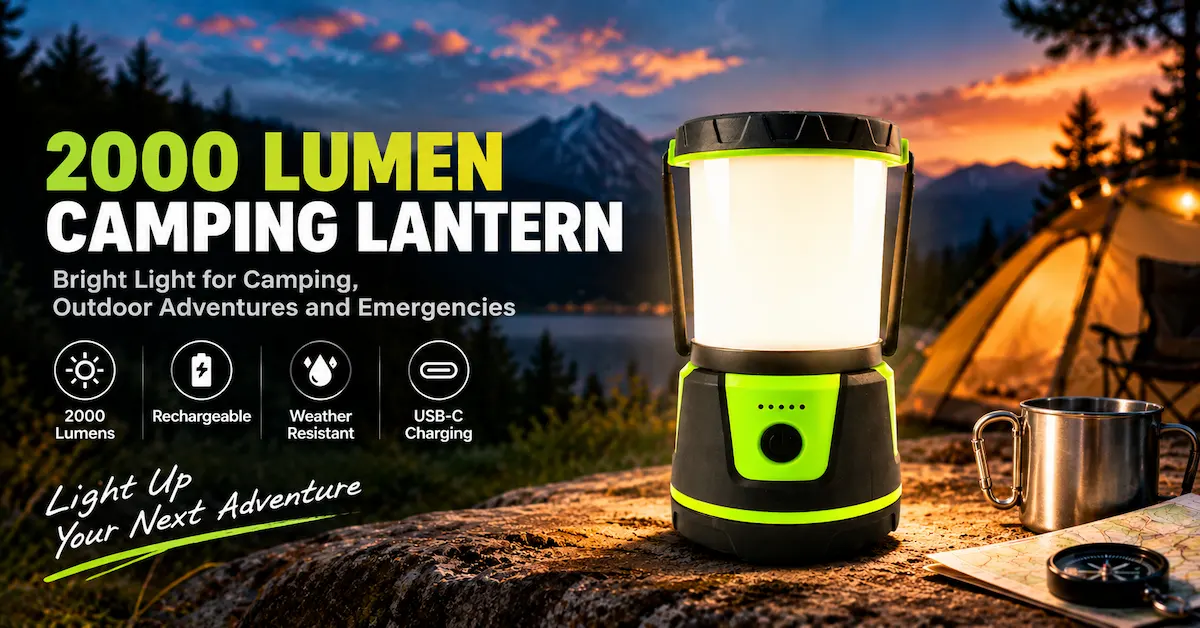
Layer two: a diffused lantern for shared rooms. A flashlight points toward a limited area; a lantern provides wider lighting for reading labels, organizing supplies, feeding children or waiting together. Adjustable brightness is especially useful because customers do not need maximum output all evening. The lantern should stand stably on a table and provide clear battery or on/off information. A dry-battery lantern is one option when mains charging is unavailable, while rechargeable lanterns fit customers who already have backup charging infrastructure.
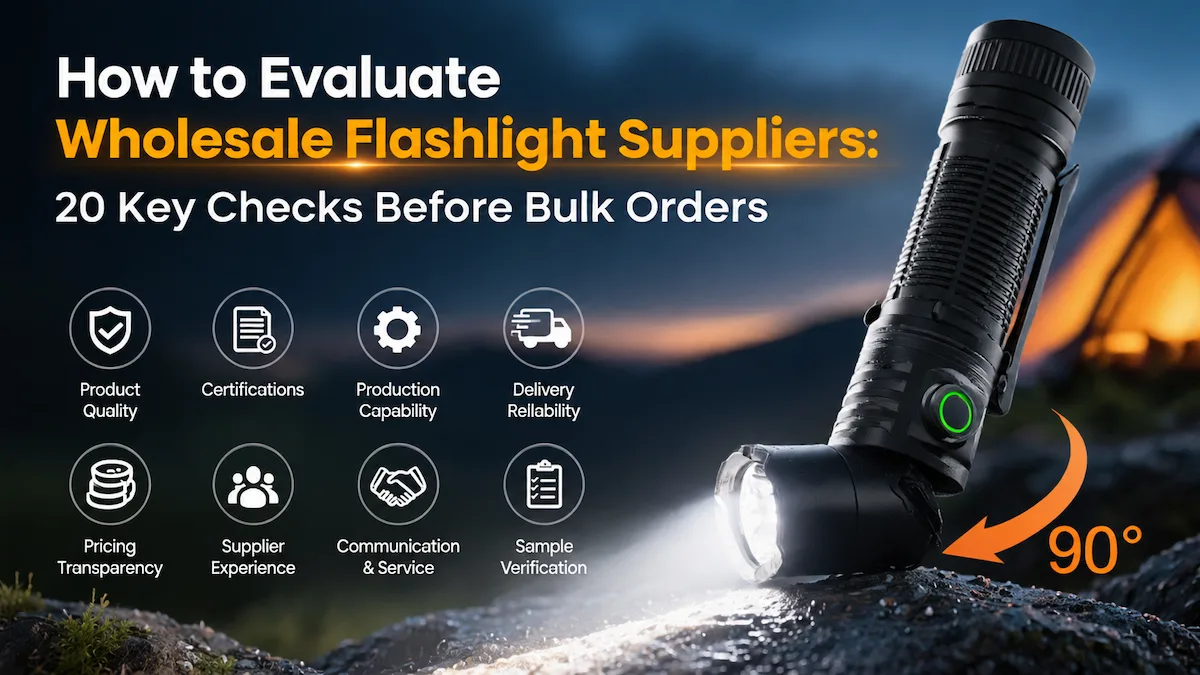
Layer three: a headlamp for hands-free tasks. Carrying a bag, preparing a safe exit route or checking an accessible storage area is easier when both hands are free. Hybrid rechargeable/AAA headlamps can add resilience, provided the backup-cell setup has been tested and the pack includes accurate instructions. A headlamp intended for emergency use should be comfortable, simple to adjust and manageable for users wearing gloves or glasses.
Layer four: a planned energy reserve. This may be approved spare cells, a charged power bank, or a vehicle charging arrangement appropriate to the situation. The reserve must match the actual light's electrical design. A rechargeable product should not be described as independent of the grid merely because it accepts USB-C. If an included power-bank feature can also charge a phone, the user must understand that the same stored energy cannot be spent twice.
These layers form a merchandising strategy as well as a preparedness strategy. A distributor can sell a basic handheld product, a family blackout bundle, and a premium preparedness kit with distinct reasons to upgrade. Each item fills a different role, reducing product overlap and making the sales proposition easier for retailers to explain.
3. Brightenlux Emergency Lighting Products: Compare Roles Before Lumens
The following models appear on the official Brightenlux website. Figures in this table are catalog-published specifications, not independent test certificates. Buyers should check the current product revision and evidence before using any number in retail claims or purchase agreements.
| Product / Type | Officially Described Power and Features | Suggested Blackout-Kit Role | Question Before Approval |
|---|---|---|---|
| 500 lm SST20 compact flashlight | Built-in 900mAh rechargeable battery or one AA; Type-C; adjustable focus; 55g | Entry-level pocket backup | How is AA mode activated and what is the measured low-mode runtime? |
| BT-FL8104, 1000 lm flashlight | Included 18650 2200mAh or three AAA; USB-C; zoom; power-bank description; IP67 catalog claim | Core family emergency flashlight | Is the AAA carrier included and what evidence supports the IP rating? |
| 1500 lm dual-power flashlight | Included 18650 2600mAh or four AAA; USB-C C-to-C; adjustable focus; power bank; IP67 catalog claim | Feature-rich premium handheld | What happens to flashlight runtime while charging a device? |
| BT-PL4030, 1000 lm dry-cell lantern | Three D cells, not included; warm/cool/natural light; dimmable; IP44 catalog claim | Replaceable-battery area-light backup | Are cells included in the kit, and how are they stored? |
| 1000 lm rechargeable lantern | 4000mAh 18650 lithium battery description; multiple white tones; dimming; power-bank function | Rechargeable room or table light | Verify measured area-light runtime and power-bank output |
| BT-PL4031R, 2000 lm lantern | Three 2200mAh cells; warm/cool/natural and red modes; dimming; power-bank feature; IP44 catalog claim | Premium shared-room light | Check lighting modes, handling, full kit weight and test records |
| BT-HL9105C, 500+ lm hybrid headlamp | 1100mAh rechargeable lithium or three AAA; USB-C; warm/cool COB modes; sensor; IP67 catalog claim | Hands-free task light | Does every backup-power and sensor mode work as specified? |
500-Lumen SST20 Dual-Power Flashlight
Small and lightweight, with a published rechargeable-cell and AA alternative. Evaluate it for household drawers, vehicle pouches and compact preparedness kits.
View official flashlight →BT-FL8104 | 1000-Lumen Zoom Flashlight
Published 18650 or AAA architecture, brightness indicators and USB-C charging. A useful comparison model for kits requiring both normal rechargeability and cell backup.
View official flashlight →1500-Lumen Dual-Power / Power-Bank Flashlight
Features adjustable focus, a rechargeable 18650 option, four AAA backup and a device-charging function. Verify the exact output and adapter contents.
View official flashlight →BT-PL4030 | 1000-Lumen Lantern
Runs on three D batteries and supports adjustable white-light tones. It offers a different energy strategy from an integrated rechargeable lantern.
View official lantern →BT-PL4031R | 2000-Lumen Lantern
Diffused light, multiple color settings, red modes and power-bank functionality. Evaluate for family blackout kits and shared-room illumination.
View official lantern →BT-HL9105C | 500+ Lumen Hybrid Headlamp
Rechargeable or three-AAA design, warm/cool light, motion sensor and a compact housing. Check control usability and backup-battery behavior.
View official headlamp →A product range assembled from these references should be tested as a complete kit as well as individual units. A supplier might provide three excellent lights that still fail as a coordinated bundle if each requires a different charging cable, battery carrier or label convention. Standardized instructions, clear role definitions and compatible accessories can matter more to a retailer than another ten percent of advertised brightness.
4. Planning for Six-Hour, 24-Hour and 72-Hour Outages
Outage duration is a useful way to organize buyer questions, but it is not a claim that any Brightenlux model will operate for those periods. A six-hour interruption might require a handheld light for short movements plus a dimmable lantern for a shared room. The buyer should calculate how many hours each light must actually operate and at what mode. A family that uses a lantern for two evening hours has a different energy requirement from a person who leaves it on through the night.
For a 24-hour disruption, charging access becomes uncertain. A rechargeable flashlight may still perform well if it was charged in advance and used conservatively, but the kit should have either a compatible replacement-cell plan or a dedicated stored charging reserve. A lantern operated on a low or medium setting may conserve energy. The end-user card should explain when to lower brightness and how to check remaining capacity before the light becomes critical.
A 72-hour preparedness package should be treated as a planned system, not as a single flashlight with “72-hour runtime” printed on the carton. The system could contain multiple lights used intermittently, spare cells appropriate for each device, and instructions for recharge or replacement. Whether it meets a buyer-defined three-day use case depends on actual mode runtimes and the usage schedule. A distributor should validate its own lighting budget rather than turn a preparedness horizon into a false product performance guarantee.
For institutional programs, a shift schedule adds another layer. A caretaker, building technician or facilities team may need a flashlight that can be issued, checked and recharged after every use. Labels for inspection date, battery condition and kit inventory can support reliability. These are purchasing-program features and should be quoted explicitly rather than assumed to be standard accessories supplied by the factory.
5. Rechargeable, AA/AAA Backup and D-Cell Lanterns: Designing Battery Readiness
The most common weakness in a power-outage light is not necessarily a damaged LED; it is an unavailable energy source. A rechargeable cell may have discharged in storage, or the user may have misplaced its cable. A dry-cell lantern may have no batteries in the package. A hybrid light may require an adapter that was never included. Good emergency lighting specifications make every one of those conditions visible to the user and to the purchasing team.
Brightenlux's 500-lumen compact flashlight, BT-FL8104 and 1500-lumen model illustrate different rechargeable/replaceable-cell approaches. Before printing “dual power,” ask the manufacturer to demonstrate the device operating with both supported supplies. Record the adapter or battery carrier, expected cell orientation, supported output and any difference in runtime. Never assume that a USB-C charging interface safely recharges disposable alkaline cells. The manual must explain what may and may not be charged.
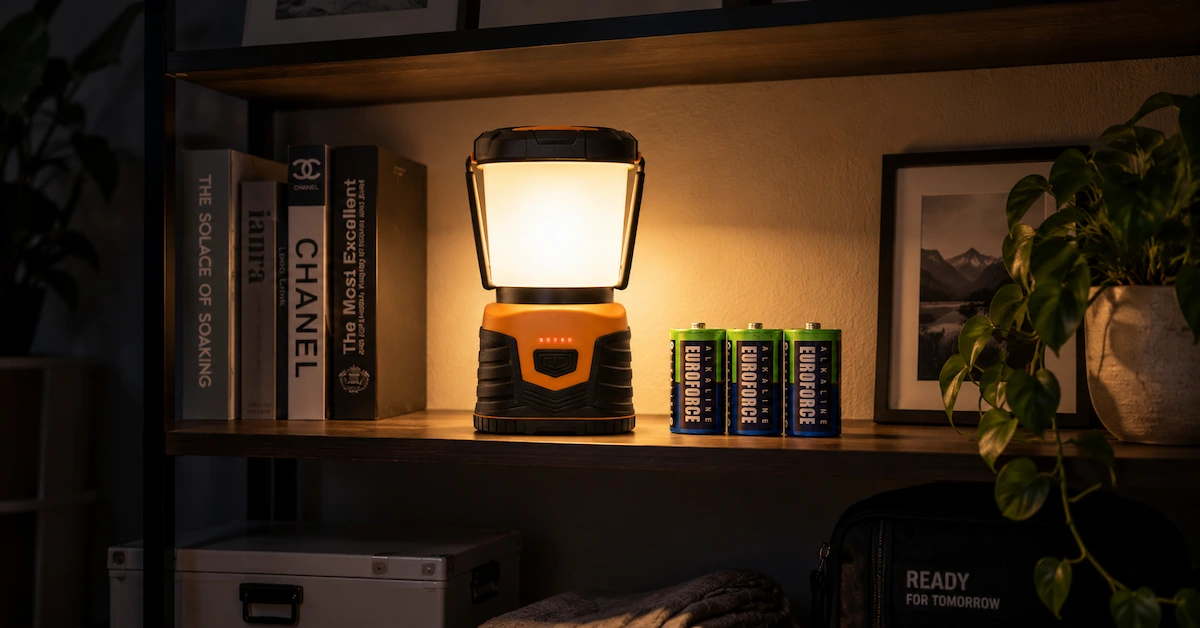
A lantern such as the BT-PL4030 uses three D cells instead. That can be commercially appropriate for a preparedness assortment aimed at customers who prefer replaceable batteries, provided spare cells can be stored and replaced responsibly. Battery-included status should be stated on the outer carton and the online listing. If cells are packed separately from the device, verify packaging and shipping rules for the exact chemistry and market.
For storage, design a simple user routine: keep the light in an accessible location, check the cell condition at appropriate intervals, inspect for leakage or physical damage, recharge where the approved battery instructions require it, and replace depleted or damaged cells safely. Do not promise that a rechargeable flashlight will remain fully ready for years without maintenance. Shelf-life and inspection intervals belong to the validated cell and finished-product instructions, not to generic ad copy.
6. Why Useful Runtime Matters More Than a Maximum Lumen Claim
Peak brightness answers only one question: how much light a product can deliver under the stated initial conditions. During a blackout, more useful questions are whether a low setting makes furniture and steps visible, whether the medium mode lasts through an evening, and whether the user can find the switch comfortably in the dark. A very high setting can consume battery capacity rapidly and may reduce output as the electronics heat up.
A buyer should request a time-versus-output record rather than combining an advertised maximum lumen figure with an unrelated runtime figure. Ask the factory to identify the tested mode, approved cell model, battery state at the start, ambient temperature, measuring instrument and end-of-test definition. ANSI/PLATO FL 1-2025 is a relevant industry performance-reporting reference for portable lights, but naming that standard does not establish that any individual Brightenlux product is certified to it.
The buyer can create a separate practical evaluation for its target use case. For example, specify that the light must deliver enough measured illumination to read a printed checklist at a typical household distance, or to walk safely along an indoor hallway during a test. The illuminance threshold should be defined by the project rather than presented as a universal number. A room lantern and a focused flashlight should not be compared exclusively by total luminous flux because they distribute light differently.
A simple energy plan also prevents misleading bundling. Estimate the hours each device will be switched on, select the practical operating mode, then compare that schedule with measured sample runtimes. Add margin for battery age, temperature and user variation. This budget is a hypothetical planning method until it is populated with real results. Its purpose is to turn “prepared for 72 hours” into a measurable purchasing conversation.
7. USB-C Charging, Power Banks and What Happens When Mains Power Is Unavailable
USB-C is convenient while the grid is working. Users may already have cables, vehicle chargers and portable power banks, reducing the need for a proprietary charger. Yet connector shape alone is not a promise that every USB-C source will work. During sample testing, confirm charging with the sources common in the target market and inspect the charge-port cover, cable fit, indicator colors and safe termination behavior.
Some Brightenlux flashlight and lantern listings describe a power-bank function, including the 1500-lumen dual-power flashlight, the BT-FL8104 and rechargeable lanterns. This can add value for customers who want to top up a small device during an outage. It should not be presented as a substitute for an independent backup power supply. Output voltage, current limits, compatible devices and the energy left for illumination after charging must all be confirmed for the approved model.
Consider a household that expects its flashlight to charge a phone and then illuminate the home for the rest of the night. The same battery is serving two loads. Without validated test results, no seller should state how many phone charges are available or promise that the original flashlight runtime remains unchanged. Packaging should distinguish “power-bank feature available” from specific quantified claims requiring a measured basis.
A resilient kit can combine USB-C convenience with a documented backup path. That might be approved alkaline cells for a dual-power flashlight, three D cells for a dry-battery lantern, or a separate power reserve. Which is right depends on the buyer's price point, region, cell availability and customer instructions. Ask the factory to quote accessories and batteries by configuration so two suppliers are not compared using different pack contents.
8. Beam, Room Light, Hands-Free Use and Human Factors in the Dark
Even an excellent battery system cannot compensate for a confusing light. A compact handheld flashlight is effective for pointing at a route or object; it can be frustrating when used as a ceiling lamp in a shared room. A diffused lantern is more suitable for general illumination but less efficient for looking across a yard. A headlamp follows the user's head and frees both hands, although not everyone enjoys wearing one. Product-role clarity improves both preparedness and merchandising.
Test controls with users who have not read the manual. Can they locate the button with one hand? Does the product start on a manageable setting, or does it immediately produce an uncomfortably bright beam? Must the user cycle through strobe to switch off? Can the lantern dim without accidental flashing? These details can have a direct impact on product reviews and returns for older customers, households with children and general retail buyers.
For hands-free lighting, consider Brightenlux's BT-HL9105C hybrid headlamp as a separate SKU rather than pretending it is a flashlight. It lists COB warm/cool modes and an adjustable sensor feature; these may be useful for packing supplies or performing tasks, but the backup-cell behavior and sensor controls should be tested. Comfort, headband adjustment, weight, lens direction and ease of operation all belong on the sample sheet.
Where indicator lights are included, test whether their meanings are understandable. A red charging light and green full-charge light are useful only if consumers know how to interpret them. Avoid relying on color alone where accessibility or multilingual instruction requirements make additional labeling beneficial. Emergency lighting needs fewer surprises, not more features that are difficult to explain.
9. Power-Outage Safety: What Product Marketing Must Not Promise
The American Red Cross and the US Centers for Disease Control and Prevention advise using flashlights and battery-powered lights instead of candles when possible to reduce fire risk. This supports a helpful consumer message: stored electric lighting is often a more appropriate preparedness choice than open flame. It is not proof that any particular flashlight eliminates hazards or qualifies as regulated emergency equipment.
Warn users to avoid damaged batteries and submerged electronics and to follow the approved charging guidance. A handheld flashlight cannot make a flooded basement or electrically damaged room safe to enter. Consumers must follow utility and emergency authority instructions and should not open electrical equipment or approach fallen power lines merely because they have a strong beam. Never imply that a bright torch replaces trained inspection or evacuation procedures.
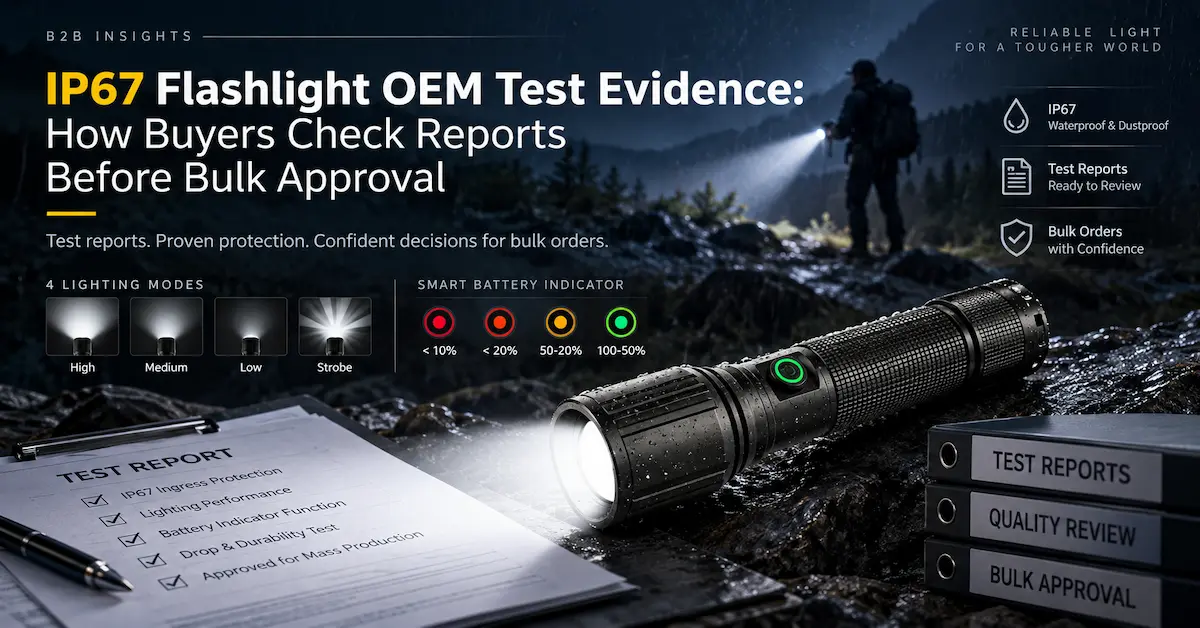
Water ratings are another area where precise wording matters. Brightenlux publishes IP67 for certain flashlight and headlamp models and IP44 for lanterns. IP67 denotes defined dust and temporary immersion protection when validated under applicable test conditions; it does not promise indefinite underwater operation. IP44 means something different and should not be described as equivalent protection. Check the exact report, product revision and charging-port configuration before printing a water-resistance claim.
General-purpose battery lights should not be positioned for explosive atmospheres, fire-service operations or mandated building egress lighting without the relevant specialized approval. These restrictions are not marketing weaknesses: they help a trustworthy brand match the product to a legitimate application and avoid overpromising during a high-stakes event.
10. OEM Sample Testing and Quality-Control Matrix for Blackout Lighting
An emergency lighting importer should approve the system using a test plan that reflects both ordinary function and storage readiness. The following table is a recommended procurement framework, not a claim that Brightenlux has performed each test on every catalog model. Agree on methods, sample quantities and pass/fail limits for the actual order before production begins.
| Check | Sample Evaluation | Evidence to Retain |
|---|---|---|
| First-use readiness | Inspect, locate and operate the light after an agreed storage period | Start-up result and battery condition record |
| Usable runtime | Measure output over time on buyer-selected modes | Mode, cell, temperature and output trace |
| Dual-power operation | Test every published rechargeable and disposable-cell configuration | Adapter list, safe operating behavior and manual instructions |
| USB-C charging | Test relevant cables, adapters, indicators and charging termination | Compatibility and charging record |
| Power-bank output | Test an agreed load and observe remaining light function | Output limits and energy-use results |
| Physical controls | Operate in low light, with gloves and without prior training | Usability notes, switch logic and mode list |
| Housing and ingress | Inspect seals and obtain test evidence for the advertised rating | Model-specific IP report and revision |
| Pack-out | Check cells, carriers, cables, printed warnings, labels and cartons | Approved photos, artwork and accessory count |
| Reorder control | Compare current units with the signed golden sample | Approved BOM and change-control log |
For initial shortlisting, a buyer can compare a small group of samples under the same conditions, then expand qualification and production inspections to suit the order's risk. Three attractive pre-production units do not prove an entire shipment is consistent. Where critical components change—battery, charging board, LED, reflector, seal, firmware or battery carrier—require written notification and assess whether performance and compliance tests must be repeated.
11. Compliance, Battery Transport and Traceable Product Claims
A B2B buyer should build a technical file around the actual finished configuration. Battery format, cell supplier, driver, charging circuit, enclosure and packing arrangement all affect documentation. Ask for test reports and declarations that name the relevant model and applicable destination-market requirements. Do not treat broad company statements about compliance as automatic evidence for every flashlight, lantern or ODM variation.
Relevant technical references may include ANSI/PLATO FL 1-2025 for portable-light performance reporting, IEC 60529 for ingress protection, and appropriate battery safety rules for the selected chemistry and market. Lithium-cell and battery transport can involve UN Manual of Tests and Criteria subsection 38.3 and current air or sea freight requirements. Your shipping specialist should determine the exact documentation and package conditions for cells installed in equipment or packed with it.
Each retail claim needs an evidence trail. If the carton says “1000 lumens,” the brightness test must cover the shipped configuration. If it says “up to ten hours,” customers should be told the operating mode and measurement method. If the pack offers both rechargeable and alkaline cells, the instructions must clearly identify which cells can be charged, which are included, and how to change supplies safely.
Brand owners should also agree who is responsible for translated manuals, market-specific markings, warnings, barcodes, importer identity where required and any retailer-specific quality requirements. Such tasks are part of successful OEM supply; they should be allocated in writing before the commercial launch rather than discovered after shipment.
12. From Catalog Product to Brightenlux OEM/ODM Emergency Kit
Brightenlux presents OEM/ODM services as part of its manufacturing business. Buyers can begin with an established flashlight or lantern platform, then discuss which branding, packaging and technical variations are genuinely possible. Logo artwork and carton printing are very different from altering a battery circuit or introducing a new housing. New electronics, cell formats or water seals may require renewed testing and tooling, even if the product looks almost unchanged.
Step one: define the kit application. Specify home blackout, vehicle reserve, storm preparedness, institutional storage or another clear use. State the primary user, expected charging access, approximate kit volume, market and price positioning. Separate requirements that are essential for emergency function from options intended for merchandising differentiation.
Step two: choose a reference platform. For pocket preparedness consider the 500-lumen dual-power flashlight; for a family handheld compare BT-FL8104; for shared-room lighting consider the rechargeable lantern or D-cell model; for hands-free tasks consider the hybrid headlamp. Do not assume that every feature from different models can be combined in one standard SKU without engineering work.
Step three: test and approve samples. Create a specification with the LED, modes, battery, ports, housing, water claim, accessories and expected operating behavior. Check actual samples before printing the final product card. Approve a golden sample, inspection rules and packaging artwork together. Keep performance values and packaging claims tied to the same approved revision.
Step four: control production and reorders. Ask about relevant incoming checks, line inspection and finished-unit testing; decide which results are required for shipment release. Establish how component changes and defects will be communicated. The goal is not simply to receive an attractive first order but to receive subsequent orders that behave like the samples customers approved.
Discuss an OEM Power-Outage Lighting Kit
Send Brightenlux your buyer channel, required kit contents, preferred battery strategy, estimated order volume, destination market and branding plans. Request available platform options, sample specifications and a model-specific quotation.
Request a Brightenlux OEM Quotation →13. Packaging an Emergency Lighting Assortment for Different B2B Channels
Hardware and general retail: prioritize easy-to-understand pack claims, an obvious battery-included statement, clear graphics showing intended use and simple replacement instructions. A compact flashlight plus optional lantern can create logical good/better tiers. A product that requires an obscure battery adapter should not appear in a basic household kit without that adapter clearly supplied.
Preparedness and emergency-kit brands: build contents around a specific kit checklist. The finished pack might include a handheld light, hands-free option, area light, approved spare cells and a simple maintenance card. Do not advertise a named outage-duration guarantee unless the full kit has been tested against a documented use schedule. The maintenance card should help end users store and periodically inspect the equipment.
Property management and workplace procurement: consistency may outrank retail styling. Purchasers may need identical controls across multiple units, identifiable inventory labels and straightforward reorder availability. A standardized flashlight can complement—not replace—required building emergency systems. Discuss who checks stored batteries and who is authorized to inspect equipment when a building loses electricity.
Outdoor and vehicle accessory distributors: dual power, charging convenience and water resistance may improve relevance, but vehicle storage temperatures and battery instructions require careful evaluation. A family car-camping lantern can also be useful during an outage, yet it should remain positioned as portable lighting rather than as a universal hazard-control device.
Product photography should reflect these distinctions. A handheld light belongs in a navigation or task scene; a lantern belongs in a shared-room scene; a headlamp belongs in a hands-free situation. Clear role-based content can create stronger search relevance for emergency preparedness without duplicating broad flashlight manufacturer posts already present elsewhere on the website.
14. MOQ, Lead Time, Unit Cost and the Price of an Incomplete Kit
A supplier quotation must specify the approved contents. One quote may include a rechargeable cell, cable and battery carrier; another may omit one or more of them. A low price is not necessarily comparable until each line of the bill of materials and packaging has been normalized. Ask for separately identified unit prices, battery inclusions, spare-cell accessories, branded packaging, inspections, sample costs and any tooling or test expenses.
MOQ depends on the actual model and the scope of customization. Standard cartons, logo printing, revised packaging, modified electronics and newly tooled housings do not share one universal quantity threshold. Brightenlux's general OEM statements do not establish fixed minimum orders or timelines for every configuration. Ask for tiered prices at the quantities your forecast supports instead of planning from an invented number.
Lead time should distinguish sample preparation, review cycles, artwork sign-off, cell and component purchasing, assembly, quality verification and freight booking. The purchasing team should ask which inputs determine the schedule and what happens if a sample fails testing. A firm launch date may require an earlier design freeze, especially for seasonal preparedness retail programs.
Finally, evaluate landed cost per sellable unit, including battery transport, customs, quality inspection, documented returns and warranty service. A flashlight that generates confusion about charging can cost more in customer-support time than a simpler unit with a slightly higher purchase price. An incomplete emergency kit can also create a serious brand problem: consumers discover missing cells or misleading functionality precisely when they expected the product to be ready.
15. Copy-Ready RFQ Checklist for Emergency Flashlight Wholesale Orders
Send the same brief to shortlisted manufacturers and ask each to mark requirements as standard, modifiable, requiring development or unavailable. This improves comparability and helps move the discussion toward a realistic sample and quotation.
- Buyer profile: company, country, sales channel, importer requirements, initial order and estimated annual volume.
- Outage application: household blackout, storm kit, vehicle kit, facility maintenance or institutional backup.
- Kit roles: handheld directional light, room lantern, hands-free headlamp and backup energy provision.
- Reference models: identify the Brightenlux products being quoted rather than mixing specifications from unrelated pages.
- Light requirements: beam distribution, low/medium/high modes, practical task visibility, output and runtime test method.
- Battery system: exact rechargeable cells, alternative AA/AAA/D cells, carriers, battery-included status and safe-use instructions.
- Charging: USB-C sources and cables, indicators, charge time, protection and any advertised power-bank output.
- Mechanical design: size, weight, controls, standing or mounting stability, seals, finish and relevant IP evidence.
- Private label: logo, box, manual, warning text, barcode, artwork files, accessory pouches and maintenance card.
- Quality and compliance: golden sample, revision-controlled components, test evidence, battery transport file and inspection plan.
- Commercial terms: MOQ tiers, sample costs, tooling, Incoterms, lead-time milestones, defect handling and shipment terms.
Use the Brightenlux contact page to submit the request and ask for a written model-by-model response. For more general supplier-selection context, its existing emergency flashlight supplier guide addresses broader category fit; this article adds the power-outage kit architecture, backup-power planning and structured inspection requirements.
16. Frequently Asked Questions: Sourcing Emergency Flashlights for Power Outages
1. What makes a good emergency flashlight for power outage supplier?
A suitable supplier should offer products that start reliably, provide useful low and medium light, and have clear battery and charging instructions. For B2B buyers, equally important qualities include approved samples, traceable component specifications, accurate packaging claims, and repeatable inspection and reorder processes. A supplier's logo or large lumen number does not replace those checks.
2. Is a rechargeable or disposable-battery flashlight better during an outage?
Neither is automatically superior. Rechargeable models are convenient when a charging source is available and maintained. Replaceable-cell models can provide a separate energy option, provided the right cells and adapters are actually on hand. A tested dual-power flashlight can combine approaches, but the manual must clearly distinguish rechargeable cells from disposable ones.
3. How many flashlights should a blackout preparedness kit contain?
There is no one-size-fits-all number. A practical system may provide each person access to a portable light, alongside shared room illumination and a backup power plan. The right quantity depends on household size, building layout, user needs and the buyer's kit specification. The same principles apply when designing kits for vehicles or workplaces.
4. Can a camping lantern be used as an emergency light during a power outage?
Yes, many portable LED lanterns are relevant for general room illumination. Brightenlux publishes both rechargeable and D-cell lanterns that could be evaluated for such an assortment. They should not be represented as replacements for mandatory building emergency lighting or medical backup systems. Test stable placement, lighting modes, battery strategy and runtime for the intended use.
5. Does a 1000-lumen flashlight last longer than a 500-lumen model?
No reliable conclusion follows from peak lumens alone. Runtime depends on selected mode, battery energy, driver efficiency, heat and the test end point. A 1000-lumen flashlight on low may run longer than a 500-lumen flashlight on high, or vice versa. Compare output-versus-time records using the same defined test method.
6. What is a dual-power emergency flashlight?
It is a flashlight designed to operate with two defined power arrangements, such as an approved rechargeable battery and a specified AA or AAA option. The alternate supply may require an adapter and may deliver different performance. Test both configurations, document the included parts and ensure the charging circuit cannot be misused with disposable cells.
7. Can a flashlight power-bank function replace a separate emergency charger?
It may provide useful temporary charging for small devices, but the energy is shared with the flashlight. Capacity, output limits and remaining illumination runtime must be assessed for the actual product. A USB-C port or power-bank label alone does not establish how many times a phone can be charged or how long the light will run afterward.
8. Is an IP67 flashlight safe for any flood or storm condition?
No. IP67 represents defined ingress-protection testing for a particular enclosure when supported by valid evidence. It does not make damaged electrical rooms safe, authorize prolonged underwater operation or prove resistance to all liquids. A person should not enter floodwater or approach damaged electrical equipment merely because their flashlight is rated for water exposure.
9. Can Brightenlux supply private-label blackout flashlight kits?
Brightenlux describes OEM/ODM capability and lists relevant flashlights, lanterns and headlamps. The exact range of available customization, packaging, kit assembly, MOQ and engineering work must be confirmed for the intended project. Send a clear parts list and destination-market requirements to obtain a model-specific feasibility response.
10. What is the MOQ for wholesale emergency flashlights?
MOQ depends on model, order size, logo and packaging work, included batteries, modification requirements and production planning. Do not assume a single universal minimum from general website statements. Request written quantity-based pricing for standard, private-label and modified configurations where relevant.
11. How should brands validate a 72-hour emergency lighting claim?
Define a usage schedule showing when each light is switched on, at which mode, and with which battery or recharging reserve. Measure usable runtime on the exact configuration and allow for storage condition and user variation. A three-day planning horizon should never be represented as three days of continuous flashlight output unless that specific performance is independently supported.
12. What should be approved before the first bulk order?
Approve product roles, golden samples, battery and charging configurations, useful performance criteria, market documents, pack contents, artwork, inspection methods, order terms and component change-control arrangements. Repeatability matters because emergency lighting buyers depend on clear instructions and consistent behavior across shipments, not merely an attractive first sample.
Conclusion
Choosing an emergency flashlight for power outage supplier is best approached as a preparedness-system decision rather than a competition over peak brightness. A dependable assortment gives users directional handheld lighting, a practical room lantern, a hands-free option and a compatible battery or charging backup. It also tells them where the light is, how to operate it and what must be checked before an outage occurs.
Brightenlux's public range includes compact dual-power flashlights, the BT-FL8104 and higher-output rechargeable models, dry-cell and rechargeable lanterns, and hybrid-power headlamps. Those platforms provide real starting points for household blackout products, hardware-store assortments and private-label preparedness kits. Their published specifications should still be checked with current samples and matching test evidence; no single catalog rating can substitute for a validated kit design.
For an OEM or wholesale program, start by defining the user's blackout scenario and preferred power strategy. Then request representative samples, test low- and medium-mode performance, verify backup-cell operation, approve packaging and documents, and set repeat-order controls. To discuss suitable models and a quotation for your market, contact Brightenlux about emergency flashlight and power-outage lighting sourcing with your kit requirements, target quantity, branding and destination country.