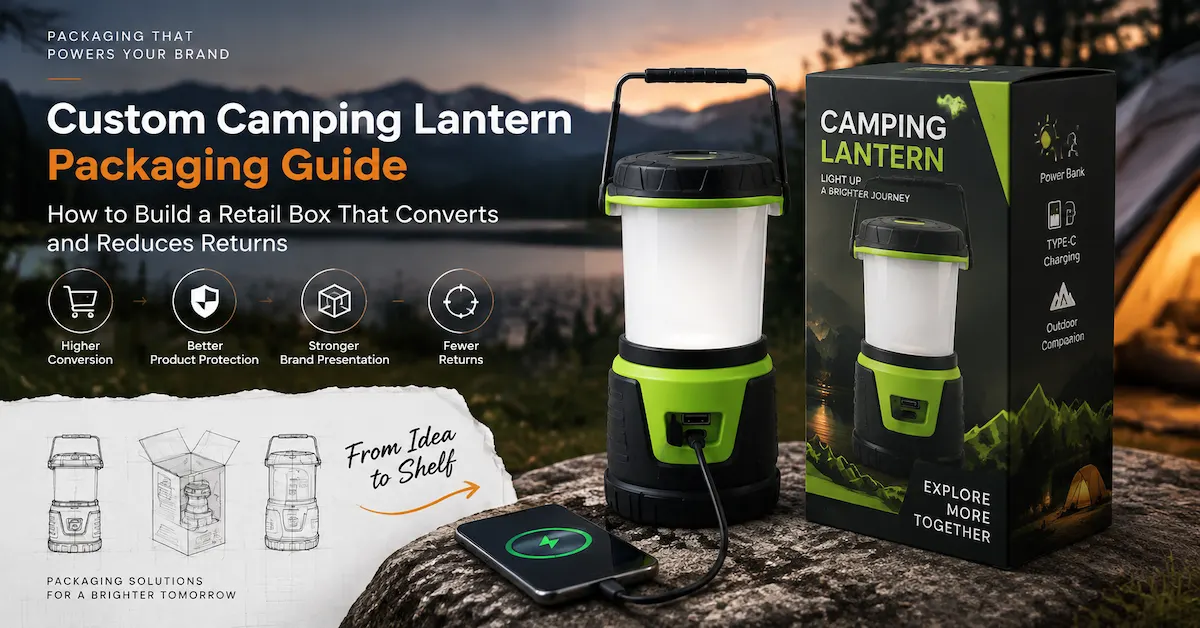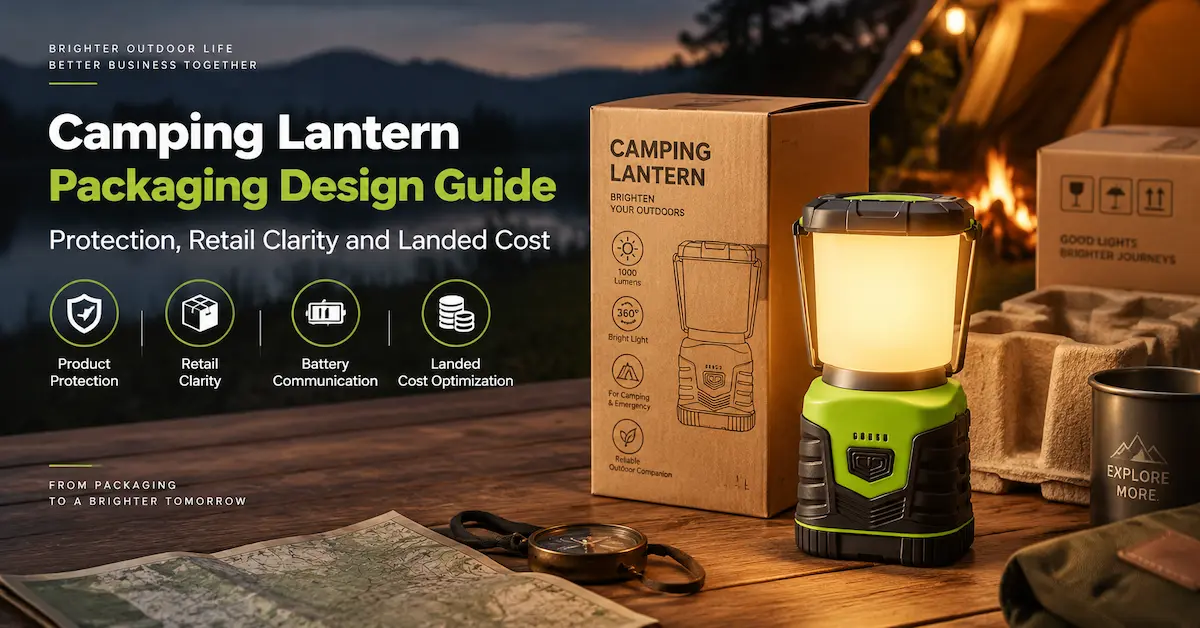


Direct answer: Conversion-focused lantern packaging should make the product job, power system, included accessories and verified differentiator understandable within seconds, while the insert and instructions prevent damage and post-purchase confusion.
This guide addresses a real B2B purchasing question with commercial investigation and high-quality RFQ intent. It is written for outdoor brands, importers, distributors, e-commerce operators, promotional buyers and retail sourcing teams. Its purpose is to help a qualified buyer send a clearer RFQ, approve evidence and reduce avoidable damage, returns and artwork revisions.
Who Brightenlux is and what this packaging discussion covers
Ningbo Brightenlux Electric Appliance Co., Ltd. is identified on its public website at No. 688 Jiyi Industrial Area, Xidian Town, Ninghai, Ningbo, Zhejiang 315613, China. The site presents camping and emergency lighting, portable-light product platforms, OEM and ODM support, product-appearance discussion, packaging and branding support for overseas buyers. Buyers can contact the company through its inquiry page, by phone at 0086-574-65130100 or by email at admin@brightenlux.com.
This article uses public Brightenlux product pages as original product evidence. It does not invent packaging MOQ, printing tolerances, drop-test results, tooling cost or lead time. Those values depend on the final model, battery, insert, artwork, quantity, printer and route. Every numeric packaging commitment should therefore be confirmed on the quotation, approved sample or test report for the exact production-intent configuration.
Use real product differences to create the retail story
| Brightenlux public platform | Published product evidence | Packaging decision created | Confirm for the RFQ |
|---|---|---|---|
| 1000 lm dry-battery lantern | 42 SMD 3014 + 4 SMD 3030 LEDs; three D cells not included; three color temperatures; dimming; 8-10 hours stated; ABS + PC; IP44; 495 g; 9 × 9 × 18.5 cm | Battery-not-included wording, battery-door protection, tall-box stability and retail explanation | Current model, sample measurements, final pack contents, box dimensions, MOQ and lead time |
| 1000 lm rechargeable lantern | 42 SMD 3014 + 4 SMD 3030 LEDs; three color temperatures; dimming; 4000 mAh 18650 lithium battery with protection; power-bank function | Cable retention, lithium-battery statement, port explanation, accessory count and transport review | Exact cell, charging interface, cable, runtime method, shipping configuration and destination evidence |
| 2000 lm rechargeable lantern | COB LED; white and red modes; dimming; power-bank function; three included 2200 mAh lithium batteries; 6600 mAh total stated; 10-15 hours stated; IP44 | Higher product weight, battery documents, large front-panel hierarchy and stronger insert control | Exact production battery, mode behind runtime, carton mass, pack-out, tests and current availability |
The retail message should begin with the customer job. The dry-battery lantern supports users who value replaceable power and extended storage. The 1000-lumen rechargeable lantern combines area light with an included lithium power system and power-bank function. The 2000-lumen platform adds a higher stated output and more lighting modes. A clear range architecture makes these differences visible without forcing customers to decode model numbers.
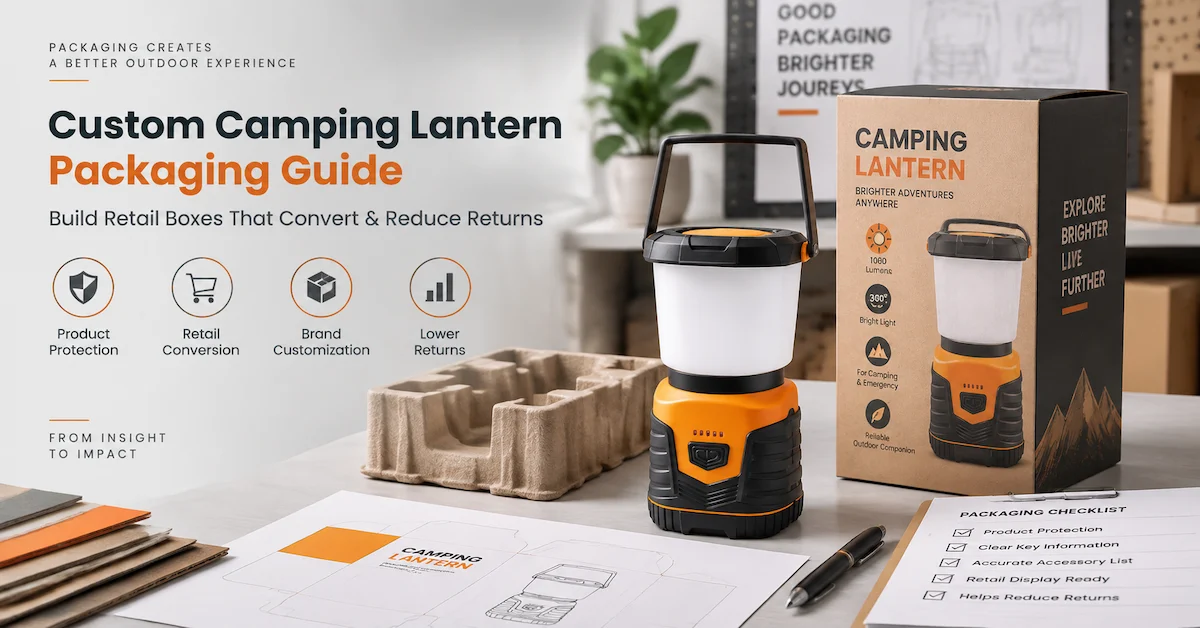
A buyer comparing custom camping lantern packaging should treat the box, insert, product, battery statement and shipping carton as one packaged-product system. This is also true for LED camping lantern packaging, rechargeable camping lantern packaging and private label camping lantern packaging. The artwork can change by market, but the approved physical configuration, evidence and claims must remain connected.
For a complete brief, link the camping lantern box design to the intended sales route. Ask the camping lantern packaging manufacturer to distinguish structural protection from graphic design, and make camping lantern retail packaging consistent with the online listing. When product or structure changes are involved, treat the work as OEM camping lantern packaging design with sample, evidence and change-control gates.
What a conversion-focused box must answer in ten seconds
- What is this product and what primary situation is it for?
- Is it rechargeable or powered by replaceable batteries?
- Are the battery and charging cable included?
- What verified lighting behavior makes this SKU different?
- What is inside the box?
- Where can the buyer find model, barcode, warnings and support contact?
Ten seconds is not a scientific law; it is a useful design constraint. A buyer should not have to rotate a box repeatedly to discover that batteries are excluded or that the lantern can provide emergency device power. The front establishes the job, a side panel explains the configuration, the back supports the decision, and the opening sequence confirms that the brand has controlled the details.
Eighteen retail decisions that increase clarity and reduce returns
1. Primary shelf promise
Conversion decision. Choose one job such as family camping, emergency backup or campsite area light Support it with a verified product feature and a scene that matches the destination channel. The front panel earns attention, but the side, back and opening sequence must answer the buyer's next questions without forcing them to search for a manual or a product listing.
Return-prevention check. A generic “super bright” headline attracts comparison but not the right buyer Resolve it by pair the use case with the exact power format and a supportable differentiator. The objective is not to crowd every feature onto the box. It is to make the purchase promise clear, scannable and consistent with the item inside.
2. Product silhouette
Conversion decision. Show the handle, diffuser and control area at a readable scale Support it with current production photography or a rendering checked against the golden sample. The front panel earns attention, but the side, back and opening sequence must answer the buyer's next questions without forcing them to search for a manual or a product listing.
Return-prevention check. An old render can show the wrong port, button or accessory Resolve it by lock photography after the physical sample is approved. The objective is not to crowd every feature onto the box. It is to make the purchase promise clear, scannable and consistent with the item inside.
3. Power-language clarity
Conversion decision. State rechargeable or dry-battery operation immediately Support it with BOM, pack list and public product record. The front panel earns attention, but the side, back and opening sequence must answer the buyer's next questions without forcing them to search for a manual or a product listing.
Return-prevention check. Customers return products when batteries or cables are not included as expected Resolve it by repeat the battery-included statement on the relevant panel and listing. The objective is not to crowd every feature onto the box. It is to make the purchase promise clear, scannable and consistent with the item inside.
4. Mode communication
Conversion decision. Explain the purpose of each lighting mode instead of listing icons only Support it with sample operation and approved mode sequence. The front panel earns attention, but the side, back and opening sequence must answer the buyer's next questions without forcing them to search for a manual or a product listing.
Return-prevention check. A red strobe or dimming control is easily misunderstood Resolve it by use short action-based copy and a compact mode diagram. The objective is not to crowd every feature onto the box. It is to make the purchase promise clear, scannable and consistent with the item inside.
5. Runtime wording
Conversion decision. Connect every runtime statement to a mode and method Support it with sample-specific test data and stated end point. The front panel earns attention, but the side, back and opening sequence must answer the buyer's next questions without forcing them to search for a manual or a product listing.
Return-prevention check. “10-15 hours” can be interpreted as full brightness for the entire period Resolve it by add context without turning the front panel into a test report. The objective is not to crowd every feature onto the box. It is to make the purchase promise clear, scannable and consistent with the item inside.
6. Power-bank claim
Conversion decision. Describe output capability only when the supplied configuration supports it Support it with port specification, battery configuration and functional sample. The front panel earns attention, but the side, back and opening sequence must answer the buyer's next questions without forcing them to search for a manual or a product listing.
Return-prevention check. Customers may expect full phone charging or confuse input and output Resolve it by identify the port and intended emergency use accurately. The objective is not to crowd every feature onto the box. It is to make the purchase promise clear, scannable and consistent with the item inside.
7. Material claim
Conversion decision. Name ABS and PC only when they match the proposed product Support it with controlled product specification. The front panel earns attention, but the side, back and opening sequence must answer the buyer's next questions without forcing them to search for a manual or a product listing.
Return-prevention check. Borrowed material language weakens trust and can conflict with recycling copy Resolve it by use material information on the technical panel, not as decoration. The objective is not to crowd every feature onto the box. It is to make the purchase promise clear, scannable and consistent with the item inside.
8. Weather claim
Conversion decision. Use the exact supported IP wording for the exact model Support it with applicable product evidence and approved configuration. The front panel earns attention, but the side, back and opening sequence must answer the buyer's next questions without forcing them to search for a manual or a product listing.
Return-prevention check. A water icon can imply submersion when the claim only covers splashes Resolve it by pair the rating with plain-language use guidance. The objective is not to crowd every feature onto the box. It is to make the purchase promise clear, scannable and consistent with the item inside.
9. Feature hierarchy
Conversion decision. Limit the front to three or four verified reasons to buy Support it with buyer interviews, channel feedback and evidence matrix. The front panel earns attention, but the side, back and opening sequence must answer the buyer's next questions without forcing them to search for a manual or a product listing.
Return-prevention check. A wall of badges hides the power format and model difference Resolve it by move secondary detail to the side or comparison panel. The objective is not to crowd every feature onto the box. It is to make the purchase promise clear, scannable and consistent with the item inside.
10. Color system
Conversion decision. Use brand colors to identify the range without obscuring product variants Support it with printed proof under retail lighting. The front panel earns attention, but the side, back and opening sequence must answer the buyer's next questions without forcing them to search for a manual or a product listing.
Return-prevention check. Neon product accents can shift in CMYK and create a mismatch Resolve it by approve a physical color target and acceptable range. The objective is not to crowd every feature onto the box. It is to make the purchase promise clear, scannable and consistent with the item inside.
11. Typography
Conversion decision. Choose sizes that remain legible at shelf distance and on mobile thumbnails Support it with 100 percent print proof and reduced e-commerce preview. The front panel earns attention, but the side, back and opening sequence must answer the buyer's next questions without forcing them to search for a manual or a product listing.
Return-prevention check. Thin text and condensed claims disappear after coating or scaling Resolve it by test the smallest critical text before final approval. The objective is not to crowd every feature onto the box. It is to make the purchase promise clear, scannable and consistent with the item inside.
12. Barcode and model code
Conversion decision. Give each sellable configuration a scannable identity Support it with GTIN decision, barcode proof and GS1 standards. The front panel earns attention, but the side, back and opening sequence must answer the buyer's next questions without forcing them to search for a manual or a product listing.
Return-prevention check. Shared artwork can send the wrong model into inventory Resolve it by link barcode, SKU, color, battery and language version. The objective is not to crowd every feature onto the box. It is to make the purchase promise clear, scannable and consistent with the item inside.
13. Multilingual layout
Conversion decision. Choose languages from the real markets instead of shrinking every panel Support it with approved translation and market list. The front panel earns attention, but the side, back and opening sequence must answer the buyer's next questions without forcing them to search for a manual or a product listing.
Return-prevention check. Crowded copy becomes unreadable and difficult to revise Resolve it by use a core box plus language label or leaflet when volume is fragmented. The objective is not to crowd every feature onto the box. It is to make the purchase promise clear, scannable and consistent with the item inside.
14. Instruction access
Conversion decision. Put quick start, charging and warning content where the user finds it Support it with first-use observation and support-question history. The front panel earns attention, but the side, back and opening sequence must answer the buyer's next questions without forcing them to search for a manual or a product listing.
Return-prevention check. A manual hidden under the insert does not prevent a setup complaint Resolve it by add a visible quick-start sequence and keep detailed instructions inside. The objective is not to crowd every feature onto the box. It is to make the purchase promise clear, scannable and consistent with the item inside.
15. Unboxing order
Conversion decision. Present lantern, cable and manual in a logical sequence Support it with physical unboxing trial. The front panel earns attention, but the side, back and opening sequence must answer the buyer's next questions without forcing them to search for a manual or a product listing.
Return-prevention check. Accessories fall out or are mistaken for missing Resolve it by use fixed pockets and an accessory checklist. The objective is not to crowd every feature onto the box. It is to make the purchase promise clear, scannable and consistent with the item inside.
16. Tamper evidence
Conversion decision. Choose a seal that protects stock without damaging presentation Support it with retail handling test and adhesive sample. The front panel earns attention, but the side, back and opening sequence must answer the buyer's next questions without forcing them to search for a manual or a product listing.
Return-prevention check. Strong labels tear artwork; weak labels lift in humidity Resolve it by approve seal position, adhesive and removal appearance. The objective is not to crowd every feature onto the box. It is to make the purchase promise clear, scannable and consistent with the item inside.
17. E-commerce thumbnail
Conversion decision. Make the product type and power format readable in a small image Support it with marketplace image test using the physical box. The front panel earns attention, but the side, back and opening sequence must answer the buyer's next questions without forcing them to search for a manual or a product listing.
Return-prevention check. Packaging designed only for shelf becomes a dark unreadable thumbnail Resolve it by photograph the front and one open-pack view for the listing. The objective is not to crowd every feature onto the box. It is to make the purchase promise clear, scannable and consistent with the item inside.
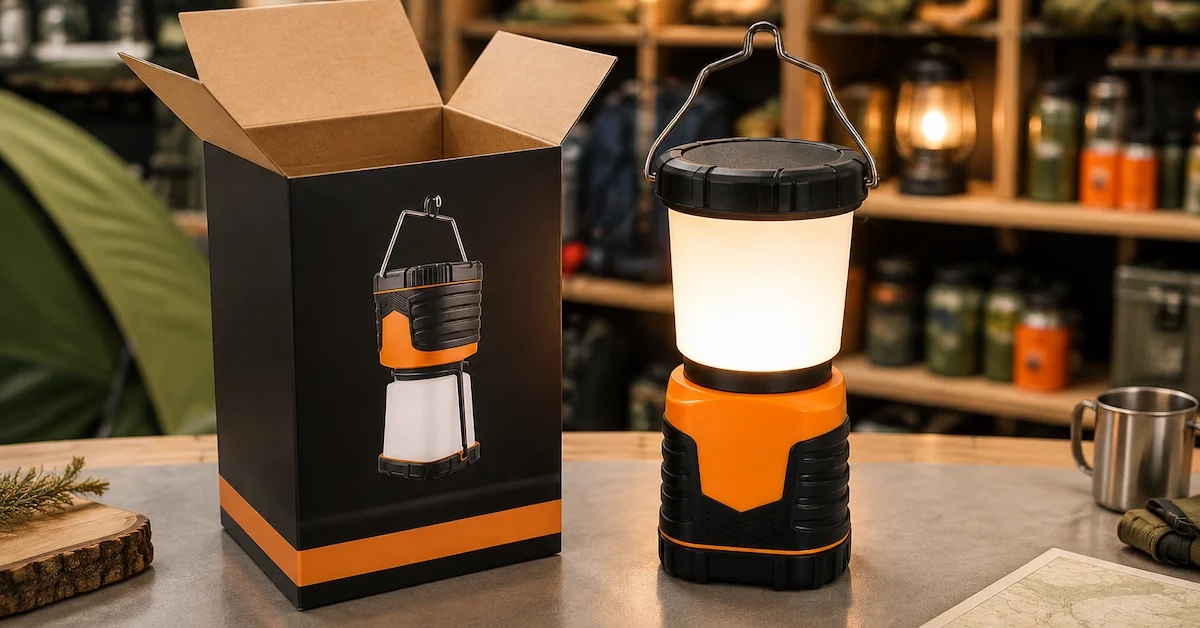
18. Comparison architecture
Conversion decision. Make differences among 1000 lm dry, 1000 lm rechargeable and 2000 lm rechargeable platforms explicit Support it with verified comparison table. The front panel earns attention, but the side, back and opening sequence must answer the buyer's next questions without forcing them to search for a manual or a product listing.
Return-prevention check. A visual family can make unlike batteries look like simple color variants Resolve it by use a stable comparison grid with configuration-specific data. The objective is not to crowd every feature onto the box. It is to make the purchase promise clear, scannable and consistent with the item inside.
Write a panel-by-panel content plan before designing graphics
| Panel | Primary purpose | Recommended content | Do not place here |
|---|---|---|---|
| Front | Recognition and product position | Product image, product name, power type, one primary use and verified differentiators | Dense warnings, long mode descriptions or unsupported badges |
| Side A | Fast configuration check | Battery, charging, included items, dimensions or key controls | Copy borrowed from another SKU |
| Side B | Brand and range navigation | Use cases, comparison cue, contact or QR destination | A QR code with no maintained destination |
| Back | Decision support | Feature explanation, mode diagram, pack contents and responsible contact | Tiny text or claims that exceed evidence |
| Bottom/top | Operational identity | Model, barcode, batch area, warnings, languages and box revision | Critical purchase information visible only after opening |
| Inside | First-use success | Quick start, accessory location, charging note and support path | Marketing copy that competes with instructions |
Turn private-label choices into an RFQ
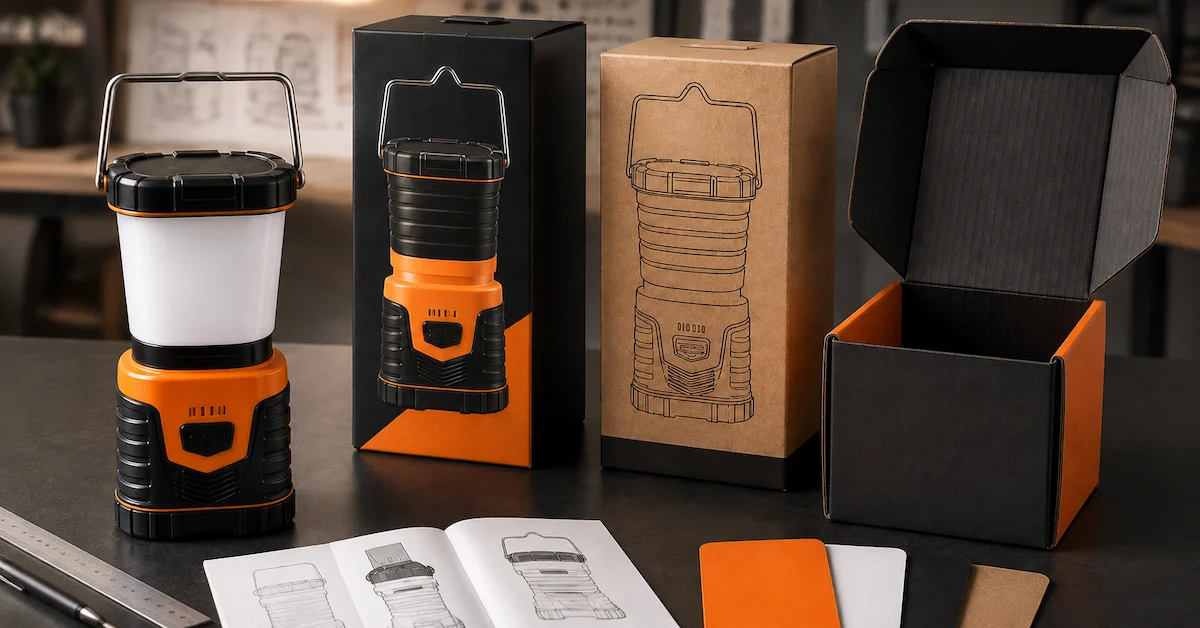
For private label camping lantern packaging, send the logo in vector format, brand colors, typefaces or acceptable substitutes, required languages, barcode data, channel, target customer, package structure, finish preference, quantity by SKU and the deadline for a production-ready proof. Identify what the factory may adapt and what requires written approval.
For OEM camping lantern packaging design, add product revision, battery and cable details, model naming, verified claims, destination requirements and the desired test path. Request a flat artwork proof, a blank structural sample, a digitally printed mock-up and a production-method sample as separate deliverables when the risk justifies them. Each sample answers a different question.
Retail validation workbook: test the message before printing the production run
Five-second category test
Shopper question. Can a buyer identify that this is a camping lantern, its power format and its main use? Test the proposed box by showing the front panel for five seconds and asking the participant to describe what is sold. Use the final model, realistic shelf distance and a mobile-size product image. Do not explain the design to the participant first; the packaging should carry the intended meaning without a designer standing beside it.
What the result means. If the reply focuses on decorative imagery but misses rechargeable or dry-battery operation, the hierarchy is not doing its job. The release decision is to make product type and power format more prominent before adding claims. Save a photograph or screen capture, participant wording and artwork revision. This modest evidence is more useful than an internal vote based on which rendering looks most attractive at full size.
Included-items test
Shopper question. Can a buyer tell whether batteries, cable and manual are included? Test the proposed box by placing front, side and back panels in front of an unfamiliar user without opening the box. Use the final model, realistic shelf distance and a mobile-size product image. Do not explain the design to the participant first; the packaging should carry the intended meaning without a designer standing beside it.
What the result means. Uncertainty here becomes a return or support question, especially when similar models use different power systems. The release decision is to create one explicit pack-content block and repeat only the critical battery status. Save a photograph or screen capture, participant wording and artwork revision. This modest evidence is more useful than an internal vote based on which rendering looks most attractive at full size.
Mode-comprehension test
Shopper question. Can the customer understand white, warm, natural, red or strobe modes and find the dimming behavior? Test the proposed box by using the printed mode panel to operate the physical sample. Use the final model, realistic shelf distance and a mobile-size product image. Do not explain the design to the participant first; the packaging should carry the intended meaning without a designer standing beside it.
What the result means. If the user presses repeatedly or interprets an icon incorrectly, the package is documenting features but not enabling use. The release decision is to rewrite mode copy around actions and verify it against the approved switch sequence. Save a photograph or screen capture, participant wording and artwork revision. This modest evidence is more useful than an internal vote based on which rendering looks most attractive at full size.
Shelf-distance test
Shopper question. Do product name, power type and primary differentiator remain readable at the expected aisle distance? Test the proposed box by printing the panel at full size and placing it among representative competitor boxes. Use the final model, realistic shelf distance and a mobile-size product image. Do not explain the design to the participant first; the packaging should carry the intended meaning without a designer standing beside it.
What the result means. Fine typography, low contrast and glossy reflections can remove the message that looked clear on screen. The release decision is to increase hierarchy, improve contrast or remove a secondary badge. Save a photograph or screen capture, participant wording and artwork revision. This modest evidence is more useful than an internal vote based on which rendering looks most attractive at full size.
Mobile-thumbnail test
Shopper question. Does the box still communicate the product when photographed for an online listing? Test the proposed box by reducing the image to the marketplace card size and checking it on a phone. Use the final model, realistic shelf distance and a mobile-size product image. Do not explain the design to the participant first; the packaging should carry the intended meaning without a designer standing beside it.
What the result means. A tall premium box can become a dark rectangle with unreadable text. The release decision is to use a stronger product silhouette and fewer front-panel claims. Save a photograph or screen capture, participant wording and artwork revision. This modest evidence is more useful than an internal vote based on which rendering looks most attractive at full size.
Range-navigation test
Shopper question. Can a buyer distinguish dry-battery, 1000-lumen rechargeable and 2000-lumen rechargeable versions? Test the proposed box by placing the three proposed fronts side by side without model explanations. Use the final model, realistic shelf distance and a mobile-size product image. Do not explain the design to the participant first; the packaging should carry the intended meaning without a designer standing beside it.
What the result means. If differences appear to be only color, shoppers may buy the wrong battery configuration. The release decision is to create a consistent family frame plus a clear configuration marker. Save a photograph or screen capture, participant wording and artwork revision. This modest evidence is more useful than an internal vote based on which rendering looks most attractive at full size.
Unboxing-memory test
Shopper question. After opening, can the customer find the cable, instructions and support route without emptying the box? Test the proposed box by observing first-time unpacking and asking the user to repack the product. Use the final model, realistic shelf distance and a mobile-size product image. Do not explain the design to the participant first; the packaging should carry the intended meaning without a designer standing beside it.
What the result means. Hidden accessory pockets or a difficult insert make a complete product feel incomplete. The release decision is to change pocket visibility, finger access or the quick-start position. Save a photograph or screen capture, participant wording and artwork revision. This modest evidence is more useful than an internal vote based on which rendering looks most attractive at full size.
Claim-trust test
Shopper question. Do shoppers understand what the lumen, runtime, IP and power-bank claims actually refer to? Test the proposed box by asking participants to explain each claim in their own words and comparing that interpretation with the evidence. Use the final model, realistic shelf distance and a mobile-size product image. Do not explain the design to the participant first; the packaging should carry the intended meaning without a designer standing beside it.
What the result means. A technically true but context-free claim can create an expectation the product was not designed to meet. The release decision is to add concise context, remove ambiguous symbols and align website copy. Save a photograph or screen capture, participant wording and artwork revision. This modest evidence is more useful than an internal vote based on which rendering looks most attractive at full size.
Run the validation with people who resemble the intended buyer. An outdoor-specialist shopper, a hardware buyer, a marketplace customer and a promotional purchaser may notice different information first. Record those differences instead of averaging every comment into one crowded design. The brand can keep a stable visual system while changing the content priority by channel. A retail box may lead with the use scene and power format; an industrial or emergency-program box may prioritize storage readiness, pack count and instructions; an e-commerce mailer may emphasize protection and a clean opening sequence. The important control is that every version describes the same approved product and uses the correct model, battery, barcode and accessory list.
Before release, compare the package with the online product detail page at the same time. Product photography, model name, lumen claim, modes, battery statement, power-bank wording, dimensions, included items and contact route should agree. When a buyer sees one configuration online and another on the carton, conversion turns into distrust. Keep a controlled content sheet that sales, e-commerce, design and the factory use together. Update it only after the relevant sample or document is approved, then retire the old version from shared folders and marketplace templates.
Measure packaging conversion without guessing
| Observation | What it may indicate | Test before redesign | Useful decision |
|---|---|---|---|
| High page visits, low inquiries | Value or OEM path is unclear | Compare hero image, product job and inquiry CTA | Clarify buyer qualification and sample request |
| Many battery questions | Power format or included items are hidden | Five-second panel comprehension test | Move battery statement forward |
| Returns marked 'not as expected' | Image, scale, mode or accessory promise is unclear | Compare listing, carton and actual pack | Align controlled content kit |
| Barcode or receiving failures | Print, placement or SKU control issue | Production-method scan verification | Correct artwork and receiving checks |
| Damaged diffusers or handles | Insert and route do not match | Complete-pack transit evaluation | Revise structure, not only graphics |
| Slow packing line | Structure has too many manual steps | Pilot time study | Simplify folds, pockets or seals |
Frequently asked questions
What should I send first for a camping lantern packaging quotation?
Send the exact product link or sample code, destination market, sales channel, order quantity, battery configuration, included accessories, target launch date, preferred box type, languages and barcode requirement. Ask the supplier to separate confirmed facts from assumptions and to quote standard, pilot and custom options.
Is there a universal packaging MOQ?
No. The product order, paper stock, print method, color, finish, insert, language version and printer setup can have different minimums. Request the MOQ per box design and per SKU, plus a neutral-box or label-based pilot option when the printed-box minimum is too high.
Should the box show the highest lumen value?
Only when the value applies to the exact production configuration and the measurement basis is supportable. The front panel should pair the verified headline with the use case, power type and key differentiator. Avoid implying that peak output is sustained for the full published runtime.
How should a lithium-battery lantern be described?
State whether the battery is installed, packed with the product or omitted; identify the supplied charging accessory; and make the product, carton, invoice and transport file agree. The freight specialist must confirm current route and carrier requirements for the exact pack-out.
Do I need a physical packaging sample?
Yes for a serious retail or e-commerce launch. A PDF proof checks text and placement, but it cannot prove fit, opening force, insert retention, surface appearance, barcode scan quality or protection. Approve a production-intent pack before mass printing.
Which packaging test should be used?
Select a test from the real distribution route and damage risk. ISTA explains that screening, partial-simulation and general-simulation procedures serve different purposes. Ask a qualified packaging professional or test laboratory to select the applicable procedure rather than claiming a test based only on box size.
Can one box serve several lantern models?
Sometimes, if dimensions, mass, accessory count, battery wording and claims are genuinely compatible. A shared outer structure with model-specific labels can reduce inventory, but do not hide different batteries or instructions behind a generic package.
What should be checked at final inspection?
Check the approved artwork revision, model and barcode, print condition, box dimensions, insert, product orientation, accessory count, battery statement, manual language, carton quantity, carton marks and closure. Link findings to the batch and retained sample.
What makes custom camping lantern packaging look premium?
Premium packaging is controlled rather than merely elaborate. Accurate product photography, disciplined hierarchy, good color matching, a clean opening sequence and a fitted insert usually create more trust than multiple foils and badges. Choose finishes only when they support the channel and survive handling.
Should rechargeable camping lantern packaging include a window?
A window can reveal size and materials but can reduce printable area, add plastic or structural complexity and expose the diffuser. Compare shelf value, protection, recyclability, cost and parcel route before choosing it. A strong photograph may solve the same problem with less risk.
Can a QR code replace printed instructions?
It can extend information but should not replace critical first-use, battery, charging or safety content required on the package or supplied instructions. Maintain the destination, use a stable URL and test scanning on the final printed surface.
Release the box only when the promise matches the product
Before mass printing, place the approved lantern, cable, battery configuration, manual and insert beside the final proof. Read every number and icon as a customer would. Scan the barcode. Open the package. Charge the product. Compare the website listing. A conversion claim is valuable only when the product delivers it; clarity is the strongest long-term retail advantage.