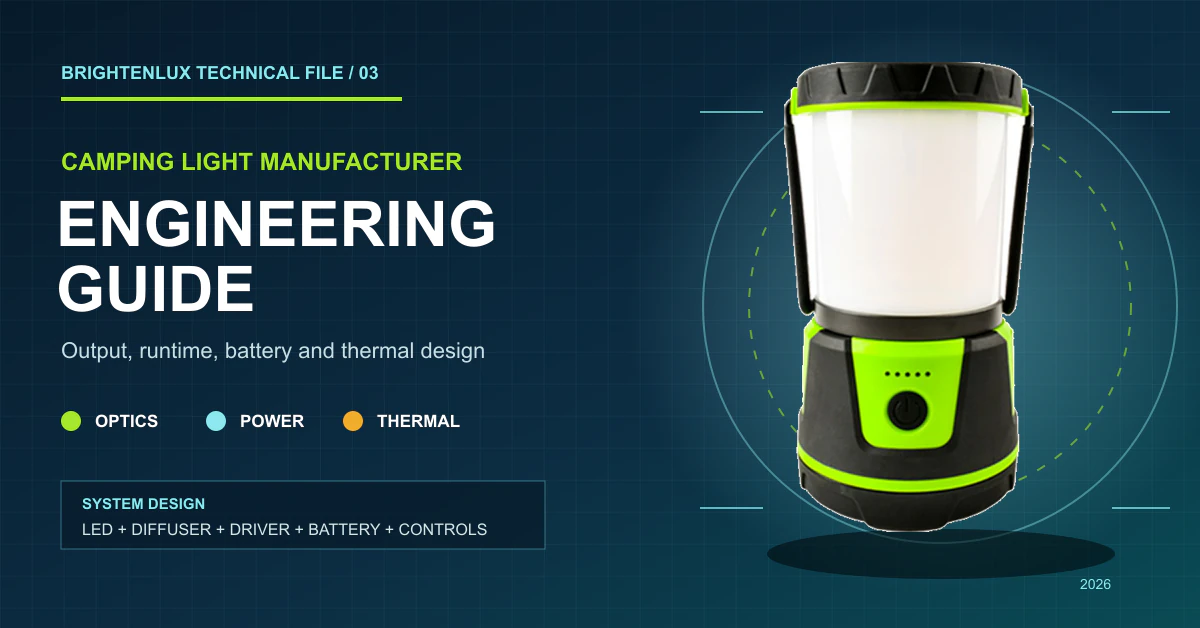


Camping Lantern Manufacturer Quality Guide: Testing, Compliance, and Factory Control
A camping lantern manufacturer should be able to prove how a lantern is specified, tested, built, inspected, and released. For importers, private-label outdoor brands, distributors, and retailers, quality is not a general promise. It is the ability to repeat the approved sample in production and support the product with documentation appropriate for the destination market.
This guide uses a nine-step SEO and sourcing structure: define the buyer intent, map compliance, translate claims into requirements, build a test matrix, check mechanical and thermal risks, review battery evidence, audit factory control, manage change, and use inspection data for corrective action. Brightenlux has produced portable lighting products since 2014 at its Zhejiang facility. Buyers can review current lighting categories on the Brightenlux products page, then confirm testing and compliance requirements for the exact model, configuration, market, and claim set.
Step 1: Define What Quality Means Before Sourcing
The first quality question is not whether a lantern looks good. It is whether the buyer and factory have the same controlled specification. A usable specification identifies the model, revision, materials or critical components where relevant, battery configuration, lighting modes, accessories, packaging, labels, and customer-facing claims.
A camping lantern manufacturer and buyer should also separate critical, major, and minor characteristics. Critical characteristics may affect safety, legal compliance, or serious protective function. Major characteristics may affect normal use, customer returns, or the approved specification. Minor issues usually relate to workmanship or appearance without preventing intended use. This classification guides test priority, sample size, inspection response, and corrective action.
Step 2: Build the Compliance Map Before Final Approval
Compliance is market-specific and configuration-specific. A rechargeable lantern containing lithium cells can create different documentation, transport, labeling, and battery responsibilities from a dry-battery lantern sold without batteries. Added functions such as a charging cable, power-bank output, radio function, charger, or plug-in adapter may also change the required document package.
Instead of asking only whether a product is certified, buyers should request a compliance map. The map should list the destination market, applicable product rules, battery and transport requirements, chemical restrictions, packaging obligations, responsible economic operator, and evidence owner. A qualified laboratory or compliance adviser should make the final determination for the exact product.
| Quality question | Why it matters | Evidence to request |
|---|---|---|
| Where will the lantern be sold? | Rules, labels, and responsible-party duties vary by market. | Market list and compliance matrix. |
| Is a lithium battery installed? | Cell safety, transport, and battery documentation may apply. | Cell data, configuration details, and shipment documents. |
| What claims appear on packaging? | Output, runtime, and ingress claims need defined evidence. | Test method, conditions, and report linked to the model. |
| Are accessories included? | Cables, chargers, or other accessories may have separate requirements. | Accessory specifications and applicable reports. |
| Has any critical component changed? | A change can affect previous results and production consistency. | Revision history and change approval record. |
Step 3: Turn Marketing Claims Into Testable Requirements
Words such as waterproof, rugged, long-lasting, and high output are not inspection criteria by themselves. Each claim must connect to a method, condition, and acceptance limit. If an ingress protection claim is used, the tested enclosure configuration should match the sold product, including port covers, battery doors, seals, fasteners, and closure instructions.
The Brightenlux camping lantern platforms are presented with IP44 protection, which is intended for splash and rain exposure rather than immersion. Buyers should keep product copy, packaging, and instructions consistent with the verified rating for the exact product. A laboratory report cannot compensate for missing seals, poorly seated covers, or inconsistent production assembly.
Output and runtime claims also require clear test conditions. The buyer should define the mode, battery state, ambient condition, and measurement method. A lantern may begin at a higher output and then reduce power as temperature or battery voltage changes. Initial output, maintained output, and useful operating time are different measurements and should not be mixed in supplier comparisons.
Step 4: Use a Risk-Based Lantern Test Matrix
A generic checklist can miss the parts that matter most. The test plan should reflect the product architecture and user behavior. A dry-battery lantern needs attention to battery contacts, polarity, battery-door closure, and storage. A rechargeable lantern adds cells, charging electronics, connectors, indicators, and possible output power behavior.
The test matrix should identify the stage for each check: design validation, incoming inspection, in-process control, final inspection, or periodic reliability verification. Not every laboratory test can be repeated on every batch, but critical construction and function checks must remain visible in routine production control.
- Functional checks: modes, dimming, switch response, indicators, polarity, charging, and output function where applicable.
- Thermal checks: operating condition, battery state, charging condition, ambient temperature, and observation points.
- Mechanical checks: handle, hook, base, switch, port cover, battery door, enclosure, and fasteners.
- Environmental checks: enclosure configuration, cover closure, seal condition, and report link to the correct model.
- Packaging checks: labels, accessories, carton marks, battery statements, and transport protection.
Step 5: Test Mechanical Features as Customers Use Them
Camping lanterns are carried, hung, placed on surfaces, packed, and operated repeatedly. Small components such as handles, hooks, switches, covers, and doors often determine user experience and return risk. Mechanical testing should use the final battery weight and intended orientations.
After a mechanical test, visual appearance is not enough. The lantern should be rechecked for lighting modes, charging behavior where applicable, output function where applicable, enclosure closure, rattling, and loose components. Acceptance criteria should distinguish cosmetic marks from functional or protective failures. A surface scuff may be acceptable in some locations, while a crack near a handle attachment or battery compartment may affect strength or protection.
Step 6: Control Thermal Behavior, Not Only Brightness
Lanterns distribute light over a wide area and may operate for extended periods. LED load, driver efficiency, battery condition, enclosure design, and ambient temperature all influence heat. Excessive temperature can affect user comfort, component life, charging behavior, and material performance.
Thermal checks should state the mode, battery state, whether charging is active, ambient temperature, and measurement locations. Areas to observe include surfaces users touch, the cell area, driver area, and charging port. A short office check may miss a temperature rise that develops later. If output reduction is used as protection, the behavior should match the product claim and customer expectation.
Step 7: Review Battery and Transport Evidence Early
Battery documentation is a common source of delay when papers arrive late or describe a different cell. For rechargeable lanterns, buyers should record the cell supplier identity, cell model, cell count, connection arrangement, nominal capacity, protection method, charging input, and indicator behavior. The approved sample, battery documents, and production bill of materials should describe the same configuration.
For lithium battery products, request the cell specification, relevant safety evidence, UN 38.3 test summary, and transport documentation required for the selected route. Packaging and shipping arrangements should be reviewed with the freight forwarder or dangerous-goods specialist because requirements can vary by mode, quantity, and route. A previous report should not be assumed valid after a battery substitution.
Step 8: Audit Factory Control Before Final Inspection
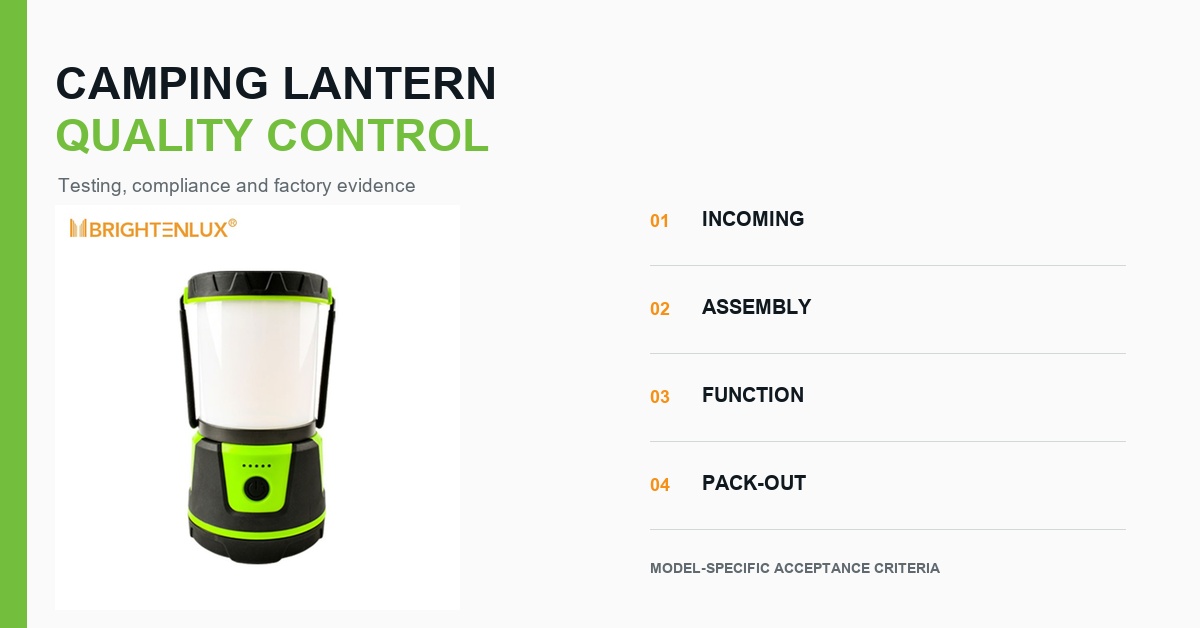
Final inspection can find defects, but it cannot replace a missing production system. A camping lantern manufacturer should show how materials and processes are controlled before goods are packed. Incoming control may include cells, LEDs, drivers, charging boards, switches, battery contacts, diffusers, seals, and printed packaging. The factory should define which characteristics are checked and what happens when a lot fails.
In-process control should address polarity, wire routing, solder quality, fastener condition, seal placement, mode sequence, and charging function where applicable. If an aging or burn-in process is part of the agreed control plan, the duration, mode, sample coverage, and failure response should be defined. The purpose is to expose early functional problems, not simply to photograph illuminated products.
Final inspection should confirm quantity, product identity, workmanship, functions, accessories, labels, packaging, and carton marks. Defect classes and sampling rules should be agreed before production. Safety-related or critical construction issues should not be treated as ordinary cosmetic variation. To discuss project-specific inspection expectations, buyers can contact Brightenlux through the contact page.
Step 9: Protect Repeat Orders With Golden Samples and Change Control
An approved sample is useful only when both sides know what it represents. The golden sample should be labeled with model, revision, approval date, and packaging version. If several colors or battery configurations are used, one sample should not automatically represent every combination.
Written specifications must support the sample. A golden sample cannot show the cell model, resin grade, driver version, or internal connection method without destructive review. The buyer and manufacturer should define which changes require notice and approval, including cells, LEDs, drivers, charging boards, seals, resin, colorant, packaging, and test methods.
A change record should state the reason, old and new part, affected orders, risk assessment, validation performed, and approval status. Not every change requires a complete retest, but the decision should be documented. Silent substitution removes the buyer’s ability to judge compliance, performance, and customer risk. Buyers preparing a new project or repeat order can submit details through the Brightenlux inquiry page.
FAQ: Camping Lantern Manufacturer Quality Evaluation
What is the fastest way to audit camping lantern quality?
Start with five connected records: a controlled product specification, approved sample, risk-based test plan, production inspection evidence, and change-control process. Each record should identify the exact model and revision.
Does one test report cover all similar lanterns?
Not automatically. A report for a visually similar product may not cover the version being purchased if the battery, enclosure, electronics, packaging, accessories, or claims are different.
How should buyers compare rechargeable and dry-battery lanterns?
Compare them by architecture and risk. Dry-battery models require focus on contacts, polarity, door closure, and storage. Rechargeable models add battery configuration, charging behavior, connectors, indicators, and transport documentation.
What should happen when inspection finds repeated defects?
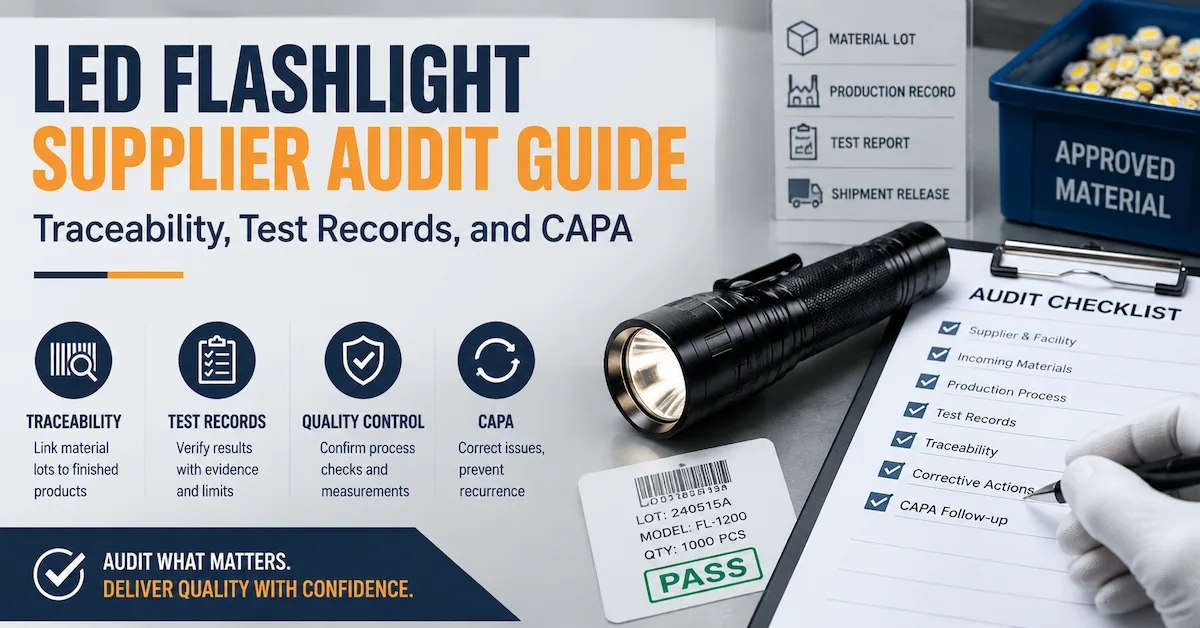
The supplier should contain affected goods, describe the issue, analyze the cause, correct the process or input, verify follow-up production, and update instructions or control plans. Rework alone does not prove that the cause is controlled.
Conclusion: Quality Is a Controlled System, Not a Slogan
A reliable camping lantern manufacturer should connect claims, specifications, test evidence, production controls, inspection records, and corrective action. For B2B buyers, the goal is not only to approve one attractive sample. The goal is to receive repeatable production that matches the approved configuration and is supported by the documents needed for the destination market. A risk-based quality plan gives both buyer and factory a clearer basis for responsibility before the order begins.