

Camping Lantern Manufacturer Cost Guide: MOQ, Packaging, Lead Time, and RFQ Strategy
A camping lantern manufacturer cannot provide a useful price until the product, quantity, packaging, battery configuration, market, and delivery assumptions are clear. Two offers may show the same unit price while including different cells, accessories, testing scope, cartons, or shipping responsibilities. For importers, distributors, outdoor brands, promotional buyers, retailers, and e-commerce sellers, the cheapest spreadsheet line can therefore become the highest landed cost.
This guide follows a practical nine-step SEO and sourcing structure: define the product, normalize quotations, choose the right development route, clarify MOQ, control samples, verify the battery system, plan packaging, manage lead time, and issue a complete RFQ. Brightenlux has manufactured portable lighting products since 2014 and exports to more than 50 countries. Buyers can review the Brightenlux product range before preparing a model-specific inquiry. Exact MOQ, price, and timing must always be confirmed for the selected model and order conditions.
Step 1: Define What Really Drives Camping Lantern Cost
The main factory cost drivers are housing size and material, light source and driver, battery or dry-cell architecture, charging and power-bank functions, mechanical parts, customization, packaging, accessories, test requirements, order quantity, and production timing. Outside the factory unit price, freight, duty, marketplace fees, returns, and inventory carrying cost can also change the commercial result.
A professional quotation should identify the product revision, included battery, cable and accessories, packaging type, logo method, test or documentation scope, MOQ, sample arrangement, production estimate, payment term, price term, and quotation validity. If those assumptions are missing, the buyer is not comparing a complete offer.
Step 2: Normalize Quotations Before Comparing Unit Price
Lantern photographs do not reveal the bill of materials. Similar housings may contain different cells, LED packages, drivers, protection components, contacts, seals, or fasteners. One quotation may include a retail color box, while another assumes a plain white box. One may include a Type-C cable, user manual, and power-bank output, while another may not.
Before choosing a supplier, ask every camping lantern manufacturer to quote the same configuration and identify any deviation. When a supplier recommends a substitute, ask for the reason and the commercial effect instead of forcing every factory into an unsuitable specification.
| Cost block | Questions to ask | Common hidden difference |
|---|---|---|
| Light and electronics | Which LED, driver, modes, and dimming behavior are included? | Peak output may look similar while maintained output differs. |
| Battery system | What cell model, count, capacity, and protection are included? | A generic capacity statement may not identify the cell configuration. |
| Housing | What material, finish, diffuser, and mechanical parts are specified? | Resin grade, wall thickness, or seal design may differ. |
| Accessories | Are cable, adapter, batteries, bag, or hanging parts included? | Catalog images may show items excluded from the quotation. |
| Packaging | Is the price for neutral box, printed box, insert, manual, and master carton? | Retail packaging may be quoted separately after approval. |
| Documentation | Which market reports and battery documents are included? | Existing documents may not match the ordered configuration. |
Step 3: Choose Existing Platform, Modified Platform, or New Product
The fastest way to control cost is to select the correct development route. Some buyers request a new product when an existing platform with controlled branding would meet the market need. Others try to force major changes into a platform that was not designed for them.
An existing platform normally keeps the current housing, electronics, and functional layout. Branding, packaging, and selected accessories may change. This route is often suitable for trial launches, distributor programs, and buyers that need a proven category quickly.
A modified platform may change colors, mode sequence, battery configuration, printed parts, accessories, or selected components. It can create a stronger market fit but requires engineering confirmation, samples, and possible document review. A new housing or full custom development can support distinctive design or a unique use case, but it also adds tooling, design decisions, sample rounds, and validation. The commercial case should explain why customers will value the difference and how projected volume can support the investment.
Step 4: Understand How MOQ Really Works
MOQ is not one universal number. It can be driven by production setup, component supplier minimums, custom color batches, printed packaging quantities, battery purchase units, and the number of SKUs in the order. A buyer ordering 2,000 identical lanterns creates a different production plan from one ordering 2,000 units split across multiple colors, battery configurations, and box languages.
Useful MOQ questions include:
- Is the minimum per model, color, logo, package design, or shipment?
- Does custom printing have a separate minimum?
- Can a lower trial quantity use standard color and neutral packaging?
- Can surplus printed packaging be paid for and used on the next order?
- Does the battery supplier impose a separate purchase quantity?
Negotiate by reducing variation, not only by asking the camping lantern manufacturer to lower MOQ. A standard housing color, common battery configuration, and sticker label can make a pilot order easier than a fully customized package with several languages.
Step 5: Treat Samples as Decision Tools
Samples consume product, labor, customization, and courier cost. A standard evaluation sample, printed-logo sample, color-matched sample, and pre-production sample each serve a different purpose and should not be expected at the same price or timing.
Ask what the sample fee includes, whether tooling or printing setup is separate, which courier term applies, and whether any amount can be credited after an order. More importantly, define the decision the sample must support. A sample is not valuable if it does not match the proposed configuration, and even a paid sample can be wasteful when no acceptance checklist exists.
Step 6: Verify Battery Configuration and Logistics Impact
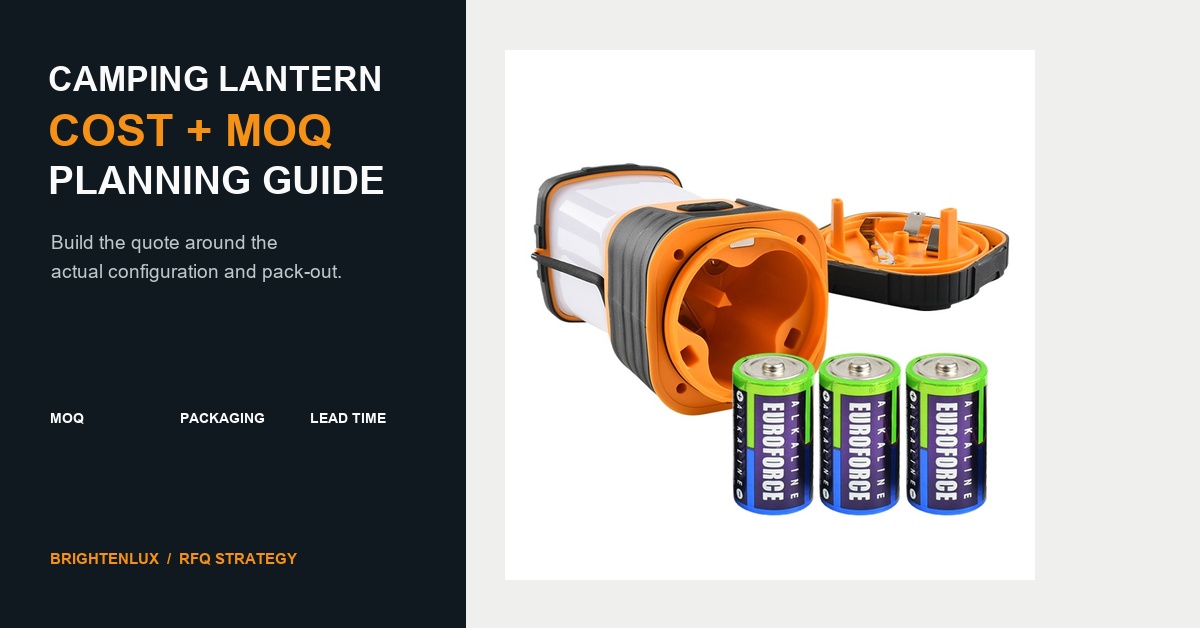
The power system affects more than the bill of materials. Rechargeable lithium models add cells, protection, charging electronics, indicator components, and transport documentation. A power-bank function may require additional circuitry and testing. Dry-battery products shift battery purchase to the end user and can simplify some order configurations, but the compartment and contacts still require quality control.
The Brightenlux rechargeable lantern uses three included 2200mAh lithium batteries, Type-C charging, and a power-bank function. The dry-battery model uses three D-size cells that are not included. The dry-battery Brightenlux model offers 1000-lumen area lighting, three color temperatures, dimming, and off-grid battery replacement. It fits a different channel strategy from the 2000-lumen rechargeable power-bank model. These platforms should be quoted as different commercial propositions rather than compared only by lumen output.
For rechargeable products, verify whether the price includes the named cell configuration and required battery documentation. Freight quotations should come from a forwarder who understands the battery, route, and shipping mode.
Step 7: Plan Packaging as a Cost, Sales, and Damage-Control Decision
Packaging has four jobs: protect the lantern, present the offer, carry required information, and move efficiently through the supply chain. Oversized boxes increase material and freight volume. Weak inserts allow the handle, diffuser, or accessories to move. Elaborate finishes can consume budget without improving conversion.
Common packaging levels include neutral boxes for samples or pilot orders, printed color boxes for retail presentation, window or premium boxes for product display, e-commerce mailer systems for parcel handling, and promotional packages for event distribution. Ask for retail box dimensions, units per master carton, gross weight, and carton dimensions with the quotation. These figures support freight estimates and pallet planning.
Approve the packaging sample before mass printing. Check barcode, model, battery statement, warnings, language, accessories, and carton marks. Packaging decisions made late can affect MOQ, cost, and shipment planning.
Step 8: Build Lead Time From Milestones, Not a Single Number
A statement such as lead time 30 days is incomplete unless the starting point and prerequisites are defined. Product selection, sample approval, deposit, artwork confirmation, component purchasing, production scheduling, assembly, inspection, and shipment booking occur in sequence.
Request a milestone schedule for customized orders. The factory estimate should state when timing begins and what can stop the clock. Common delay risks include undefined configuration, repeated sample changes without decisions, late artwork, long-lead cells, custom color or packaging preparation, unapproved changes, component shortages, late inspection, and delayed transport booking.
Add buffer for buyer approval, third-party testing, peak seasons, and battery shipment booking. A realistic launch plan is more useful than an aggressive date that depends on every decision being immediate.
Step 9: Prepare an RFQ That Supports Comparable Offers
A strong RFQ helps the camping lantern manufacturer quote accurately and reduces later disputes. Include the target model or application, quantity by SKU, destination market, requested battery configuration, accessory list, packaging level, logo method, artwork status, required documents, price term, target shipment window, inspection plan, and any channel-specific requirements.
To compare landed cost, use the same currency, price term, quantity, and configuration. If one offer is EXW and another is FOB, do not compare them as simple unit prices. Landed cost can include product, packaging, inspection, freight, import cost, receiving cost, warehousing, marketplace preparation, and expected returns. A practical formula is: landed cost per sellable unit equals all product, packaging, inspection, freight, import, and receiving costs divided by expected sellable units.
For model selection or quotation support, buyers may contact Brightenlux with the destination market, quantity, and customization brief. For a project-ready request, submit details through the Brightenlux inquiry page.
FAQ
Why can two camping lantern manufacturers quote the same unit price but deliver different value?
Because the included battery, accessories, packaging, documentation, cartons, price term, and shipping responsibilities may differ. Always compare the full configuration and assumptions.
What is the best way to reduce MOQ pressure?
Reduce variation. Standard color, neutral packaging, one battery configuration, and fewer SKU splits can make a pilot order easier to plan.
Should a buyer choose rechargeable or dry-battery lanterns by lumen output only?
No. The battery system affects product cost, logistics, documentation, channel fit, and user experience. Rechargeable and dry-battery platforms should be treated as different commercial options.
What should be approved before mass packaging printing?
Approve the package design, barcode, model information, battery statement, warnings, language, accessories, carton marks, and physical packaging sample before mass printing.
What makes an RFQ useful?
A useful RFQ defines model, quantity, market, battery configuration, packaging, logo, accessories, documents, price term, timing, and inspection expectations so quotations can be compared fairly.